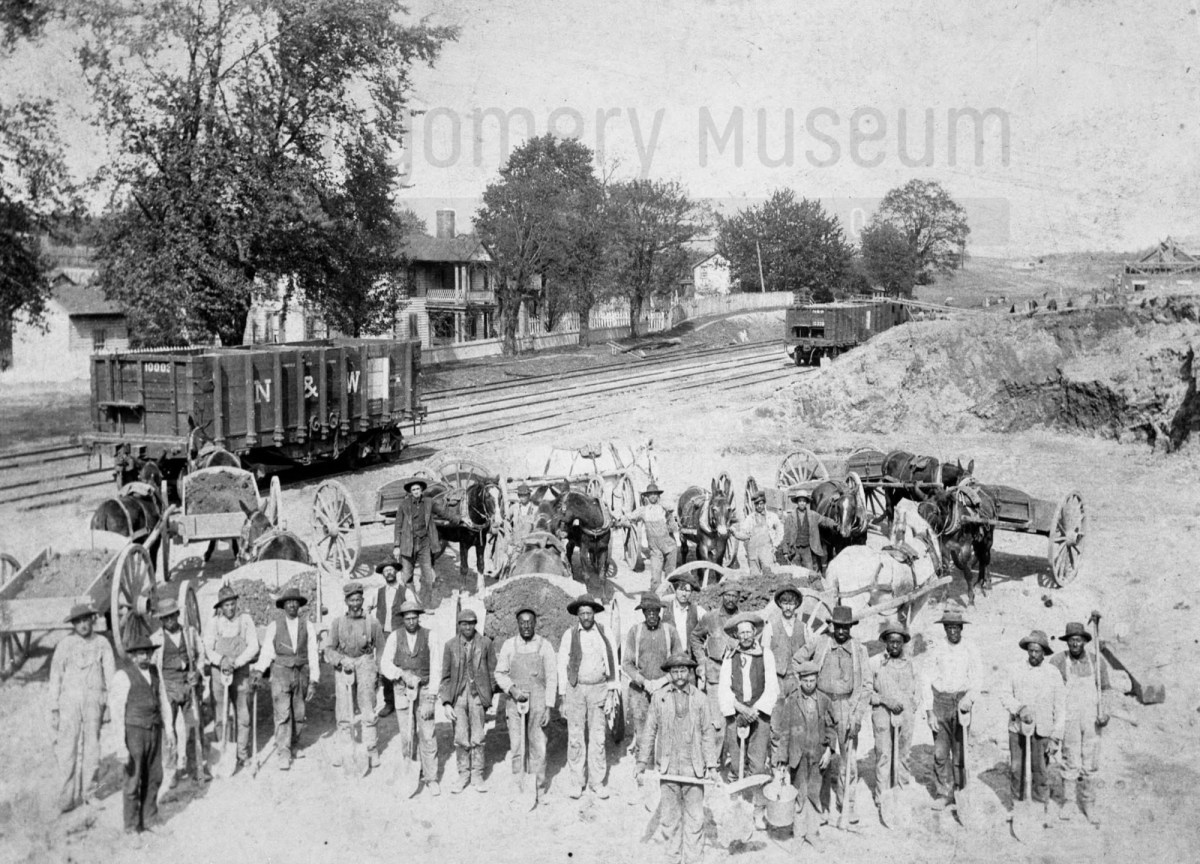
In 1904, a mixed-race crew built the new Cambria, Virginia Depot passenger station. Their faces were captured, but their names were not. As we search census records and explore new tools like AI facial recognition, we hope to uncover who they were — the hands and lives behind this piece of our shared history.
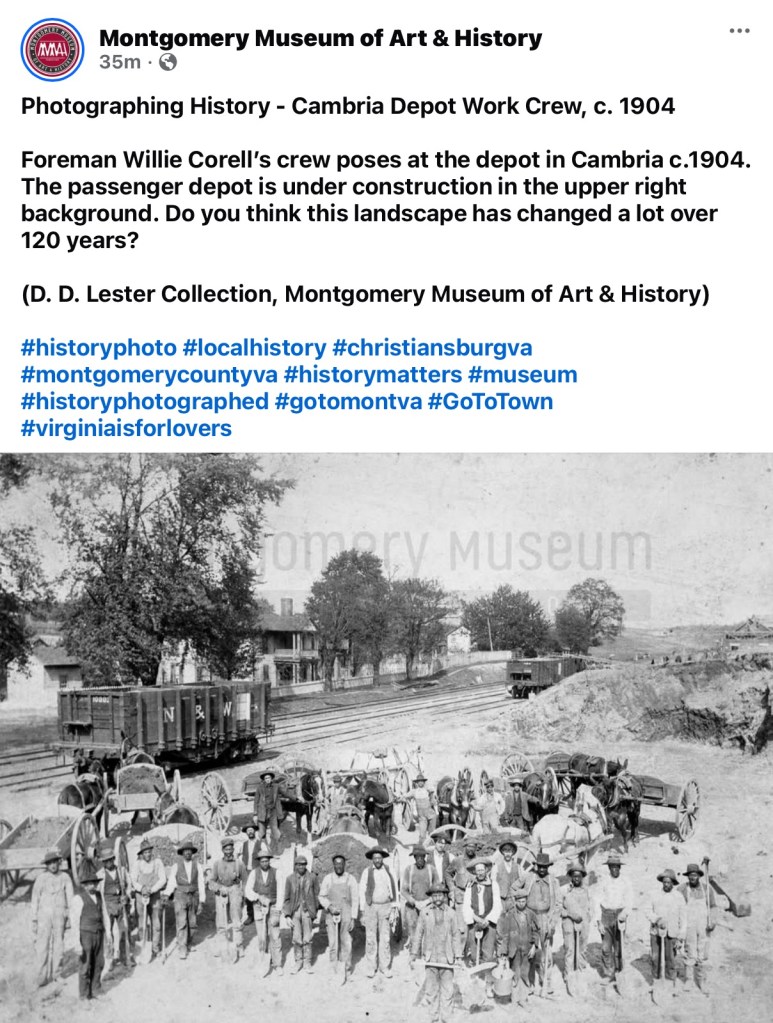
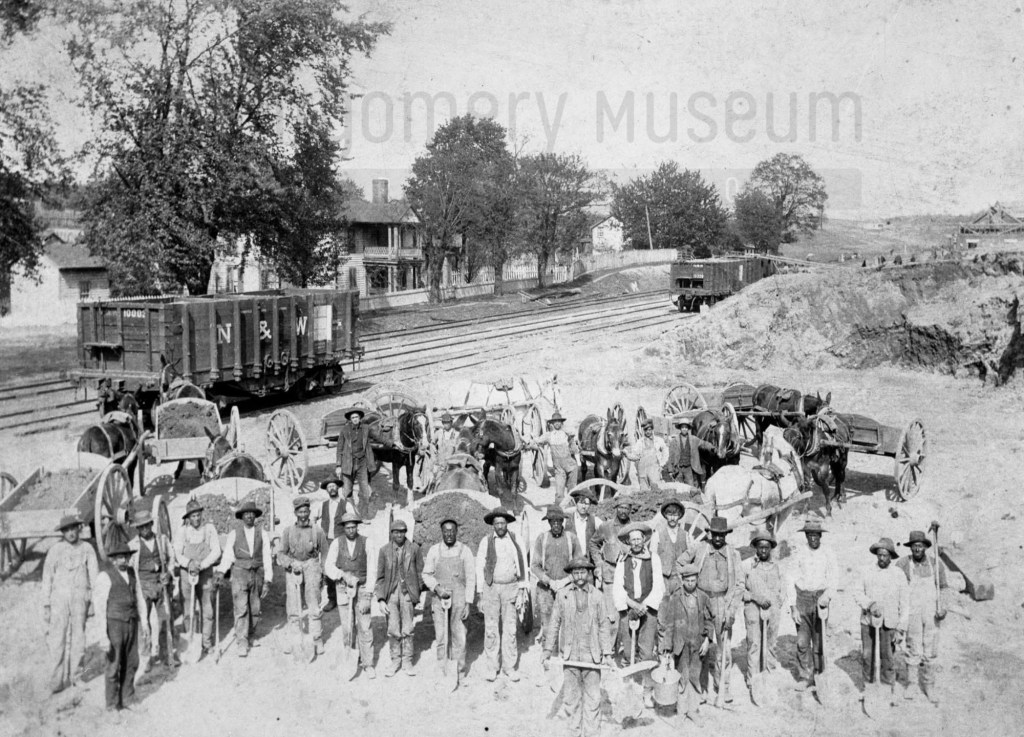
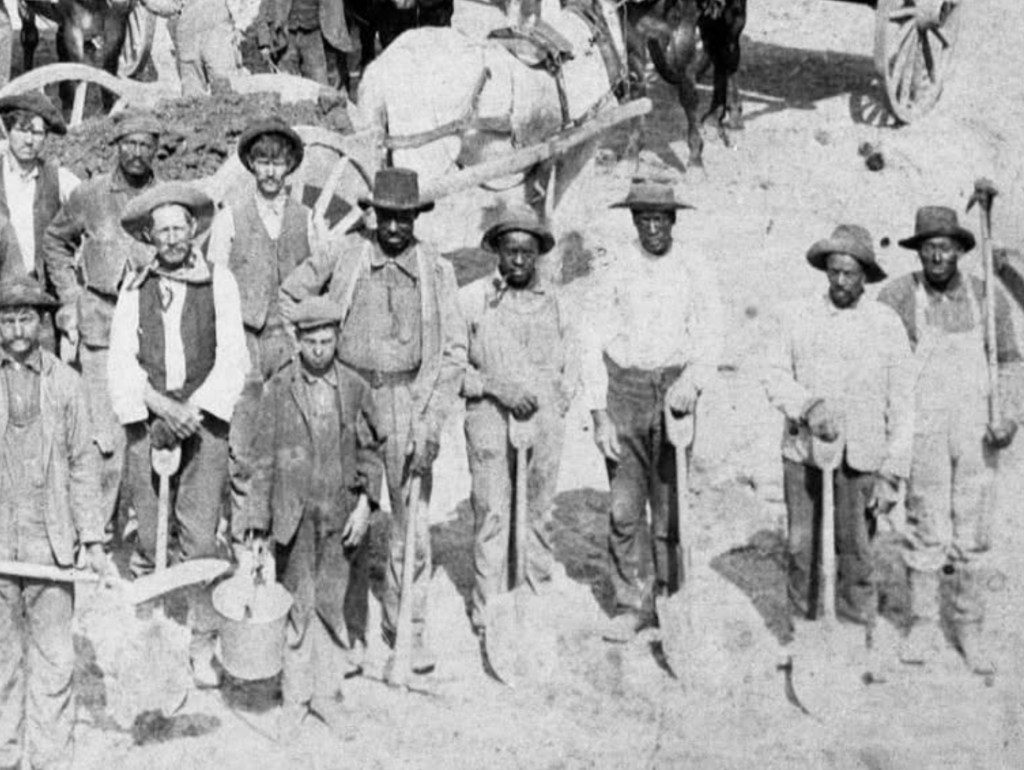
Facebook PostCambria Depot Work Crew, about 1904 (DD Lester Collection, Montgomery Museum of Art & History)Close-up of Cambria Depot Work Crew, about 1904 (DD Lester Collection, Montgomery Museum of Art & History)Close-up of Cambria Depot Work Crew, about 1904 (DD Lester Collection, Montgomery Museum of Art & History)Close-up of Cambria Depot Work Crew, about 1904 (DD Lester Collection, Montgomery Museum of Art & History)
This 1904 photograph captures a work crew—Black and white men together—building the new passenger station for the Cambria, Virginia Depot. It’s a remarkable image of shared labor and community effort during a time of deep segregation.
Yet, like so many images from the early 20th century, the men remain unnamed, except for the foreman, Willie Corell. Their faces look back at us across more than a century, but their identities have been lost to time. Who were they? What were their lives like?
With advancing technology, tools like AI facial recognition may one day help uncover their names and family connections. Until then, our research turns to the 1900 and 1910 census records, where we hope to find traces of the African American laborers who helped shape the Cambria community and build this station that still stands as part of our shared history.
If you have family stories, photographs, or names that might help identify these men, we would love to hear from you. Each clue brings us closer to giving them the recognition they deserve.
This searchable document is a rich source of information about the county and its wider connections. For example, it notes that the New River boatmen once lived on Kent Farm, where they were enslaved by James Randle and Margaret Cloyd Kent prior to emancipation (see page 13). Additional details about Kentland and these freedmen can be found in the following postings: Historic Kentland and Historic Wake Forest
The names of some of the black boatmen of 19th-century Montgomery County include Frank Bannister (who was a boatman on the James River before the Civil War), Calvin Bannister, Roland Stuart, George Brown, and Lewis Smith.
This report that was written by Gibson Worsham, Dan Pezzoni, Charlotte Worsham, David Roenizer, and others. It addresses the following: 1) Overview of the county’s history, 2) A comprehensive inventory of significant structures and sites in the county and 3) Maps delineating the location of said structures and sites. Similar to the report above, this is a wealth of information about the county.
The Formation of Montgomery County, Virginia and Why it Matters to African American History of the Region
When Virginia’s earliest European colonial settlers first pushed westward beyond the Blue Ridge Mountains, they entered the border lands already inhabited by Native peoples for thousands of years. As Europeans laid claim to these territories in the 18th century, Virginia’s county boundaries began shifting rapidly to keep pace and the need for local governance.
At first, all of western Virginia was considered part of vast counties based far to the east. Augusta County, created in 1738, stretched from the Blue Ridge to the Mississippi River—a landmass so large it was nearly impossible to govern effectively. As settlement expanded, Augusta was gradually carved into smaller counties.
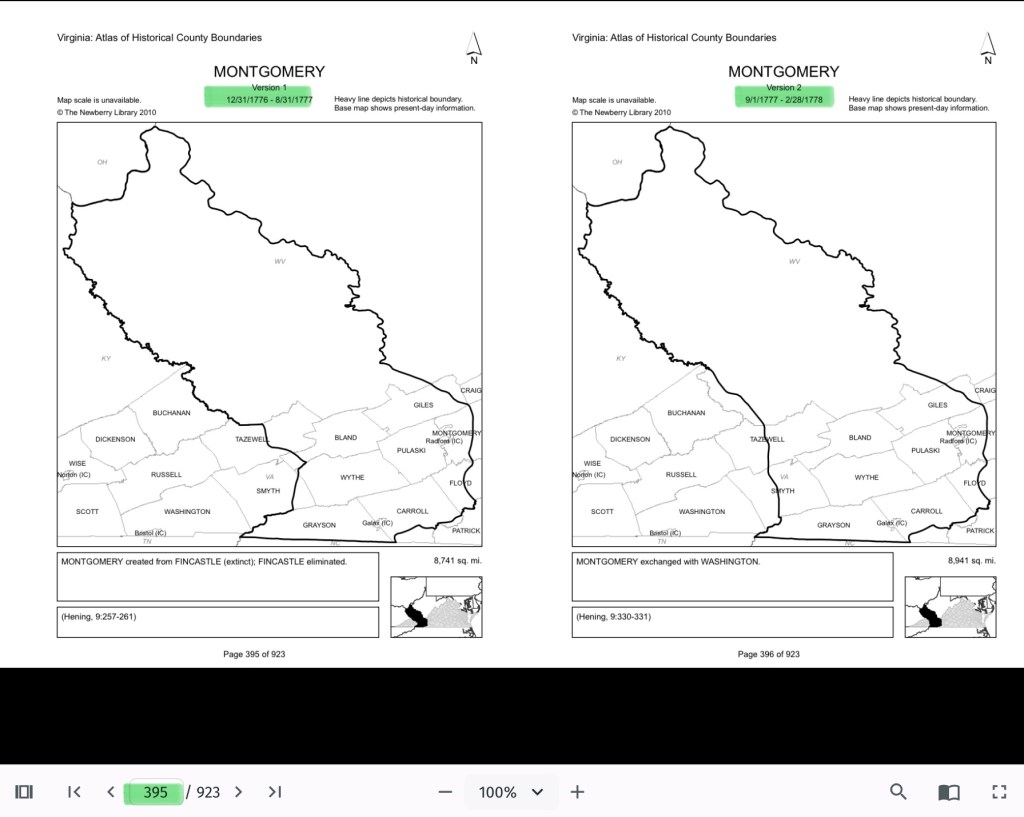
Botetourt County was created in 1770 out of Augusta, and just two years later, in 1772, Fincastle County was formed to cover the far southwest. But Fincastle itself was short-lived: in 1776, it was split into three new counties—Montgomery, Washington, and Kentucky (the latter eventually becoming the Commonwealth of Kentucky).
Thus, Montgomery County was officially established in 1776, named in honor of General Richard Montgomery, a Revolutionary War hero.
Like most early counties, Montgomery did not remain the same size for long. As population grew and communities demanded closer courts and local representation, Montgomery’s original boundaries were gradually reduced.
1790: Wythe County was formed from Montgomery.
1790: Parts of Montgomery contributed to the creation of Kanawha County (now in West Virginia).
1806: Giles County was carved from Montgomery, Monroe, Wythe, and Tazewell.
1831: Montgomery giving land to Floyd
1839: Montgomery giving land to Pulaski
1892: City of Radford
By the mid-19th century, Montgomery County had taken on the approximate shape we recognize today.
Why This Matters
Tracing these changing boundaries shows how the western border lands of Virginia evolved from a vast Indigenous landscape into the network of counties we know today. When we study Montgomery County’s formation and its changing borders, we are not only tracking political geography—we’re also uncovering how those shifts shaped the daily realities of enslaved people and freedmen. The “line on a map” often meant the difference between where families were recorded, where they could live, and how they could begin to claim freedom and opportunity.
County seats like Christiansburg were not only centers of trade and government but also of the slave market and the courthouse records that tracked the lives of enslaved people. After emancipation, those same courts became the places where freedmen registered marriages, secured contracts, and sought land. As county lines shifted, so too did the jurisdictions that controlled access to justice, opportunity, and community life.
The flip book of maps below is a helpful resource to understand how the boundaries changed with time. Begin on page 395.
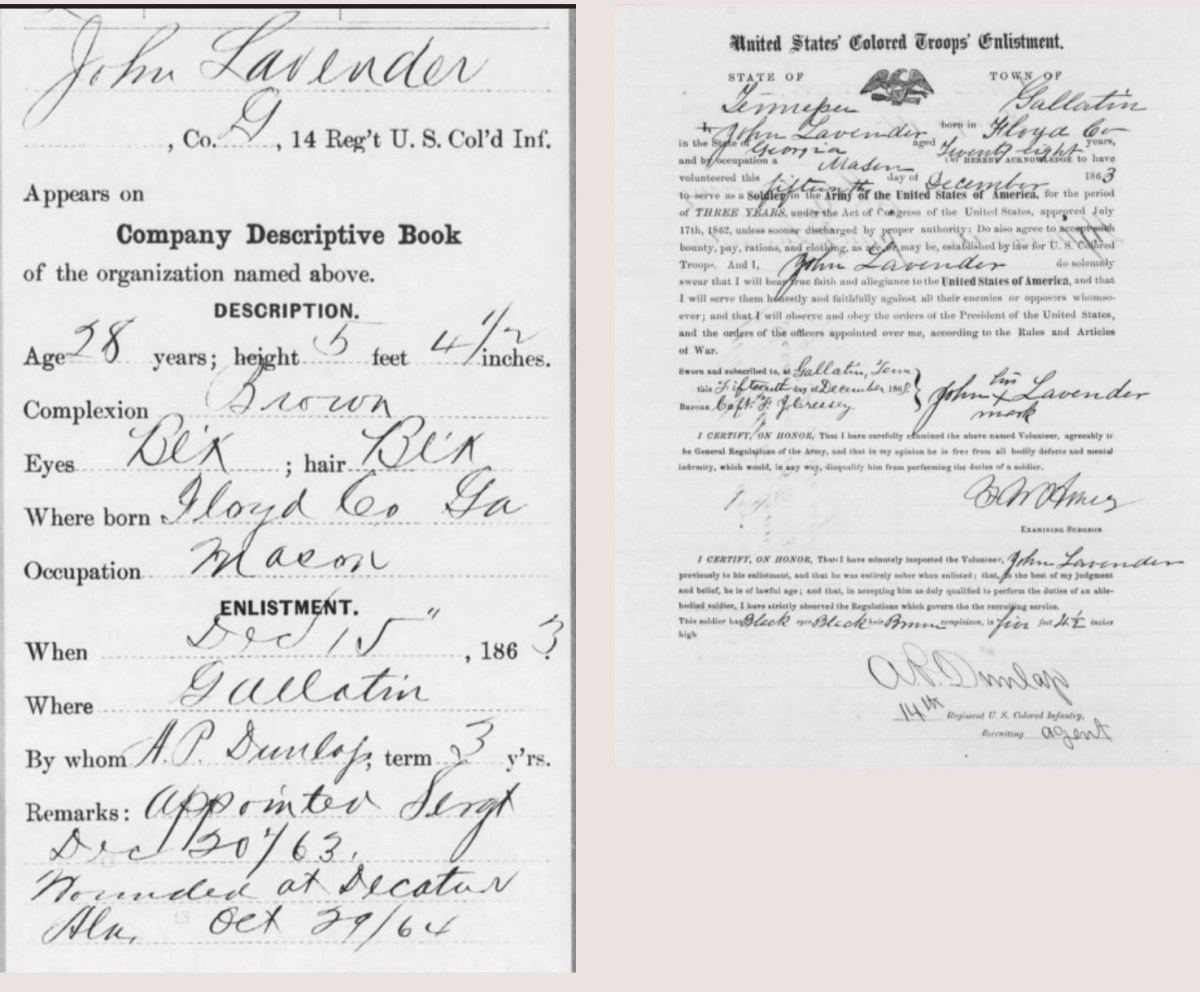
When researching African American genealogy, particularly in the South, it can be challenging to trace family history due to the lack of comprehensive records. However, some of this information can be found in an unexpected place: the Civil War documents of the Southern Confederacy and the United States Military.
When researching African American genealogy, particularly in the South, it can be challenging to trace family history due to the lack of comprehensive records. However, some of this information can be found in an unexpected place: the Civil War documents of the Southern Confederacy and the US Military.
The book Virginia’s Black Confederates: Essays and Rosters by Greg Eanes highlights this, providing primary source documents that list the roles free and enslaved Black men, women, and children performed for the Southern war complex. These records, while written from a perspective that upholds the Confederacy’s narrative, contain valuable data for tracing African American ancestry.
The information in the post is found within this book. Eanes, Greg. Virginia’s Black Confederates: Essays and Rosters 2014. Civil War Sesquicentennial Edition, 2nd Edition.
Virginia 11th Regiment and Montgomery County
This regiment was established in Lynchburg, VA in May 1861 and put into service in July that same year. It was comprised of men from Botetourt, Campbell, Culpeper, Fauquier, Montgomery, and Rockbridge Counties. The free and un-free Blacks associated with this regiment may be listed in the regimental documents.
Eane’s Compilation of of Jobs Performed by Free & Enslaved (pgs 22-23)
Body Servant – “Assist with care, cleanliness, and order as assigned quarters, uniforms, and military personal equipment; Help to purchase, prepare, and serve food and beverages in the General Officer’s quarters.”
Cook – “Preparation and service of food in field or garrison food service operations.”
Teamster – “Motor Transport Operators” and “Cargo Specialist.”
Laborer-Breastwork – “Combat Engineer” and “Carpentry and Masonry Specialist.”
Pension Applications of the Confederacy and US Military
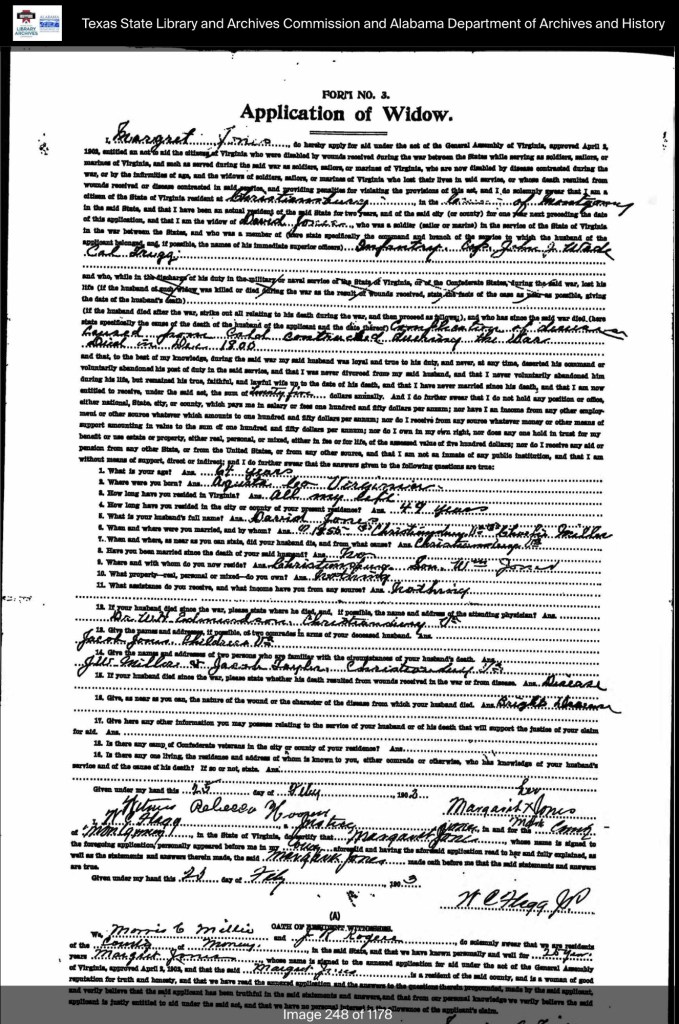
Confederate Pension Acts for Virginia were enacted between 1888 and 1934. On 14 of March, 1924 the act centered on servants granted pensions. “The 1928 Act broadened recognized duties to include performance of guard duty, burring Confederate dead, working in railroad shops, blacksmith shops or hospitals” (Page 26).
The pension records can be found at the Library of Virginia and on Ancestry.com (subscription required).
National Archive article on how to use the Pension Records, “Union Pension Files Giving Voice to Former Slaves”
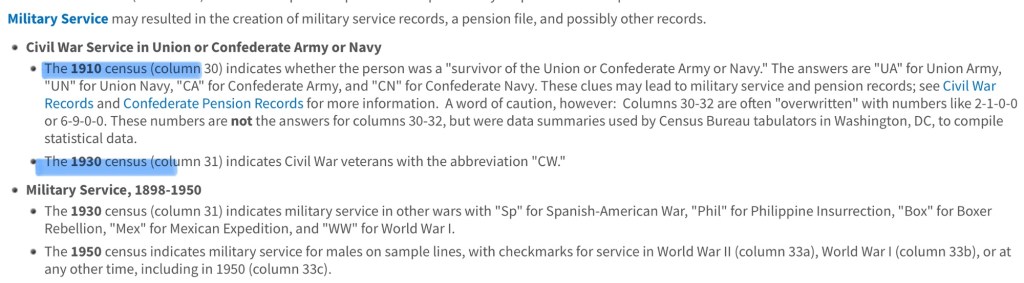
The 1910 (see image) and 1930 (CW) census indicates that the person was a veteran. The National Archives provides a helpful list of codes that were used.
Confederate Soldiers’ Home Application for Admissions Records
The archives of the museum maintain a large holding, some of which is digitized.
Confederate Certificate of Service – Freemen and Enslaved.
According to Eanes on page 113, the Army of the Confederate States adopted (1861) Form #4, the Certificate of Service. This was used for both free and unfree persons. Where these are located? We have not found an online source, yet.
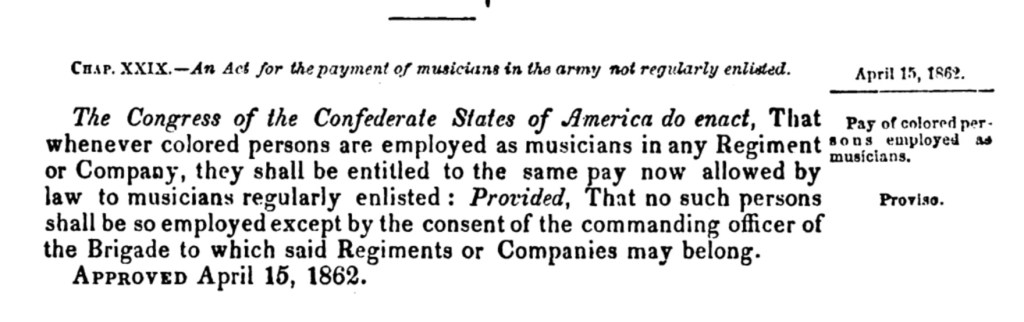
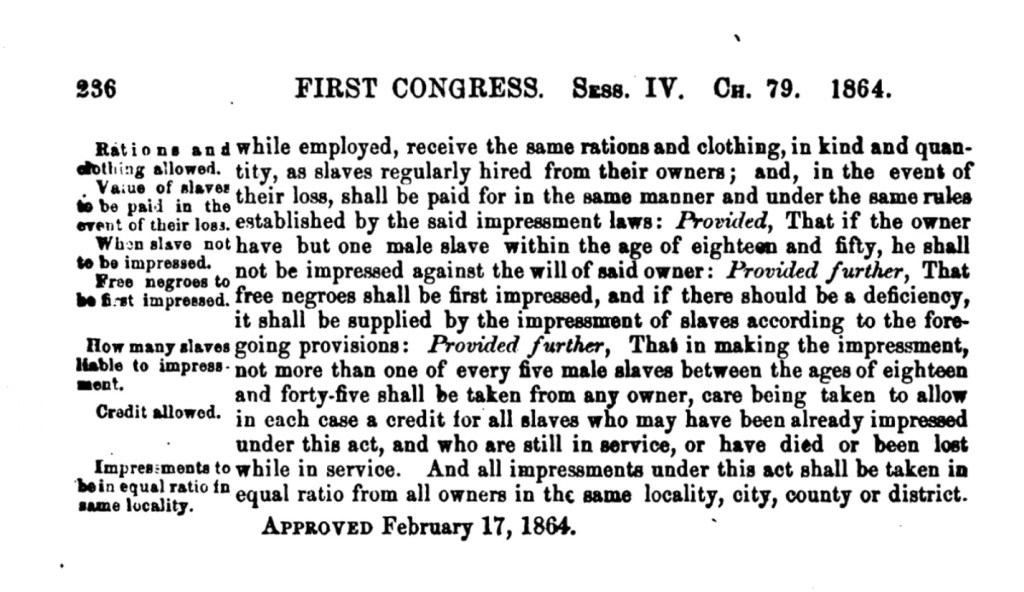
Public laws of the Confederate States of America, first Congress, 1862-1864 / [edited by James M. Matthews].
“Chapter XXIX – An Act for the payment of musicians in the Army no regularly enlisted.” Page 29 (book, not pdf)“Chapter LXIV – An Act for the enlistment of Cooks in the Army”. Page 48 (book, not pdf)“Chapter LXXIX – An Act to increase the efficiency of the Army by employment of free negroes and slaves in certain capacities” Page 235-236 (book, not pdf)“Chapter LXXIX – An Act to increase the efficiency of the Army by employment of free negroes and slaves in certain capacities” Page 235-236 (book, not pdf)
Linda Killen transcribed the reports of Brevet-Captain Charles S. Schaeffer who held the post of agent for the Bureau of Refugee, Freedmen and Abandoned Lands during the early years of Reconstruction. More information about Schaeffer can be found at Christiansburg Institute, Inc.. Schaeffer sent this list of African American Freedmen to his reporting officer, Bvt. Brig. Genl. O. Brown, dated 15 March 1867 (page 18). Minnis Headen (Hadean) was listed on the deeds as Trustee for the Hill School and Christiansburg African Baptist Church.
“C. Minnis Hadean – Age 40 – Blacksmith – Christiansburg Va. – can read, write and cipher – one of the best colored men in the state.”
John Campbell – Age 40 – Farmer – Big Springs Depot Mont’y Co. Va – can read and write – owns property – was free before the war.
Peter Noulen (?) – Assistant to a Machinist – Depot of the Va. & Tenn. R.R. – Central Depot, [Radford], Mont’y Co. Va. – can read a little.
Sampson Gleaves – Age 35 – Farmhand – Christiansburg P.O. Lives one mile from town – Can read (and write a little).
Robert D. Jones – Age 30 – Farmer – Christiansburg P.O. Lives six miles from town – Can read and write.
Felix Johnson – Age 30 – Brick Layer – Christiansburg P.O. Lives in the direction of Blacksburg Va. – Can read and write.
John P. Taylor – Age 35 – Farmhand – Christiansburg P.O. Lives in the direction of the White Sulphur Springs – Can read & write.
Richard Taylor – Age 65 – Farmer & Preacher – Christiansburg P.O. – Lives near Blacksburg Mont’y Co. Va. – Cannot read nor write, but is quite intelligent.







 Gathering African American History