Montgomery County, Virginia, was slow to dismantle enforced racial separation in its schools, not doing so until September 1961. Neighboring counties followed a similar pace—Floyd in January 1961 and Pulaski in September 1961. (Martin, Black Education in Montgomery County 1939–1966, Virginia Tech master’s thesis, 1996).
After the U.S. Supreme Court’s 1954 Brown v. Board of Education ruling outlawed segregation, Montgomery County resisted. The school board leaned on “states’ rights” arguments and used tactics from Virginia’s Gray Commission—such as controlling student assignments and offering tuition grants to white families—to delay integration for years.
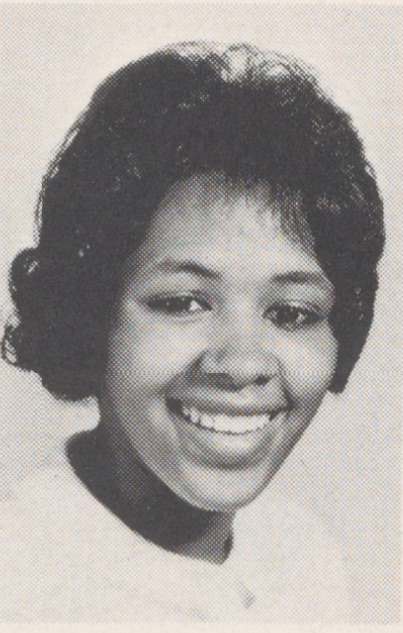
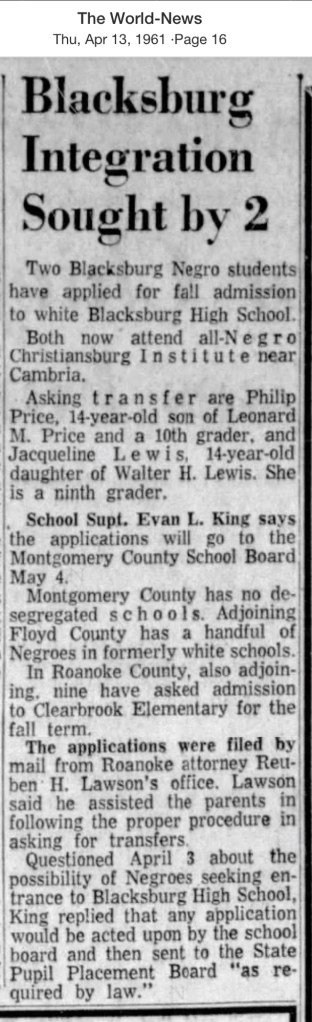
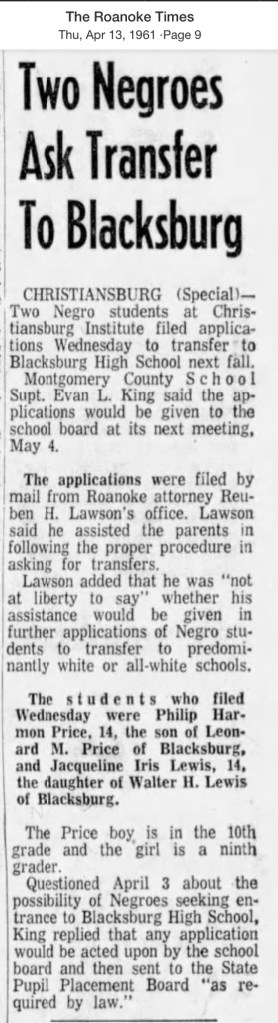
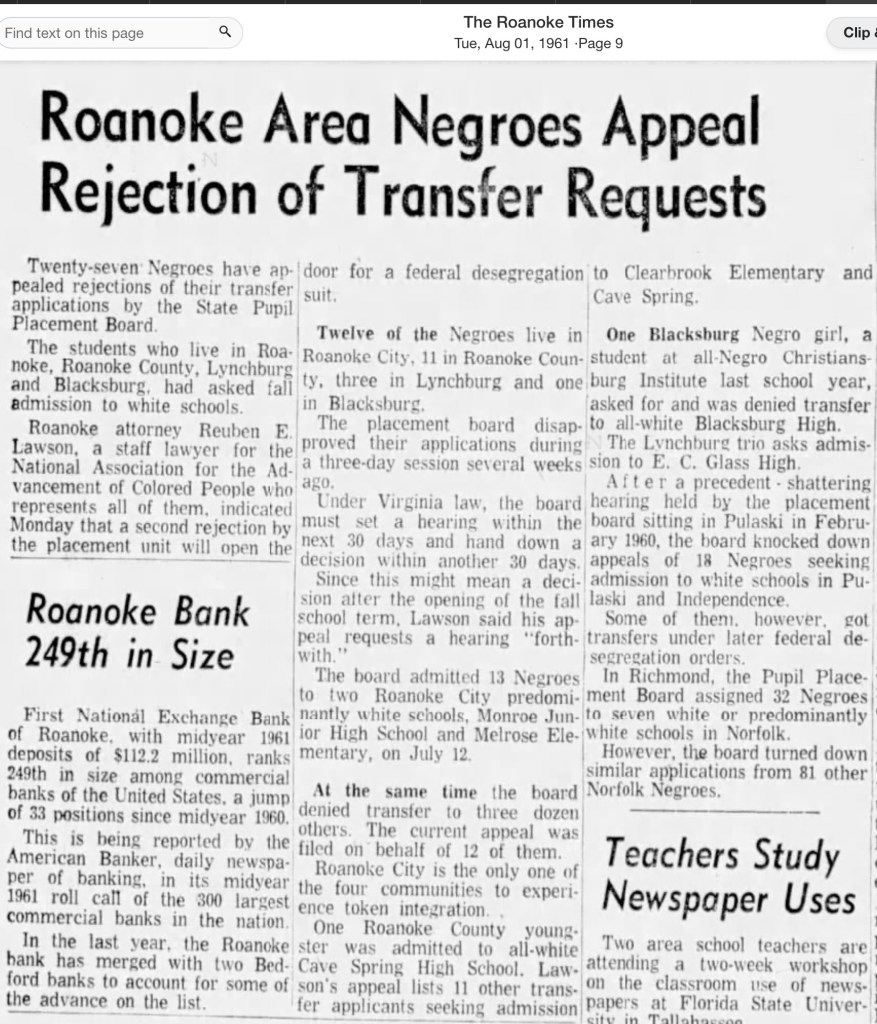
Amidst this resistance, three students from Christiansburg Institute applied to transfer to the all-white Blacksburg High School, which then enrolled about 900 students. They were siblings Phillip H. Price (15) and Ann Christine Price (13), along with Jacqueline Iris Lewis (14). With support from NAACP attorney Reuben E. Lawson of Roanoke, their applications went before the State Pupil Placement Board. Phillip and Ann Christine were admitted for the 1961 school year, but Jacqueline’s request was denied on the grounds of “academic standards”—a requirement never applied to white students.
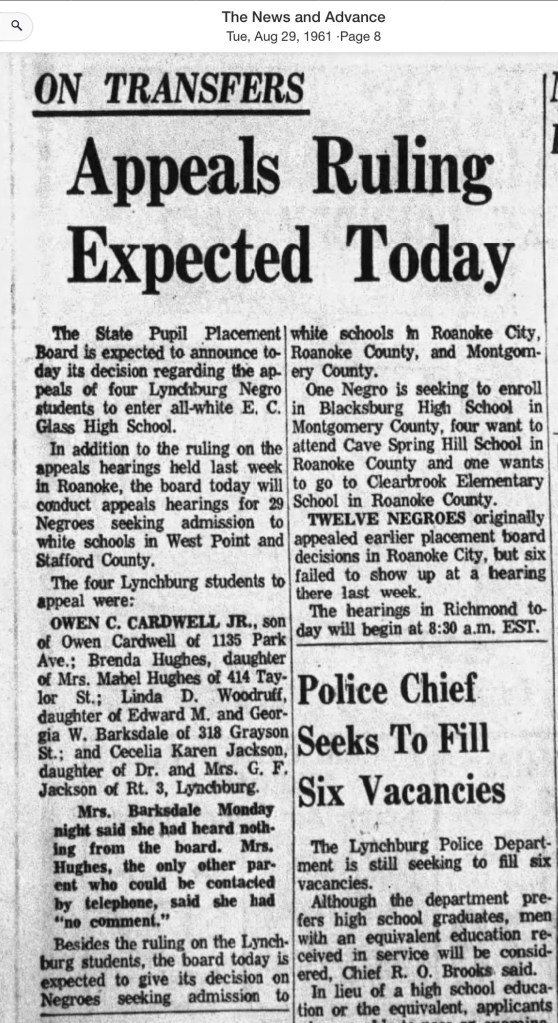
On August 23, 1961, Jacqueline and her father, Walter H. Lewis, traveled to Roanoke for the hearing, an intimidating experience for a 14-year-old. The Board delayed its ruling for a week before denying her appeal. That fall, Jacqueline remained at Christiansburg Institute.
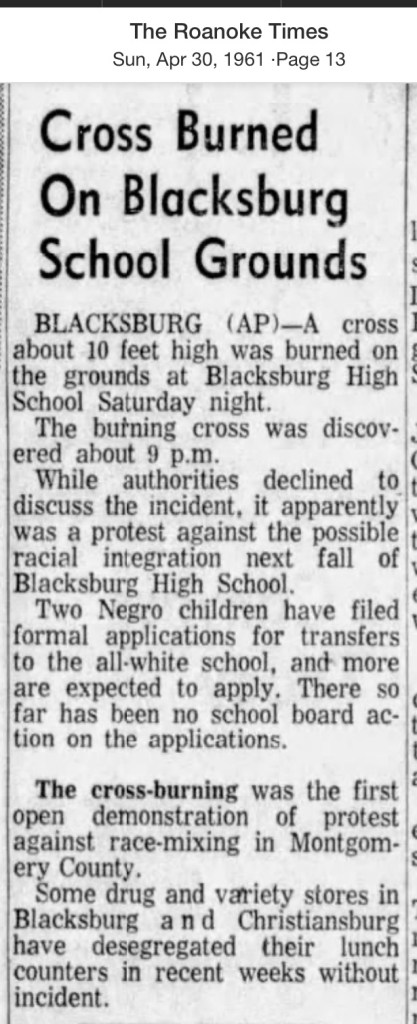
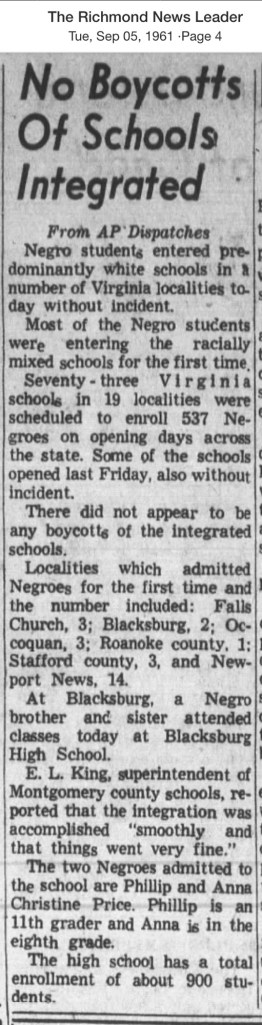
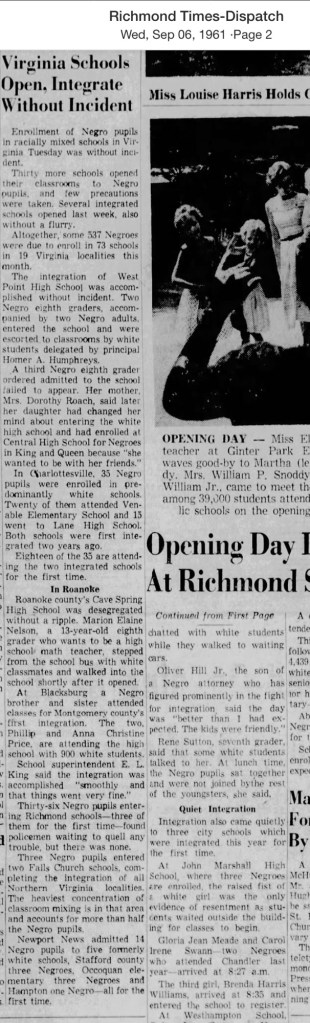
That September, Phillip and Ann Christine Price became the first Black students to integrate Montgomery County schools when they walked into Blacksburg High. According to researcher Tracy A. Martin, they were not alone—their white neighbors walked beside them in solidarity. This act of courage followed a chilling warning: on April 29, 1961, a ten-foot burning cross had been discovered on the school grounds, South Main Street.
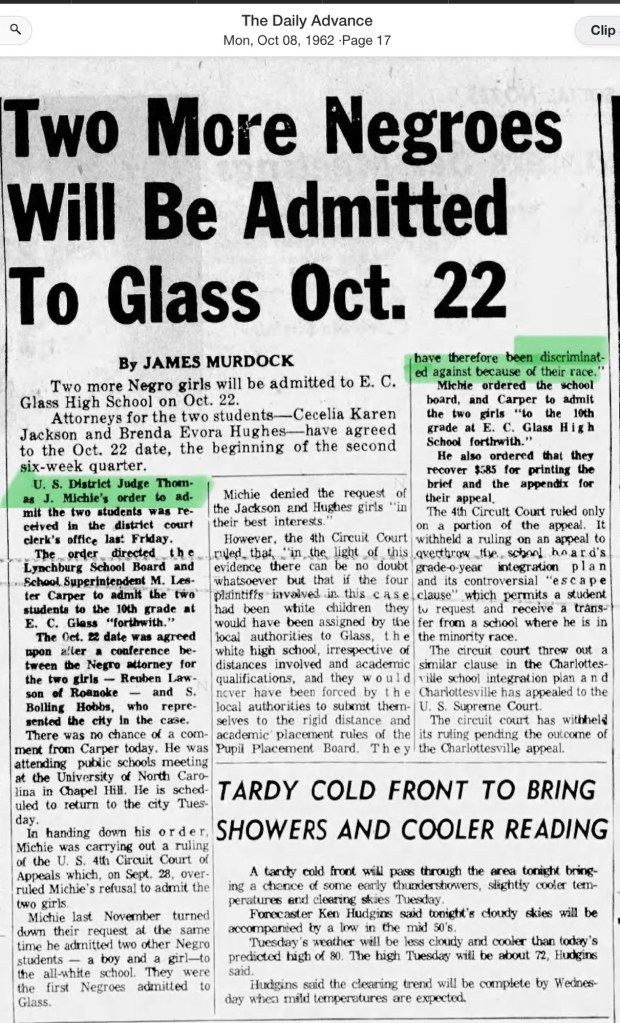
In 1962, the school board again delayed the application process for two more students seeking admission. Yearbooks from 1961–1964 suggest that the Price siblings were the only African American students at Blacksburg High during those early years. In the years that followed, more students of color began to appear in the yearbooks. By 1966, the school board closed Christiansburg Institute, and all of the county’s white high schools were finally opened to every student.

Interview with Reverend Philip Price on 1 February 1996. (“Oral History with Phillip Price, February 1, 1996 (Ms2003-011),” VT Special Collections and University Archives Online, accessed March 28, 2026, https://digitalsc.lib.vt.edu/items/show/10735.)
Newspaper Articles
April 1961




July 1961


August 1961


September 1961



1962 Application of Two Young Women, the Courts Ruling


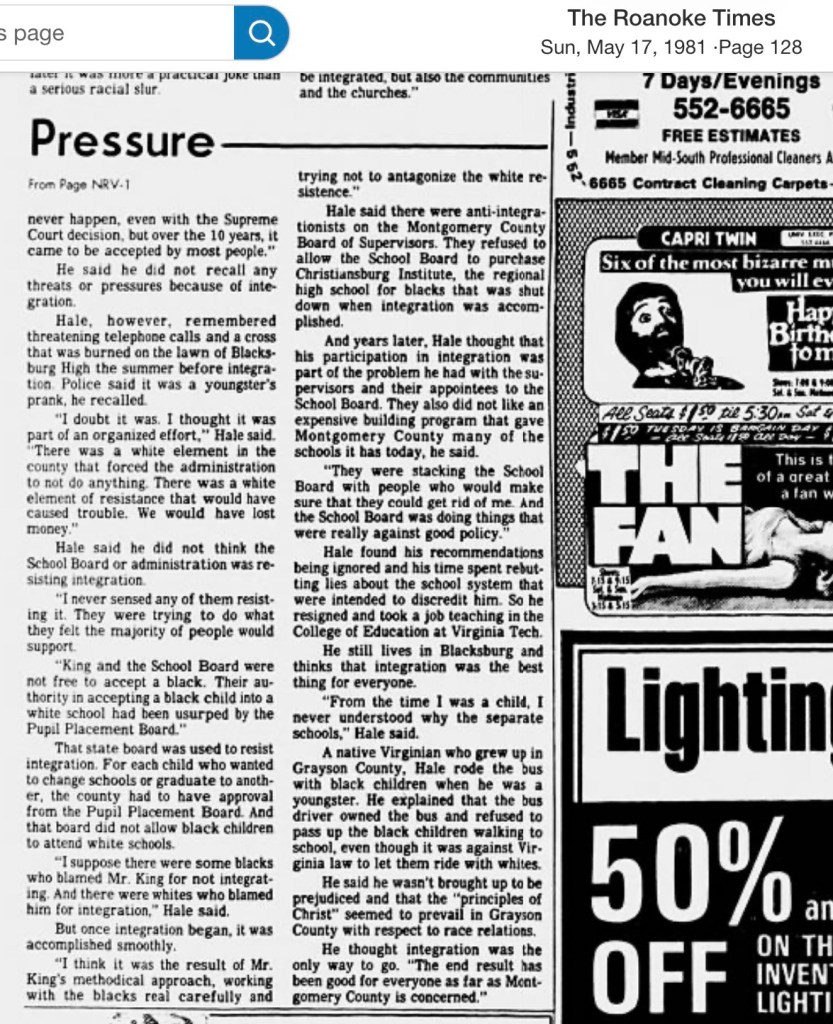
1979-81 Roanoke Times Reporting on the Desegregation of the Montgomery County Schools
In 1979 and 1981, as Montgomery County marked the tenth anniversary of the first African American students attending previously white-only public schools, The Roanoke Times published a series of articles examining the community’s experiences with school desegregation and the racial issues that surrounded it.
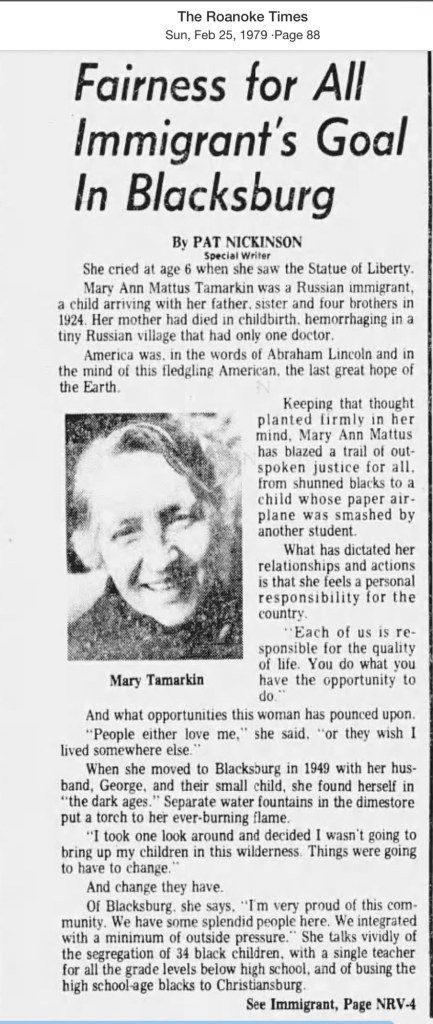
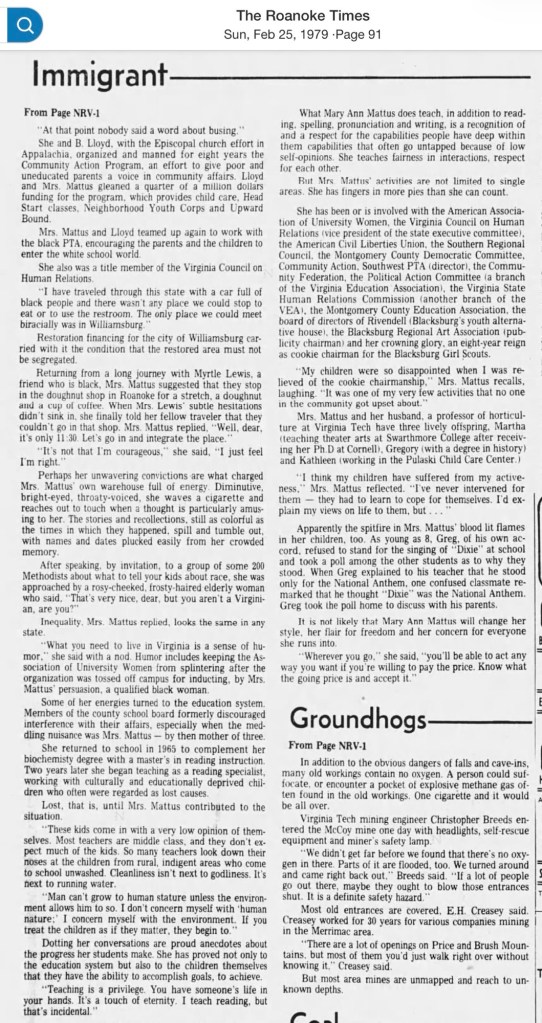
In 1979, reporter Pat Nickinson focused on the memories and activism of Mary Ann Tamarkin Mattus. Mary Ann and her husband, Dr. George Mattus, a pomologist and professor at Virginia Polytechnic Institute (now Virginia Tech), moved to Blacksburg in 1949 when he joined the university faculty. They raised their family in Blacksburg, where Mary Ann became a reading specialist in Montgomery County Public Schools and an outspoken advocate for civil rights and educational equity.
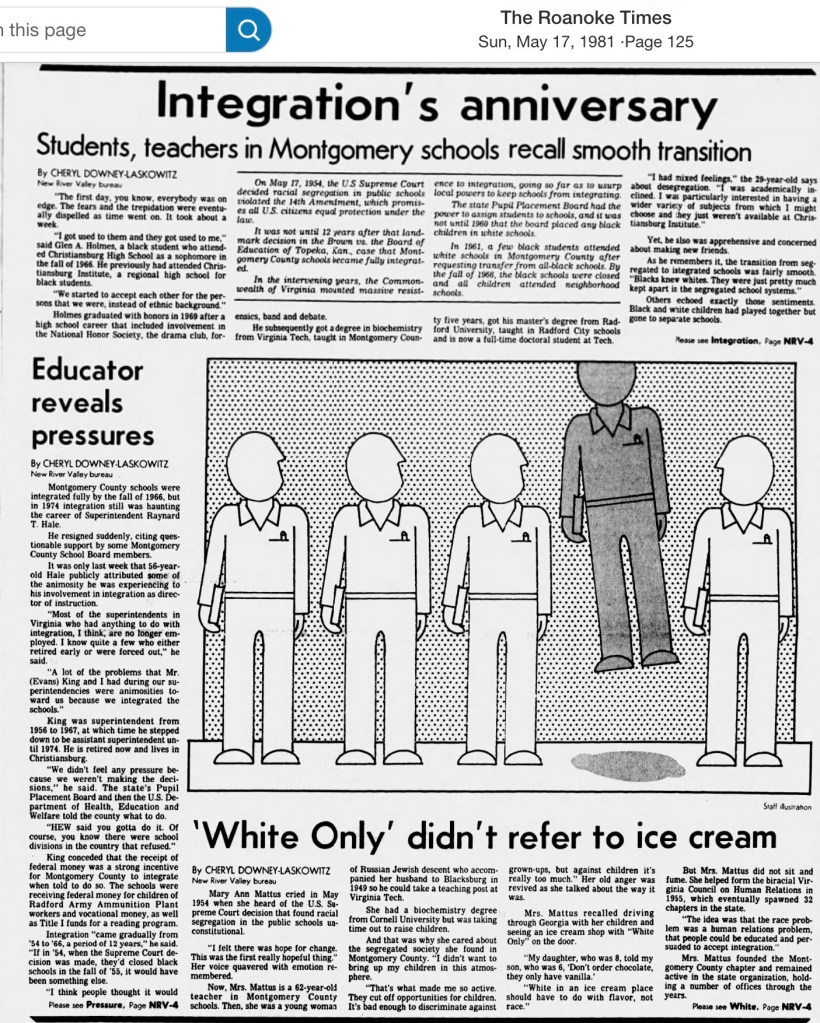
Two years later, Cheryl Downey-Laskowitz revisited the subject through a three-part series that examined school desegregation from multiple perspectives.
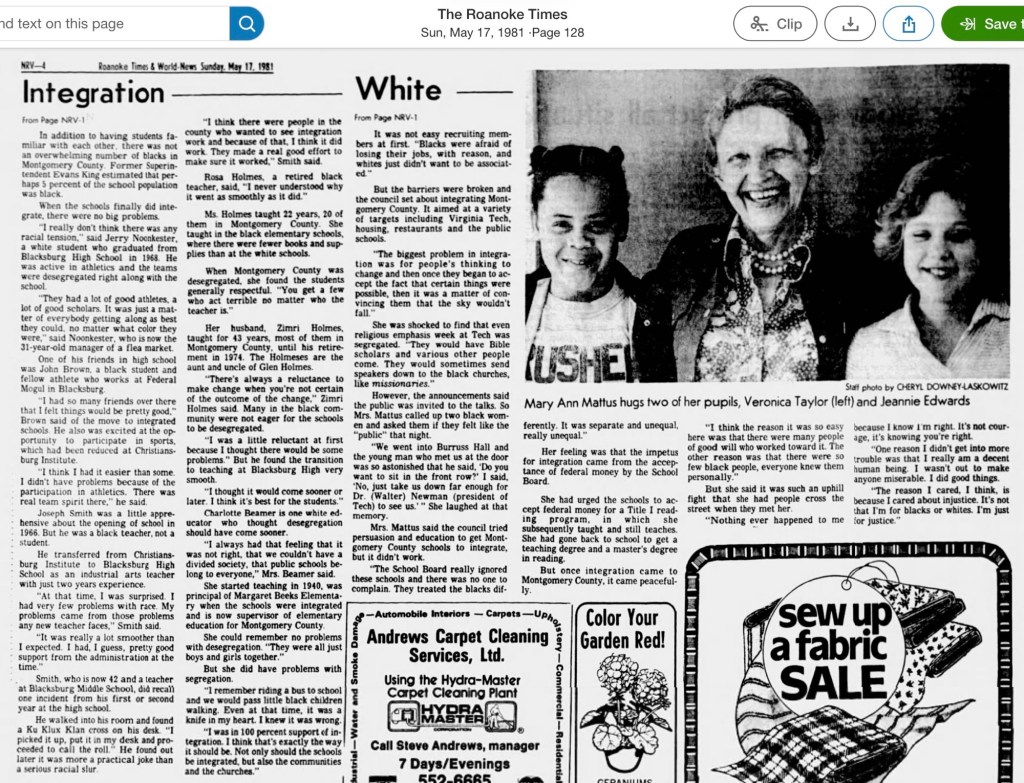
The first article, “Students, Teachers in Montgomery Schools Recall Smooth Transition,” featured the recollections of former Black students Glen A. Holmes and John Brown; Black educators Joseph Smith, Rosa Holmes, and Zimri Holmes; and white educators Charlotte Beamer, principal of Margaret Beeks Elementary School, and Mary Ann Mattus, reading specialist. Veronica Taylor and Jeannie Edwards were pictured with Mrs. Mattus in the accompanying photograph. Collectively, the interviews and photograph illustrated both the successes and the complexities of integrating Montgomery County’s schools.
The second article, “Educators Reveal Pressures,” examined desegregation from the perspective of Superintendent Raynard T. Hale and former Superintendent Evans King. Hale recalled the hostility surrounding the approach of integration, including threatening telephone calls and a cross burned on the lawn of Blacksburg High School the summer before desegregation. Although police characterized the incident as “a youngster’s prank,” Hale disagreed, recalling, “I doubt it was. I thought it was an organized effort.”
Hale and King also described the constraints imposed by Virginia’s Pupil Placement Board and the U.S. Department of Health, Education, and Welfare. They emphasized that local superintendents had little flexibility in implementing desegregation policies. At the same time, federal officials tied compliance to the continuation of significant funding streams, including support associated with educating children connected to the Radford Army Ammunition Plant, as well as Title I and vocational education funds. Their recollections highlighted the complex intersection of local decision-making, state authority, and federal enforcement during the desegregation era.
The third article, ”‘White Only’ Didn’t Refer to Ice Cream,” returned to the experiences of Mary Ann Mattus and her decades-long commitment to civil rights. The article recounted the founding of the Montgomery County chapter of the Virginia Council on Human Relations in 1955, an interracial organization established by Mattus and local clergy. The coalition included Rev. Archie Richmond of the AME Church in New Town and Rev. B. Lloyd of the Episcopal Church, who worked together to promote racial understanding, challenge segregation, and foster dialogue within the community years before public school integration became a reality.
Taken together, these articles provide a valuable retrospective on Montgomery County’s desegregation experience.