Virginia Untold offers a rich online archive of African American history. Search Montgomery and Wythe County records, and use downloadable PDFs for more precise, in-document searching.
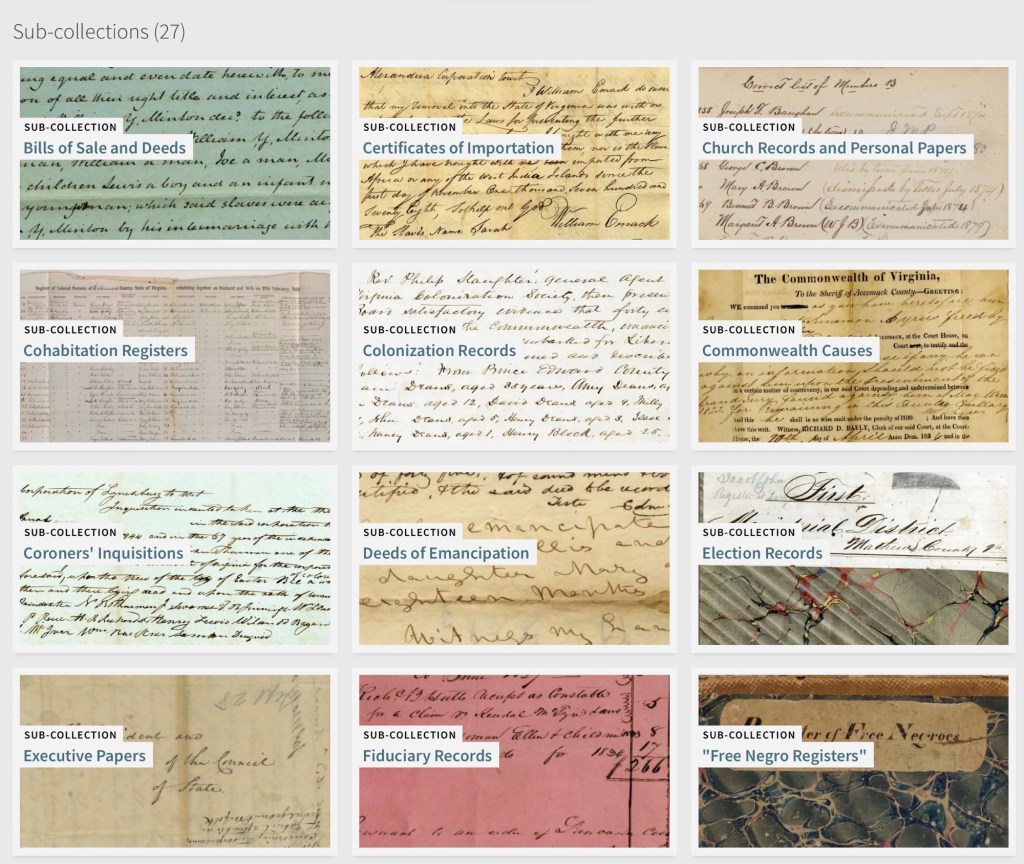
Library of Virginia’s Virginia Untold: The African American Narrative provides a comprehensive online archive of African American and related history. These primary sources are invaluable for researchers and genealogists. Search “Montgomery County, VA” to locate local materials, and include “Wythe County, VA,” as some Montgomery County records are held there.
While the site offers search functionality, downloading the PDF transcriptions allows for more targeted searching. For example, a name search will return relevant documents, but locating specific references within them requires opening the PDF and using your browser’s search function. Please note that name spellings may vary.
Don’t forget to scroll down the Virginia Untold Search page for additional online resources. Also, the Library holds a huge collection of other online resources that is growing.
This collection of archival letters and newspaper clippings—many discovered through eBay searches focused on Virginia—is shared in the spirit of public history and community research. By making these materials accessible, we hope they may help individuals uncover, reconnect with, or deepen their understanding of their ancestors and the stories that shape our shared past.
This is a collection of archival letters and newspaper clippings, many of which were discovered through eBay searches focused on Virginia. We’re sharing them in the hope that they may help someone uncover or connect with their ancestors.
Disclaimer: Any text in quotation marks reproduces the seller’s original listing. As with all archival materials, we encourage careful interpretation, as this information has not been independently confirmed.
February 27, 1798 – Mention of Dolly
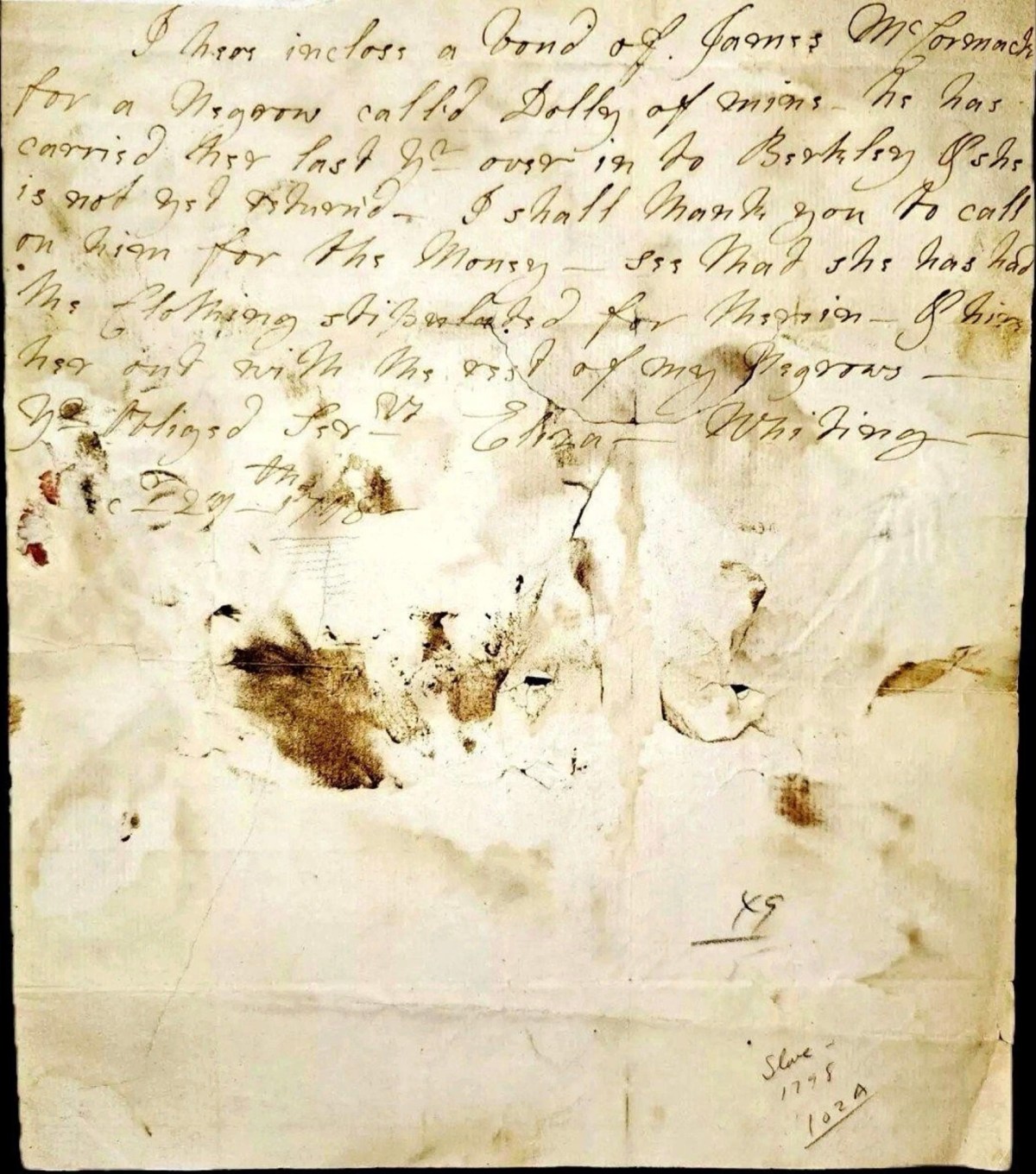
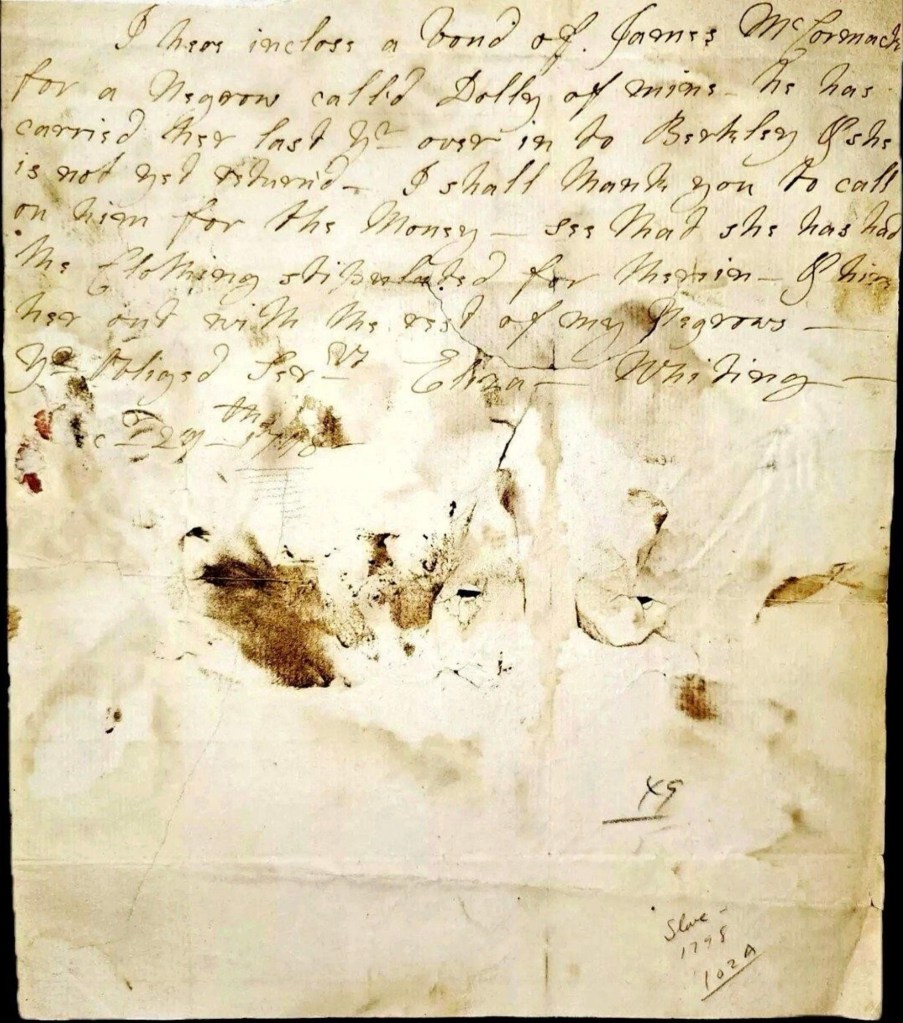
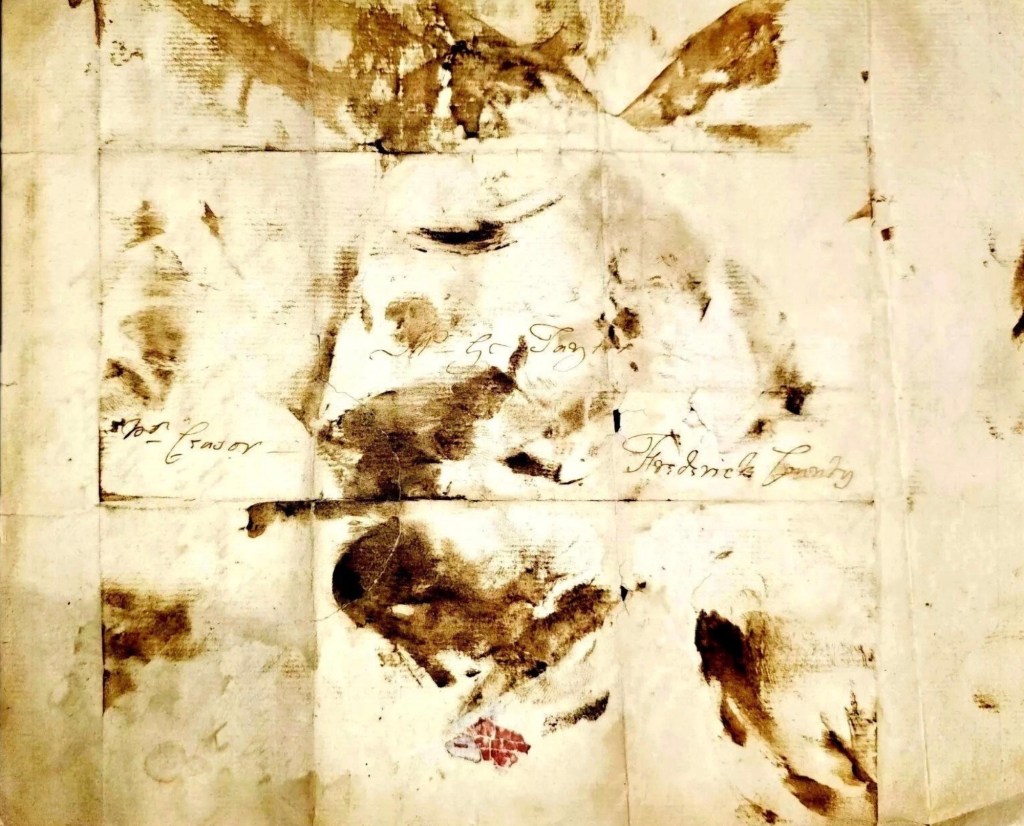
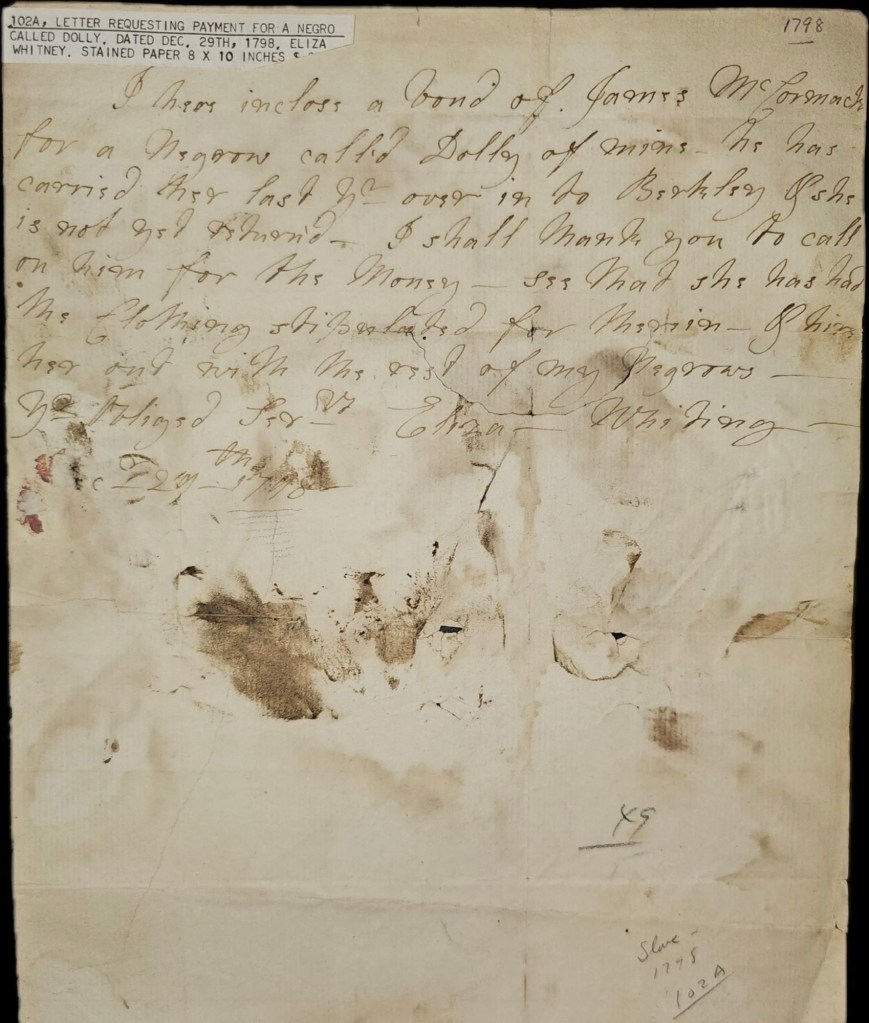
“This rare and historical slave letter from 1798 is Eliza Whiting to James McCormack is a must-have for collectors or slavery historian. The letter, written on old paper and hand-stamped for cancellation, depicts the harsh realities of slavery and commerce in the United States. Specifically relating to the Frederick County Virginia area in 1798.
The letter reads…
“Mr. George Taylor
Frederick County
-for favor
I hereby inclose a bond of James McCormack for a Negrow called Dolly of mine. He has carried her last go-over in to Berkley Pshs (Plantation) is(has) not yet returned – I shall mark you to call on him for this money – see that she has had the clothing stipulated for mention – Of hire her on I with the assist of my negroes.
Your Most Obliged Servant – Feb 27th 1798 – Eliza Whiting”
Elizabeth Burwell Whiting was the daughter of Lewis Burwell (1710–1752) of Carter’s Creek, Gloucester County, Virginia. A graduate of Cambridge who studied at the Inner Temple, Burwell served in the Virginia House of Burgesses and was acting governor of the colony in 1750. Mrs. Whiting’s husband, Beverley Whiting, was probably the son of Peter Beverley Whiting (c.1707–1755) of Gloucester County. Peter Beverley Whiting may have been the son of the Beverley Whiting who was one of George Washington’s godfathers.
James McCormick was born on June 8, 1768, in Frederick, Virginia, United States. His father was also named James McCormick, and his mother was Mercy Lupton. In 1784, James married Elizabeth Hanna in Rockbridge, Virginia. They had at least three sons. James passed away in 1841 in his hometown at the age of 73.
The letter’s aspects include a Stampless Courier denomination, a year of issue 1798, and a place of origin in the United States. It is a valuable addition to any collection and a testament to the rich history of Maryland. Don’t miss out on the opportunity to own a piece of history.
The piece has significant staining, probably dating to the time of creation, as it could be ink, or mud, or caused from water during delivery to its recipient.
Upon further research the name appears to be Eliza “Burwell” Whiting who was from a prominent family out of Prince William County.”
April 22, 1840 – Mention of Bill
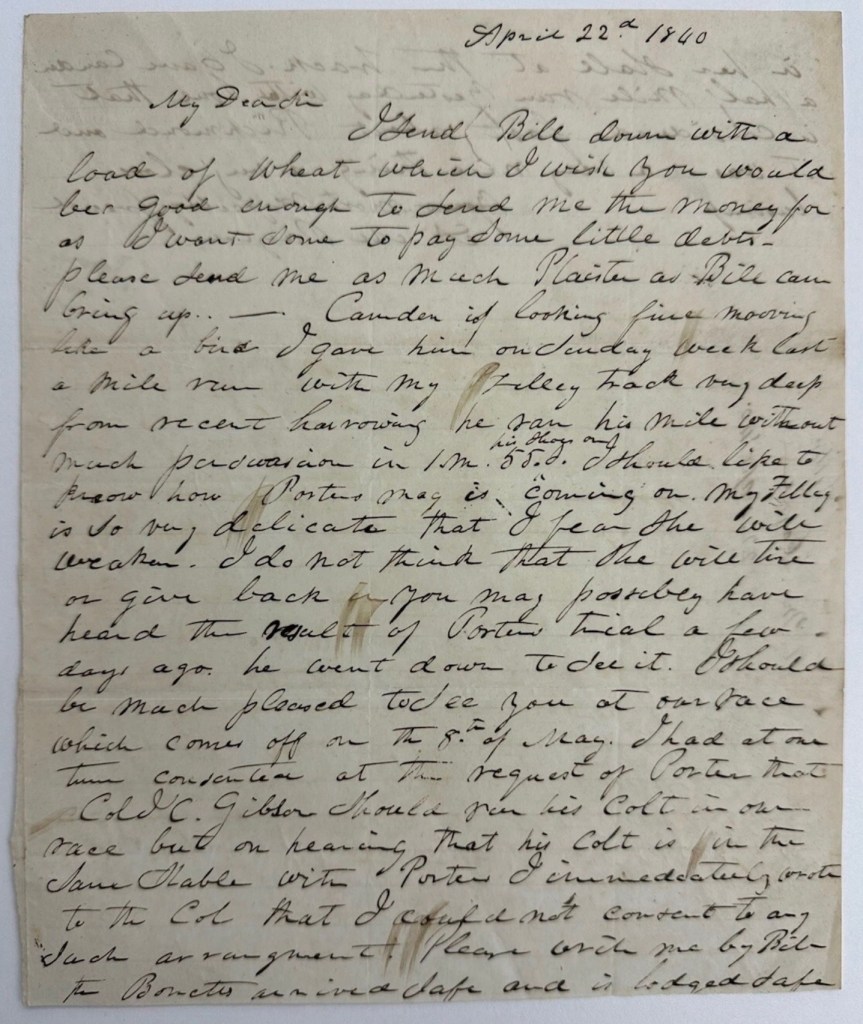
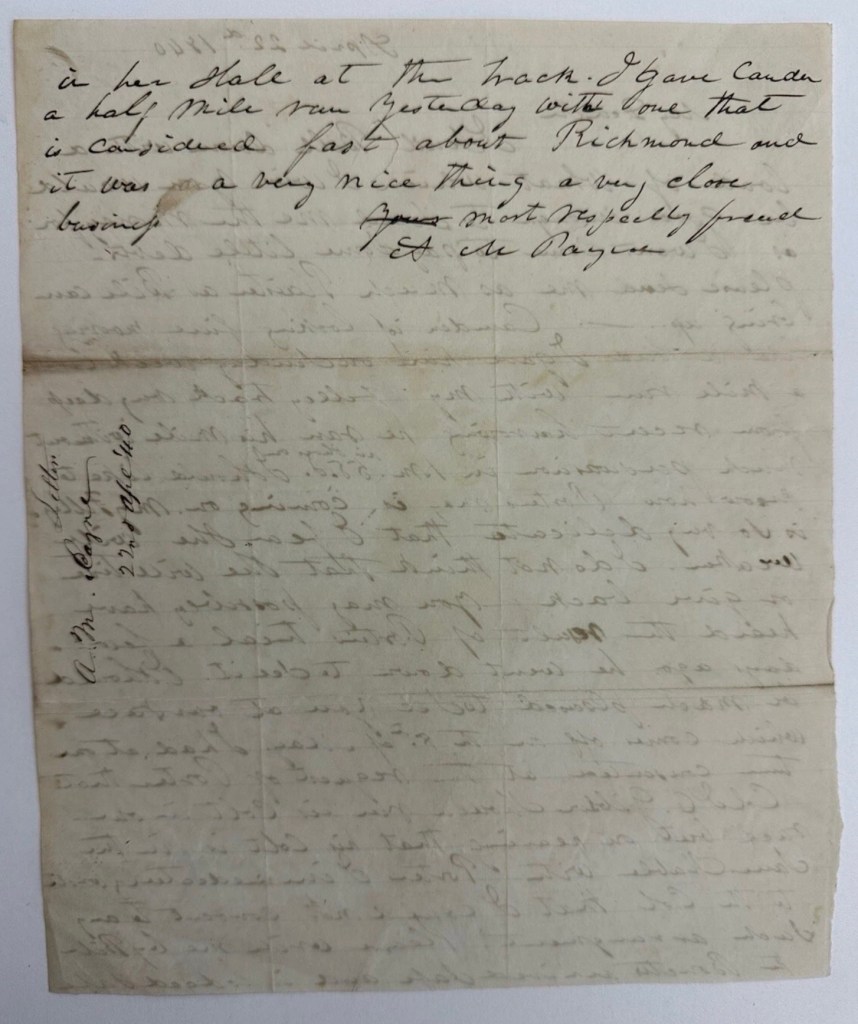
“April 22d 1840 [-] My Dear Sir [-] I send Bill down with a load of wheat which I wish you would be good enough to send me the money for as I want some to pay some little debts – Please send me as much plaister as Bill can bring up. – Camden is looking fine mooving [sic] like a bird. I gave him on Sunday week last a mile run with my [filley?] track very deep from recent harrowing [-] he ran his mile without much persuasion in 1 m[inute] 55 [seconds] his shoes on. I should like to know how Porter’s nag is coming on. My filler is so very delicate that I fear she will weaken. I do not think that she will tire or give back in. You may possibly have heard the result of Porter’s trial a few days ago. he went down to see it. I should be much pleased to see you at our race which comes off on the 8th of May. I had at one time consented at the request of Porter that Col. J.C. Gibson should run his colt in our race but on hearing that his colt is in the same stable with Porter’s I could not consent to any such arrangement. Please write me by Bill [illegible] Bonetis arrived safe and is lodged safe in her stall at the track. I gave Camden a half mile yesterday with one that is considered fast about Richmond and it was a very nice thing a very close business. Most respectably friend. A. M. Payne.”
“The author of this letter, Arthur A.M. Payne (1804-1868), was a member of the longstanding family associated with Fauquier County, and the last familial owner of the Clifton estate in that county, which he sold in 1854 on moving to Missouri, where he passed away in 1868. His father was Captain William Payne (1755-1833) who served in the Virginia Militia under General Richard Henry Lee during the American Revolution. A.M. Payne was in turn the father of Confederate States Army Brigadier General William Henry Fitzhugh Payne (1830-1904). The man mentioned in the letter, Colonel Jonathan Catlett Gibson (1793-1849), was a notable landholder in both Culpeper and Rappahannock County, Virginia.
Colonel Gibson served in the Virginia militia during the War of 1812 and rose to command rank in later years. He was elected to the Virginia House of Delegates in 1830. Originally married to a niece of George Washington, he remarried after her death, raising five sons, all of whom served in the Confederate Army. “
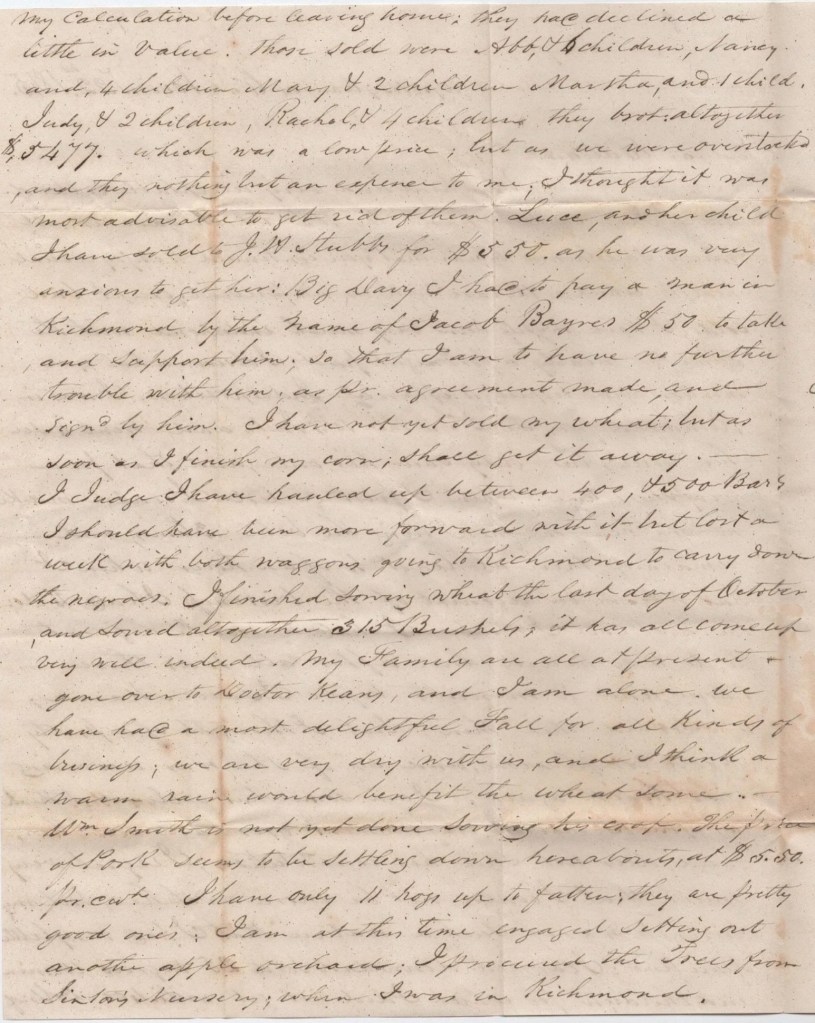
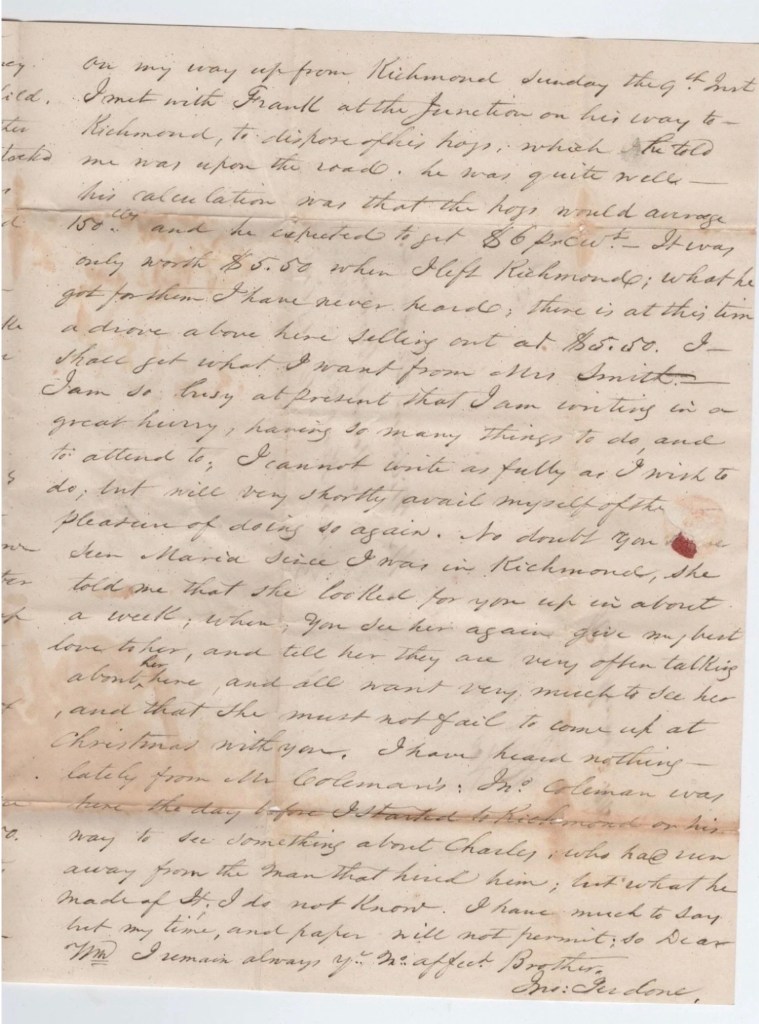
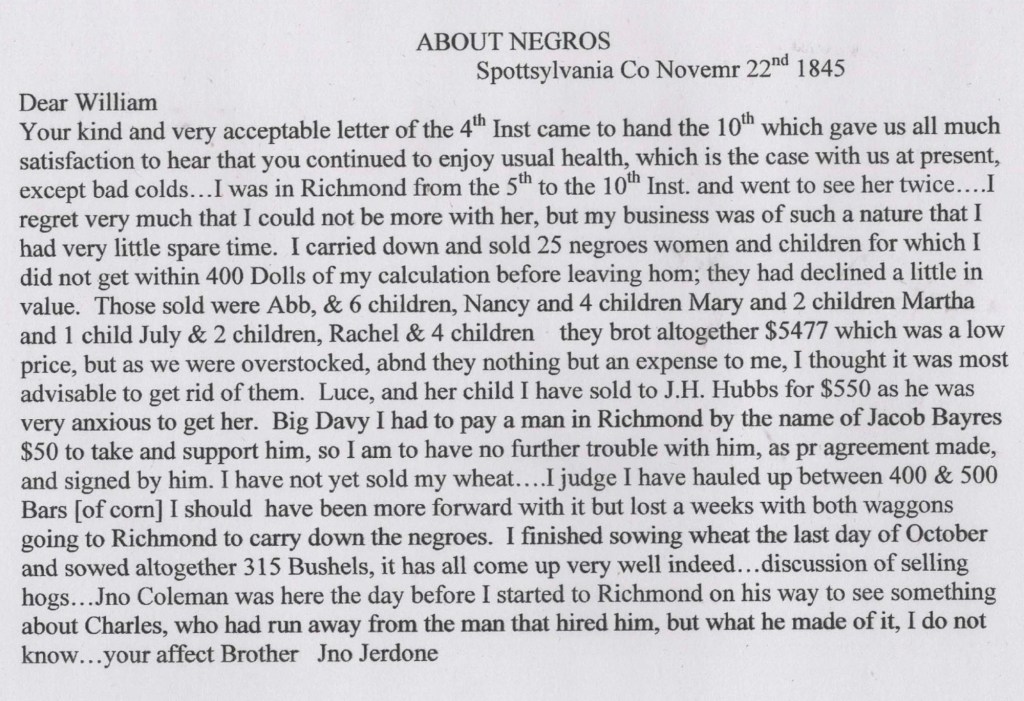
November 22, 1845 – Mention of Abb, Nancy, Mary, Martha, Rachel, Luce, Big Davy
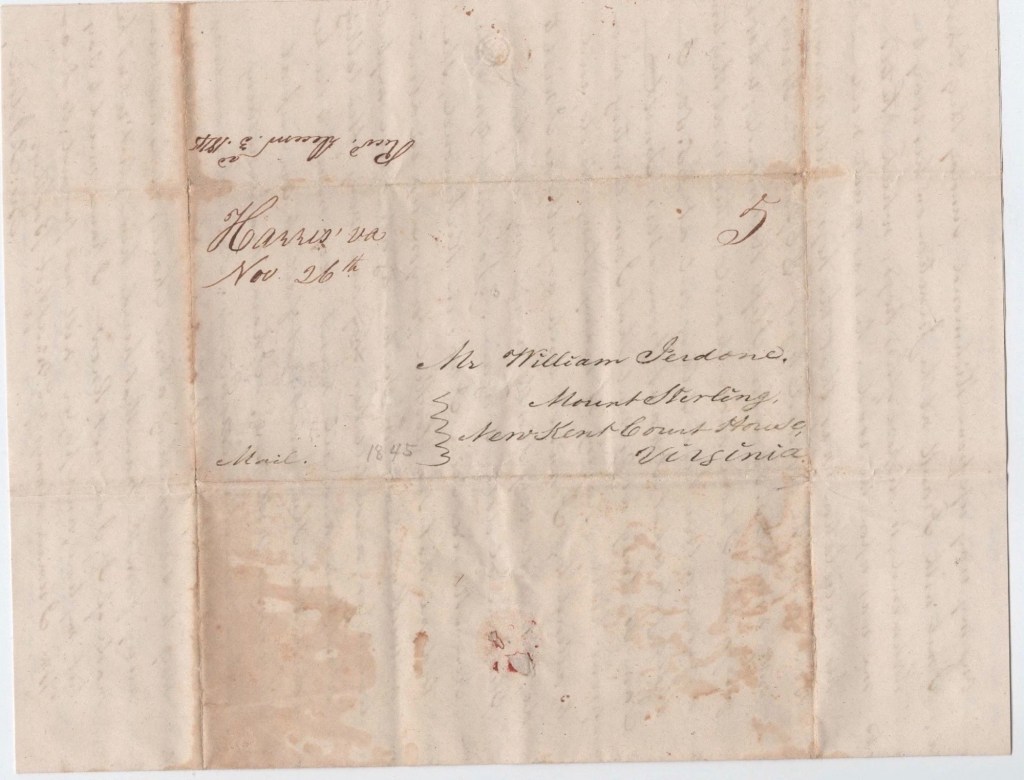
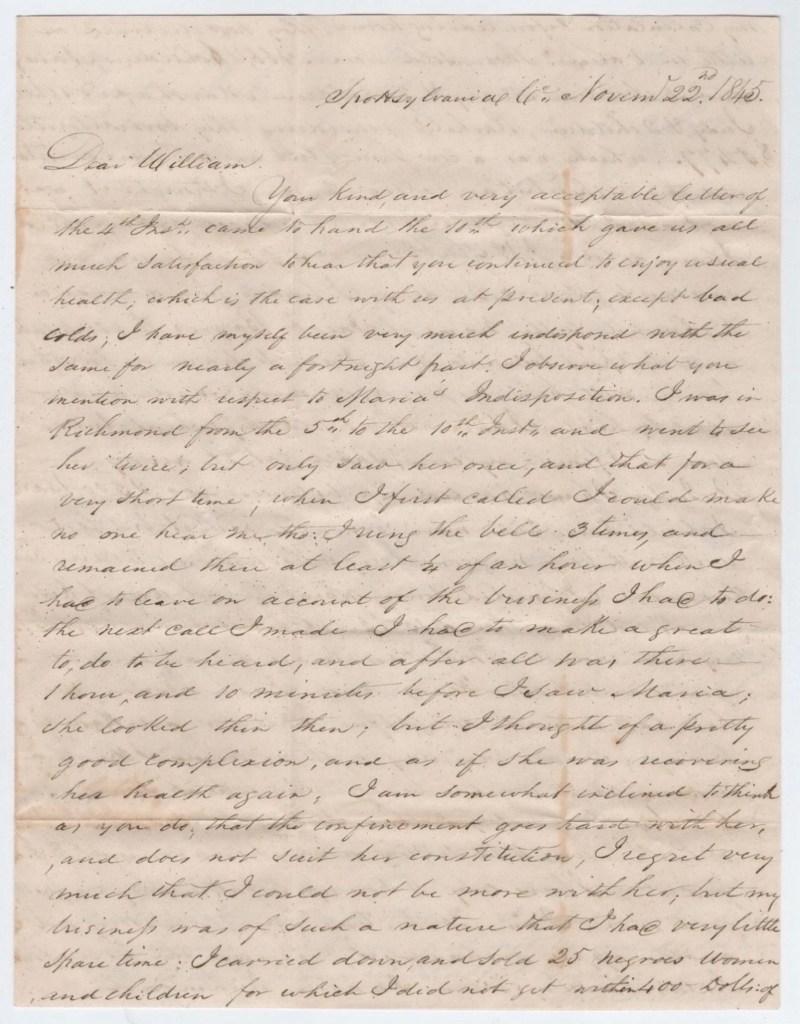
“Remarkable Stampless folded letter written November 22, 1845 by John Jerdone, a prominent plantation owner in Spottsylvania, Virginia and sent to a relative, William Jerdone in Mount Sterling, New Kent Court House, VA.
Content is about the sale 25 enslaved negro women and children, the prices obtained. Rest of content is farming news, selling hogs in Richmond etc.”
As noted by Dan Thorp in Seeking Justice: The Extraordinary Freedom Suits of an Enslaved Virginia Family, fluctuations in the enslaved labor market in eastern Virginia reflected broader economic shifts in the decades before the Civil War. Periods of declining prices—such as those described in this letter, where individuals were said to be “overstocked”—often prompted enslavers to sell people out of the region, feeding the domestic slave trade to the Deep South. This language of “overstock” underscores the brutal commodification of human lives, where people were treated as surplus property in a market economy, and their forced movement reshaped families and communities across the South.
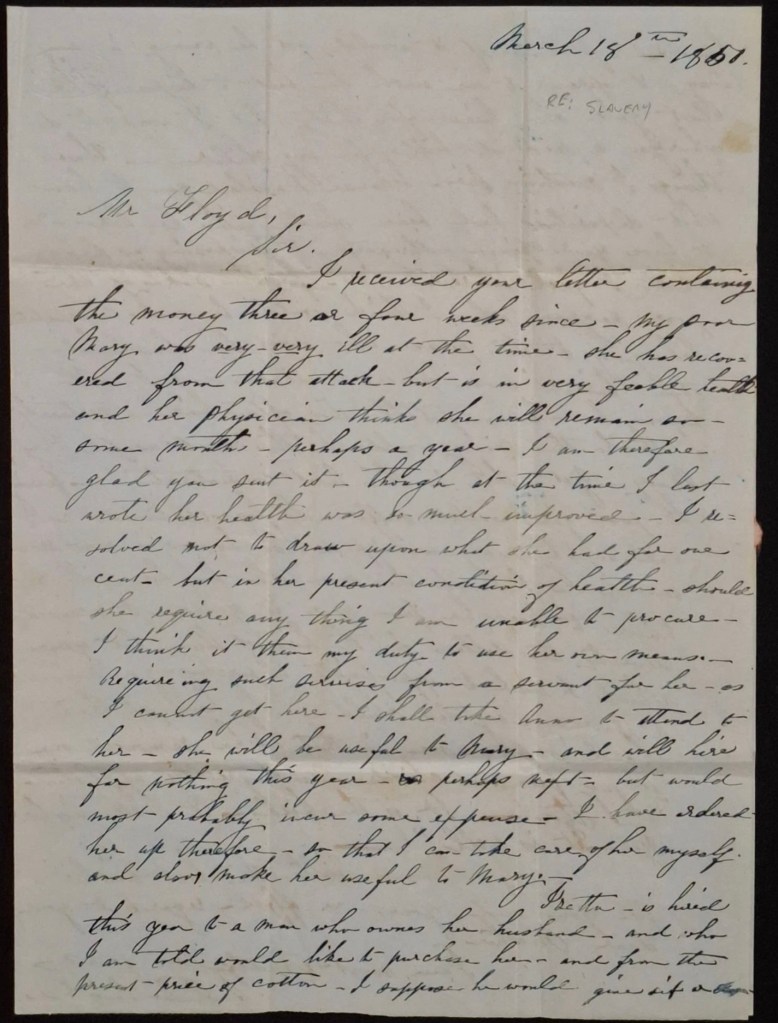
1851 March – Mention of Isetta
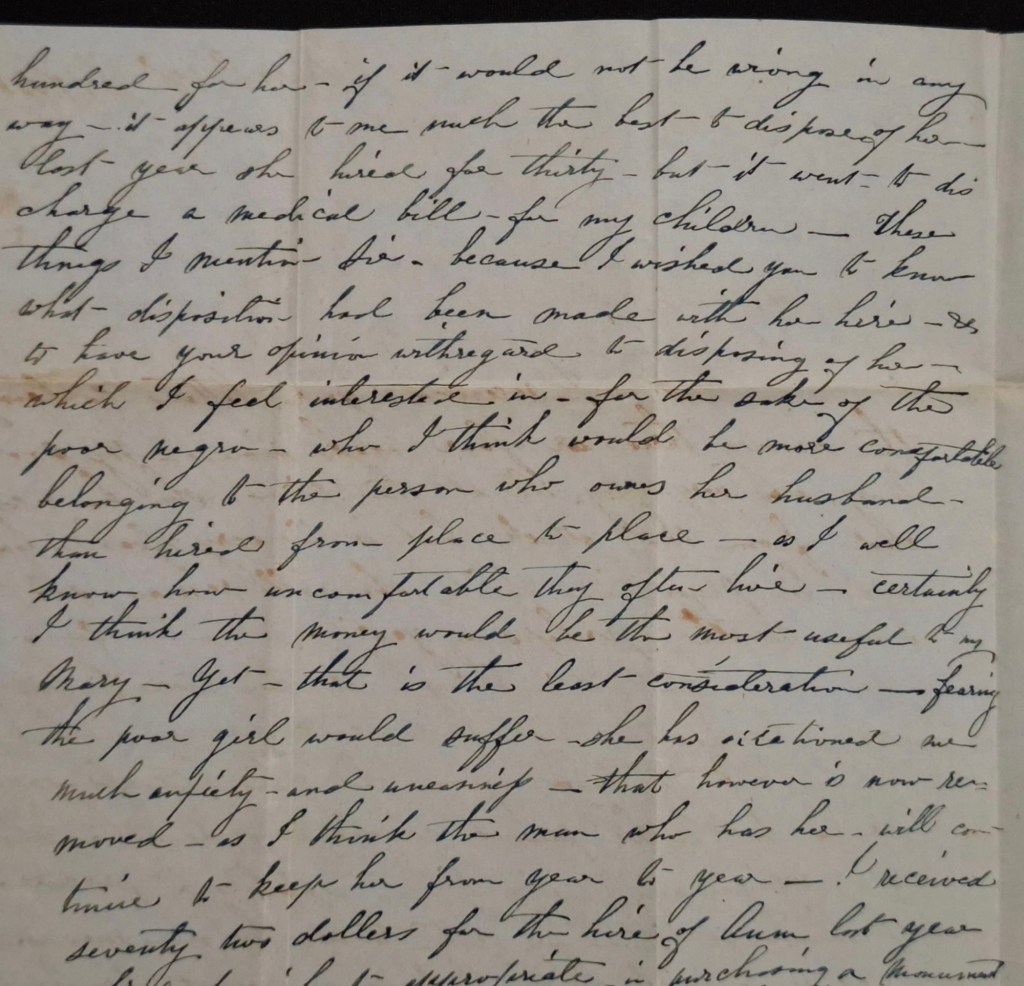
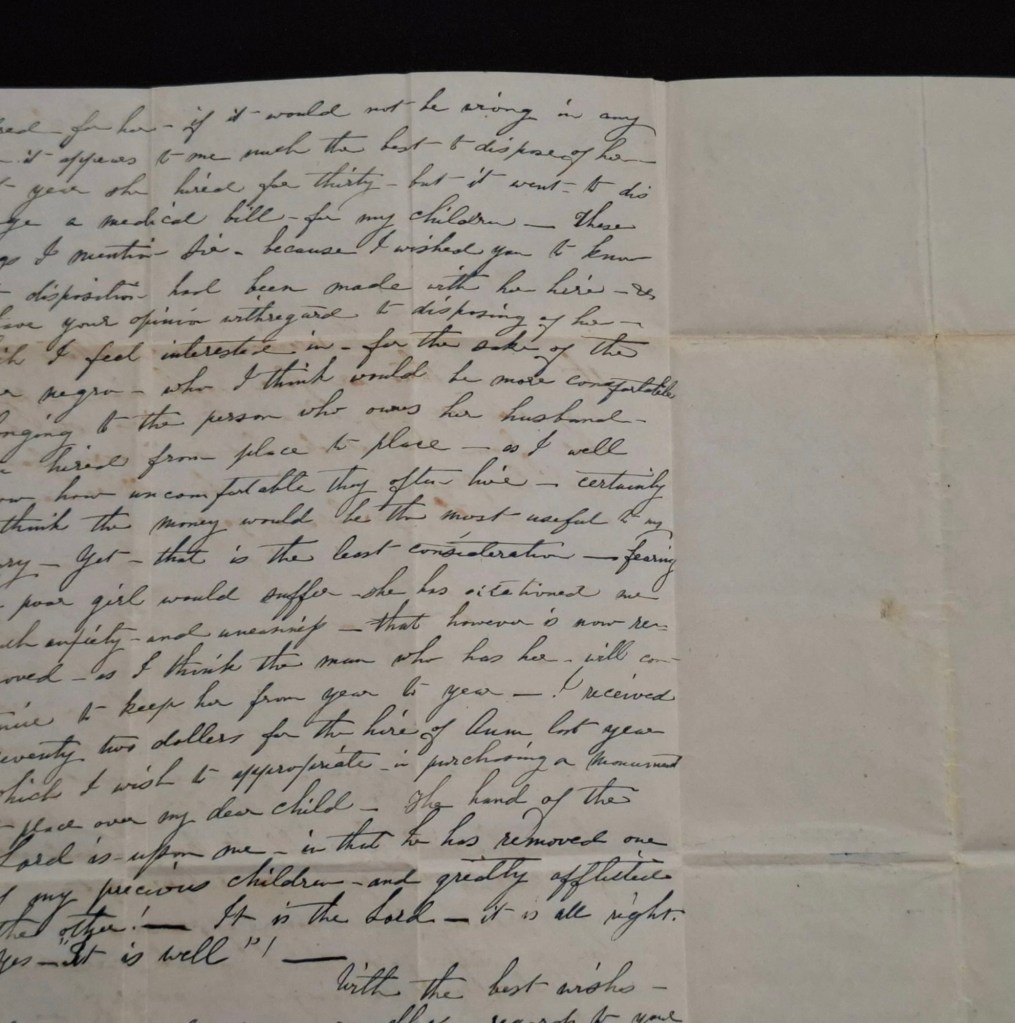
“An autograph letter signed S.W. Leigh to Benjamin Rush Floyd, discussing personal matters and asking for advice on the sale of a slave woman named Isetta.
Excerpt:
“[….] Isetta is hired this year to a man who owns her husband and who I am told would like to purchase her and from the present-price of cotton – I suppose he would give six hundred for her….”
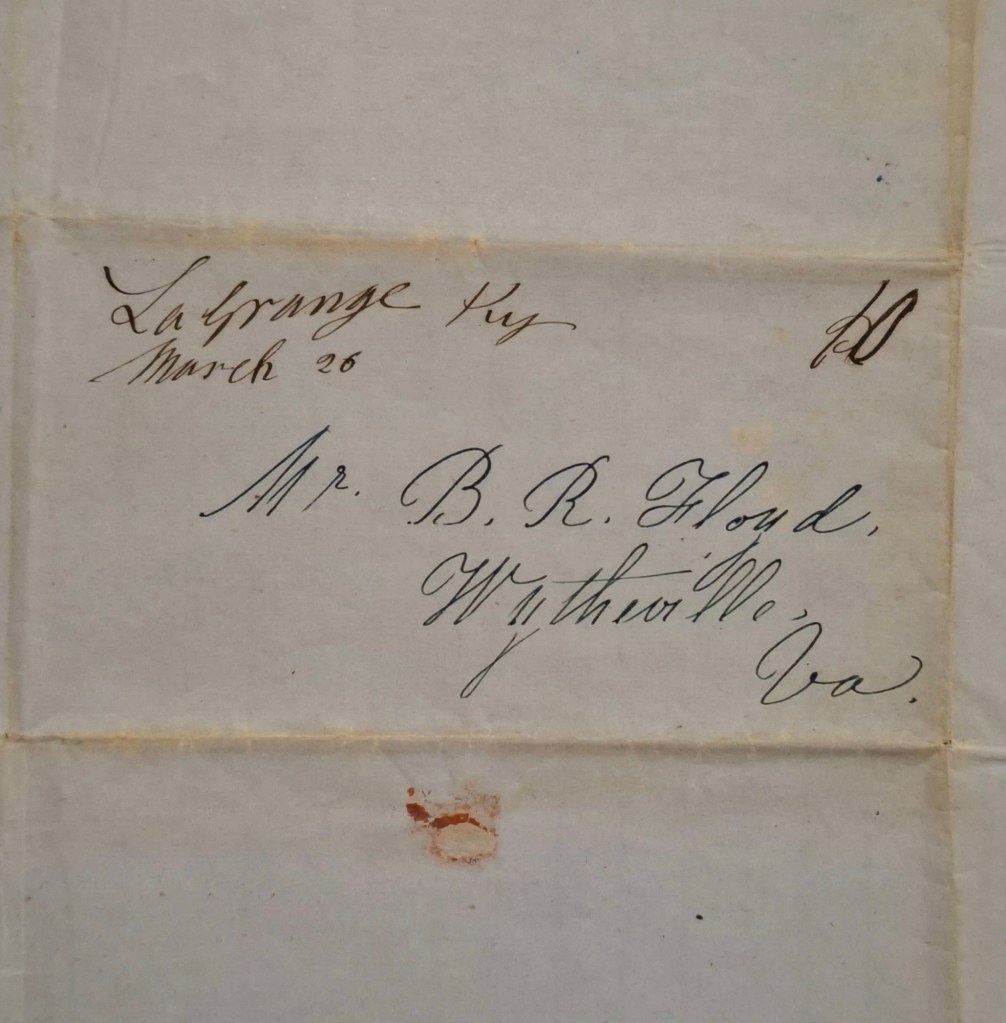
2 pp. , 25 x 18,5 cm, leaf address “Mr. B.R. Floyd, Wythe, Virginia” sent from La Grange, Kentucky, March 1851.
Note: The recipient of the letter, Benjamin Rush Floyd (1811-1860), American lawyer and politician was a member of the Virginia House of Delegates from 1847-1848, and state senator from 1857-1858.”
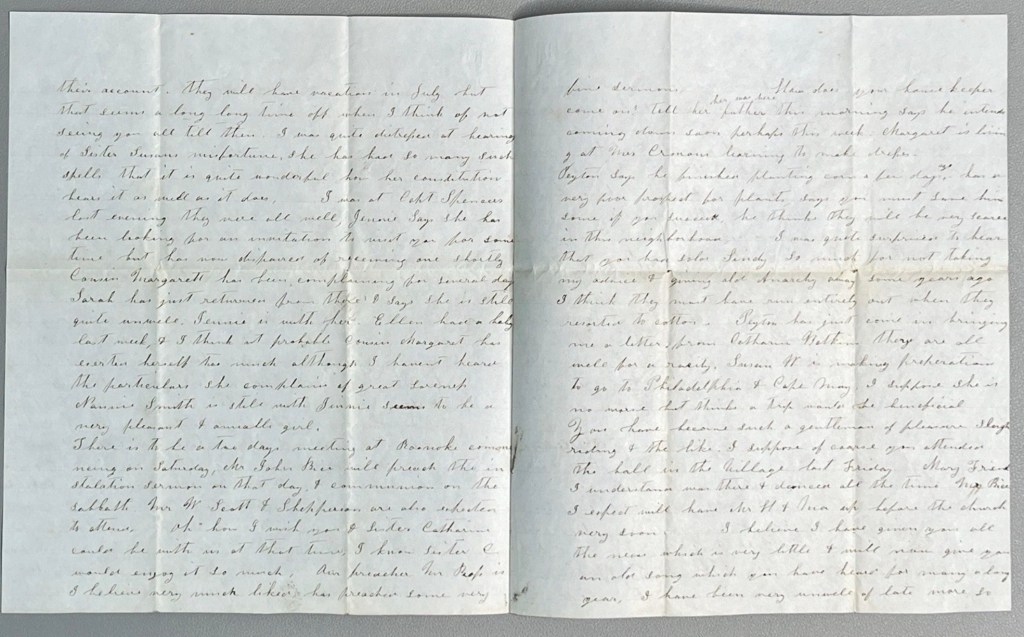
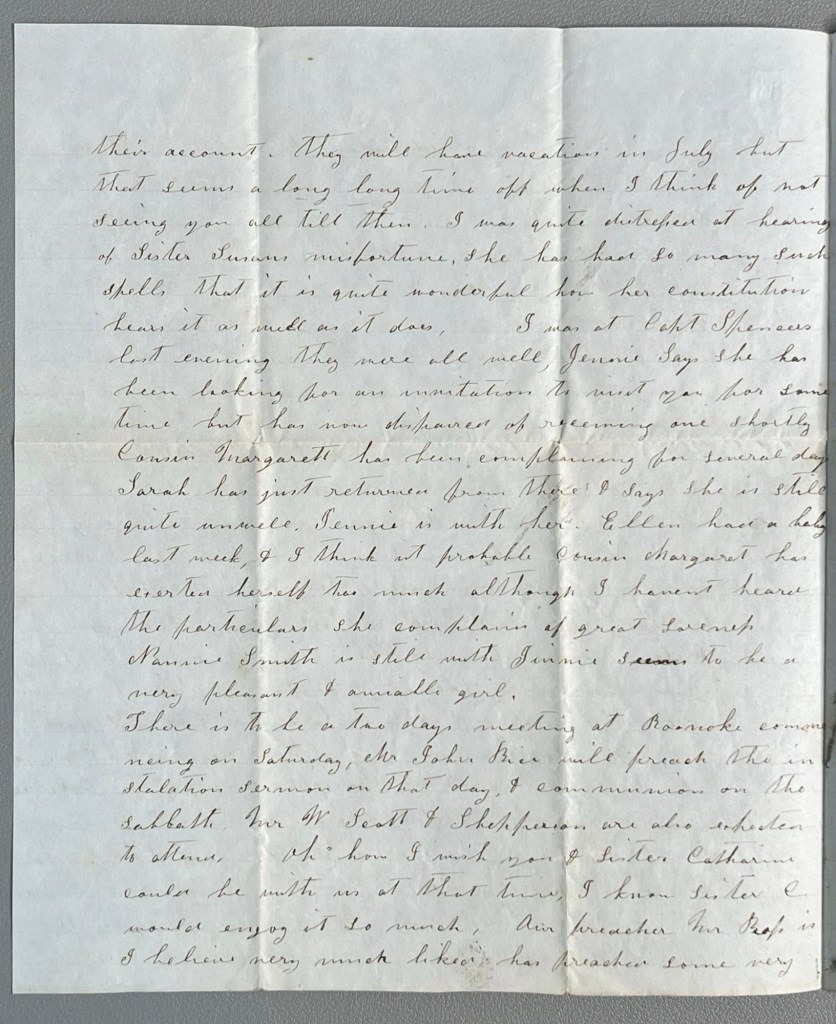
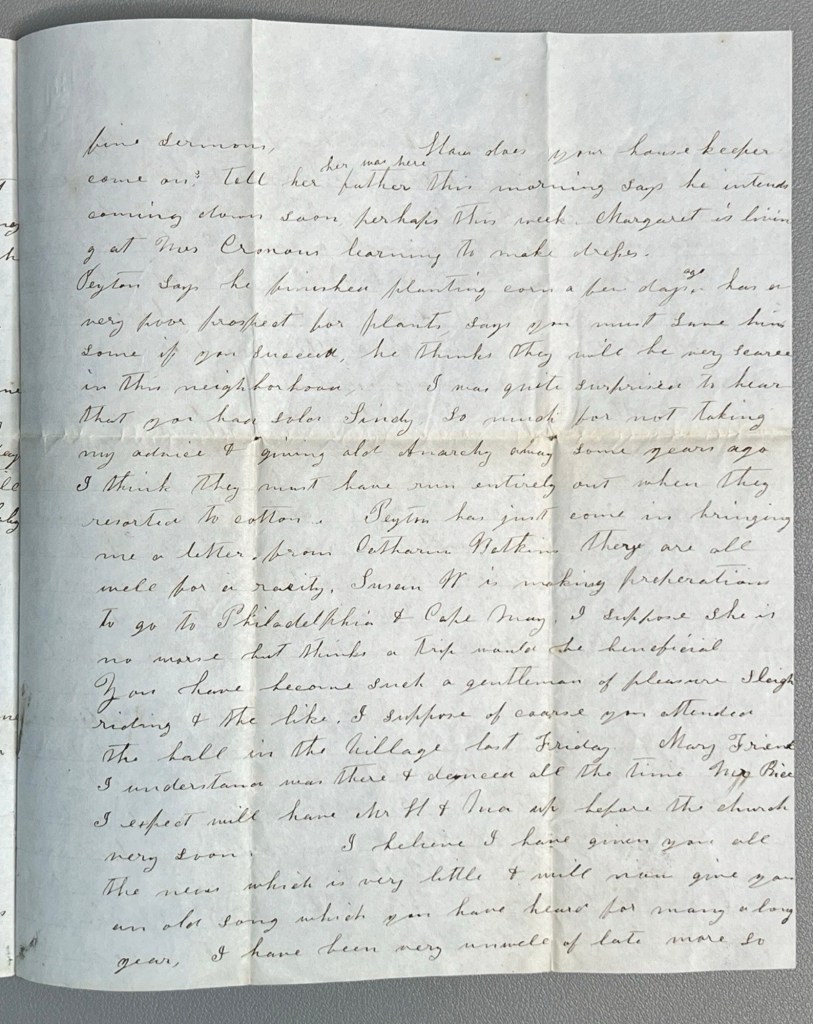
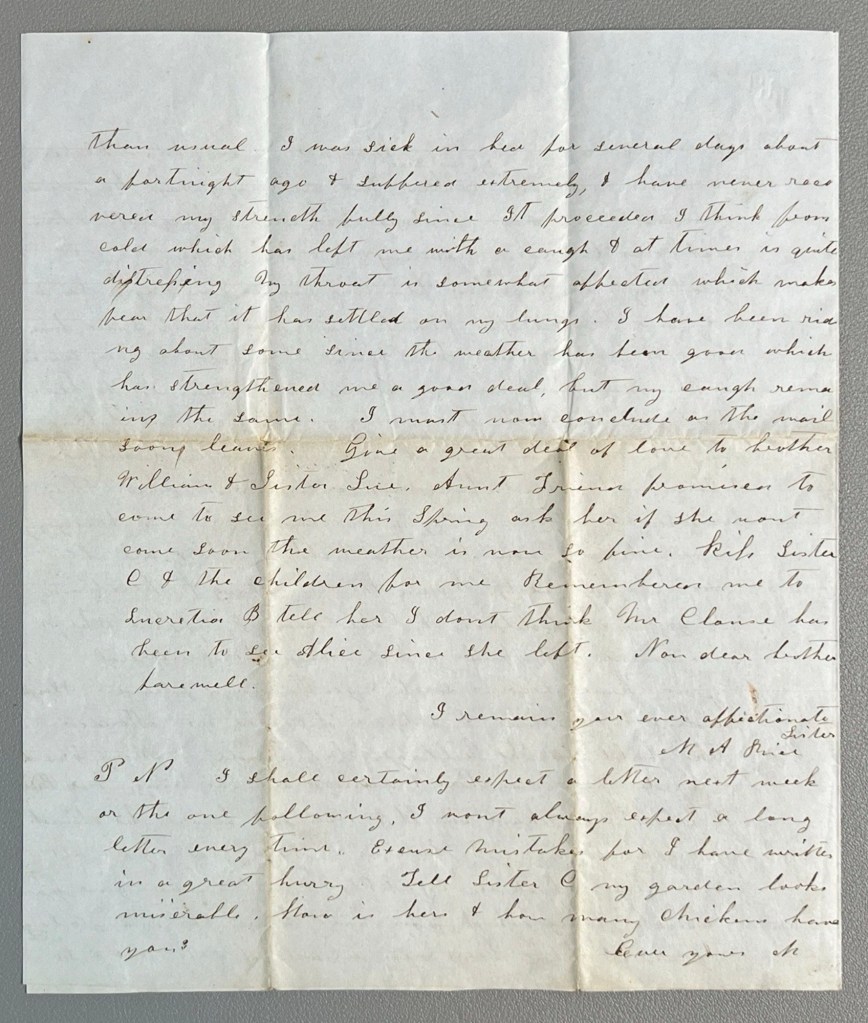
1854 – Roanoke
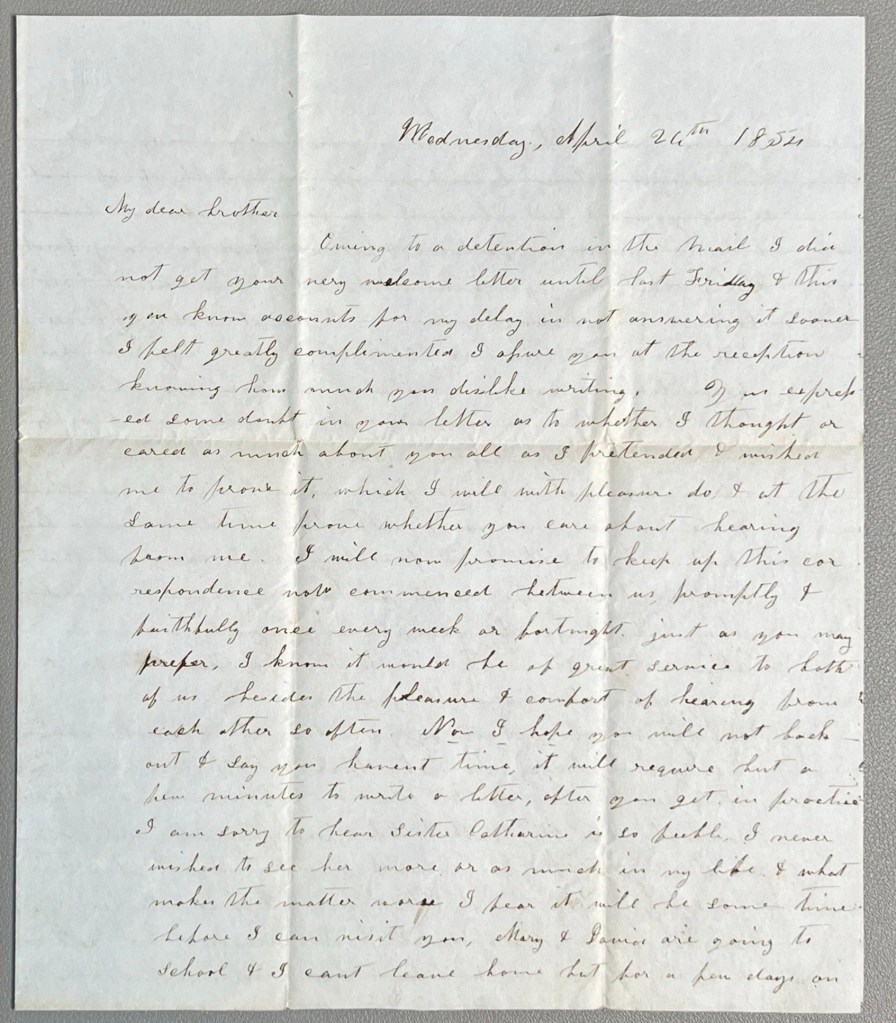
Primary Historical Hook: The defining value of this manuscript rests on the explicit mention of the sale and transfer of enslaved individuals. Within the text, the author expresses surprise at the recipient’s actions:
“I was quite surprised to hear that you had sold Sindy. So much for not taking my advice & giving old Anarchy away some years ago.”
Antebellum correspondence that names specific enslaved persons is highly sought after by academic archives, museums, and private historical collectors for its rarity and research potential.
Date & Origin: The letter is dated Wednesday, April 26th, 1854.
Local Interest: Refers to a “Two days meeting at Roanoke” with sermons delivered by “Mr. John Rice” and “Mr. Proffit.”
Identified Individuals: The text is rich with genealogical data, mentioning “Sister Catharine,” “Sister Susan,” “Sister Sue,” “Brother William,” “Capt. Spencer,” “Cousin Margaret,” “Nannie Smith,” “Peyton,” and “Aunt Irene.”
Health & Daily Life: Details the “feeble” state of Sister Catharine, agricultural concerns regarding a “poor prospect for plants,” and general family news regarding school and recent births.
Date: April 26, 1854
Location: Roanoke, Virginia
Author: M. A. Price
Key Themes: Slavery/Enslavement history, Southern Social History, Genealogy, 19th-Century Religion
This searchable document is a rich source of information about the county and its wider connections. For example, it notes that the New River boatmen once lived on Kent Farm, where they were enslaved by James Randle and Margaret Cloyd Kent prior to emancipation (see page 13). Additional details about Kentland and these freedmen can be found in the following postings: Historic Kentland and Historic Wake Forest
The names of some of the black boatmen of 19th-century Montgomery County include Frank Bannister (who was a boatman on the James River before the Civil War), Calvin Bannister, Roland Stuart, George Brown, and Lewis Smith.
This report that was written by Gibson Worsham, Dan Pezzoni, Charlotte Worsham, David Roenizer, and others. It addresses the following: 1) Overview of the county’s history, 2) A comprehensive inventory of significant structures and sites in the county and 3) Maps delineating the location of said structures and sites. Similar to the report above, this is a wealth of information about the county.
The Formation of Montgomery County, Virginia and Why it Matters to African American History of the Region
When Virginia’s earliest European colonial settlers first pushed westward beyond the Blue Ridge Mountains, they entered the border lands already inhabited by Native peoples for thousands of years. As Europeans laid claim to these territories in the 18th century, Virginia’s county boundaries began shifting rapidly to keep pace and the need for local governance.
At first, all of western Virginia was considered part of vast counties based far to the east. Augusta County, created in 1738, stretched from the Blue Ridge to the Mississippi River—a landmass so large it was nearly impossible to govern effectively. As settlement expanded, Augusta was gradually carved into smaller counties.
Botetourt County was created in 1770 out of Augusta, and just two years later, in 1772, Fincastle County was formed to cover the far southwest. But Fincastle itself was short-lived: in 1776, it was split into three new counties—Montgomery, Washington, and Kentucky (the latter eventually becoming the Commonwealth of Kentucky).
Thus, Montgomery County was officially established in 1776, named in honor of General Richard Montgomery, a Revolutionary War hero.
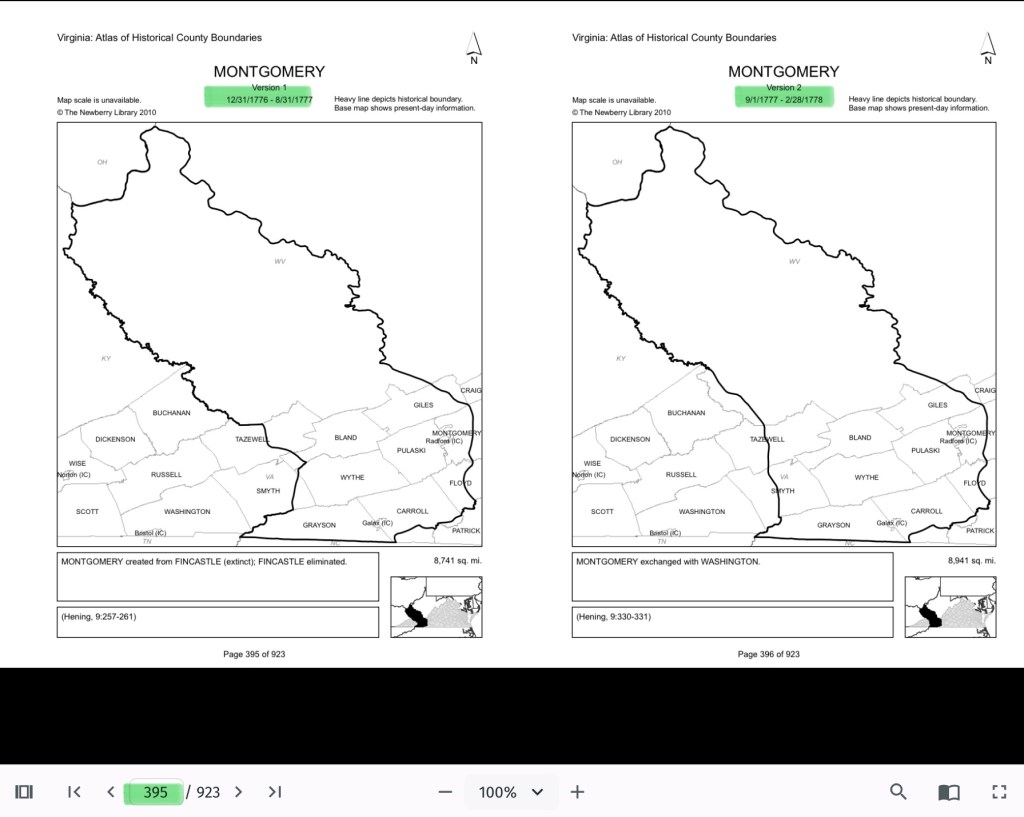
Like most early counties, Montgomery did not remain the same size for long. As population grew and communities demanded closer courts and local representation, Montgomery’s original boundaries were gradually reduced.
1790: Wythe County was formed from Montgomery.
1790: Parts of Montgomery contributed to the creation of Kanawha County (now in West Virginia).
1806: Giles County was carved from Montgomery, Monroe, Wythe, and Tazewell.
1831: Montgomery giving land to Floyd
1839: Montgomery giving land to Pulaski
1892: City of Radford
By the mid-19th century, Montgomery County had taken on the approximate shape we recognize today.
Why This Matters
Tracing these changing boundaries shows how the western border lands of Virginia evolved from a vast Indigenous landscape into the network of counties we know today. When we study Montgomery County’s formation and its changing borders, we are not only tracking political geography—we’re also uncovering how those shifts shaped the daily realities of enslaved people and freedmen. The “line on a map” often meant the difference between where families were recorded, where they could live, and how they could begin to claim freedom and opportunity.
County seats like Christiansburg were not only centers of trade and government but also of the slave market and the courthouse records that tracked the lives of enslaved people. After emancipation, those same courts became the places where freedmen registered marriages, secured contracts, and sought land. As county lines shifted, so too did the jurisdictions that controlled access to justice, opportunity, and community life.
The flip book of maps below is a helpful resource to understand how the boundaries changed with time. Begin on page 395.
Pulaski County Reconnaissance Survey, created by Gibson Worsham, Dan Pezzoni, and many others, is such a valuable resource. It provides vital insights into African American history in Southwest Virginia and the greater Central Appalachian region, helping us better understand the interconnected stories that shaped our communities.
Montgomery County, Virginia, has never existed in isolation.
The people who have lived here—whether by choice, through enslavement or servitude, or as Indigenous communities who established towns long before European arrival—moved across boundaries freely. They traveled, traded, fought, buried their dead, and carried out the everyday work of survival across what later became county lines.
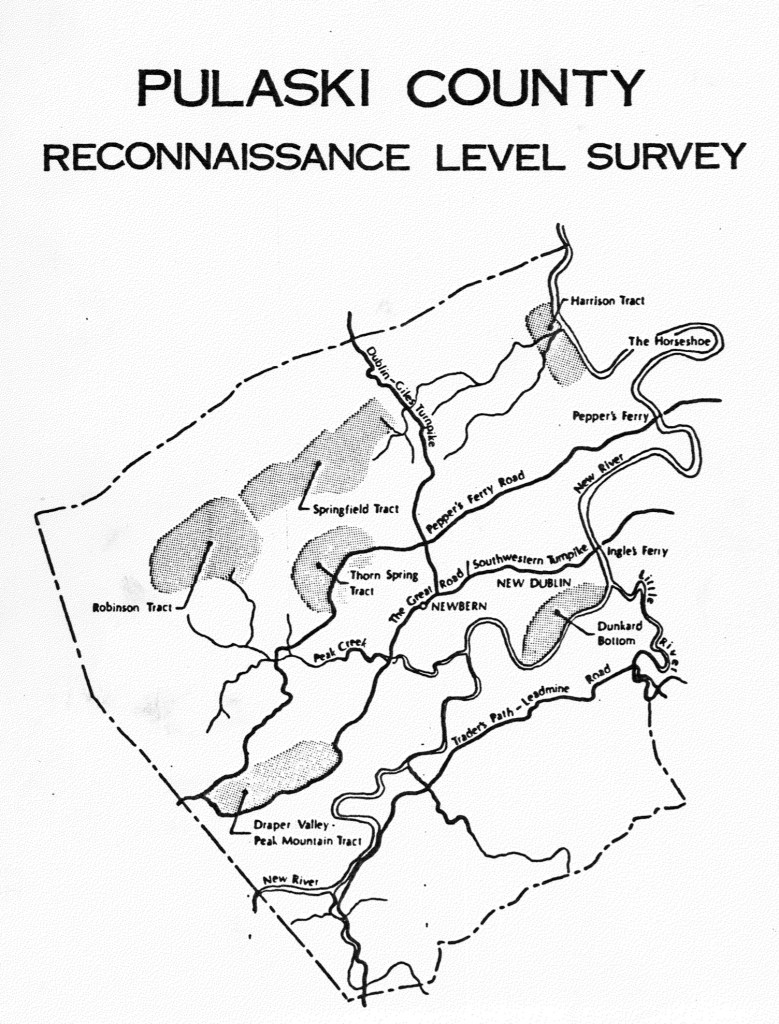
This is why the Pulaski County Reconnaissance Survey, created by Gibson Worsham, Dan Pezzoni, and many others, is such a valuable resource. It provides vital insights into African American history in Southwest Virginia and the greater Central Appalachian region, helping us better understand the interconnected stories that shaped our communities.
This report is fully searchable and contains valuable early documentation on African American schools, churches, and communities. It also includes a generalized map that highlights both early European settlements and land tracts. For example, Dunkard’s Bottom—now submerged beneath Claytor Lake—was once part of an early German settlement.
The report also identifies significant Scotch-Irish tracts such as Draper Valley/Peak Mountain, Harrison, Robinson, Springfield, and Thorn Spring. It notes the communities of Newbern and New Dublin, along with the region’s main transportation routes: Traders Path/Leadmine Road, the Great Road/Wilderness Road/Southwestern Turnpike, Peppers Ferry Road, and the Dublin/Giles Turnpike.
The report offers a clear explanation of the early Importation and Treasury Rights system used to claim land (see pages 23–24). For further detail, see F.B. Kegley, Kegley’s Virginia Frontier, Roanoke, VA: Southwest Virginia Historical Society, 1938. p. 59.
The report contains interesting data about the enslaved, noted on page 44. Also, the churches and New River Village is discussed beginning on page 56.
In Pulaski the pattern of large landholding influenced the ownership of slaves. Whereas in Montgomery County there were 2,219 slaves, and in Pulaski only 1,589 in 1859, eight slaveholders had more than fifty slaves in Pulaski while only two landowners in Montgomery possessed as many. In both counties, however, the majority of owners possessed ten or fewer slaves. During the Civil War, the Confederacy began requisitioning slaves to work in the war effort. At the beginning of the war many slaves were requisitioned and shipped to Richmond to fortify the state capital. In the following three years slaves were requisitioned four times so that by 1865 the county found it could no longer comply as it was being drained of free and slave manpower, food supplies and money.
Timeline was created for the 2030 Comprehensive Plan of Pulaski County
A Note on the Language in the County’s Comprehensive Plan
As part of Montgomery County’s 30-year Comprehensive Plan, a historical timeline was created. While the dates provided are generally accurate, the language used to describe Indigenous people and borderlands does not align with our values.
We want our readers to be aware that these depictions reflect the language of the plan’s authors—not the values or beliefs of this website. Our commitment is to present history in a way that acknowledges the dignity, presence, and contributions of all people who have lived in this region.
Note that the African American community of “New River” came to exist after emancipation.
On July 5, 1852, Frederick Douglass delivered his powerful speech, “What to the Slave Is the Fourth of July?” to the Rochester Ladies’ Anti-Slavery Society at Corinthian Hall in Rochester, New York. In it, he confronted the meaning of Independence Day from the perspective of those still enslaved, asking what freedom could mean in a nation that denied it to millions.
On July 5, 1852, Frederick Douglass delivered his powerful speech, “What to the Slave Is the Fourth of July?” to the Rochester Ladies’ Anti-Slavery Society at Corinthian Hall in Rochester, New York. In it, he confronted the meaning of Independence Day from the perspective of those still enslaved, asking what freedom could mean in a nation that denied it to millions.
The copies of both the full version and excerpts are available.
Back Story Radio – excellent production and provides insightful context to the time and place.
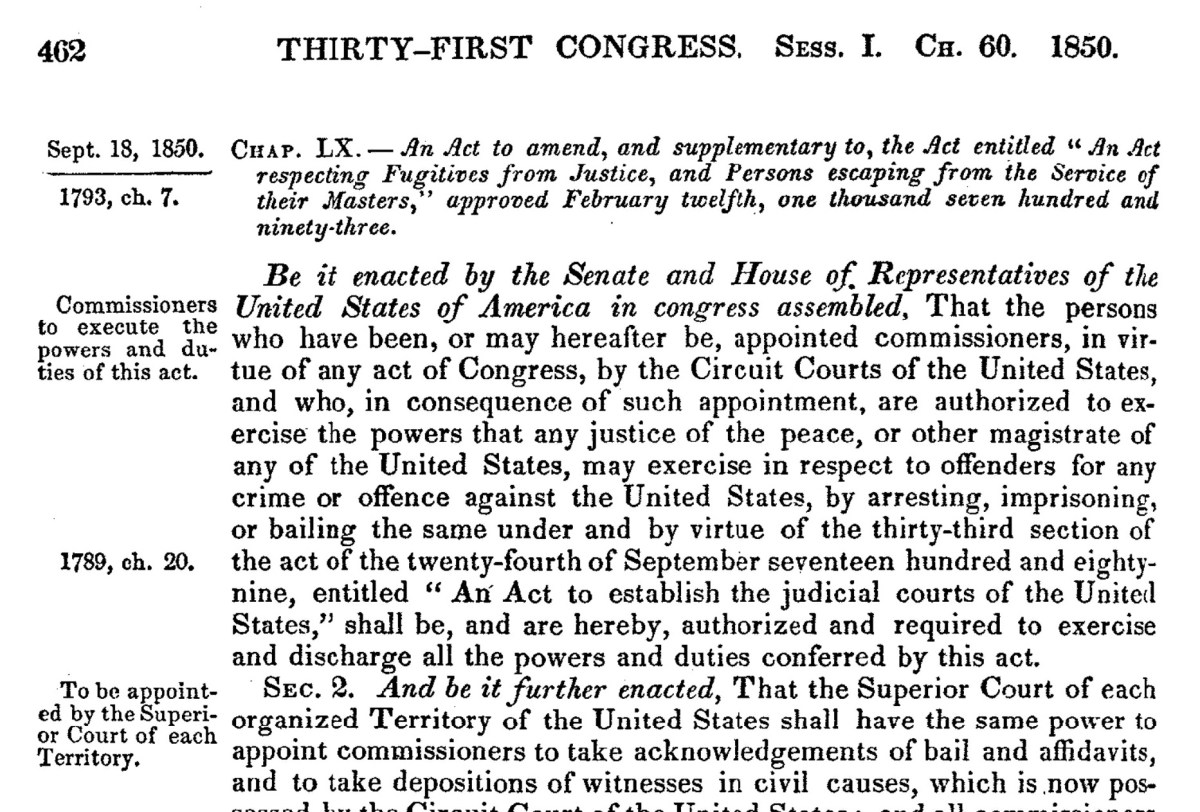
The Compromise of 1850 included the Fugitive Slave Act, a federal law signed just two years before Mr. Douglass’s 1852 speech. As historian Eric Foner has noted, this act demonstrates that pro-slavery states were willing to abandon their usual defense of states’ rights when it came to protecting the institution of chattel slavery. Eric Foner on the Fugitive Slave Act.
Timeline of Mr Douglass’ life, presented by the Library of Congress. Brief Summary Based on the Library of Congress
Frederick Douglass married Anna Murray in 1838. Together, they had five children: Rosetta (1839), Lewis Henry (1840), Frederick Jr. (dates vary, likely born around 1842–1843), Charles Remond (1844), and Annie (1849). The family moved to Rochester, New York in 1847, where Douglass continued his abolitionist work.
In 1859, following the failed John Brown raid, Douglass fled briefly to Canada to avoid arrest, returning in 1860—the same year his daughter Annie died. That year, Abraham Lincoln was elected president, and South Carolina became the first state to secede from the Union.
During the Civil War, slavery was abolished in Washington, D.C. in 1862, and the Emancipation Proclamation took effect in 1863, freeing enslaved people in Confederate states. That year, Douglass met with President Lincoln to advocate for Black soldiers and equal treatment.
On April 9, 1865, General Lee surrendered to Grant, effectively ending the Civil War. Lincoln was assassinated five days later. The 13th Amendment, abolishing slavery, was ratified later that year.
Douglass remained active during Reconstruction, fighting for civil rights and women’s suffrage. In 1870, the 15th Amendment guaranteed the right to vote regardless of race. That same year, after a suspicious fire at their Rochester home, the Douglass family moved to Washington, D.C., where Douglass was nominated for vice president by the Equal Rights Party, alongside presidential candidate Victoria Woodhull.
In 1874, Douglass became president of the Freedmen’s Savings Bank in a final effort to save the institution, which was failing and held the savings of many newly freed people. In 1875, Congress passed a Civil Rights Act to combat public discrimination, but in 1883 the U.S. Supreme Court rules the act was unconstitutional.
By 1877, Douglass had been appointed U.S. Marshal for the District of Columbia and later purchased a home in Anacostia (now Cedar Hill). Anna Murray Douglass, his wife of 43 years, died in 1881. He married Helen Pitts in 1884.
From 1889 to 1891, Douglass served as U.S. minister to Haiti and chargé d’affaires to Santo Domingo. He died unexpectedly in 1895.
Quotes From “What To A Slave Is the Fourth of July?”
Now, take the Constitution according to its plain reading, and I defy the presentation of a single proslavery clause in it. On the other hand it will be found to contain principles and purposes, entirely hostile to the existence of slavery. . . .
Great streams are not easily turned from channels, worn deep in the course of ages. They may sometimes rise in quiet and stately majesty, and inundate the land, refreshing and fertilizing the earth with their mysterious properties. They may also rise in wrath and fury, and bear away, on their angry waves, the accumulated wealth of years of toil and hardship. They, however, gradually flow back to the same old channel, and flow on as serenely as ever. But, while the river may not be turned aside, it may dry up, and leave nothing behind but the withered branch, and the unsightly rock, to howl in the abyss—sweeping wind, the sad tale of departed glory. As with rivers so with nations.
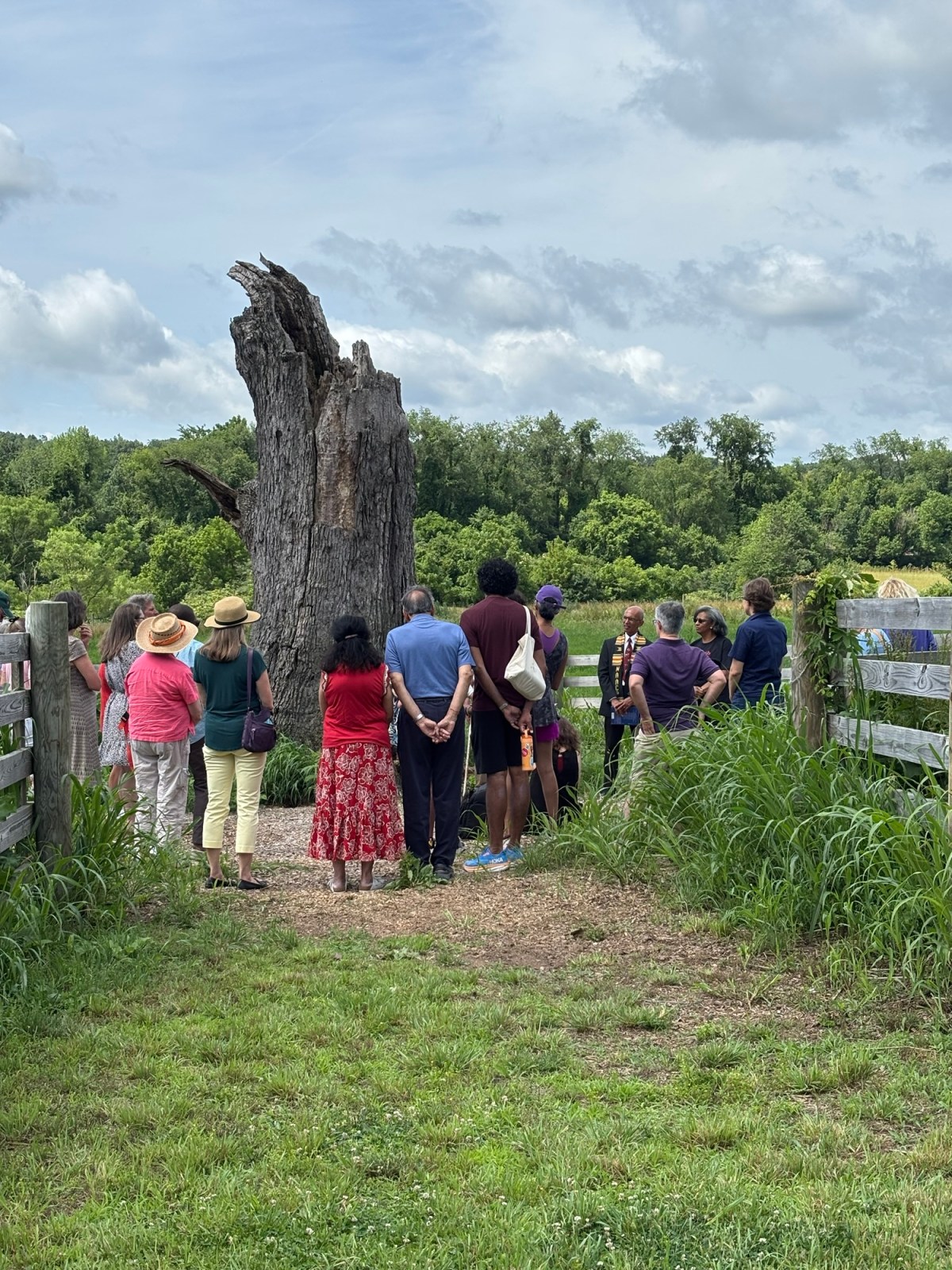
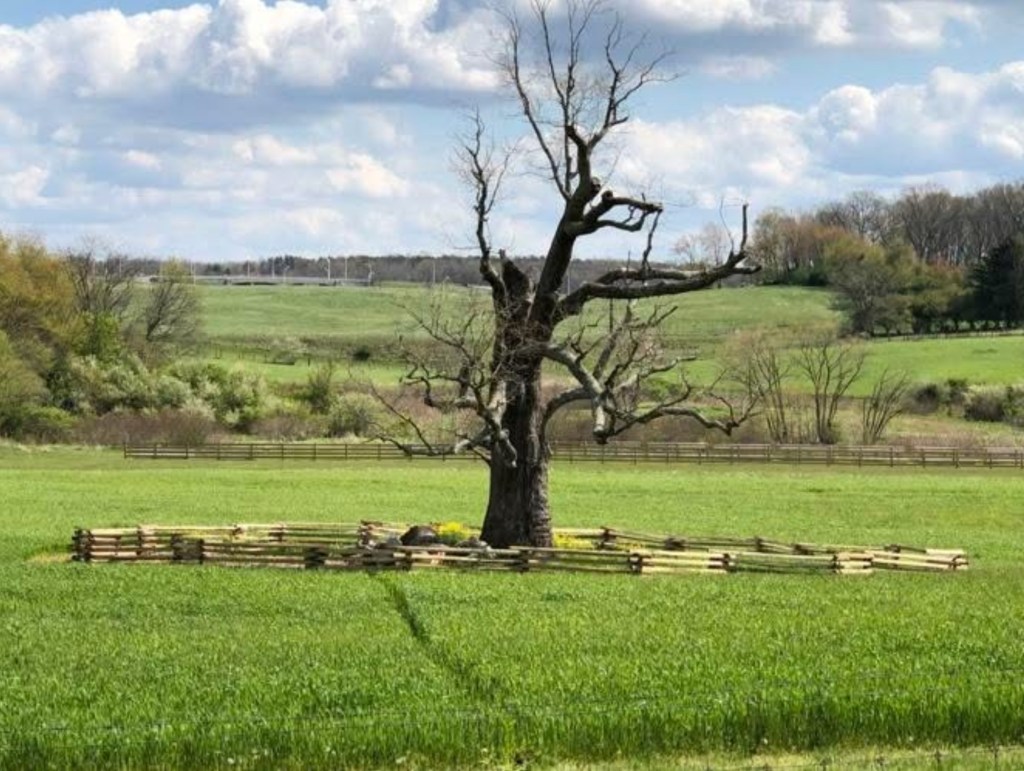
The Merry Tree, now a broken and weathered stump southeast of the Preston home, once stood as a silent witness to over a century of enslavement. It remains a sacred place where descendants return to honor their ancestors. We are gathering stories, photos, and memories connected to this tree. Let’s preserve its powerful legacy.
Help Us Tell the Story of the Merry Tree
For over a century, the Merry Tree stood as a silent witness to the lives of the 226 people enslaved by the Preston family at Smithfield, Blacksburg, Virginia. Planted near the time the Prestons built their home, this tree bore witness to generations of forced labor, family separation, resistance, and endurance. Though now reduced to a broken and weathered stump, the Merry Tree remains a place of deep meaning—especially for the descendants of those once enslaved, who return here to remember, honor, and reflect.
We are seeking to gather as much information, memory, and meaning as possible about this special tree. Did your family speak of it? Do you have photos, stories, or oral history connected to the Merry Tree? Whether you are a descendant, community member, or researcher, your voice matters in helping us preserve and understand the role this sacred place played in Black history in Montgomery County.
Please share what you know. Together, we can ensure the story of the Merry Tree—and those who stood beneath it—is never forgotten.
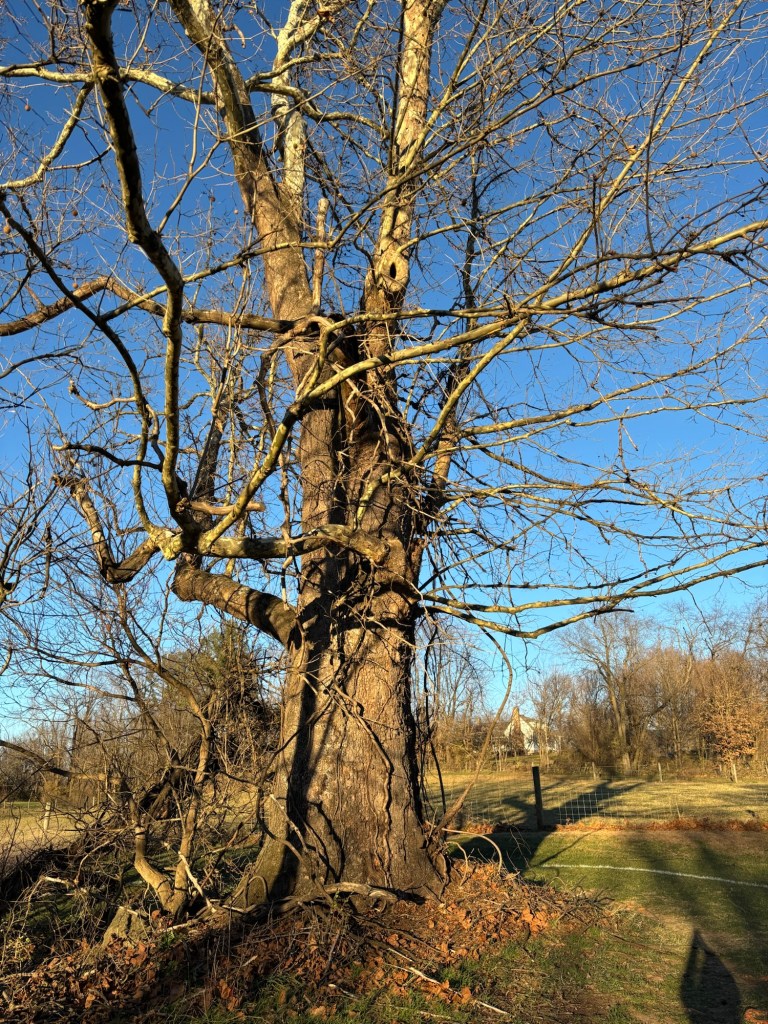
This enormous sycamore stands just east of the spring that once provided potable water for the people living on the Smithfield property. The spring lies a considerable distance from the house and closer to the old Merry Oak. One can only imagine the countless gallons of water enslaved people carried from that spring to the white house on the knoll over nearly a century. Like the Merry Tree, this sycamore may have held significance for the men, women, and children forced to labor here—its presence a silent witness to their daily lives.
This website serves as an important resource for understanding the history and legacy of slavery in our region. It contains information collected from Roanoke County sources about more than 4,000 enslaved individuals.
This website serves as an important resource for understanding the history and legacy of slavery in our region. It contains information collected from Roanoke County sources about more than 4,000 enslaved individuals. Many of the family names of enslaved African Americans recorded here also appear in neighboring Montgomery County, making this work deeply relevant to our local history. In addition, the family names of many individuals who enslaved others are found in the Roanoke primary sources.
The purpose of this page is to document and connect these shared names, with the hope of bringing to light the lives of those too often lost to history and deepening our understanding of the enduring legacy of slavery in Montgomery County and beyond.
More names will be added with time.
Family Names of Enslaved African Americans in Montgomery County
Brown
William Brown – enslaved by William Watts. “In IAS Book 4, the partition of the lands and other property of Edward Watts, William Brown is listed among the enslaved individuals that were bequeathed to Edward Watts’s daughter, Alice W. Morris. A value of $1,700.00 was placed on William Brown.”; Inventory, Appraisements, and Sales Book 4, Roanoke County Archives.
George Campbell – “George Campbell was listed in an indenture agreement: “…bind unto the said Lewis Zirkle a boy of colour named George Campbell until he arrives to the free age of twenty one which will be on the 25th day of June 1854.” In the Common Law book, it was ordered that the Overseers of the Poor bind out George, “a boy of color,” to Lewis Zinkle.”; Common Law Orders – A – May 1838 – May 1840, Roanoke County Archives.
Saunders/Sanders
Catherine Saunders – Mother of Henry Saunders; Common Law Orders – C – August 1843 – June 1848 – pgs. 227-478; Roanoke County Archives
Henry Saunders – 8 year old child of Catherine Saunders and Hercules Cuff, mention of Stephen Henry; Common Law Orders – C – August 1843 – June 1848 – pgs. 227-478; Roanoke County Archives
Magdeline Saunders – “Magdeline Saunders was listed in an indenture agreement: “unto the said Benjamin Hawley a girl of colour by the name of Magdeline Saunders until she arrives to the age of 21 years…the 22nd day of June 1858…” The Common Law book states that the Overseers of the Poor were ordered to bind out Magdalen Saunders, “a poor, colored girl” until she turned 21”; Common Law Orders – B – June 1840 – July 1843, Roanoke County Archives
Elizabeth Evans (List of first names of people they enslaved), “Elizabeth was listed in Michael Shepard’s property appraisement as having purchased enslaved people after Michael’s death. In the record, Elizabeth purchase” the enslaved people Joe, Nancy, and an unrecorded named child for $675.00.” She was possible daughter of Jonathan Evans. “Elizabeth’s son was William Evans and her husband was William W. Evans.”; Common Law Orders – B – June 1840 – July 1843, Roanoke County Archives
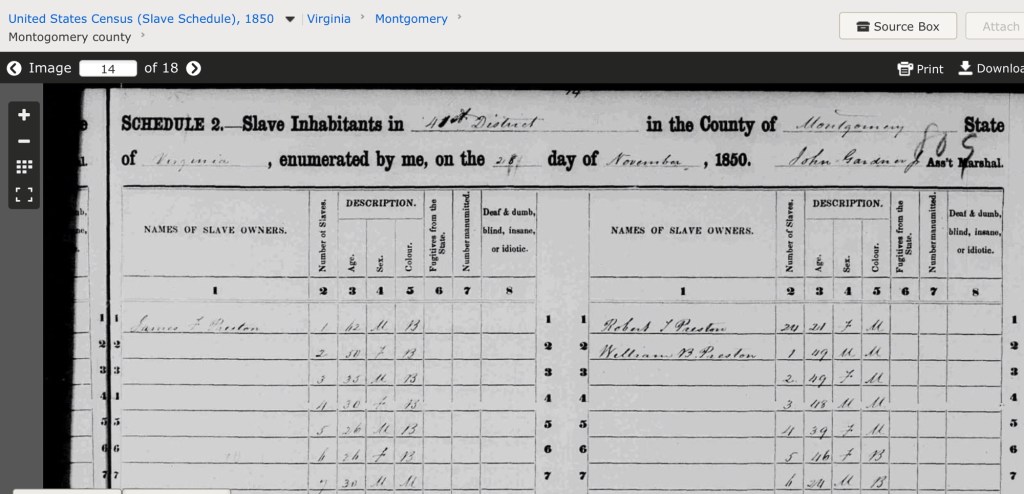
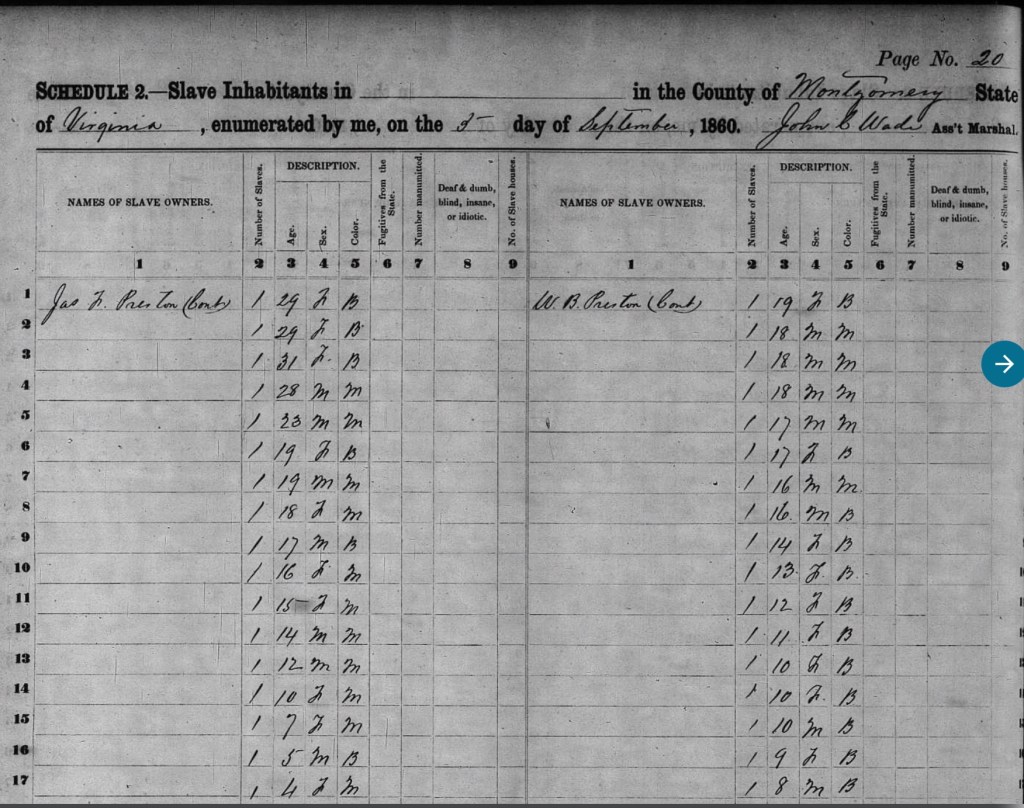
If you’re searching for a specific enslaved individual, please note that their names are generally not listed, except in rare instances. To browse the records, enter the names Preston, Hoge, or Wade (all enslavers), and then navigate through the document.
If you’re searching for a specific enslaved individual, please note that their names are generally not listed, except in rare instances. To browse the records, enter the names Preston, Hoge, or Wade (all enslavers), and then navigate through the document.
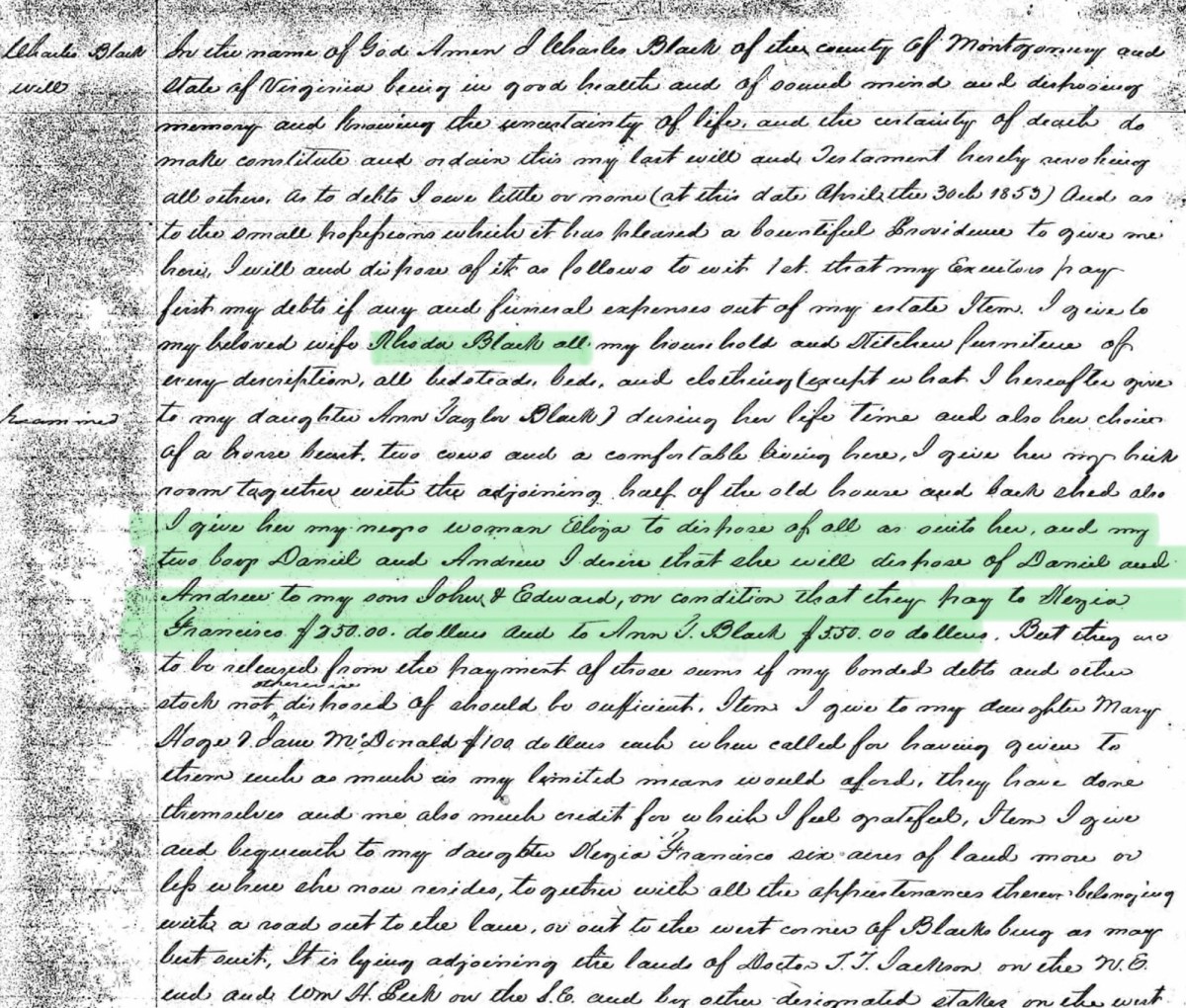
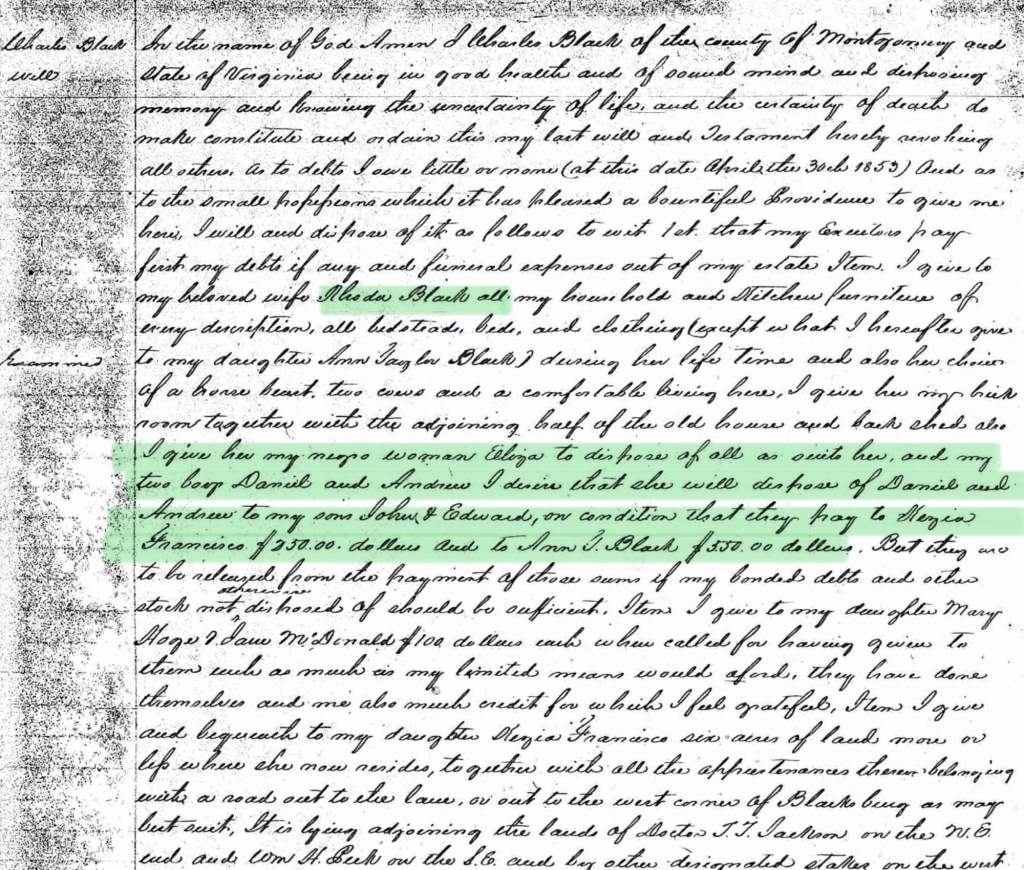
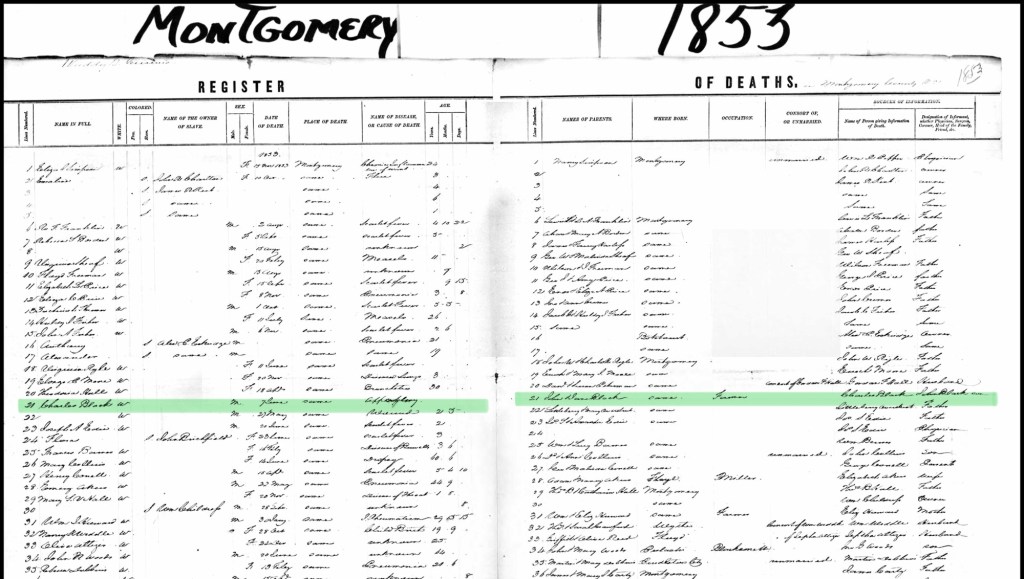
This is the last will and testament of Charles Black (1796-1853), son of John Black (1755-1845) and nephew of William Black, namesake of the Town of Blacksburg, Virginia. Charles died 1853 and his will was proved in Montgomery County, by Rice D. Montague, Clerk.
Quote: “I give her [my beloved wife Rhoda Black] my negro woman Eliza to dispose of all as suits her, and my two boys Daniel and Andrew I desire that she will dispose of Daniel and Andrew to my sons John & Edward, on condition that they pay to Kezia Francisco $750.00. dollars and to Ann T. Black $550.00 dollars.”
Rhoda McDonald Black (1805-1859), wife and mother of Keziah Black Francisco (1830-1903), Ann Taylor “Nannie” Black (1837-1903), John Black A. (1831-1899), and Edward Black (1835-1912).
Much of Charles and Rhoda Black’s land becomes part of Virginia Tech campus after the death of Charles and Rhoda.
Page 1 Charles Black Last Will & Testament, Montgomery County Court HousePage 2
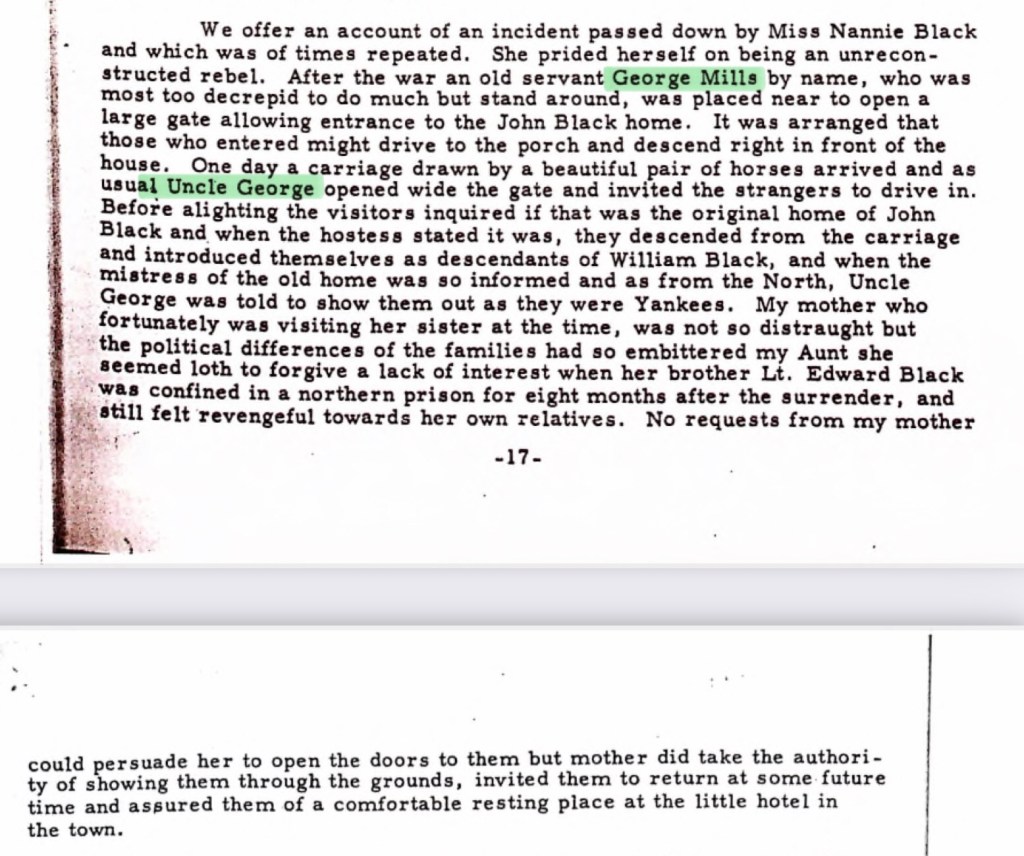
George Mills is noted as “After the war an old servant George Mills by name….” in Nannie Francisco Porter’s , daughter of Keziah Black Francisco.
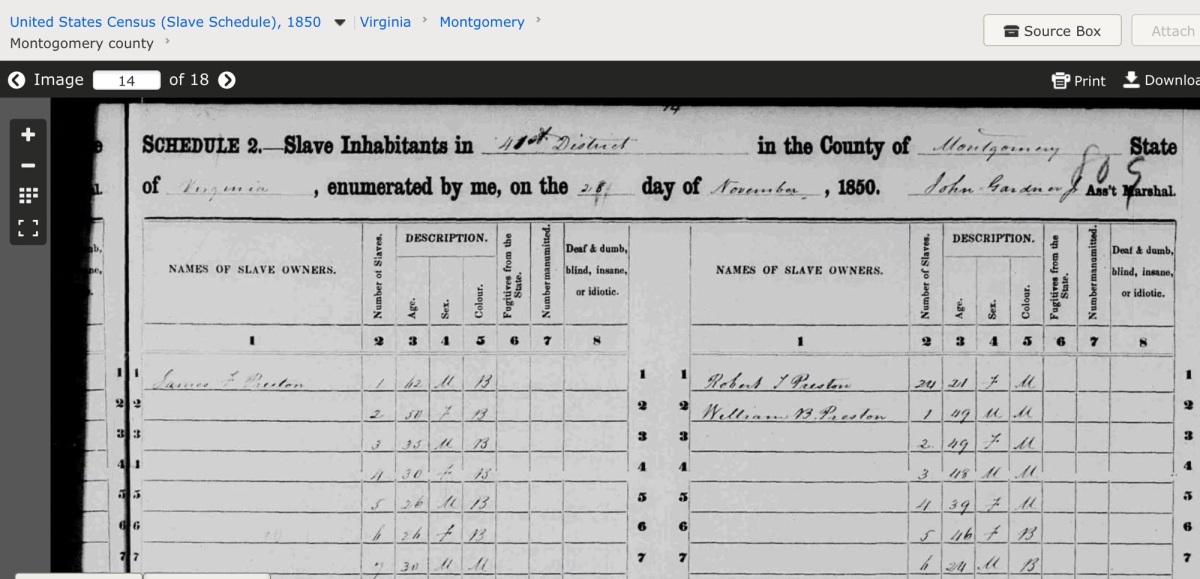
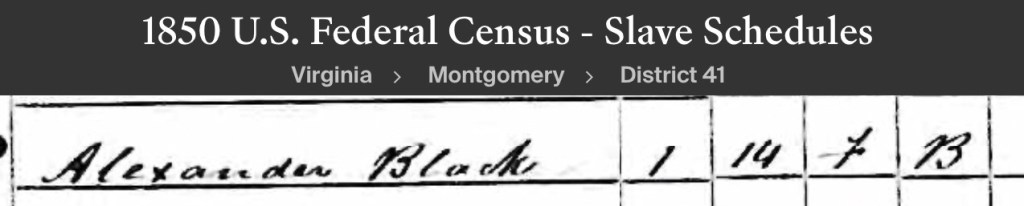
The 1850 Slave Schedule for Montgomery County does not name the people held against their will and provide a documentation of the slave owners. Charles Black’s will notes three people, a woman and two men, not four as noted below. No proof yet, but perhaps Eliza is the one listed female. Daniel and Andrew are likely one of these three people.
Alexander Black is the brother of Charles Black.
1859 Slave Schedule for Charles Black (3 years before his death)1850 Slave Schedule for Alexander BlackRegister of Death of Charles Black