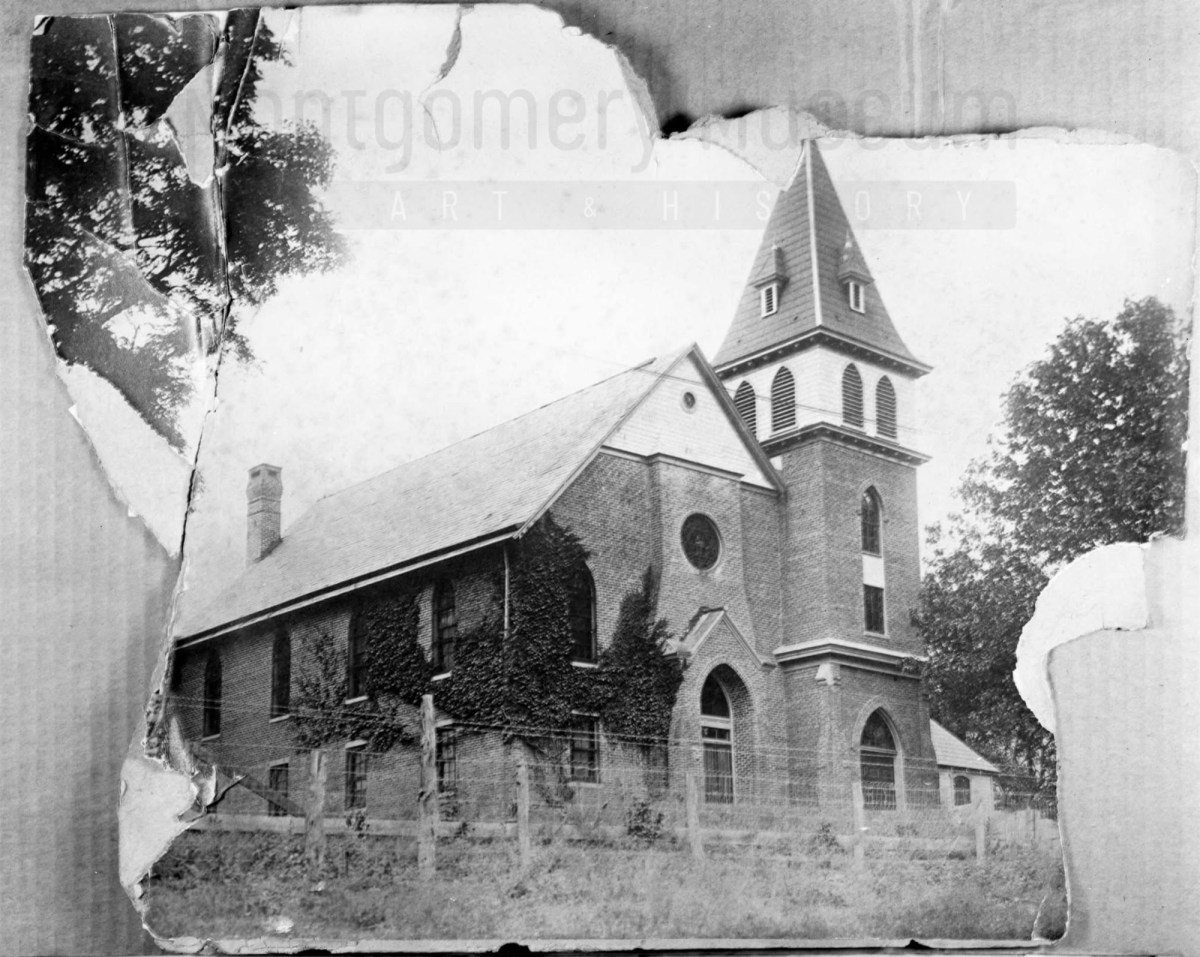
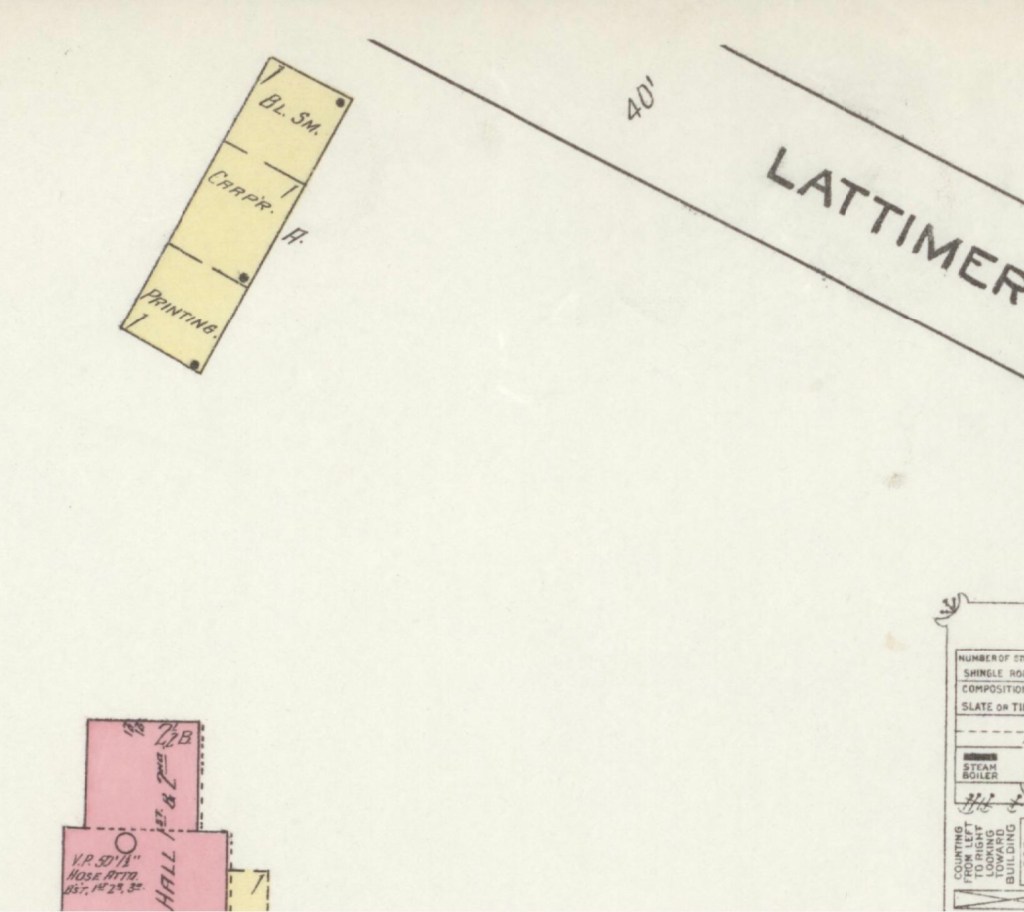
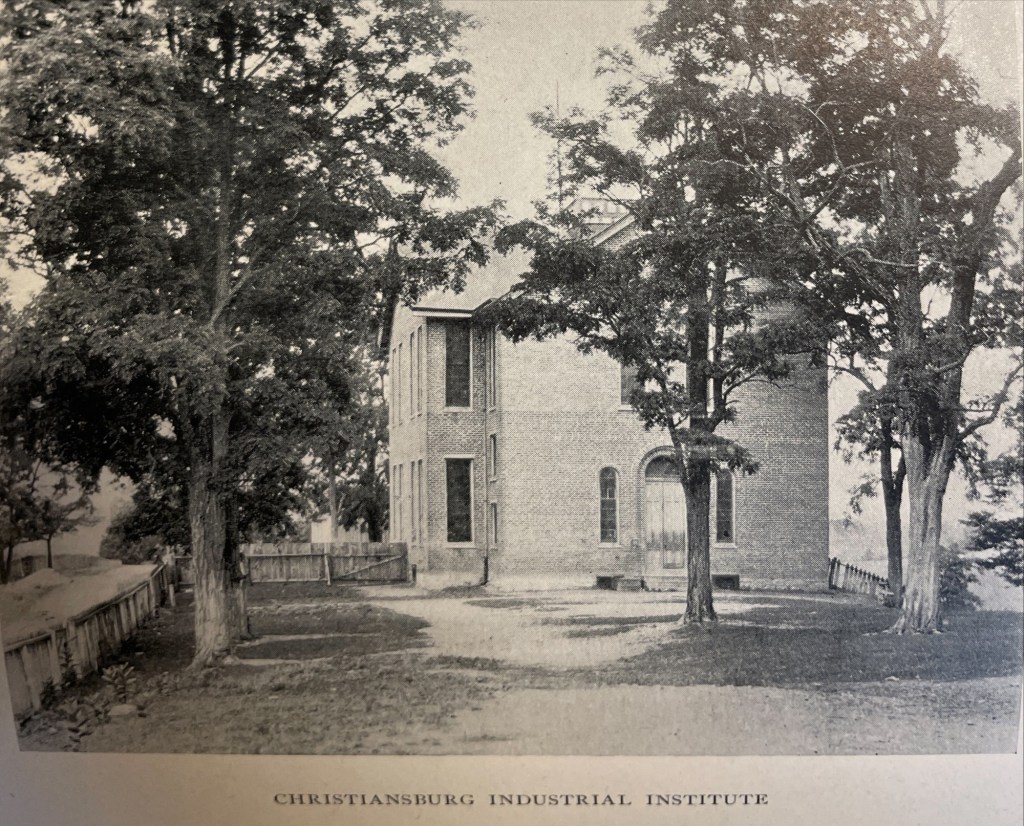
This 1913 Sanborn Fire Map of Christiansburg, Virginia offers a rare glimpse into the heart of the town’s early African American community during segregation. The map identifies key institutions including the Hill School Elementary, the Christiansburg Industrial Institute, and Schaeffer Memorial Baptist Church — places that anchored education, faith, and community life for Black residents in Montgomery County.
The Sanborn Fire Insurance maps are often the only early glimpse of buildings in rural towns over time. Christiansburg Industrial Institute moved from the Zion Hill location to the Lattimer Plantation site, north west of Christiansburg, at the turn of the 20th Century. This Sanborn Fire Insurance Map from Christiansburg, Montgomery County, Virginia was published by the Sanborn Map Company, dated Sep, 1913. The key to the maps is at the end.
The map is of Christiansburg Industrial Institute, situated north west of Cambria and north of Christiansburg courthouse. Note that frame constructed buildings are coded yellow and red for the solid brick building. The Baily Morris Building which housed the girls dorm, assembly hall, dinning hall and kitchen (close-up below) is heated by steam and lighted by electricity.
“Baily-Morris” Building
The Morris Hall Boys’ Dorm is both red and yellow, denoting built of a combination of building materials. The building is heated by hot water and lighted by electricity. Note that the buildings were supplied with water by 2,500 ft of pipes connected to the 10K gal water tank on the hill. The tank is filled by a Worthington Pump, moving water from a spring.
The girls and boys dorms were named for two Friends’ of the Freedmen of PA, Elliston P. Morris and Joshua L. Baily. They also donated money to construct the water system which was installed in 1907, before either Christiansburg or Blacksburg had a community water system. (A Vision of Education, Selected Writings of Edgar A. Long, Anna Fariello, Ed. Christiansburg Institute, Inc. 2021, pg 86,)
The Lattimer Mansion House, wood framed, was heated by stove and not connected to the water supply. The house was used as classrooms. Note the printing, carpenter and black smith shop close to the entrance road.
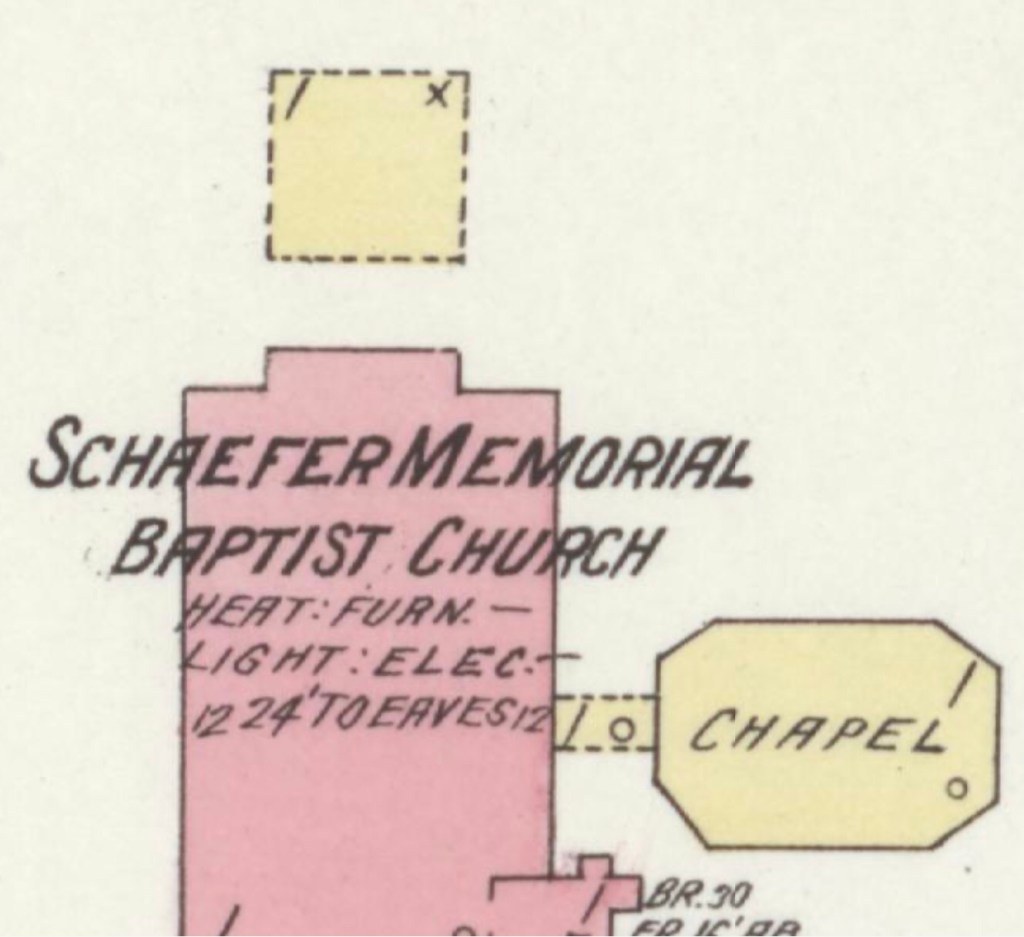
1913 Hill School & Schaeffer Memorial Baptist Church
This map is of Zion Hill which is located on the ridge (now High Street) between Cambria and Christiansburg. The brick (red) “Public School” housed the Christiansburg Industrial Institute before that secondary school moved to the Lattimer Plantation property by the turn of 20th century. This brick school, built by 1885, was converted to a primary school for African American children after CII moved. As noted by the Sanborn map, the building was heated by stoves and lighted by electricity.
Image of the Hill School from The Story of a Consecrated Life, Commemorative of Rev. Charles S. Schaeffer by CH Harrison, 1900. High Street is visible.
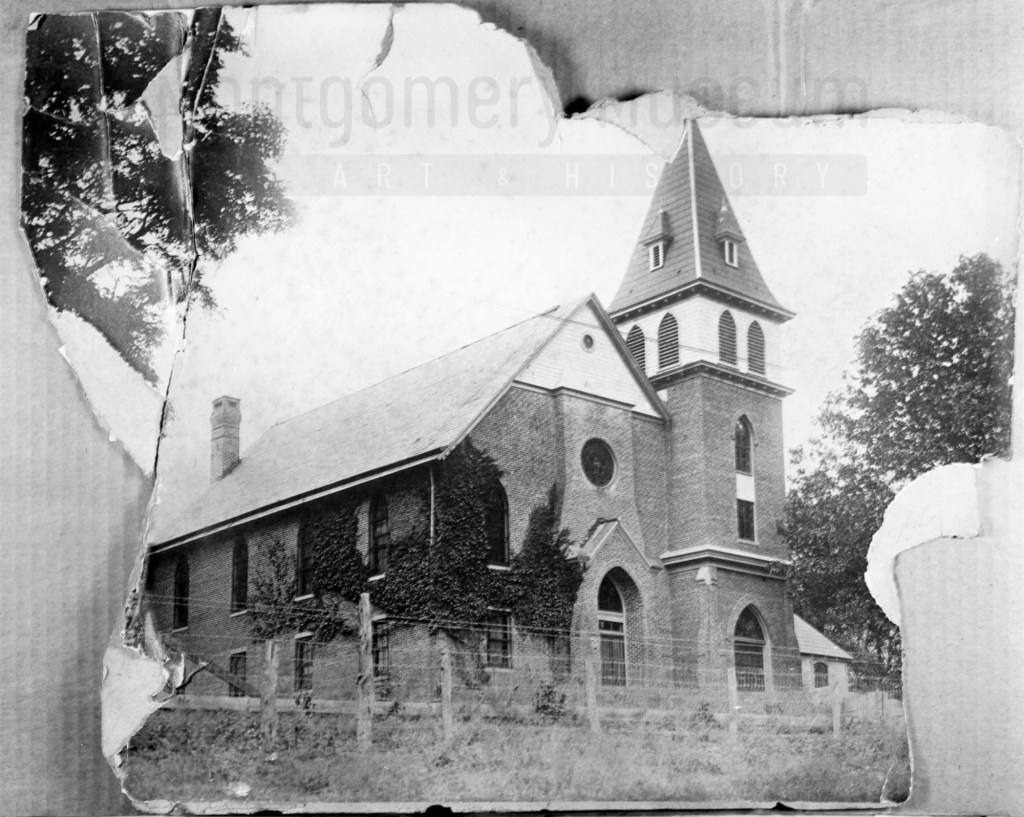
The Schaeffer Memorial Baptist Church is also of brick and built by 1885. Charles S Schaeffer’s memorial brass plaque were unveiled 1 October 1899, after he died in May of that same year. Note the frame chapel to the left (east) of the brick structure.
Image of Schaeffer Memorial Baptist Church from The Story of a Consecrated Life, Commemorative of Rev. Charles S. Schaeffer by CH Harrison, 1900. High Street is visible in the foreground. Later photograph, courtesy of the D.D. Lester Collection, Montgomery Museum of Art & History
On the Sanborn map, note the small frame, 1 story building behind the church? This may be the first school/church building on Zion Hill. The deed (DB S, pg 12, Oct 1868) and Harrison, 1900 * note the existence of this building. The brick school on the 1913 Sanborn map was the third version of this school at this site. The second school on Zion Hill was a 2 story & frame building, used between 1974 and 1885. (The rented Campbell house was the first school but it was not located on Zion Hill.)*
The image of the small school/meeting house shows a one story frame building with hip-roof and double stove-pipes. The dressed limestone block foundation was typical in this area and seen on buildings dating from early 1800s to the turn of the 20th century.
Image of the first school house on Zion Hill from The Story of a Consecrated Life, Commemorative of Rev. Charles S. Schaeffer by CH Harrison, 1900. High Street is visible in the foreground.
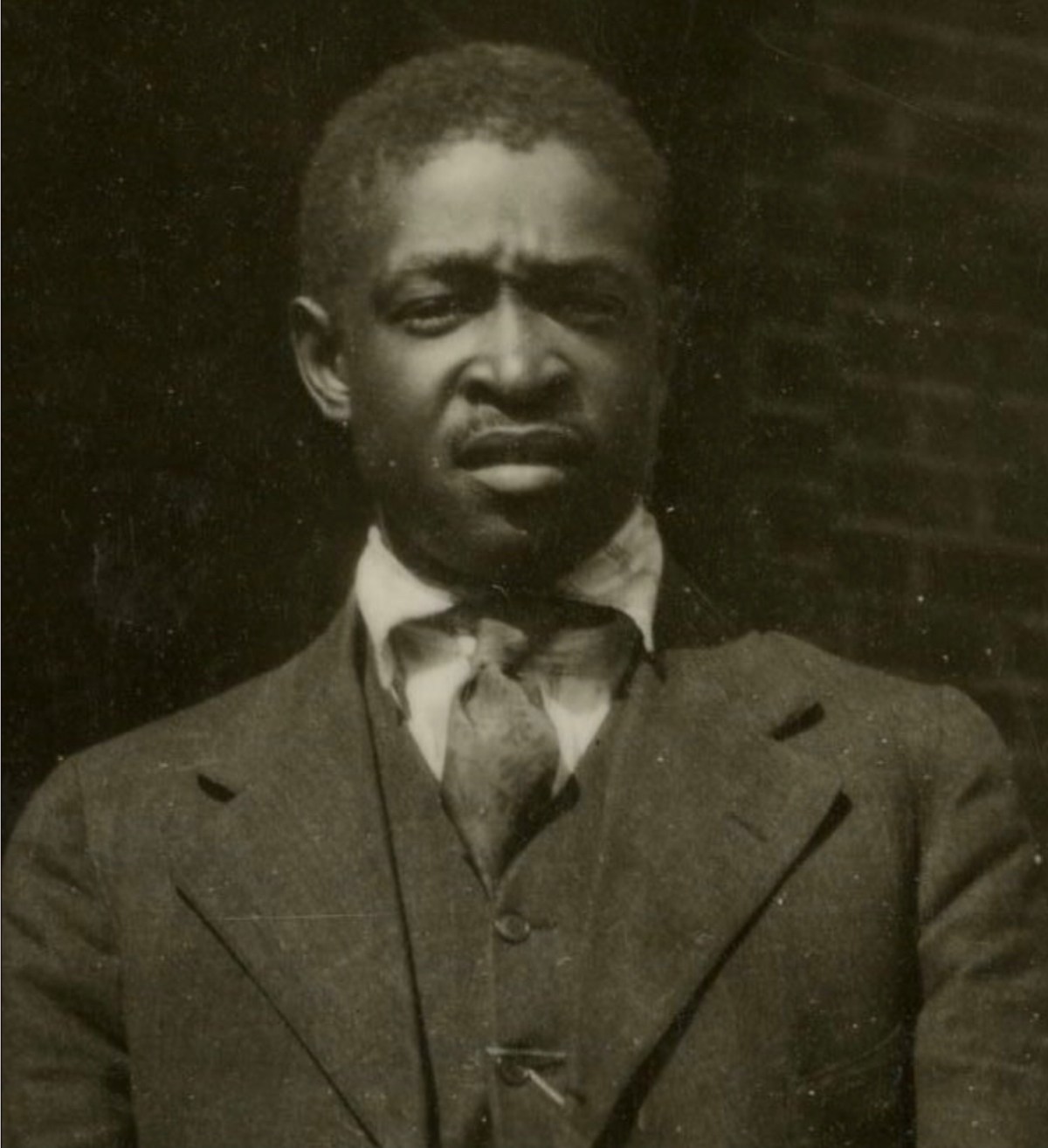
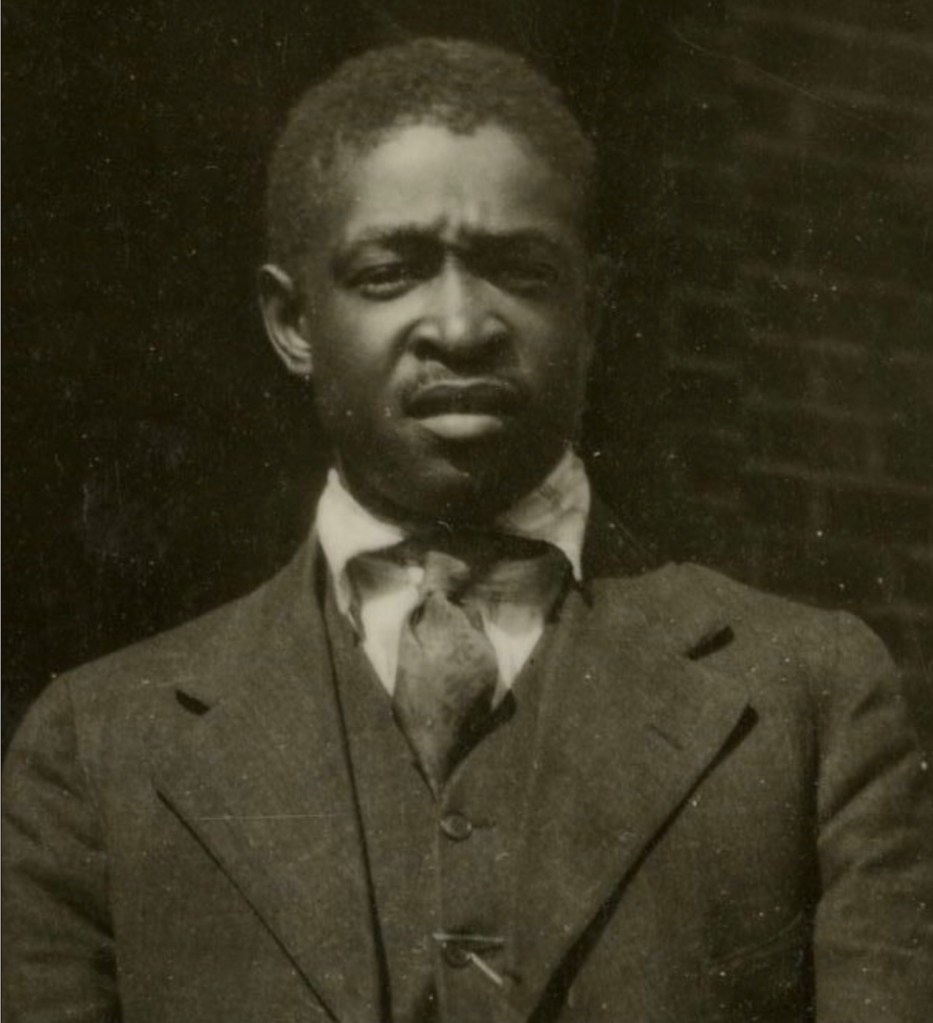
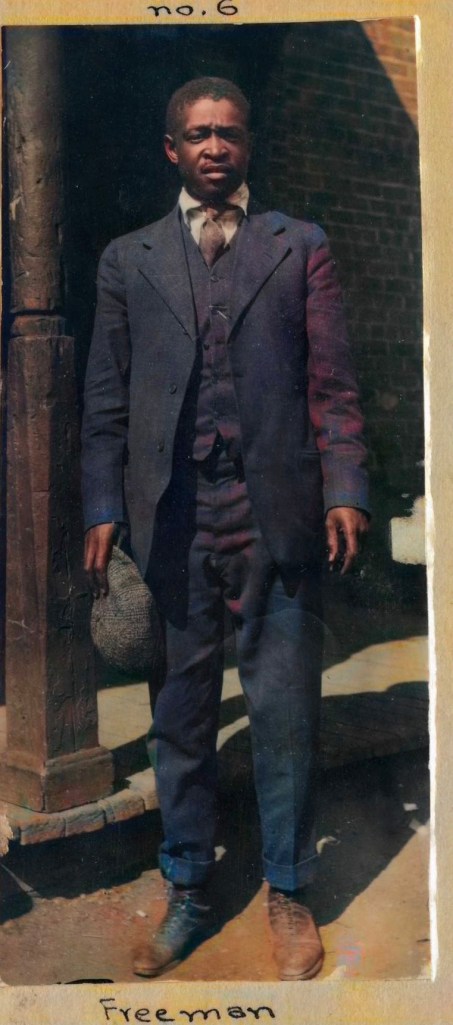
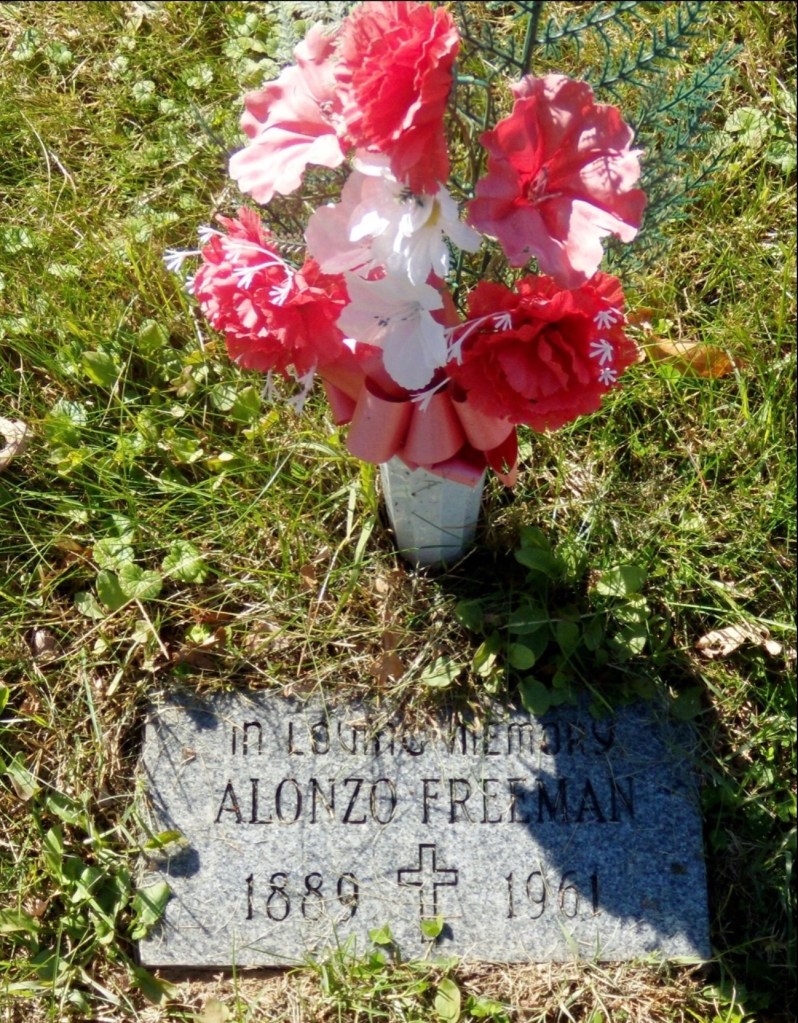
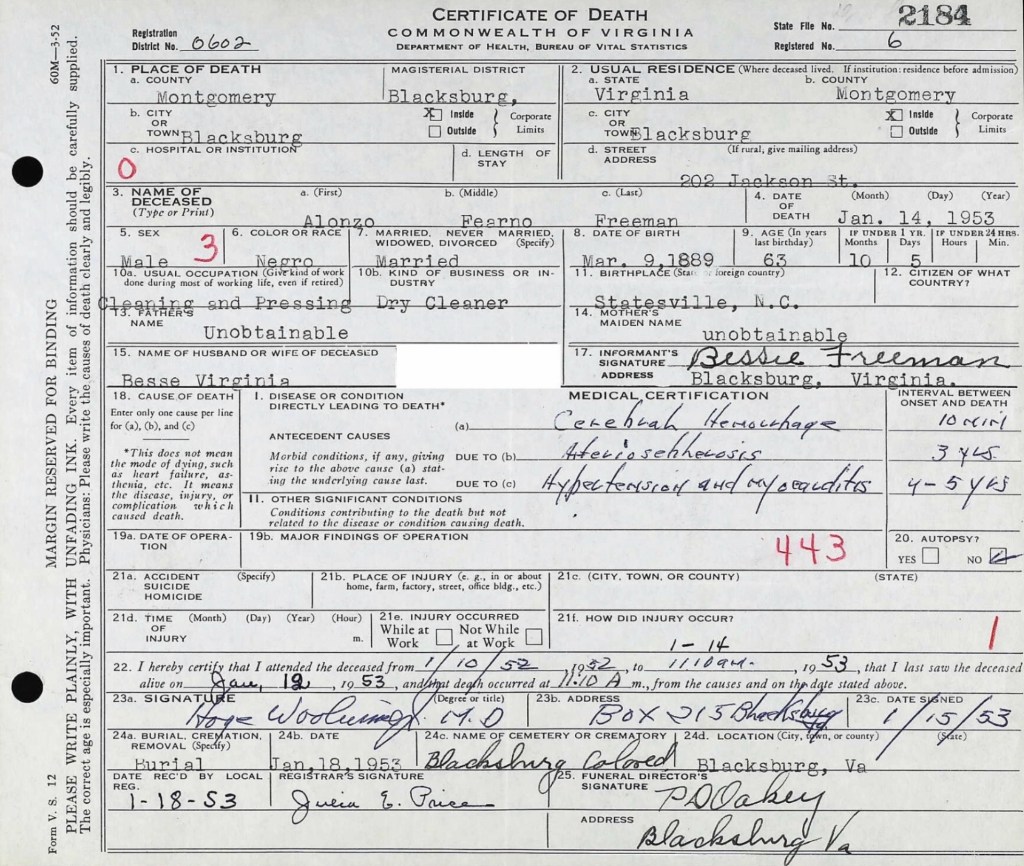
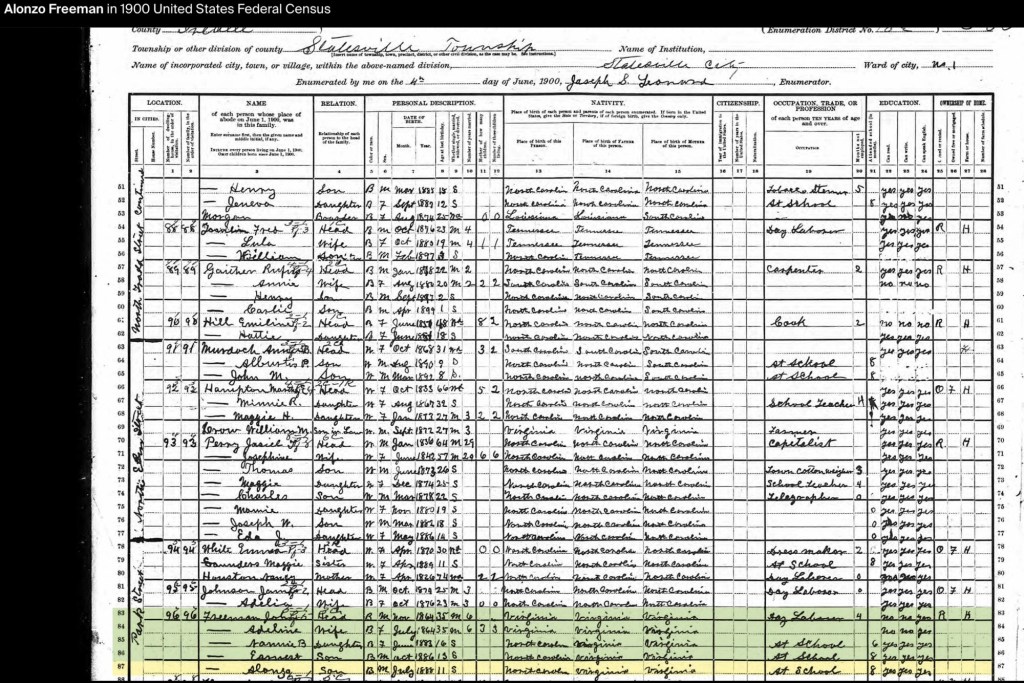
Alonzo Feadore (Fearno) Freeman, Sr. was born on March 10, 1889, in Statesville, North Carolina, to John (b. circa 1864) and Adeline Freeman (b. circa 1864). By the 1900 U.S. Census, John, a day laborer, and Adeline were living with their three children: Nannie B. (b. June 1883), Earnest (b. October 1886), and Alonzo Sr. (b. July 1888, student).
Alonzo F. Freeman (1889-1953)
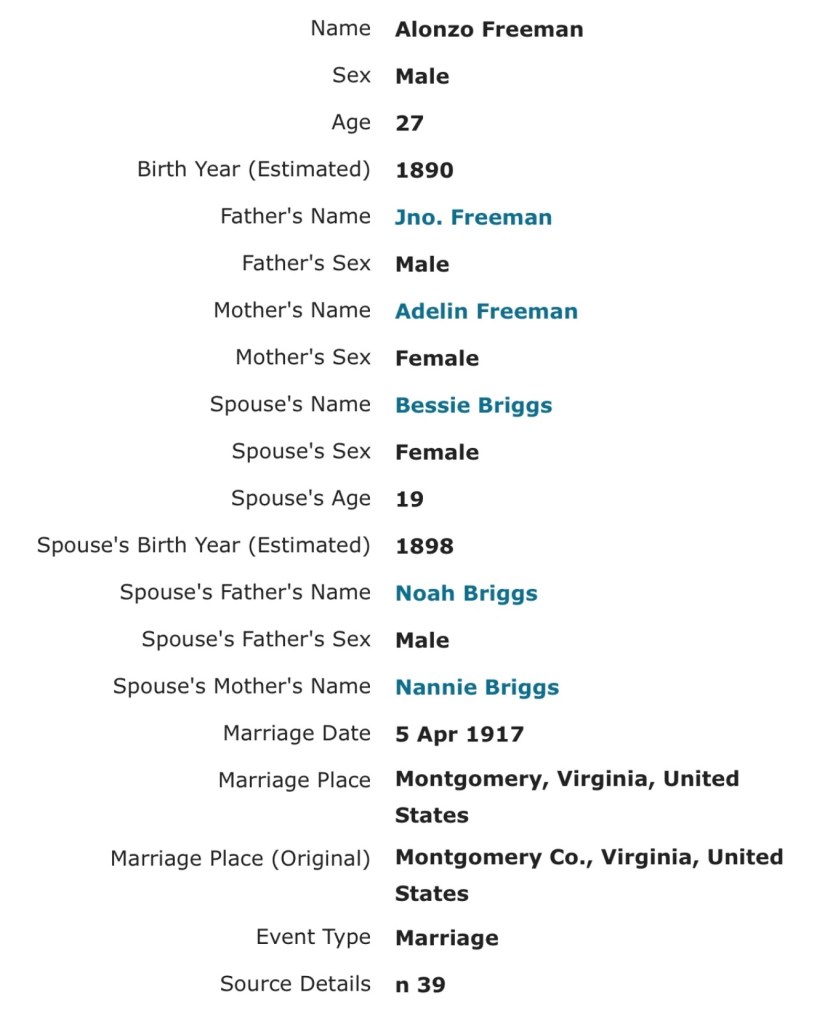
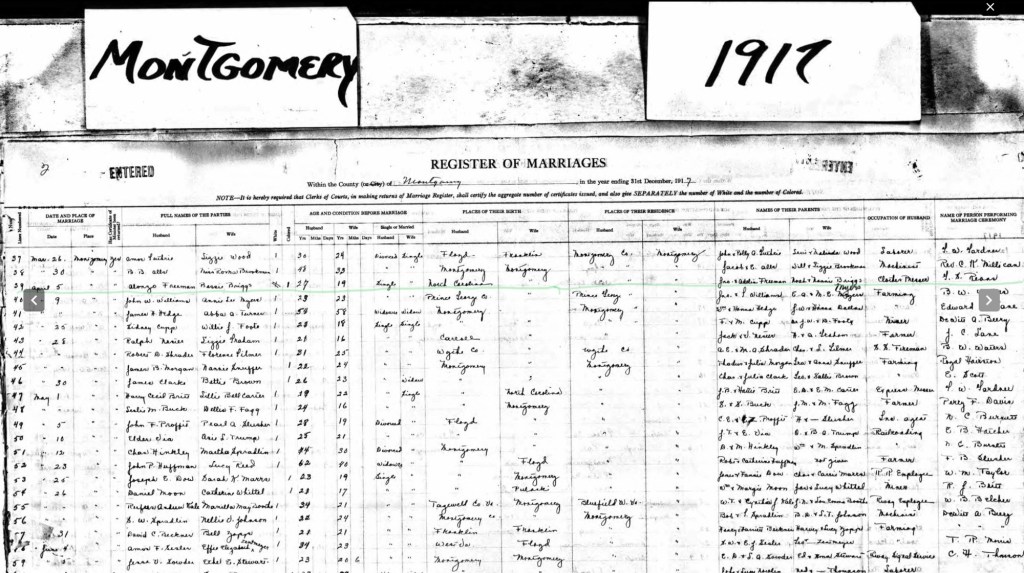
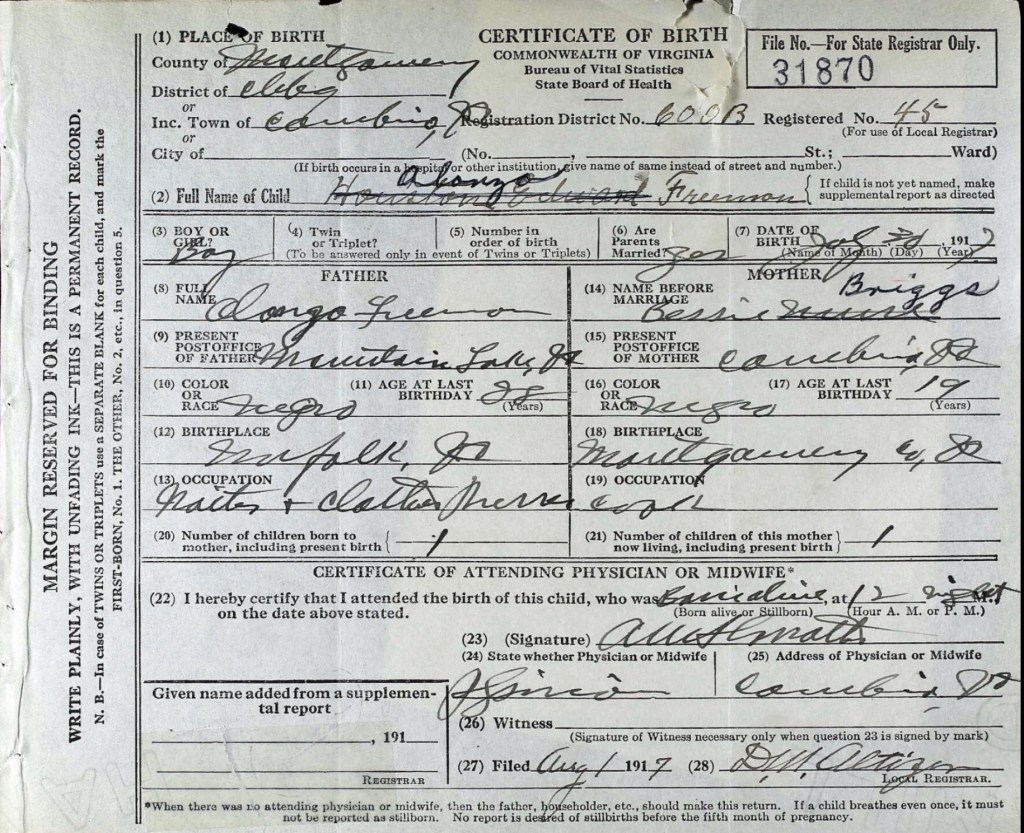
On April 5, 1917, Alonzo married Bessie Virginia Briggs (1899–1976) in Cambria, Virginia. Just a few months later, on July 31, 1917, their first son, Alonzo Freeman Jr., was born in Cambria, Virginia. According to his birth certificate, Alonzo Sr. worked as a waiter and clothes presser at Mountain Lake Resort, Virginia, while Bessie was a cook. During this time, they may have been living with Bessie’s mother and stepfather, who resided near the railroad tracks in Cambria.
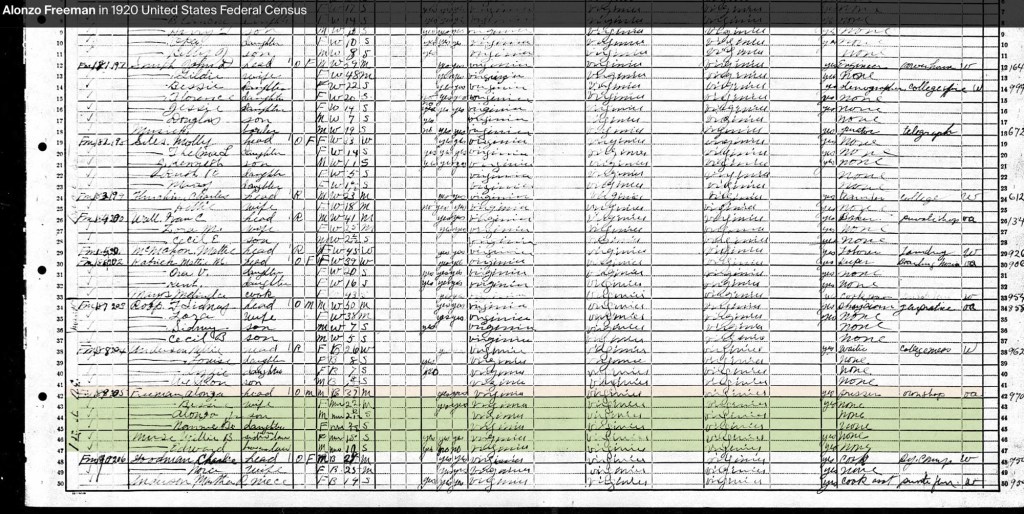
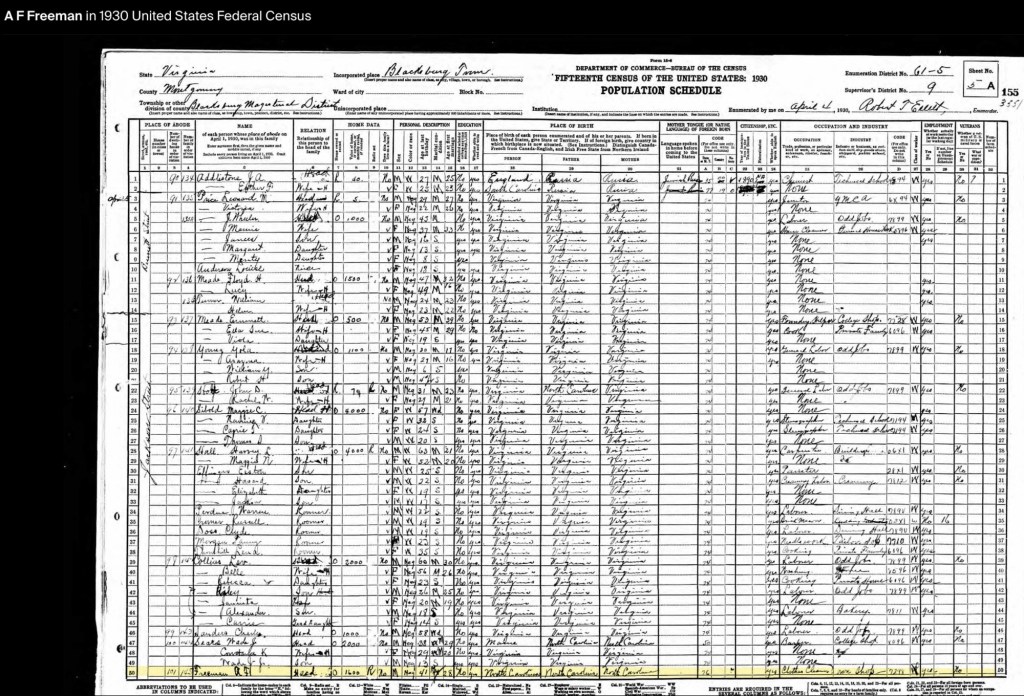
By the 1920 U.S. Census, the Freeman family had settled in Blacksburg, Virginia, on Jackson Street (originally Smithfield Road). Alonzo and Bessie were raising their two children, Alonzo Jr. and Nannie Bell (1919–1987). Also living in the household were Bessie’s siblings, Willie B. Muse and Edward Muse. At this point, Alonzo Sr. owned his home and operated his own pressing and cleaning shop. Their next-door neighbor was Nellie Anderson.
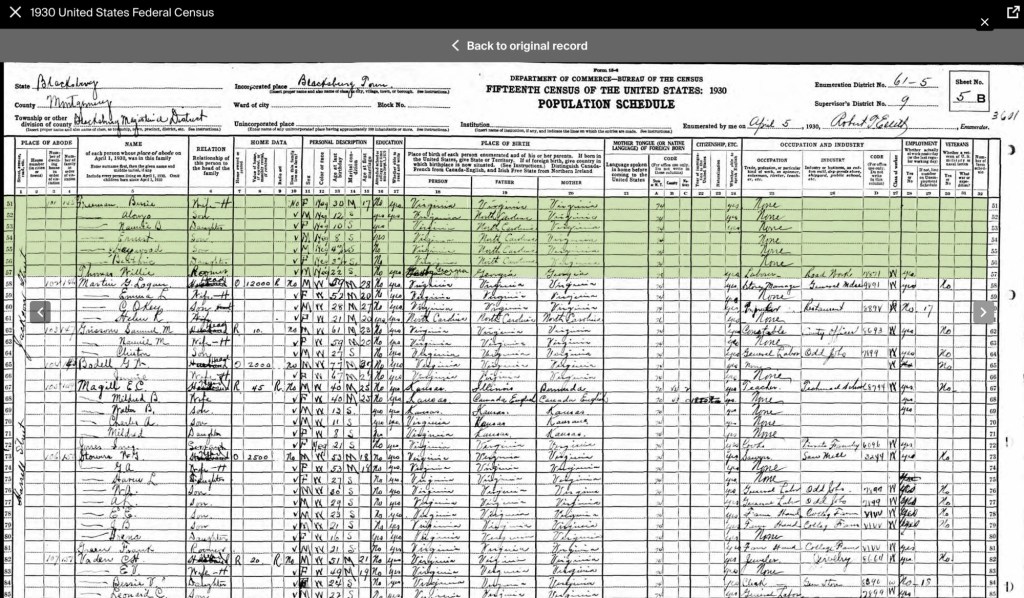
In the 1930s, the Freeman family were living in the same home, now valued at $1,600. They were part of a growing Black community on Jackson and Bennett Streets, surrounded by neighbors such as Wade Sears, Charles Saunders, Lev Collins, John Stolt, Yola Young, Emmett Meade, William Turner, Floyd Meade, Louise Anderson, and Leonard Price. The 1932 Blacksburg City Directory lists Alonzo Sr. as the proprietor of the Blacksburg Press Shop at 302 E. Jackson Street.
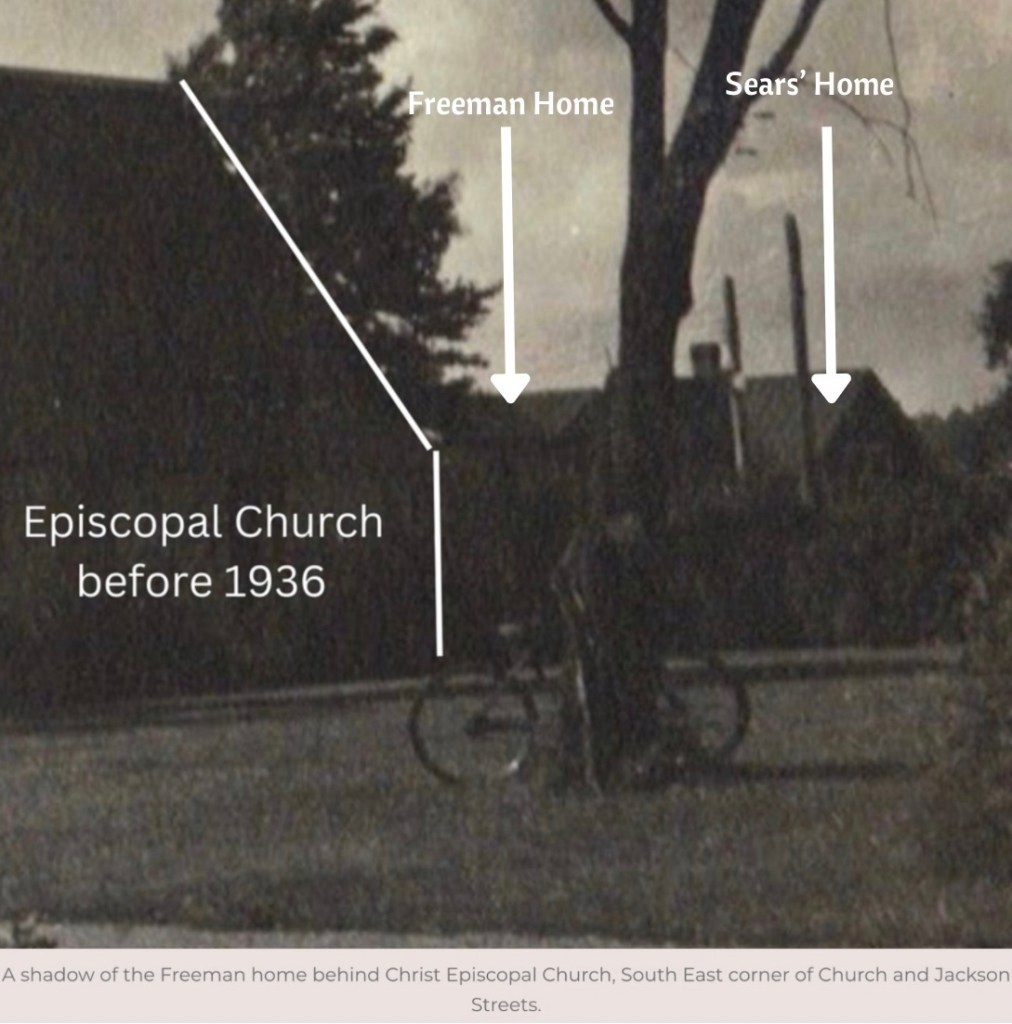
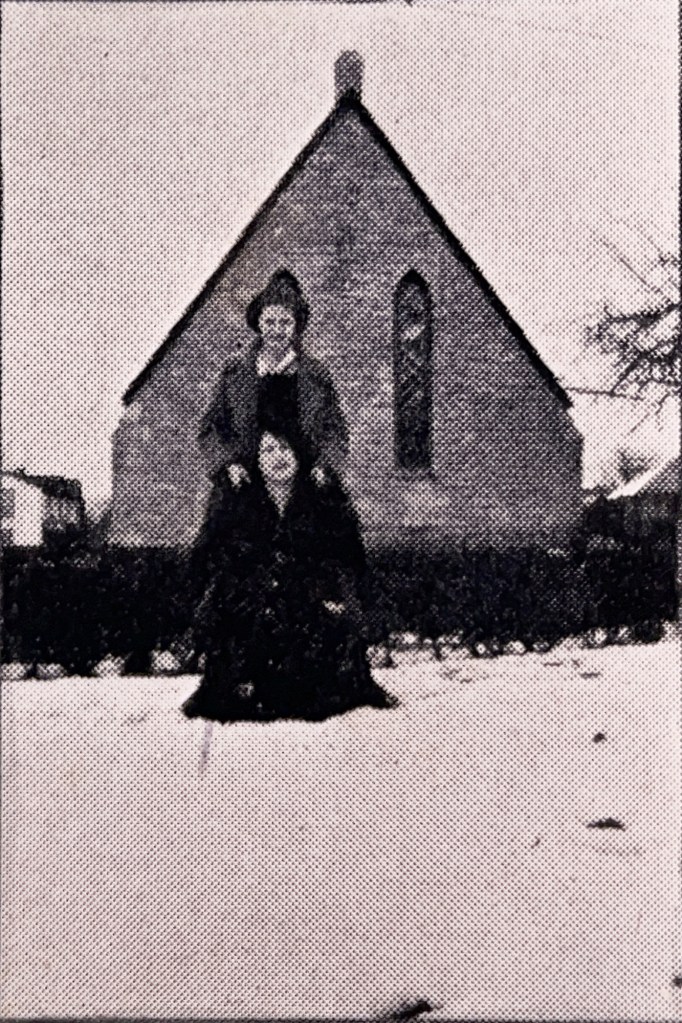
Freeman house is to the left of Christ Episcopal Church, Church and Jackson Streets, prior to 1930s.
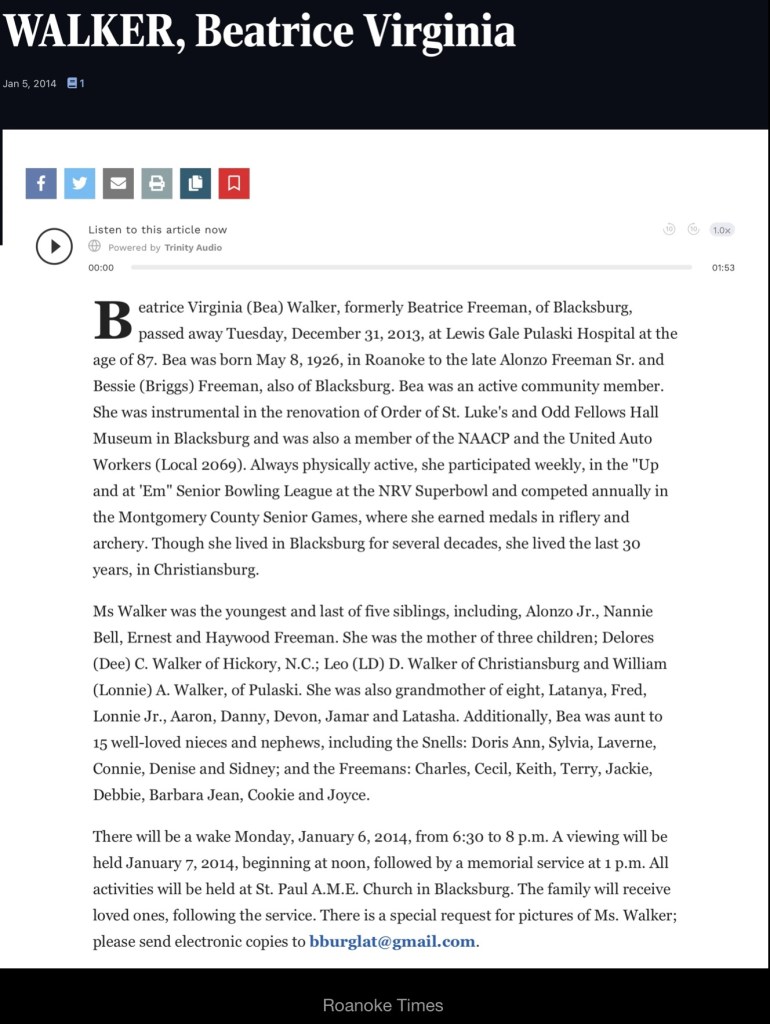
By this decade, the Freemans had expanded their family with three more children: Ernest Linwood (b. 1922), Haywood (1924–1984), and Beatrice (1926–2013). Alonzo Sr. continued to run his cleaning business—the first of its kind in Blacksburg—while Bessie worked for the Episcopal priest, Rev. Richard Martin, and his wife, Jean in the church’s office.
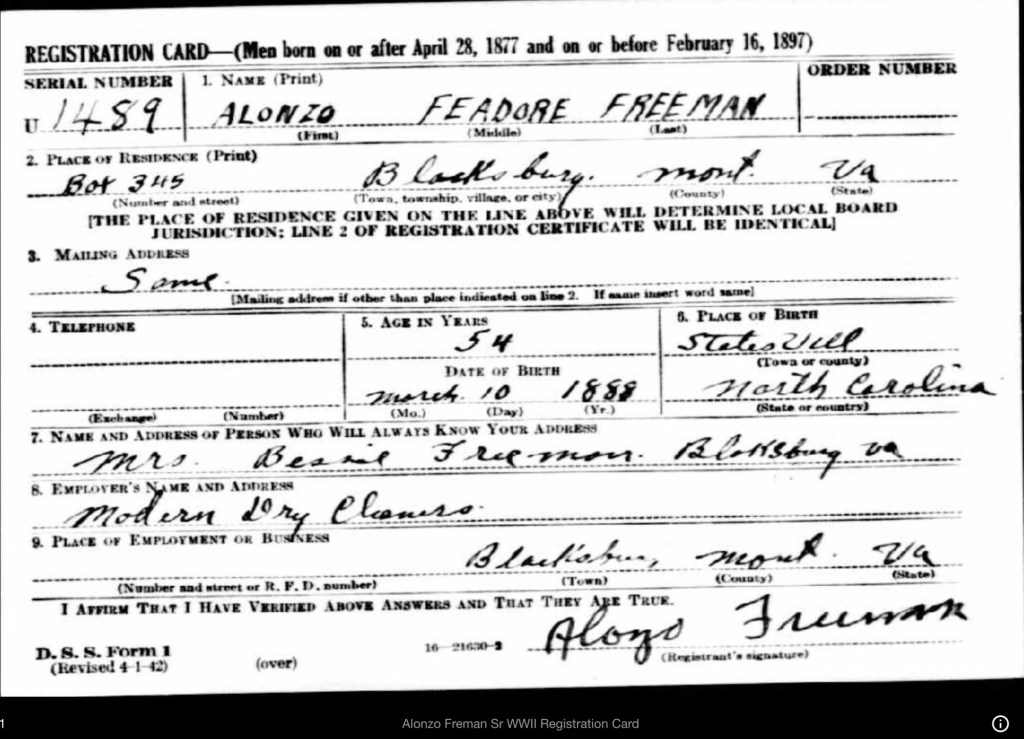
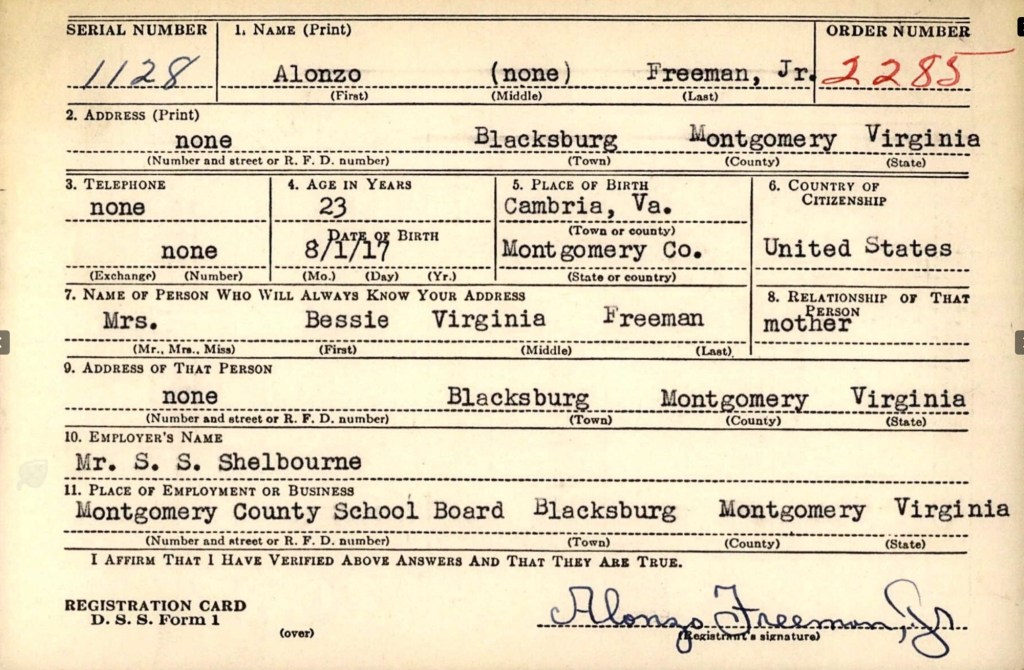
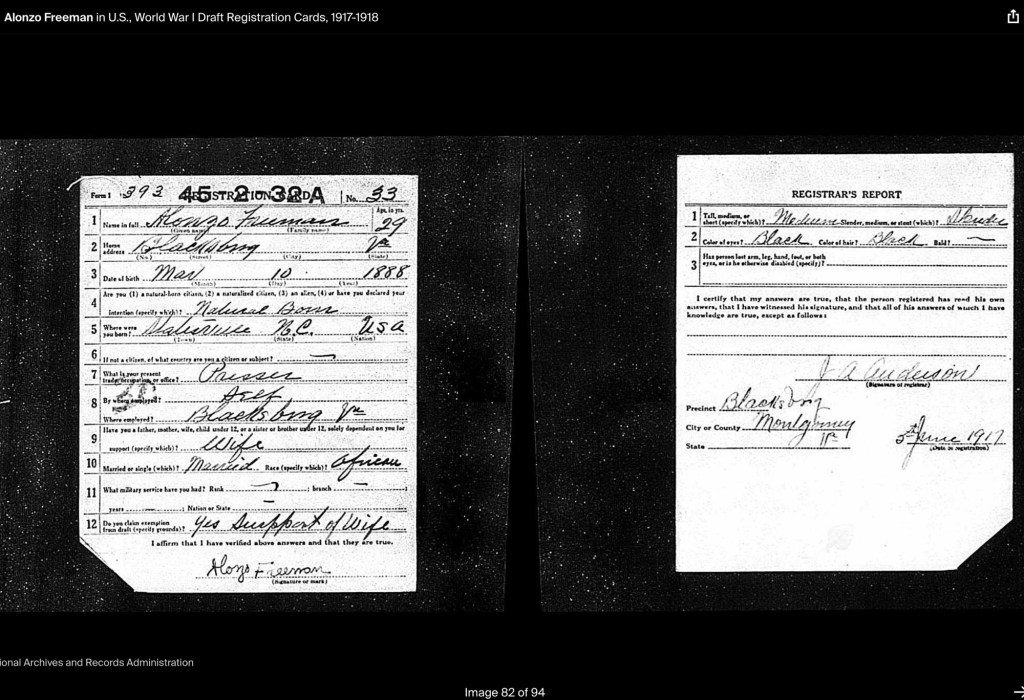
The 1940s marked a pivotal time for the Freeman family, as all the male members registered for the 1942 World War II Draft. These records provided Alonzo Sr.’s full name, Feadore, and documented his business, Modern Dry Cleaners (featured on an early 1950s map of Blacksburg). During this time, Alonzo Jr. served as the principal of the Clay Street Graded School, Linwood worked at the Radford Ordnance Works, and Haywood was employed by Ray Taylor.
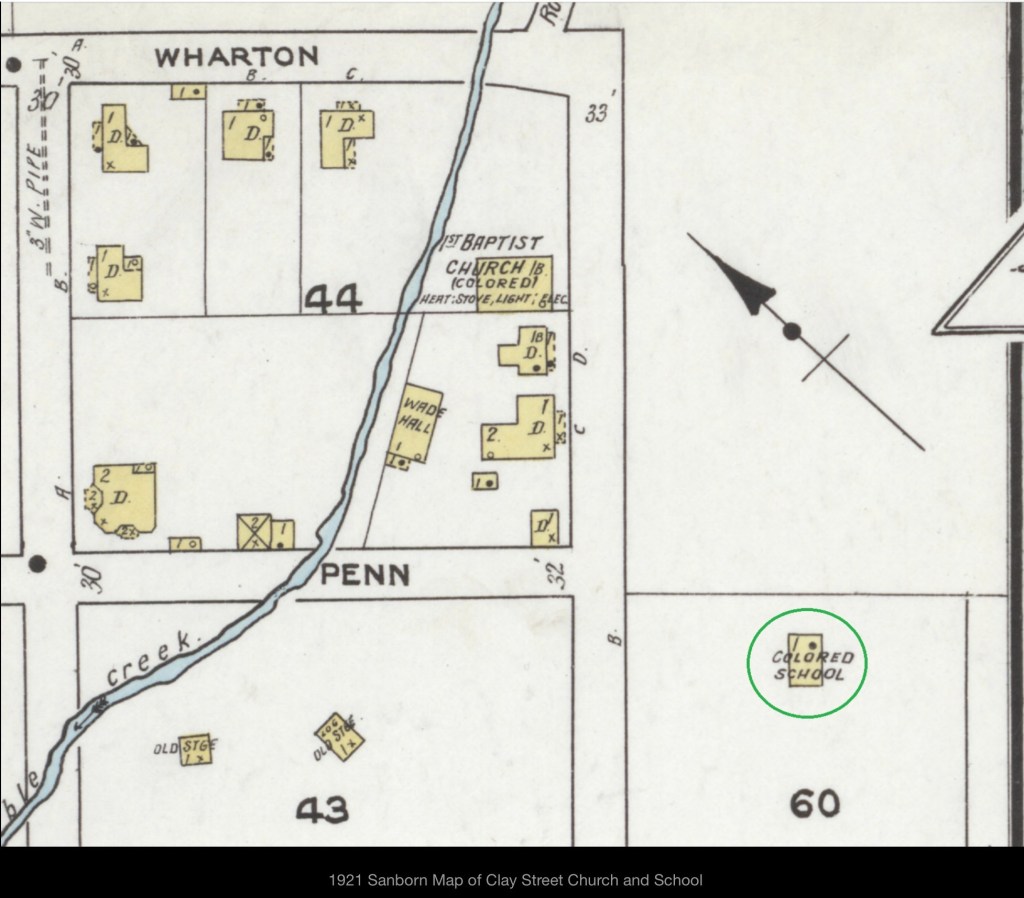
1921 Sanborn Fire Map
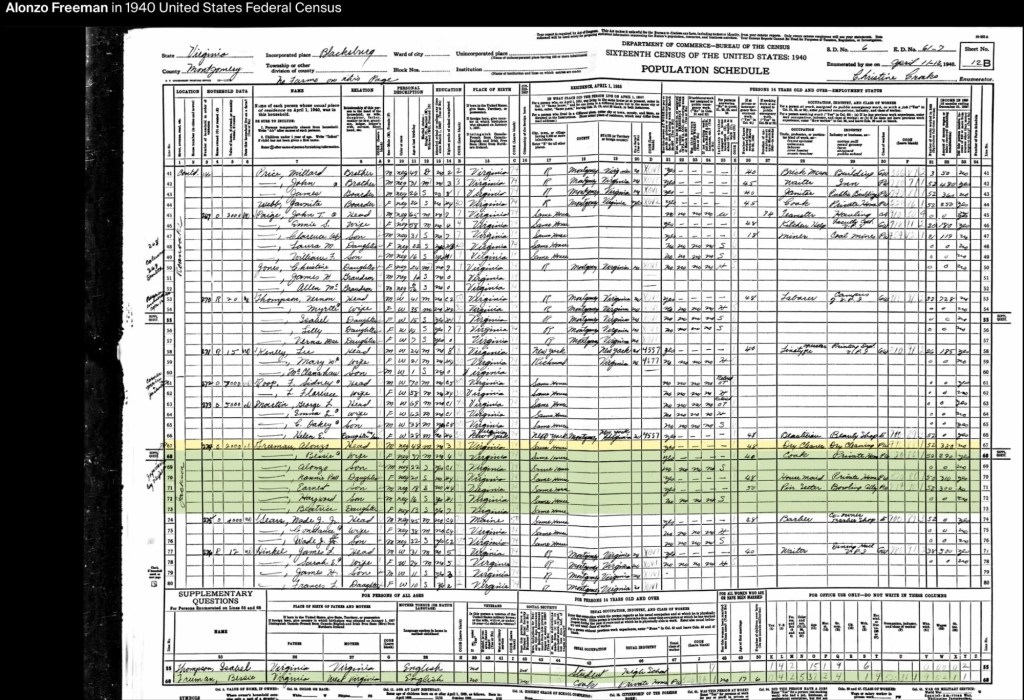
According to the 1940 U.S. Census, all of Alonzo and Bessie Freeman’s children were still living at home. Nannie Bell worked as a private housemaid, while Linwood was employed as a pin setter at the college bowling alley. Alonzo Sr. continued running his cleaning business, and Bessie worked as a private cook.
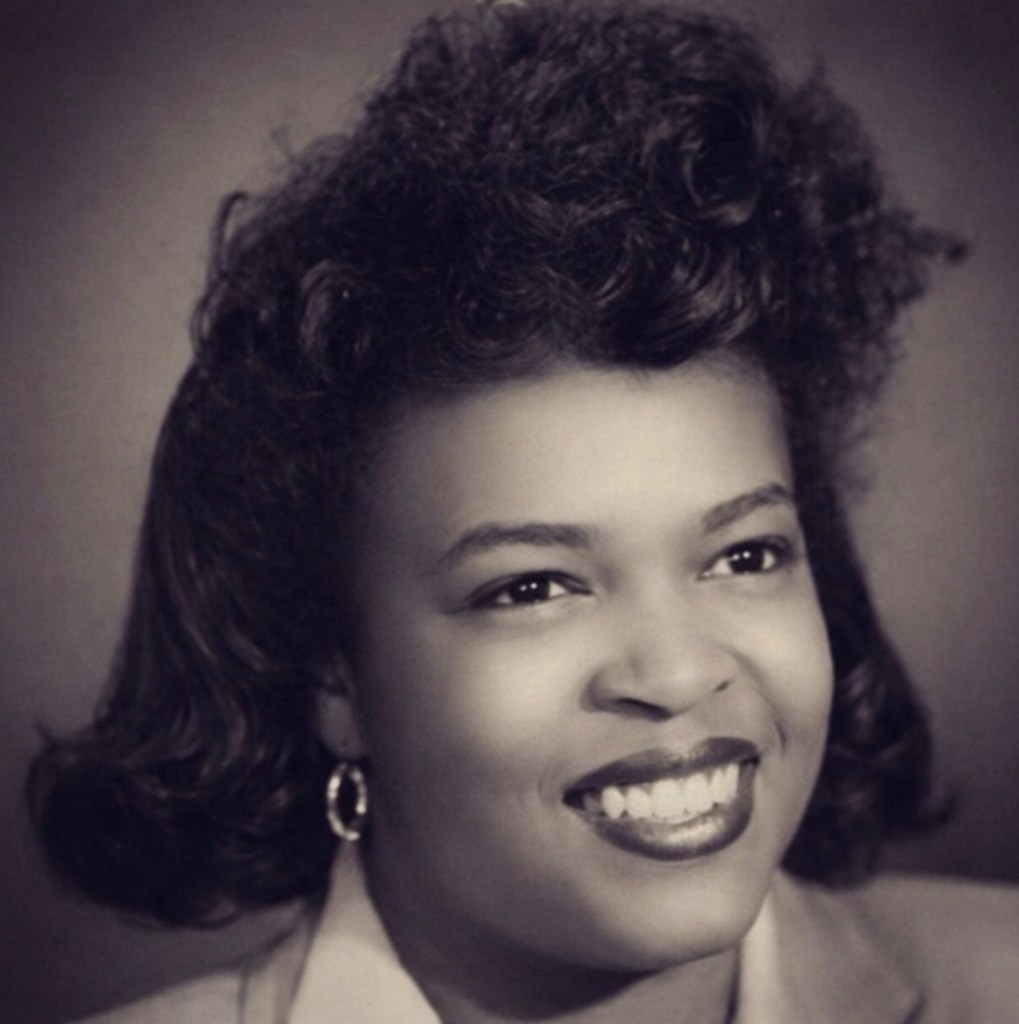
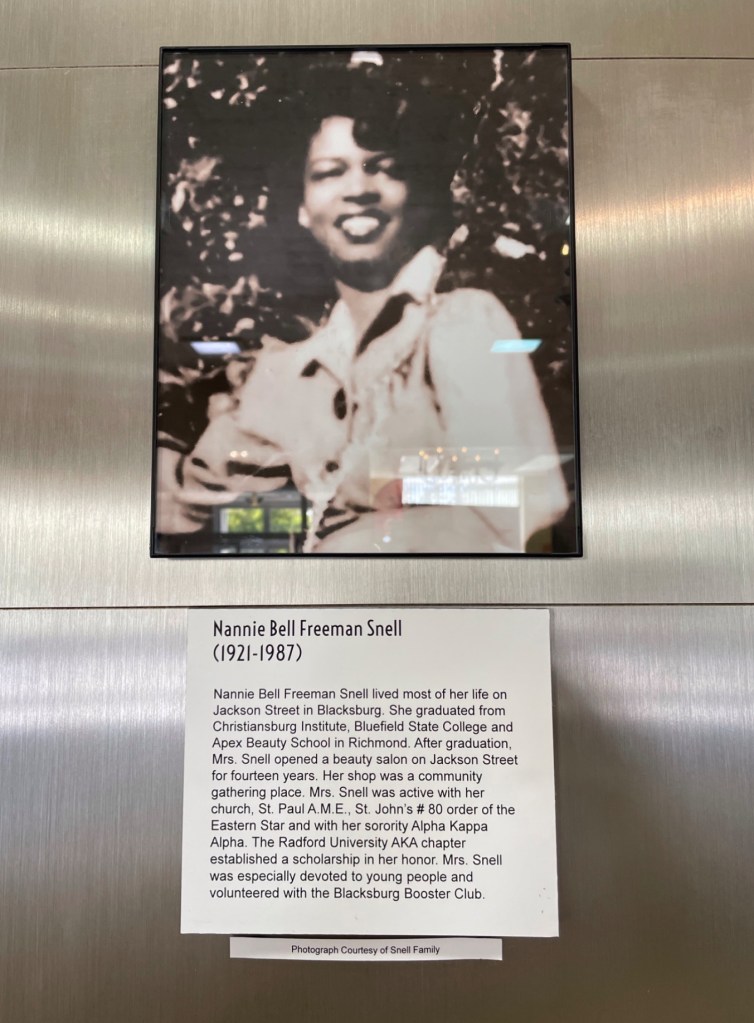
Nannie Bell Freeman Snell (Courtesy of Montgomery Museum of Art & History, repaired image)
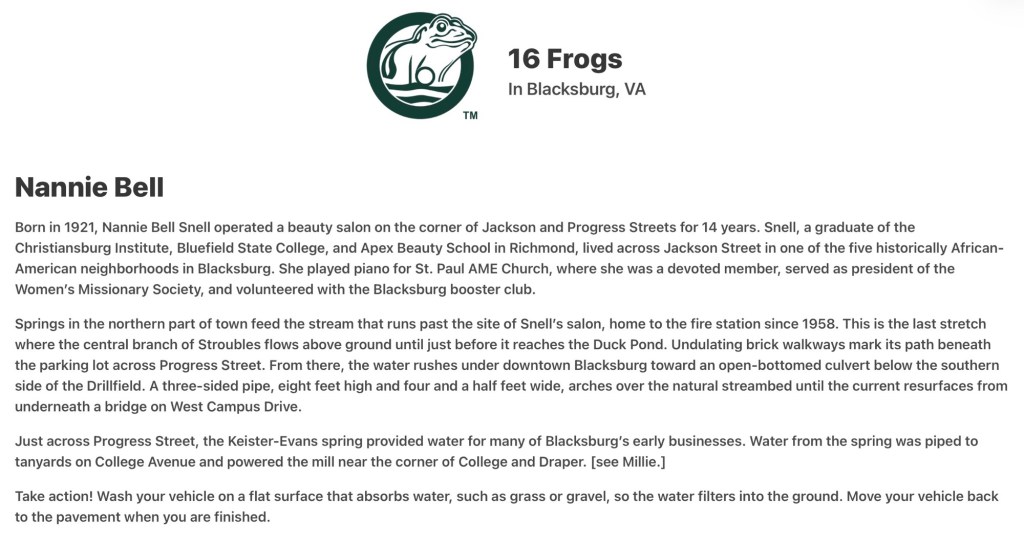
On November 19, 1947, Nannie Bell, now a beautician, married Sidney Grant Snell (1921–1975), a mechanic from Radford. The Snells raised six children and lived at 404 Jackson Street, just down the street from Nannie Bell’s parents, Alonzo and Bessie, who resided at 202 Jackson Street. Only the Snell’s home remains standing today, but the Freeman residence was located at the same corner of Jackson and Progress Streets where the town’s 1958 firehouse now stands. Blacksburg named a frog to honor Nannie Bell.
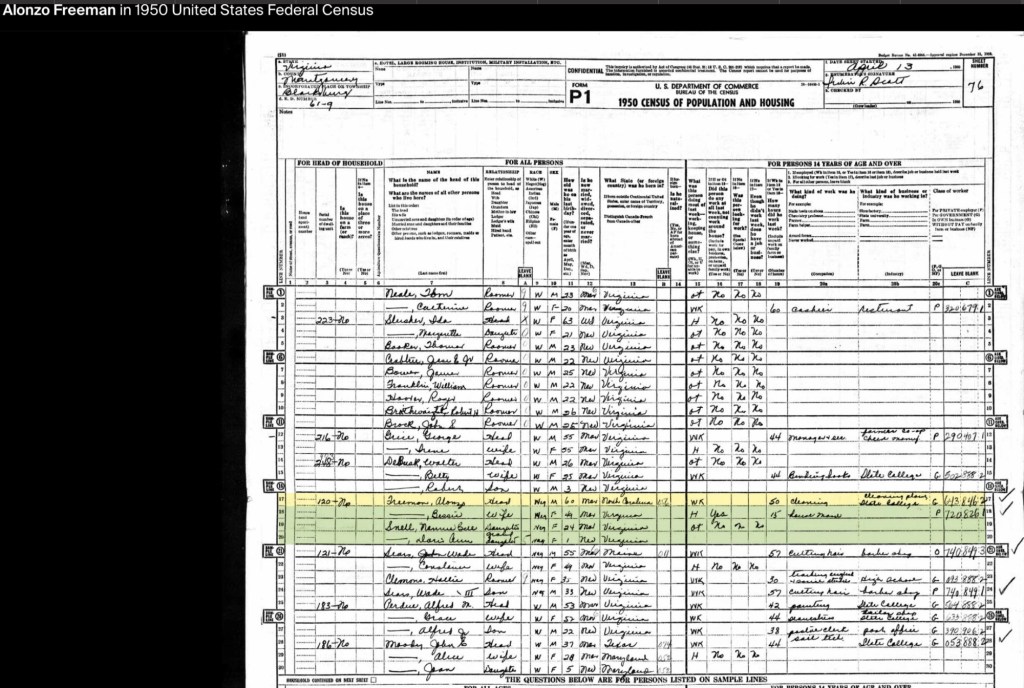
By the 1950 U.S. Census, Alonzo Sr., now in his 60s, was working at Virginia Polytechnic Institute’s Cleaning Plant. Nannie Bell and her daughter, Doris Ann, were living with her parents at the family home. By this time, all three Freeman sons had moved to Washington, D.C., with Linwood living alongside Haywood. Alonzo Jr. had married and was serving as the principal of the Clay Street segregated school before becoming the principal of an elementary school in Baltimore.
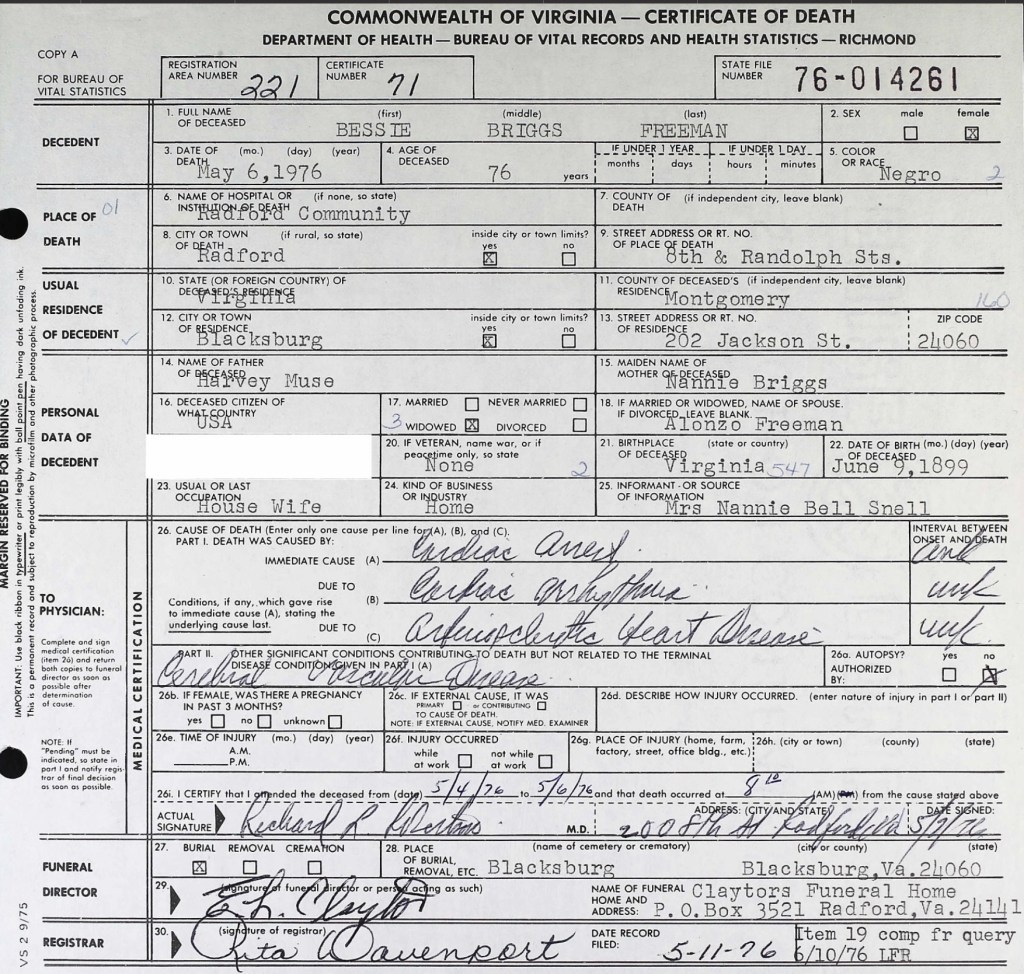
Bessie Virginia Briggs Freeman (1899 to 1976)
Bessie’s mother, Nancy Sweeney, was born in 1872 in Christiansburg, Virginia. Her father, Noah Briggs, was the son of George and Jane Briggs. Nancy and Noah were married on February 14, 1894. By the 1900 Census, the Briggs, Green, and Sweeney families—several generations of the same extended family—were living as neighbors in Cambria.
By the 1910 Census, Nancy Sweeney Briggs had married Harvey (Harry) Muse of Cambria, a laborer at the lime kiln. Together, they had four children: Willie B. (b. 1902), Grace (b. 1904), Connie (b. 1906), and Edward (1909–1950). Edward Muse later married Bessie Lynch (b. 1911), and they settled in New Town, where they raised five children: Jean (b. 1932), Constance (b. 1934), Shirley Ann (b. 1936), Edward Jr. (b. 1938), and Harold A. (b. circa 1940). By 1940, Edward Muse was working at the Virginia Polytechnic Institute Monogram Presser Plant alongside his neighbor, John Green, and Alonzo Freeman Sr.
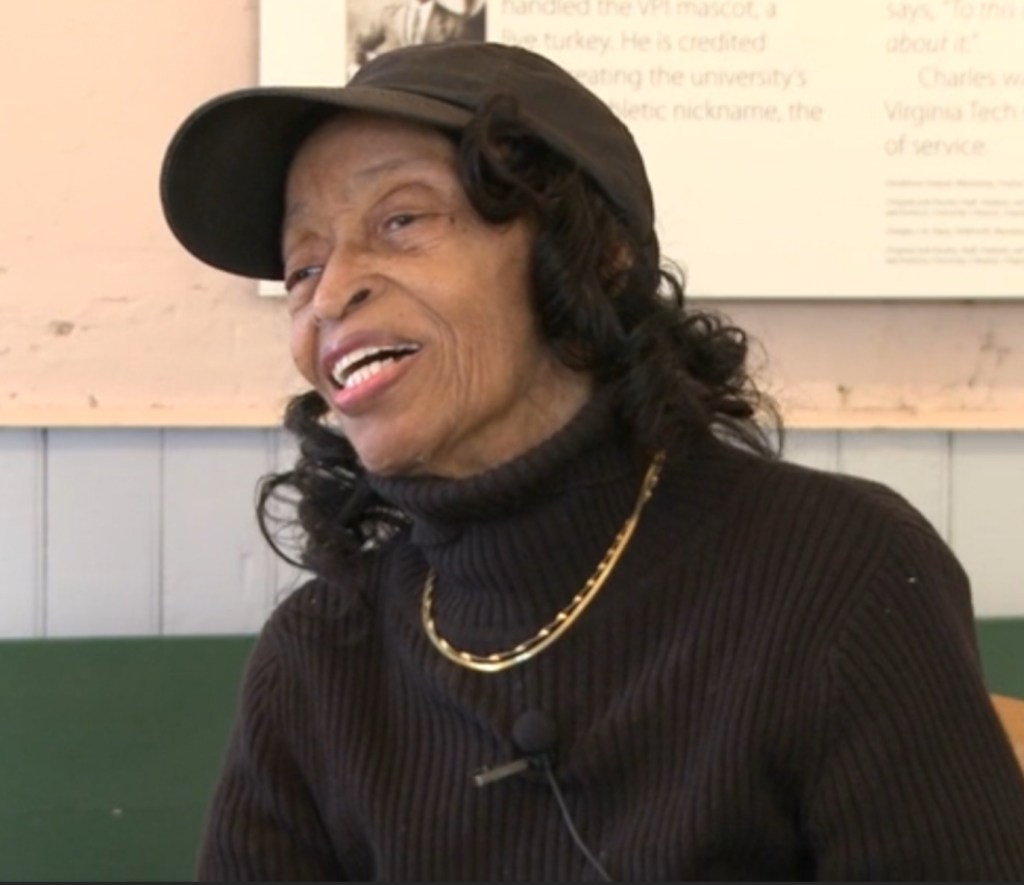
In 2013, Beatrice Freeman Walker, the youngest daughter of Bessie and Alonzo Freeman, participated in an oral history interview now archived at Virginia Tech University Libraries. In this interview, she shared valuable insights into her mother’s work in the homes of prominent community members and her leadership in the Independent Order of St. Luke’s (St. Frances Council #235), which operated out of the shared building in New Town alongside the Odd Fellows and the Household of Ruth. Beatrice also highlighted her mother’s important role in coordinating the return of soldiers for family funerals through the Red Cross.
Beatrice Freeman Walker (courtesy of Virginia Tech University Libraries)
Additionally, the interview sheds light on her father, Alonzo Freeman Sr., and his contributions to the Black community in Blacksburg. Among these was his creation of a weekend retreat for African Americans, called Paradise View, located on land he owned off Grissom Lane—now known as Nellie’s Cave. Beatrice’s recollections provide a crucial window into the history of Black life in Blacksburg and the legacy of her parents.
Notes to Further Explore – Mountain Lake Connection
In her book Kentland at Whitethorne (Walpa Publishing, Blacksburg, VA, 1995), historian Patricia Givens Johnson mentions a “Mrs. Freeman,” who worked as a chambermaid at Mountain Lake Hotel shortly after emancipation. According to Johnson (p. 53), Mrs. Freeman married Bob Jackson, who had been enslaved by James Randal Kent (1792–1867), the owner of Kentland Plantation. Some of their children took the Jackson surname, while others retained the Freeman name. Johnson identifies their children as Flemish Jackson, Bessie, Bob, Qu, and Irene Freeman, noting that they were employed by the hotel well into the 1900s.
This connection warrants further research, but it raises an interesting possibility—when Alonzo Freeman married Bessie Briggs in 1917, he was working at Mountain Lake Hotel as a waiter and clothes presser. Could this employment have been influenced by family ties to the hotel? Further exploration may help clarify the Freeman family’s long-standing connection to Mountain Lake.
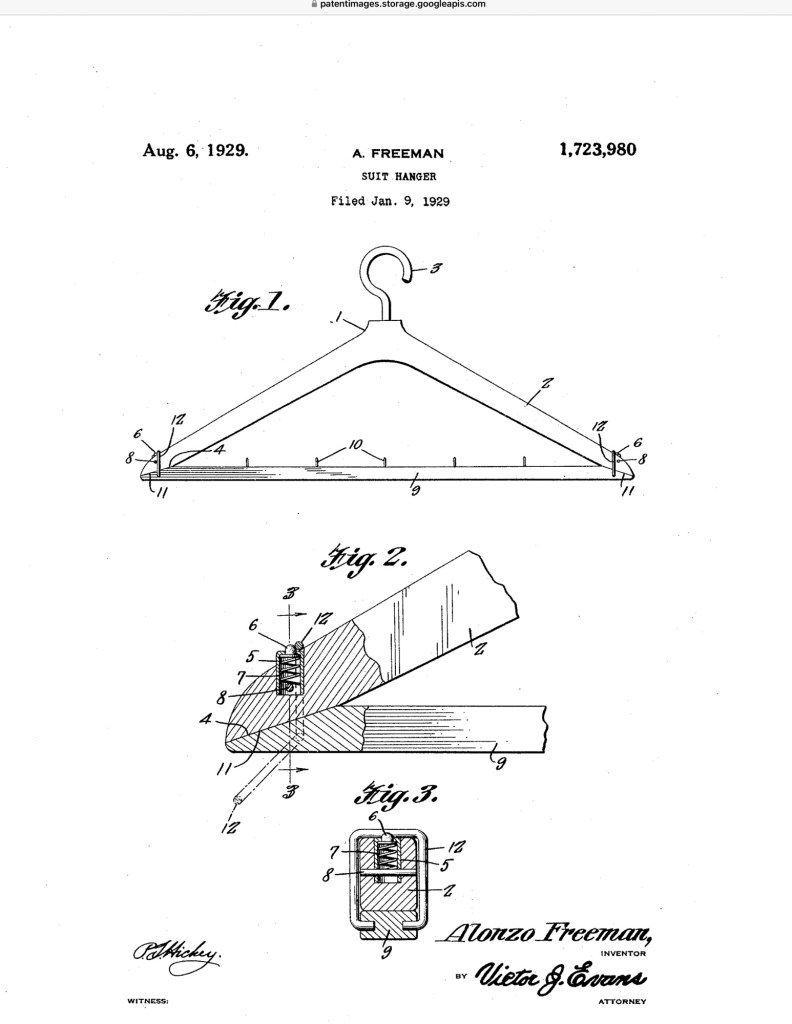
In the winter of 1929, in Blacksburg, Virginia, Alonzo Freeman did something remarkable. While running his clothes-cleaning business during the era of government sanctioned segregation, he took time to solve a practical problem he faced every day.
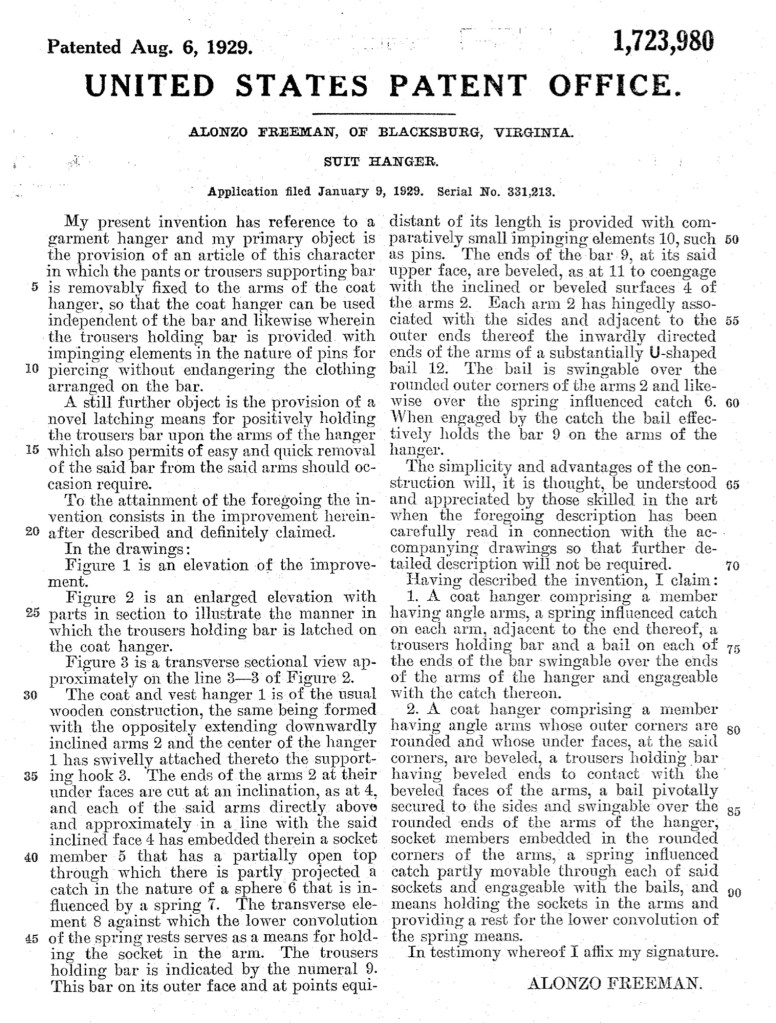
Working with coats, suits, and trousers, Freeman designed a better garment hanger. His invention included a removable bar for trousers and a simple latching mechanism that held the bar securely in place while still allowing it to be quickly removed.
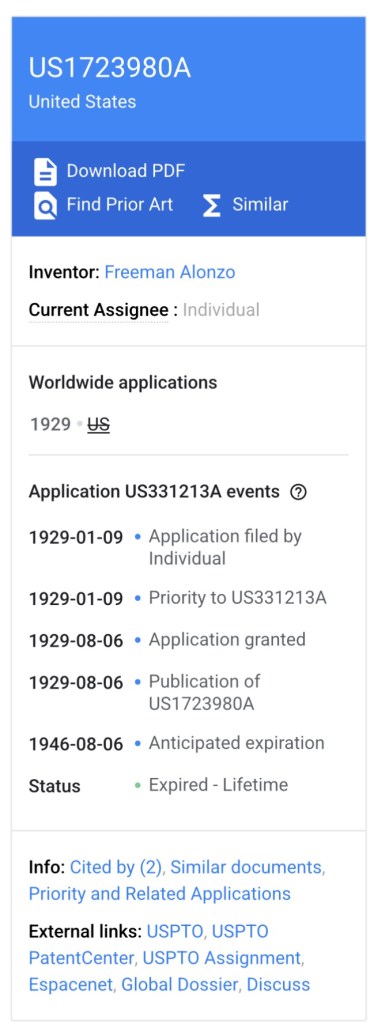
On January 9, 1929, Freeman filed for a patent with the United States Patent and Trademark Office. Later that year, on August 6, he was granted U.S. Patent 1,723,980.
Freeman’s hanger is a reminder that innovation often grows out of everyday work. Even in the face of segregation, Black entrepreneurs and tradesmen were imagining new ideas, improving tools, and shaping their communities.
Gallery
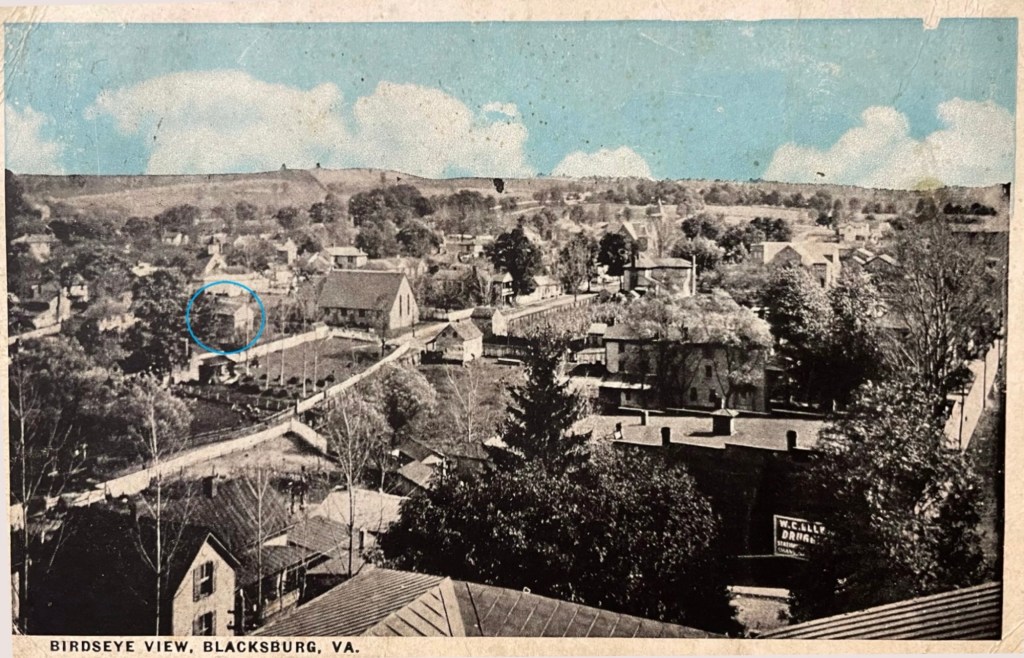
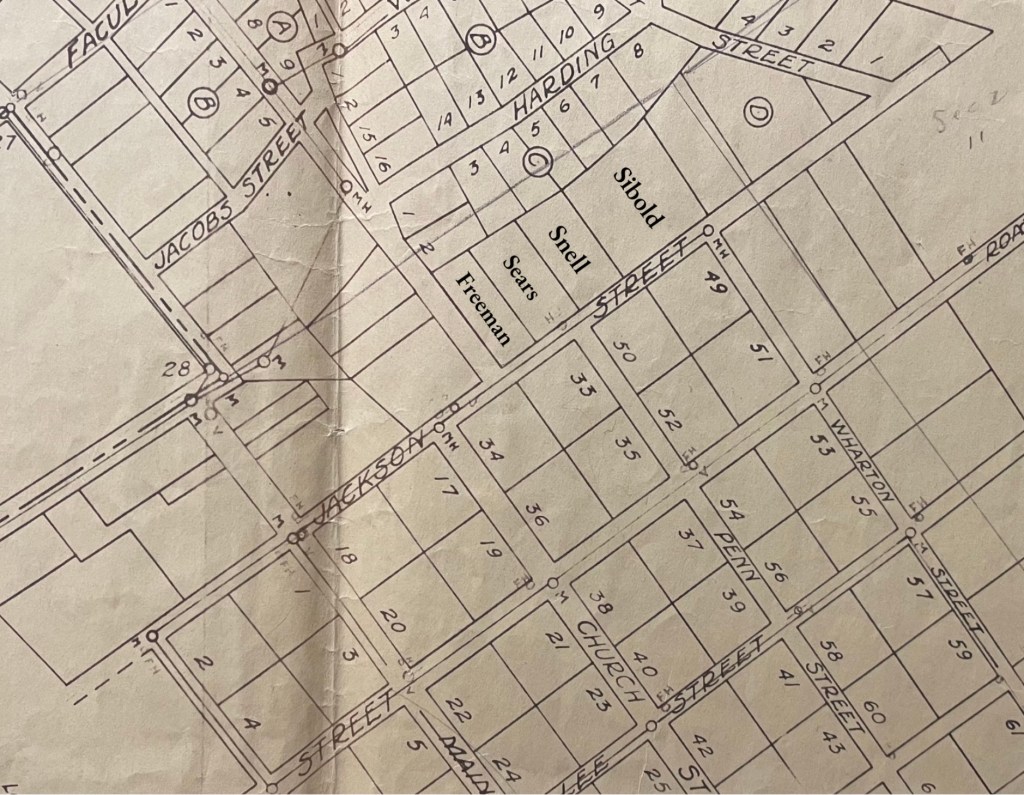
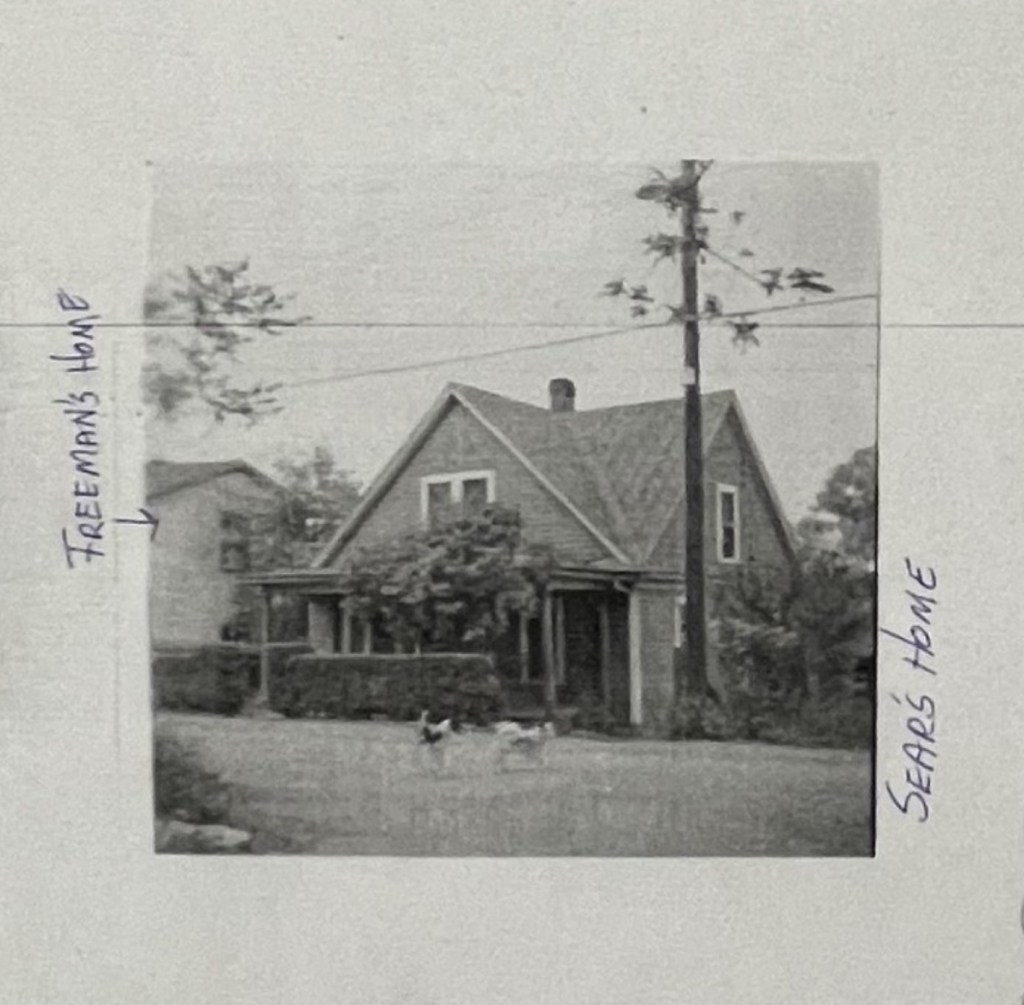
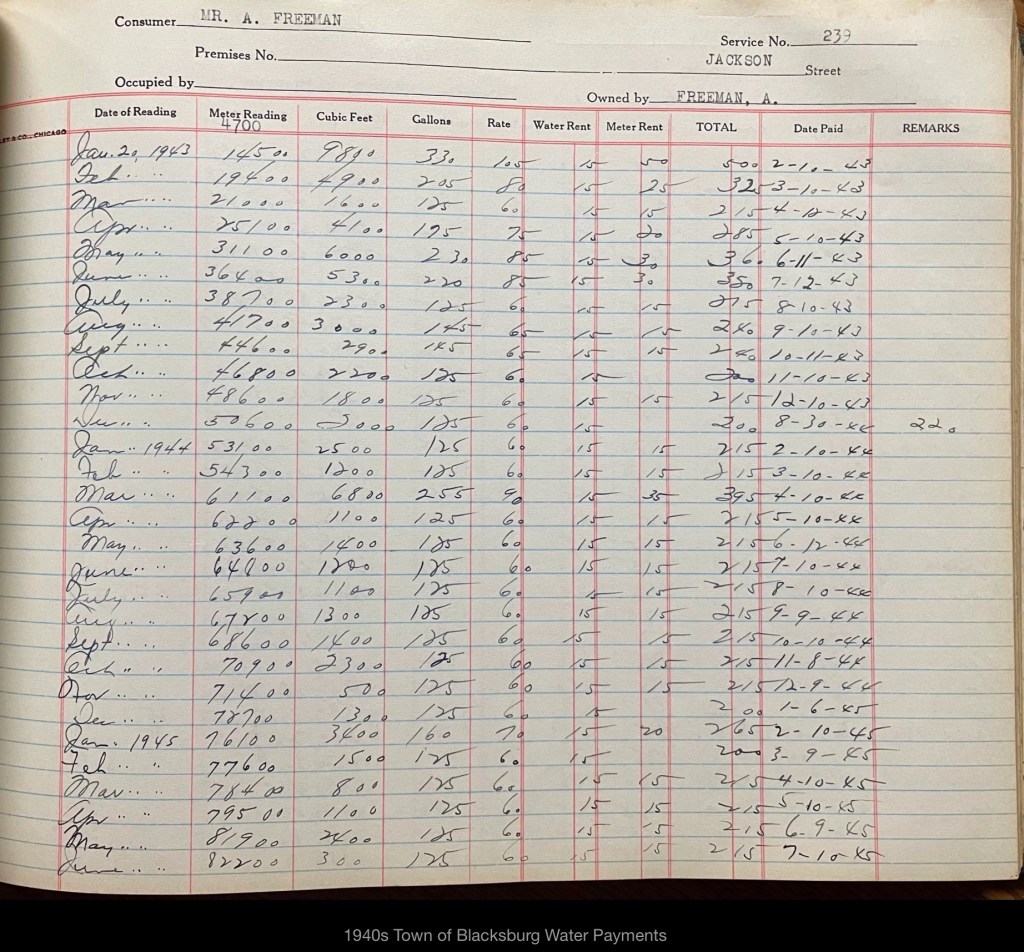
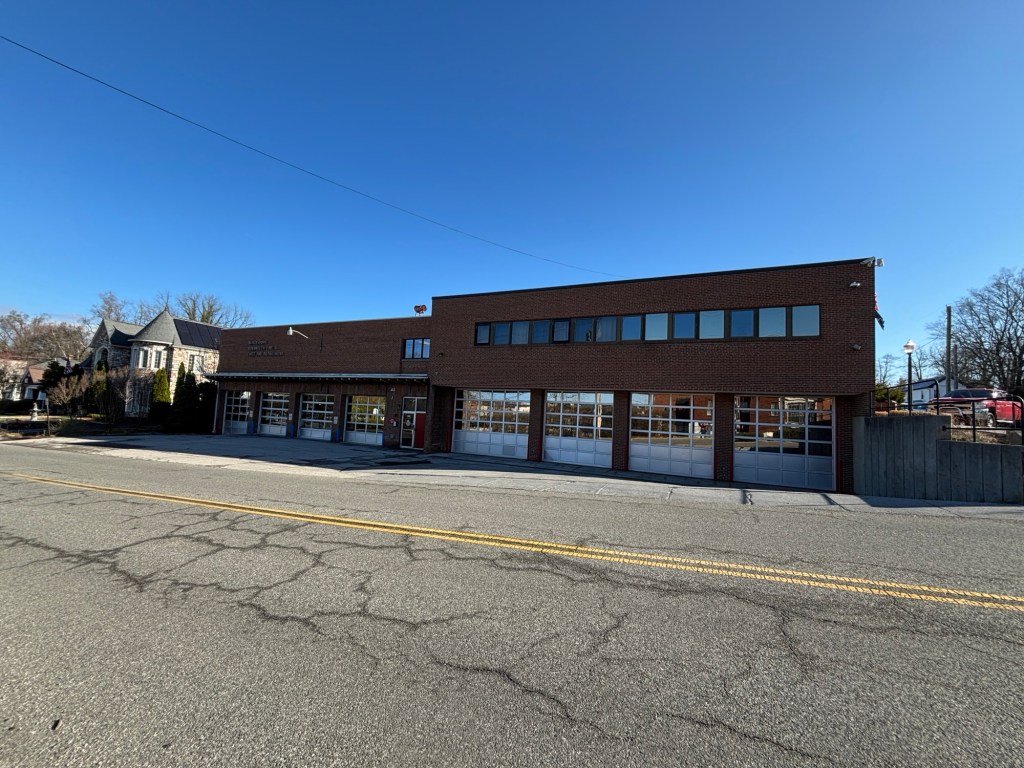
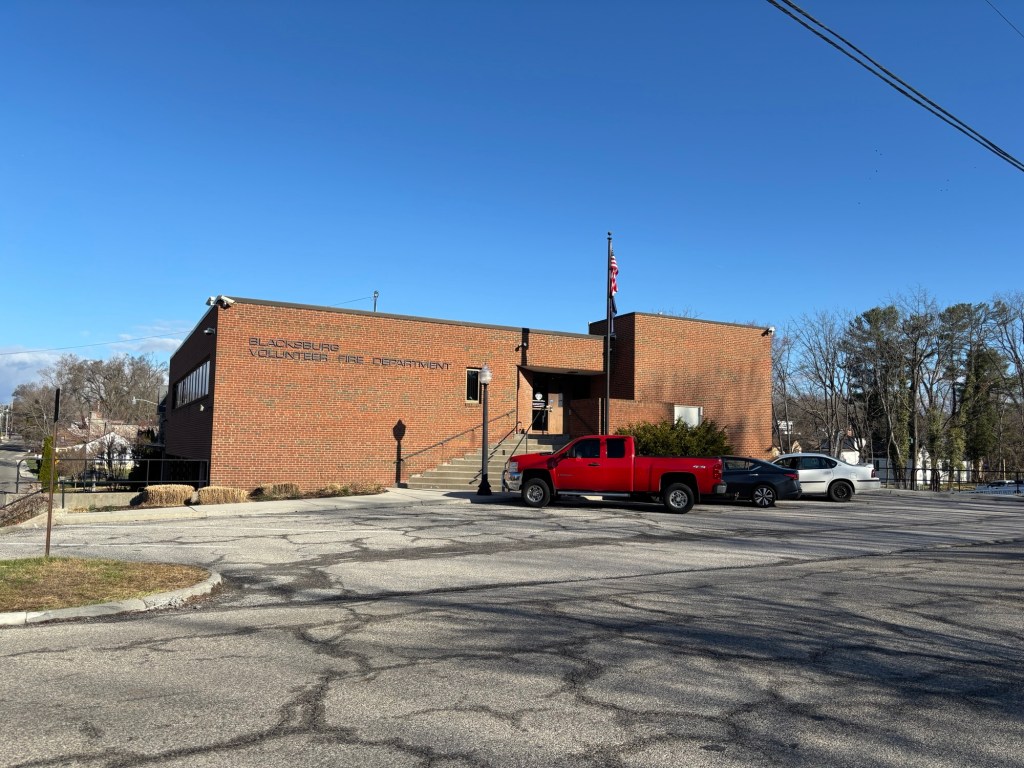
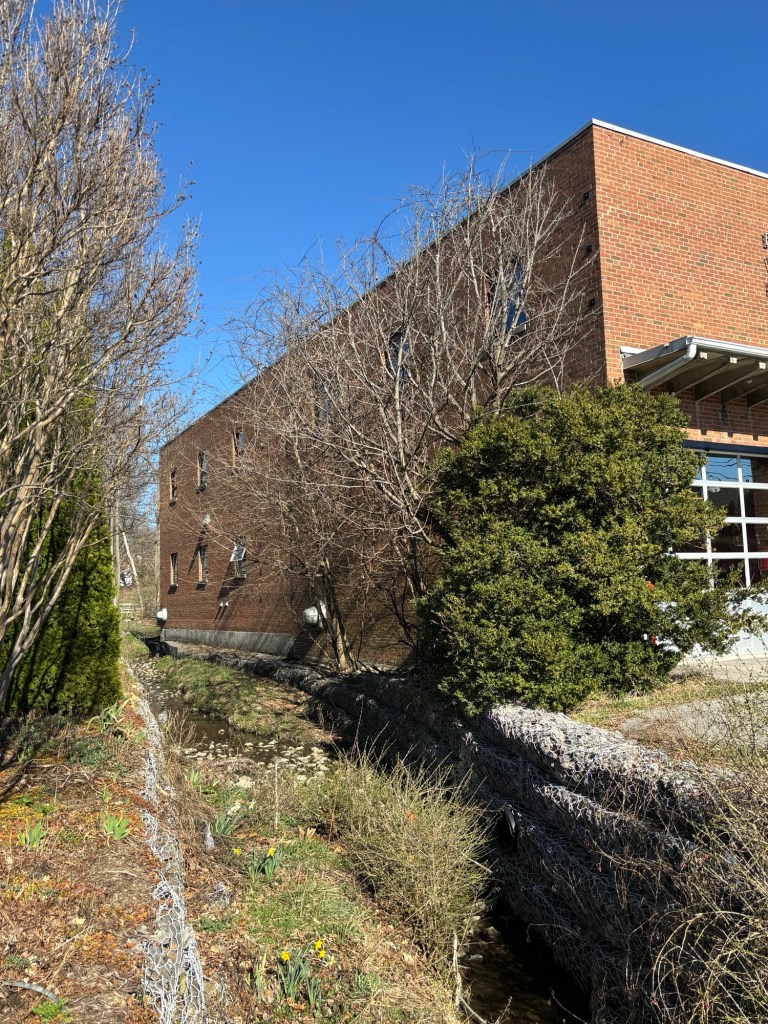
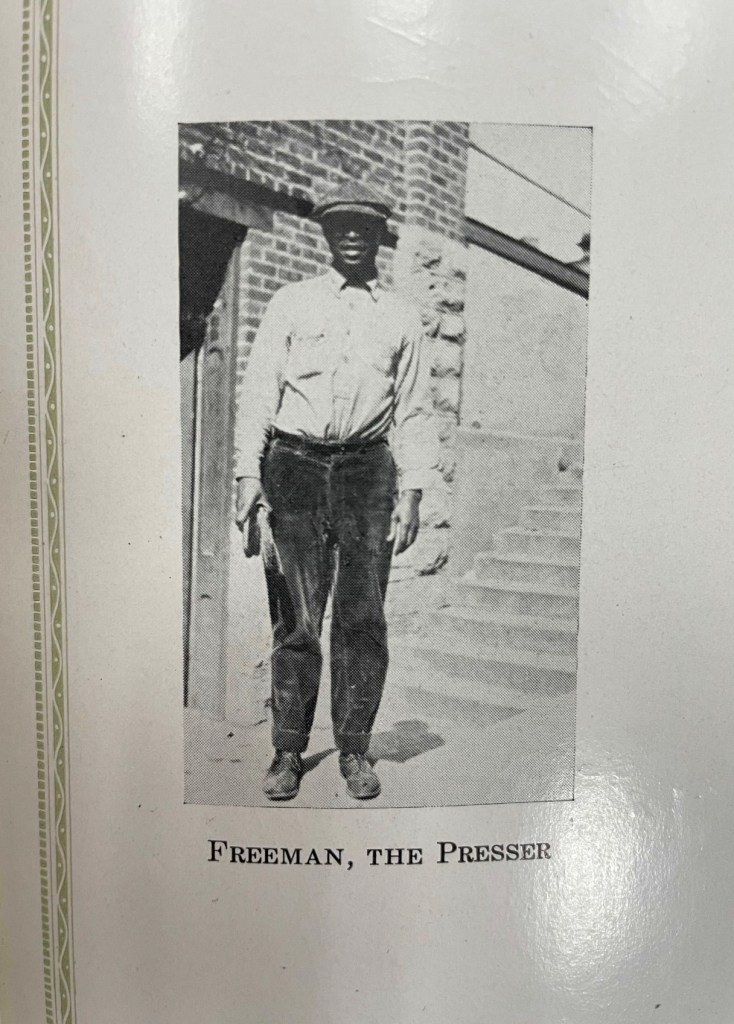
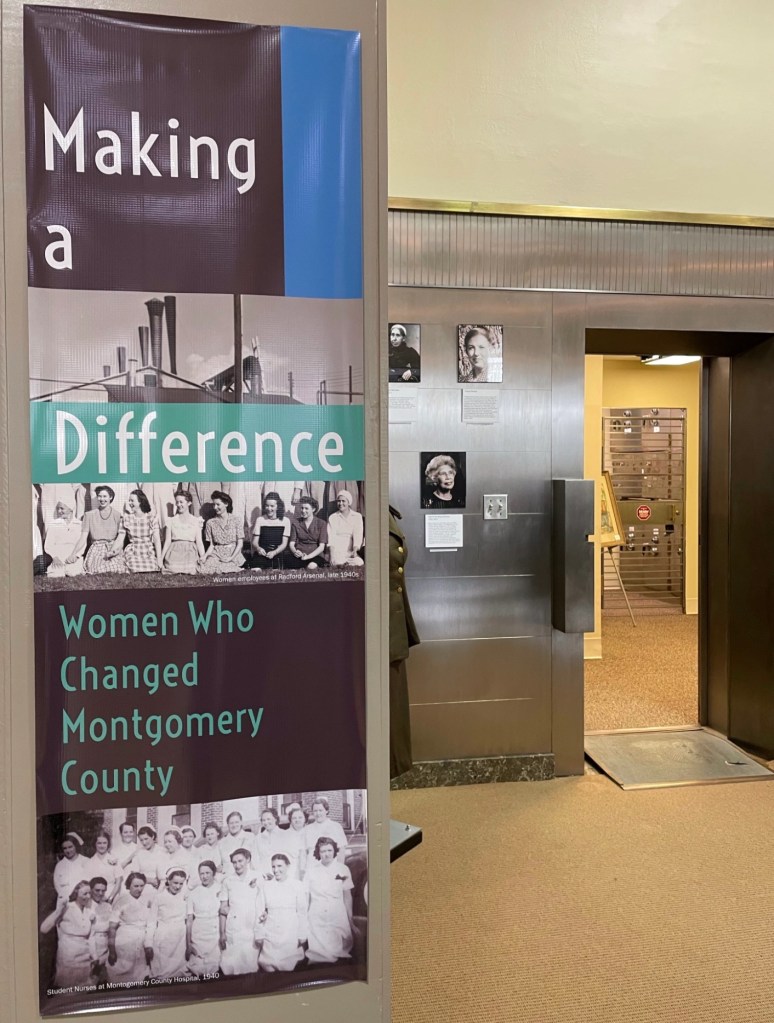
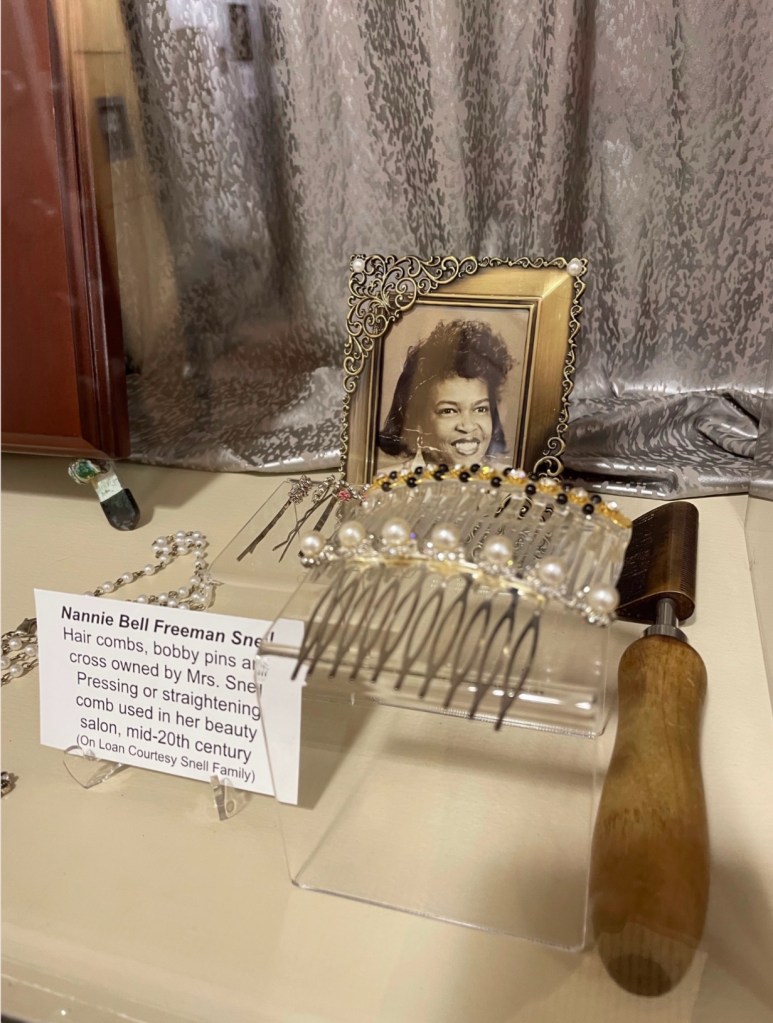
Location of the Freeman’s Home (postcard of Blacksburg prior to 1913, courtesy of Jody Booze-Daniels)Map of Blacksburg prior to 1957 with the families noted. Freeman’s home located west of Wade Sears’ Home prior to 1957, date the firehouse was built. (Martha Shupp Phillips masters thesis, 1948, VPI)The two houses in the background.The Freeman’s home is behind the church (people unknown) to the left of the image. The 1940s town water payment ledger (courtesy of BMCF)West-facing façade of Blacksburg Fire Station #1. The original 1957–58 building appears on the left side of the image, marked by the smaller doors. The Freeman family home once stood on the site where the newer vehicle bays are now located.South-facing façade of Blacksburg Fire Station #1, on the site where the Freeman family’s home once stood.North-facing façade of Blacksburg Fire Station #1. The original 1957–58 building extended about halfway along the brick wall that runs parallel to Stroubles Creek, near the location of Nannie Bell’s frog.Alonzo Freeman, Sr from 1922 Bugle Yearbook. Alonzo Freeman, Sr (source unknown) Freeman family Lee Street Cemetery (now called Southview Memorial Gardens)Alonzo Feadore Freeman WWI registration card. Alonzo Freeman Death CertificateAlonzo and Bessie Marriage Record information.Alonzo and Bessie Marriage Record 1917Alonzo Freeman in Statesville, NC in US Census 1900.Freeman family in Blacksburg, Va on Jackson St (1st St) in US Census 1920Freeman family in Blacksburg, Va on Jackson St (1st St) in US Census 1930Freeman family in Blacksburg, Va on Jackson St (1st St) in US Census 1930. Willie Thomas included, boarder. Freeman family in Blacksburg, Va on Jackson St (1st St) in US Census 1940. Freeman family in Blacksburg, Va on Jackson St (1st St) in US Census 1950Bessie Briggs Freeman obituaryBeatrice Freeman Walker obituaryAlonzo Freeman, Jr WWII registration cardAlonzo Freeman, Jr birth certificateNannie Bell Freeman Snell was featured in a 2022 exhibit at the Montgomery Museum of Art & History titled “Making a Difference: Women Who Changed Montgomery County.” The exhibit recognized women whose leadership, work, and community impact helped shape the history of Montgomery County.Nannie Bell Freeman Snell was featured in a 2022 exhibit at the Montgomery Museum of Art & History titled “Making a Difference: Women Who Changed Montgomery County.”Nannie Bell Freeman Snell was featured in a 2022 exhibit at the Montgomery Museum of Art & History titled “Making a Difference: Women Who Changed Montgomery County.”Alonzo Freeman, Sr WWI registration Card
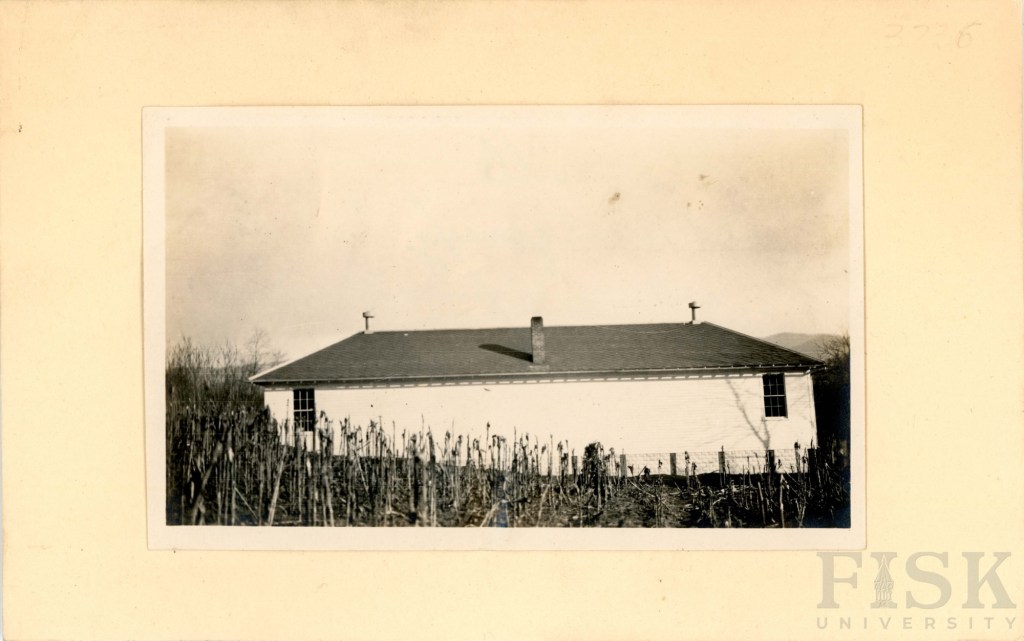
Fisk University has released its Rosenwald School Digital Collection, preserving and sharing the history of these vital institutions. In Montgomery County, the collection highlights schools built through the determination of African American communities in Elliston, Pine Woods, Shawsville, and Wake Forest.
Fisk University has made its Rosenwald School Digital Collection publicly accessible, a significant step in preserving and sharing the history of these important institutions. For Montgomery County, the collection documents the Rosenwald Schools established through the determination and vision of African American communities in Elliston, Pine (Piney) Woods near Riner, Shawsville, and Wake Forest.
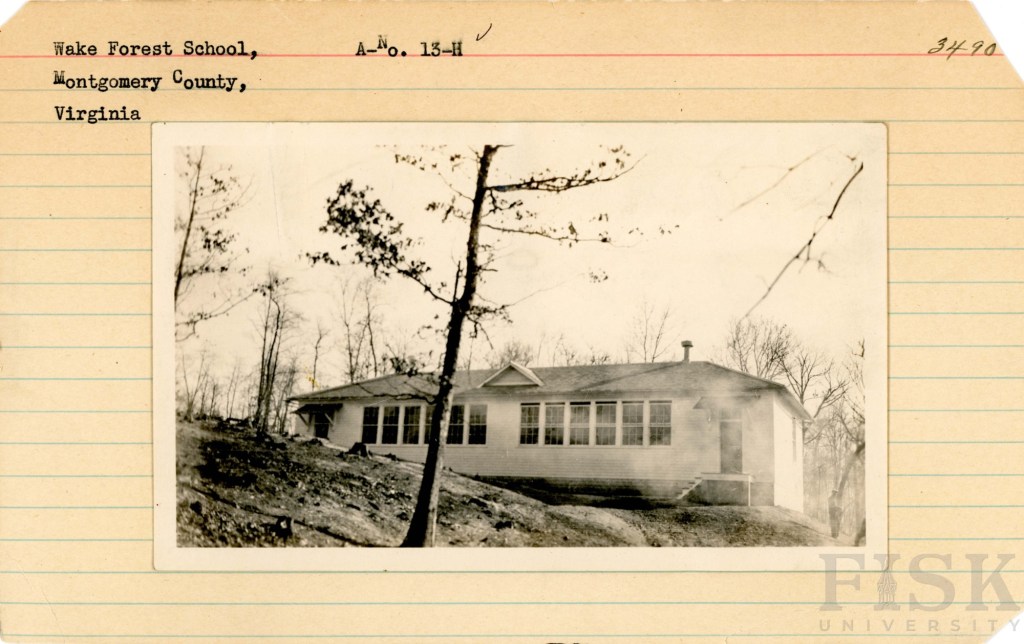
Although only the Wake Forest school remains today—adapted for use as a private residence—the collection ensures that the legacy of all three schools endures. These schools stand as a testament to community leadership, resilience, and the transformative power of education during the early twentieth century.
The Story of Rosenwald Schools
The website (scroll down) offers a wealth of information: the story of Julius Rosenwald and his vision, the purpose of the school fund, the significance of the school designs, and the requirement that African American communities contribute a share of the cost. Visitors will also find maps, photographs, and documentation of schools across the region and beyond.
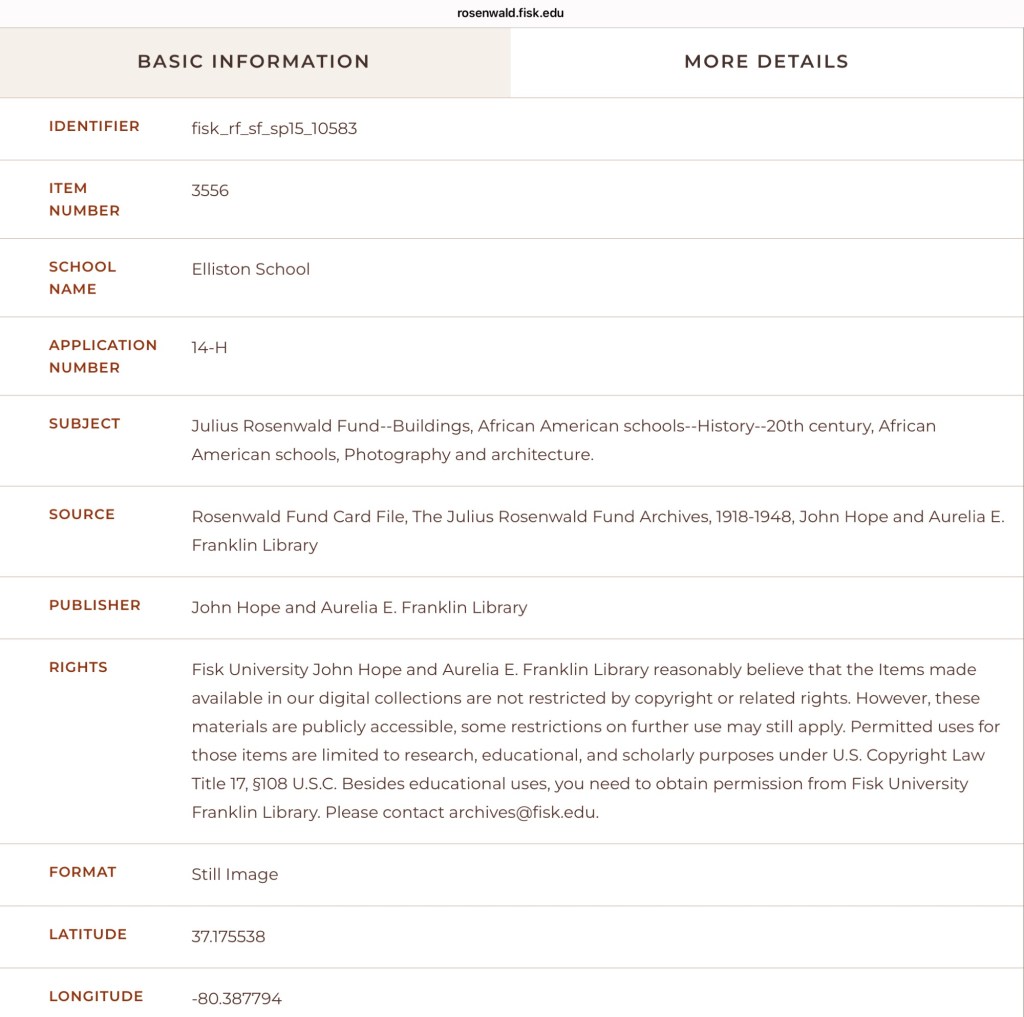
Elliston School Info1940 School Census Map2002 Image (Courtesy of Meadowbrook Museum, Shawsville)Image of the list of students in 1935 (Courtesy of Meadowbrook Museum, Shawsville, James Earnest Dow document)
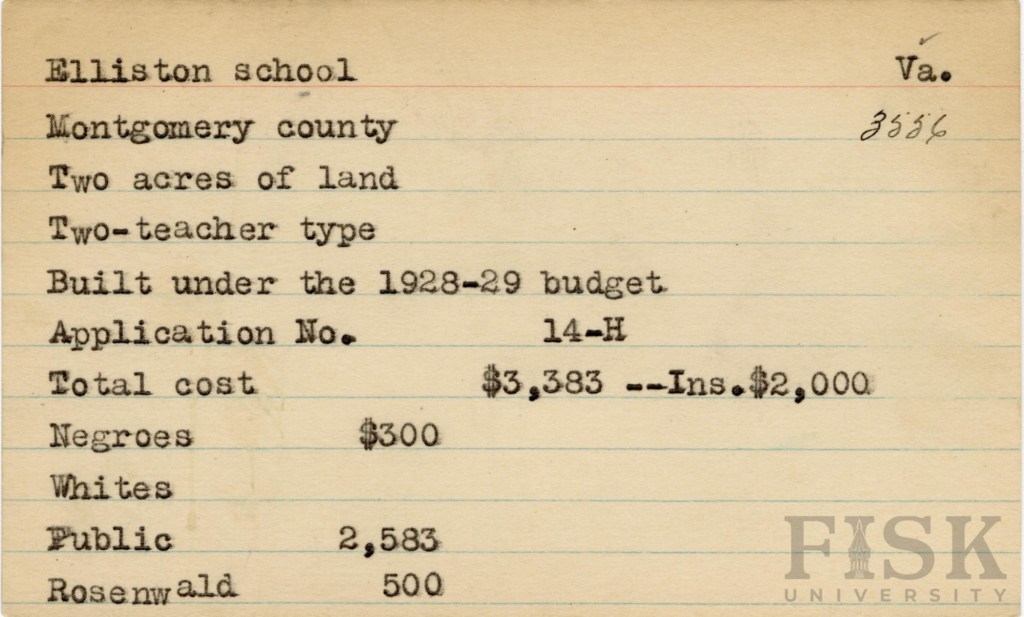
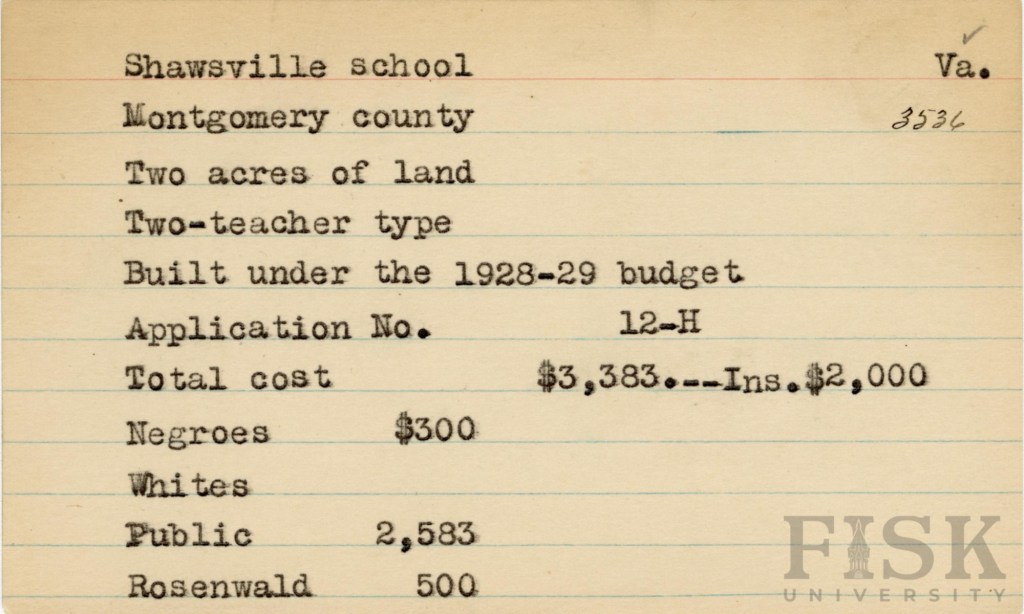
Built in 1928–1929, the Elliston Rosenwald School reflects the determination of the local African American community to provide better educational opportunities for their children. Families in Elliston raised $300 toward the project, which was matched by $500 from the Rosenwald Fund and $2,583 from the Montgomery County School Board.
The school stood on two acres of land and housed two classrooms, each with its own teacher. The school was located on Brake Road, in the Allegheny School District. The legacy: the Elliston Rosenwald School was a center of learning, community, and pride during an era when access to education was hard-won.
The Pine Woods Rosenwald School (Piney Woods) was built in a two-teacher design under the supervision of Tuskegee University. The school was sited on Piney Woods Road, in the Auburn School District. While the exact construction date is unknown, records indicate the total cost was $1,075. Of that amount, the Rosenwald Fund contributed $300, the African American community raised $275, and the Montgomery County School Board provided $500.
Unlike white schools of the period, which were fully funded by the School Board, African American families were required to make direct financial contributions toward the construction of their schools. This inequity underscores both the systemic barriers they faced and the extraordinary commitment of the Pine Woods community to ensuring education for their children.
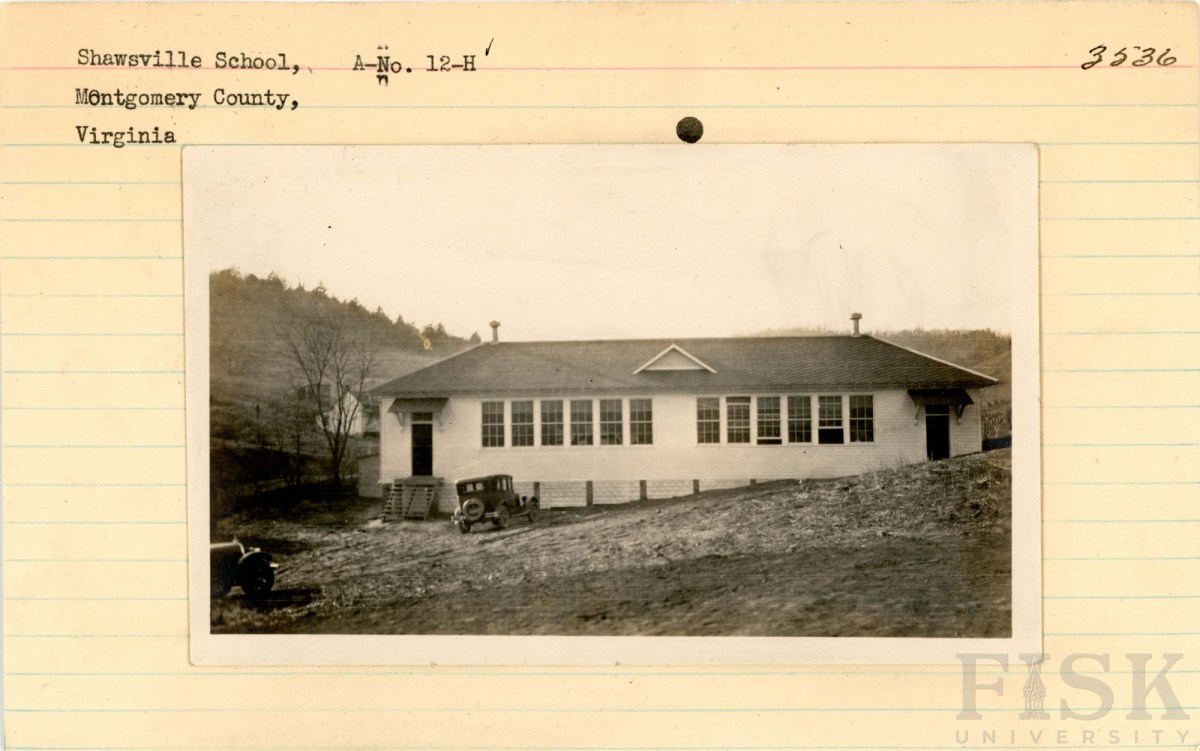
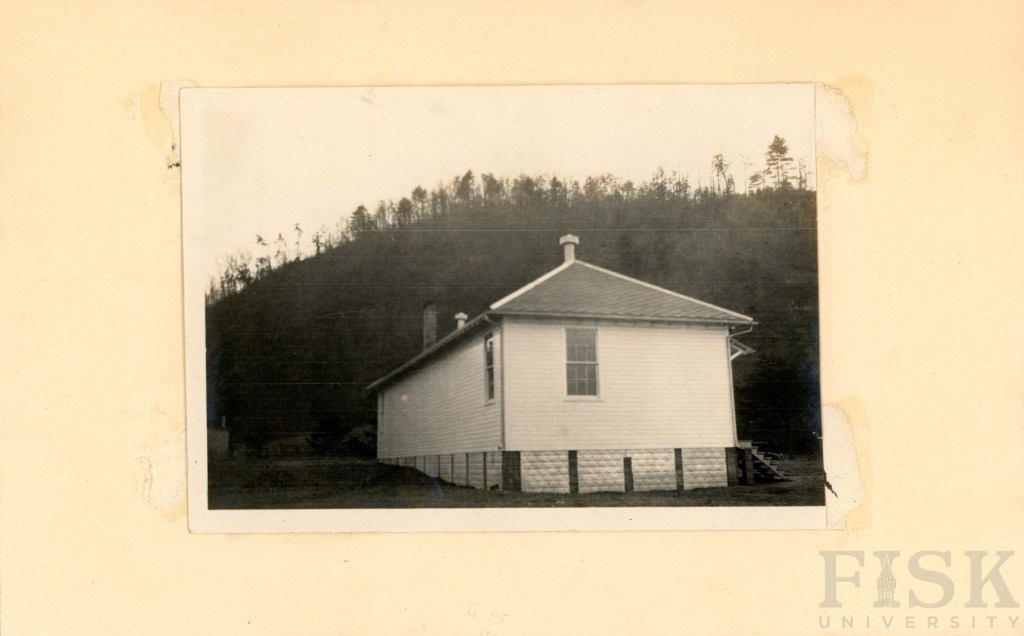
Constructed between 1928 and 1929, the Shawsville Rosenwald School followed a two-teacher design overseen by the Montgomery County School Board. The total cost of $3,383 was shared among the Rosenwald Fund ($500), the African American community ($300), and the Montgomery County School Board ($2,583).
At the time, Shawsville, of the Allegheny School District, was a thriving hub, energized by railroad service and new road (US Route 11) construction projects. These opportunities drew African American laborers and rail workers to the area, many of whom invested their limited resources into building a school for their children. Their contributions—financial and communal—stand as a testament to the determination of Shawsville’s African American families to secure education despite inequities in public funding.
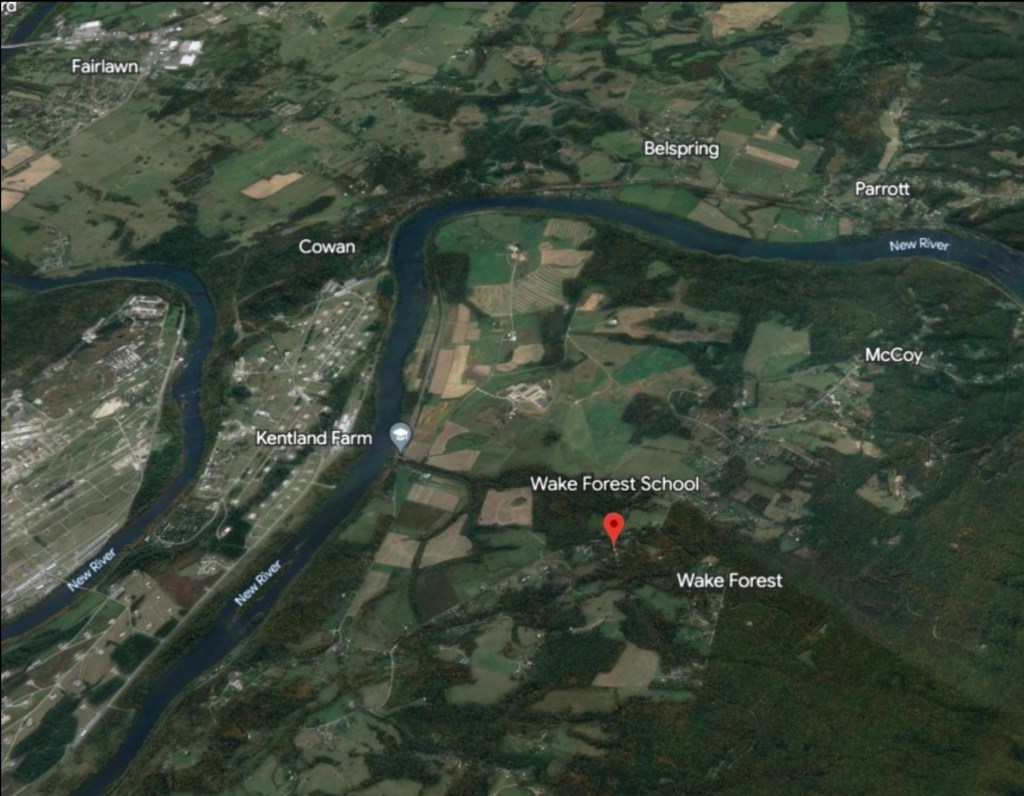
Constructed between 1928 and 1929, the Wake Forest Rosenwald School followed a two-teacher design on a two-acre site, in the Blacksburg School District, overseen by the Montgomery County School Board. The project cost $3,383, with funding shared by the Rosenwald Fund ($500), the African American community ($426 in 1928, about $7,500 in today’s value), and the Montgomery County School Board ($2,457). This school is now a private residence.
The Wake Forest community at this time was made up of independent farmers, farm laborers, boatmen, railroad workers, teamsters, and domestic workers. As coal extraction began to rise and reshape the region’s economy, African American families recognized that education would be essential for their children’s future. By pooling their resources—despite economic hardship—they ensured access to schooling that could open paths beyond the limits of labor and provide new opportunities for the next generation.
In 1961, Blacksburg High School became the first in Montgomery County to admit African American students, paving the way for full integration of all county high schools by 1966.
After the U.S. Supreme Court’s 1954 Brown v. Board of Education ruling outlawed segregation, Montgomery County resisted. The school board leaned on “states’ rights” arguments and used tactics from Virginia’s Gray Commission—such as controlling student assignments and offering tuition grants to white families—to delay integration for years.
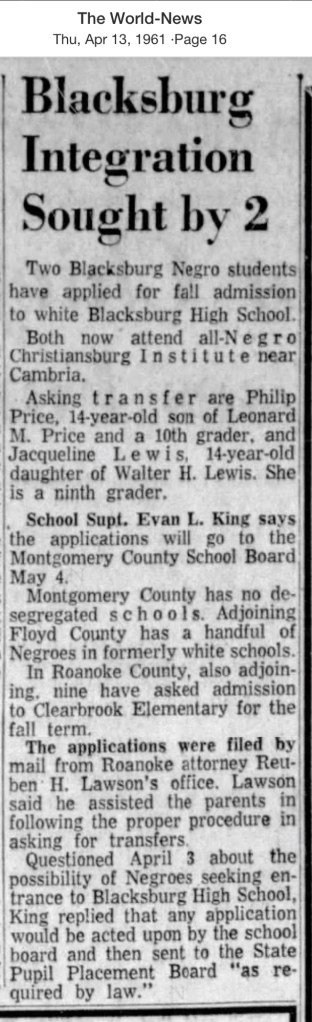
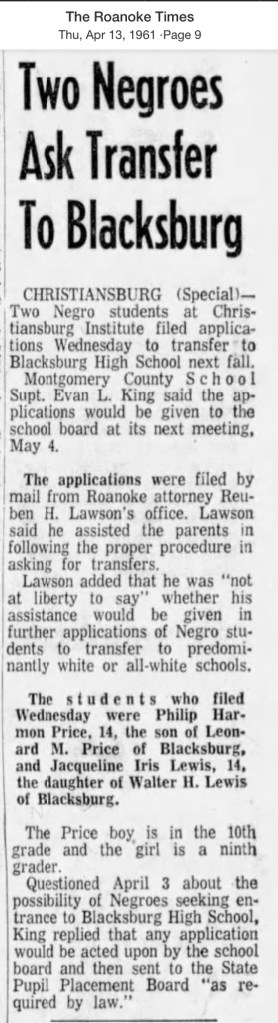
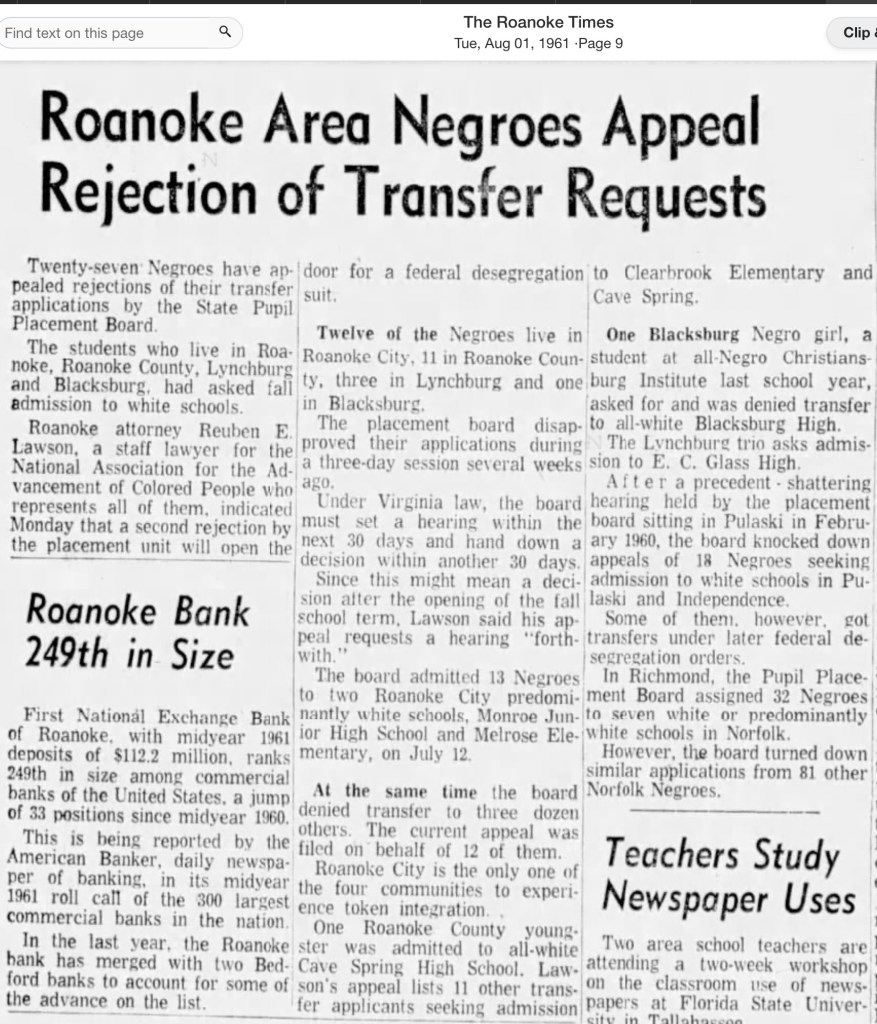
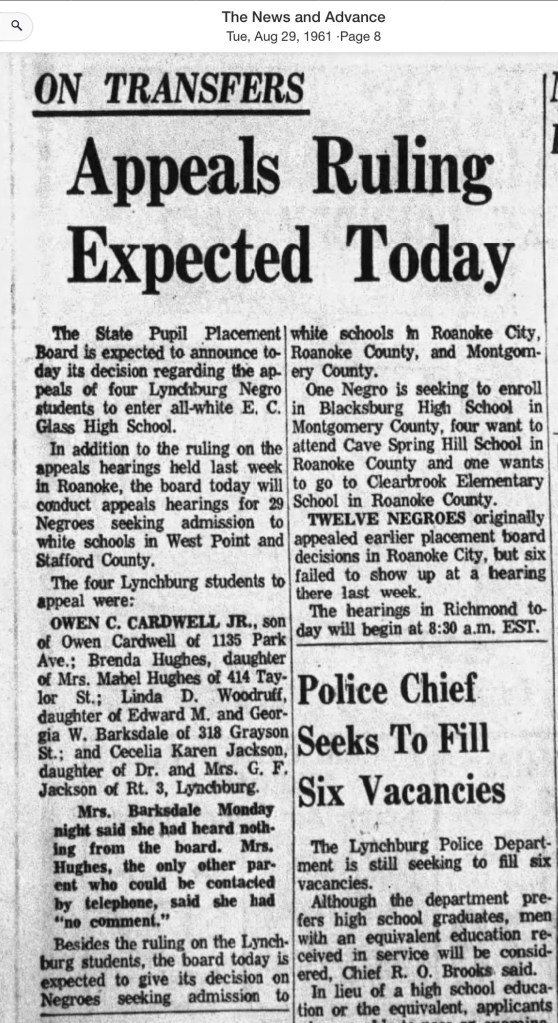
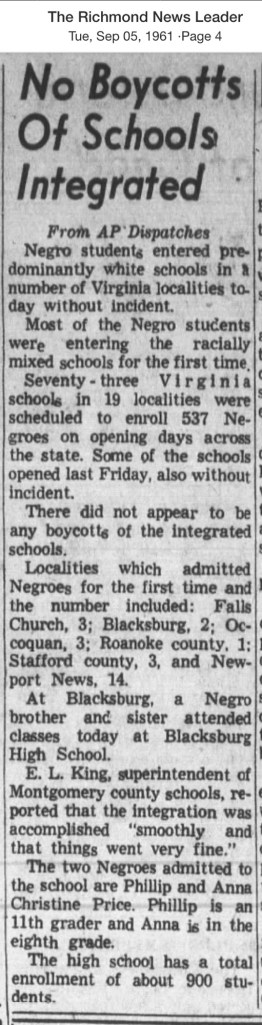
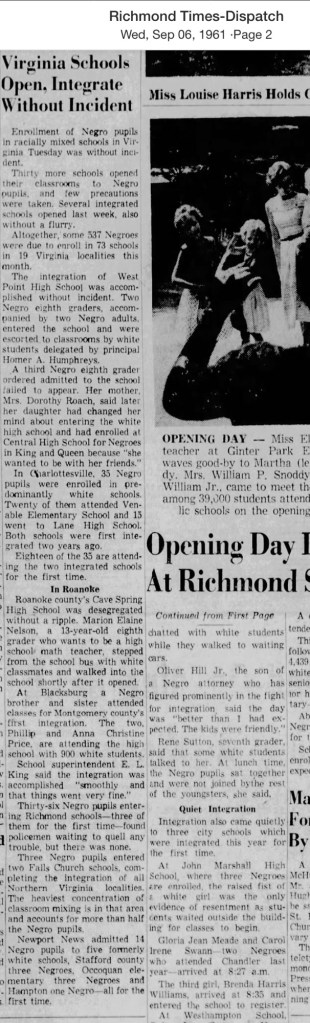
Amidst this resistance, three students from Christiansburg Institute applied to transfer to the all-white Blacksburg High School, which then enrolled about 900 students. They were siblings Phillip H. Price (15) and Ann Christine Price (13), along with Jacqueline Iris Lewis (14). With support from NAACP attorney Reuben E. Lawson of Roanoke, their applications went before the State Pupil Placement Board. Phillip and Ann Christine were admitted for the 1961 school year, but Jacqueline’s request was denied on the grounds of “academic standards”—a requirement never applied to white students.
On August 23, 1961, Jacqueline and her father, Walter H. Lewis, traveled to Roanoke for the hearing, an intimidating experience for a 14-year-old. The Board delayed its ruling for a week before denying her appeal. That fall, Jacqueline remained at Christiansburg Institute.
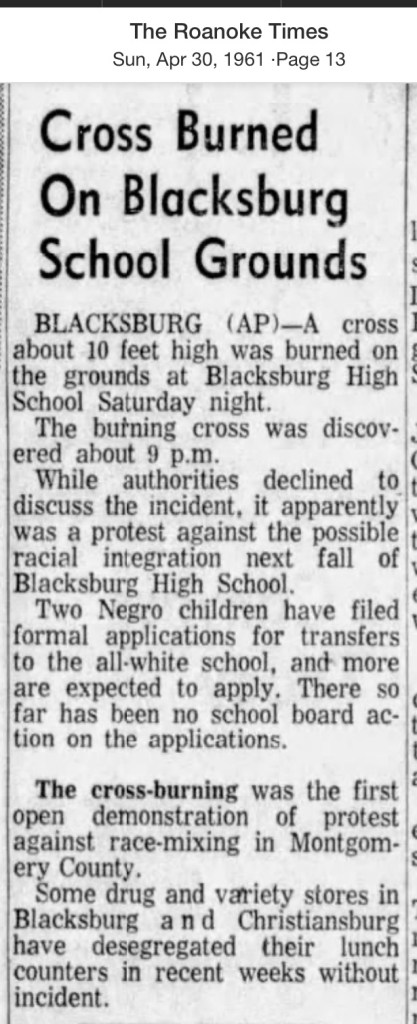
That September, Phillip and Ann Christine Price became the first Black students to integrate Montgomery County schools when they walked into Blacksburg High. According to researcher Tracy A. Martin, they were not alone—their white neighbors walked beside them in solidarity. This act of courage followed a chilling warning: on April 29, 1961, a ten-foot burning cross had been discovered on the school grounds, South Main Street.
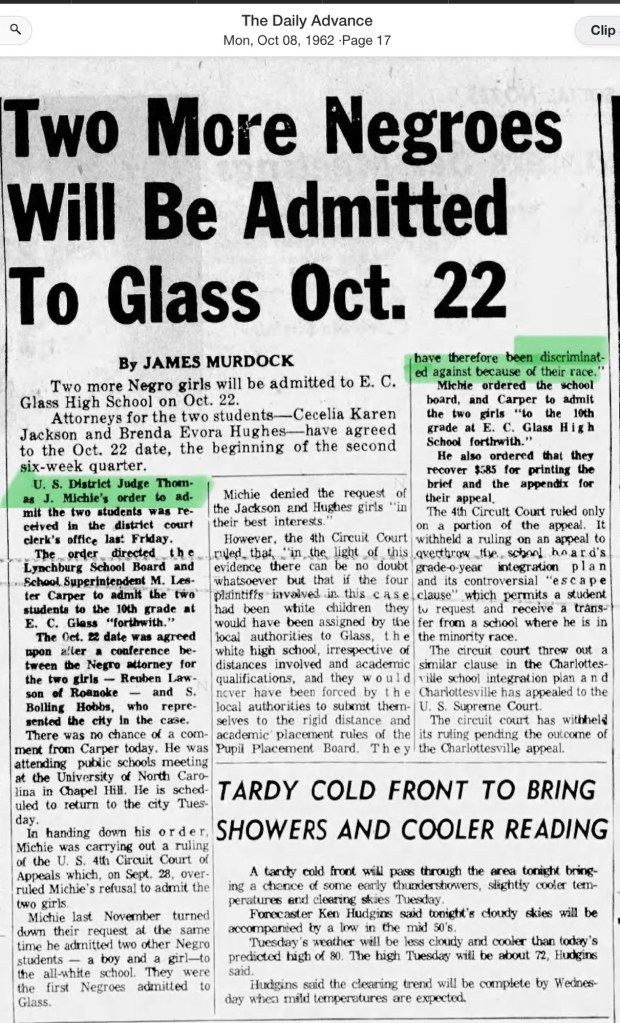
In 1962, the school board again delayed the application process for two more students seeking admission. Yearbooks from 1961–1964 suggest that the Price siblings were the only African American students at Blacksburg High during those early years. In the years that followed, more students of color began to appear in the yearbooks. By 1966, the school board closed Christiansburg Institute, and all of the county’s white high schools were finally opened to every student.
04 April 1961 Daily Progress04 April 1961 The Free Lance-Star04 April 1961, Roanoke Times04 April 1961 Martinsville Bulletin13 April, 1961 The World-News13 April 1961, Roanoke Times13 April 1961 News & Advance14 April 1961 The World News17 April 1961 The World-News19 April 1961, Ledger-Star30 April 1961 “Cross Burned on Blacksburg School Grounds” Roanoke Times
July 1961
26 July 1961 Richmond News Leader26 July 1961 Danville Register & Bee31 July 1961 The World-News
August 1961
01 August 1961 Roanoke Times10 August 1961 Roanoke Times21 August 1961 The World News23 August 1961, Danville Register & Bee23 August 1961 The World News29 August 1961 The News and Advance
September 1961
05 September The Richmond News Leader05 September 1961 The Ledger-Star06 September 1961 The Richmond Times Dispatch 06 September 1961 The Virginia Pilot06 September 1961 The News and Advance05 September The Ledger-Star
1962 Application of Two Young Women, the Courts Ruling
18 May 1962 Roanoke Times14 July News and Advance08 October 1962 Daily Advance
1979-81 Roanoke Times Reporting on the Desegregation of the Montgomery County Schools
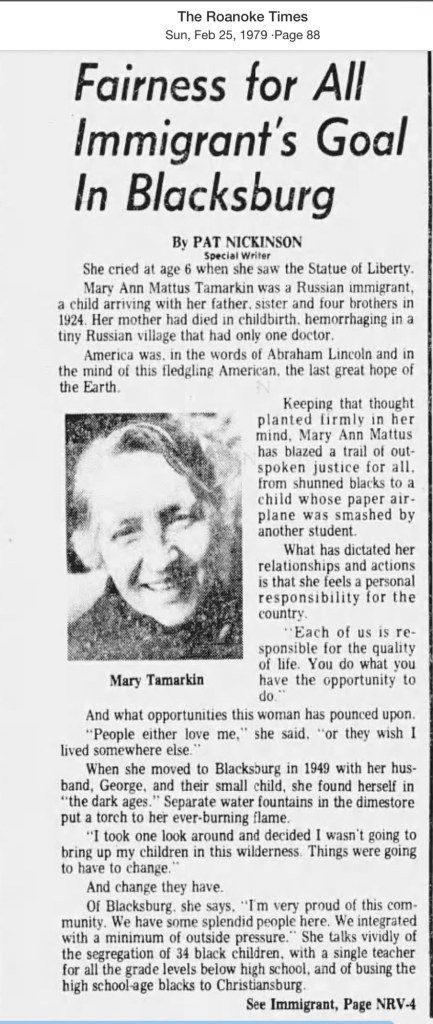
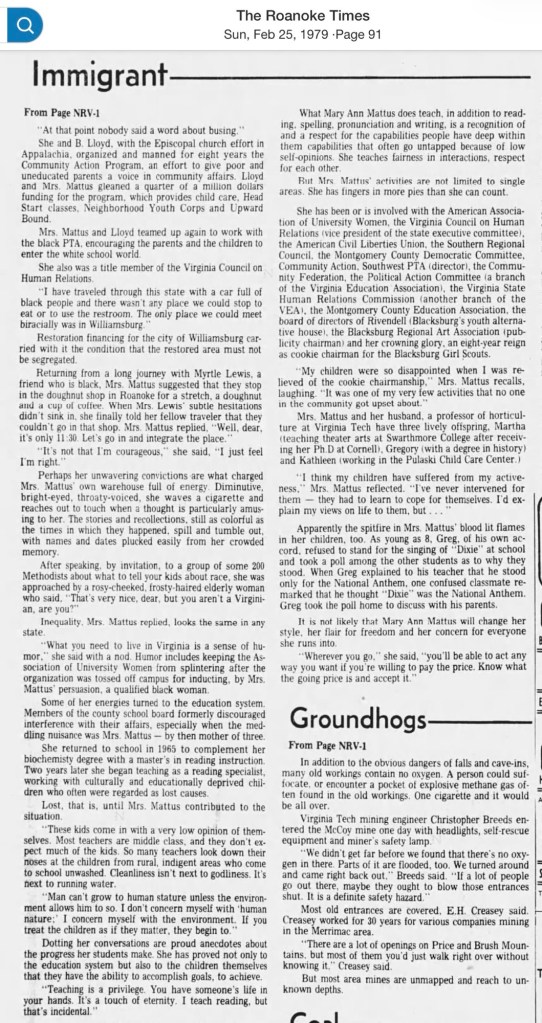
In 1979 and 1981, as Montgomery County marked the tenth anniversary of the first African American students attending previously white-only public schools, The Roanoke Times published a series of articles examining the community’s experiences with school desegregation and the racial issues that surrounded it.
In 1979, reporter Pat Nickinson focused on the memories and activism of Mary Ann Tamarkin Mattus. Mary Ann and her husband, Dr. George Mattus, a pomologist and professor at Virginia Polytechnic Institute (now Virginia Tech), moved to Blacksburg in 1949 when he joined the university faculty. They raised their family in Blacksburg, where Mary Ann became a reading specialist in Montgomery County Public Schools and an outspoken advocate for civil rights and educational equity.
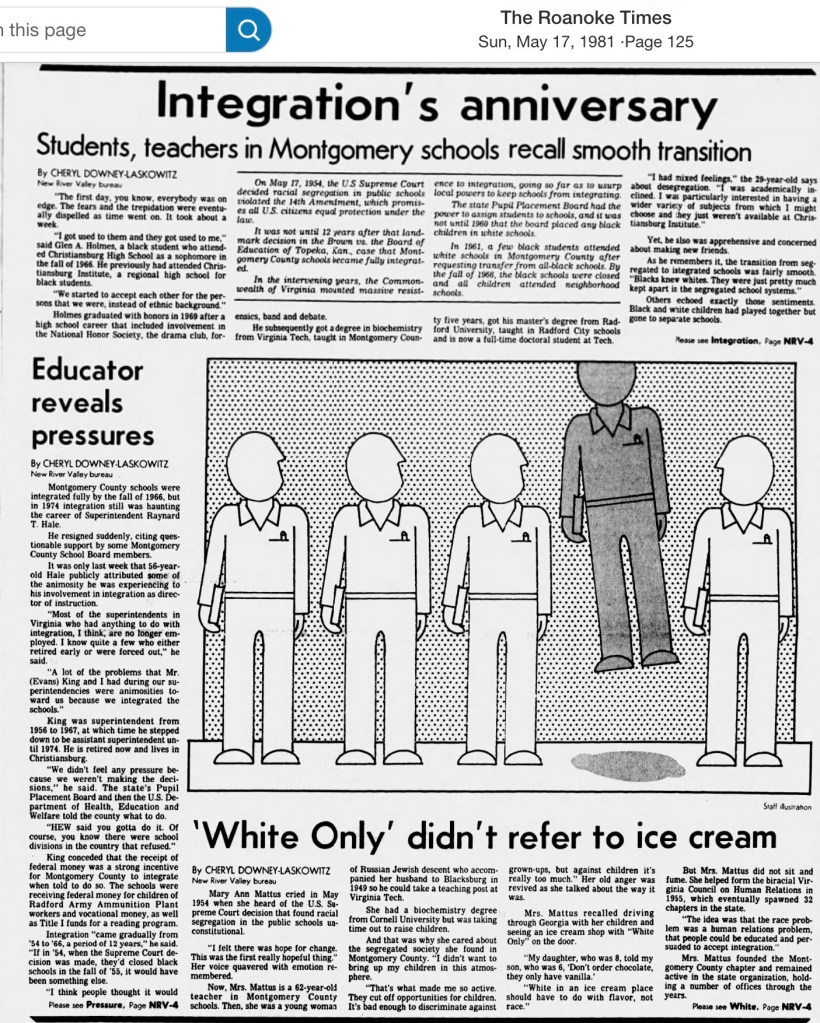
Two years later, Cheryl Downey-Laskowitz revisited the subject through a three-part series that examined school desegregation from multiple perspectives.
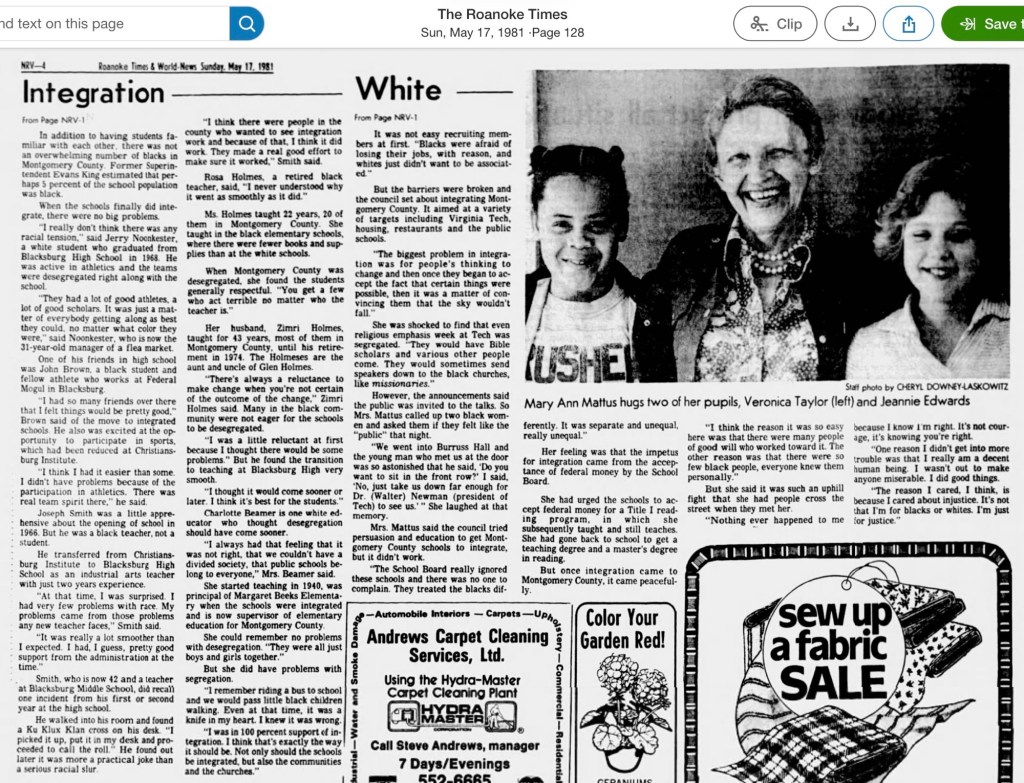
The first article, “Students, Teachers in Montgomery Schools Recall Smooth Transition,” featured the recollections of former Black students Glen A. Holmes and John Brown; Black educators Joseph Smith, Rosa Holmes, and Zimri Holmes; and white educators Charlotte Beamer, principal of Margaret Beeks Elementary School, and Mary Ann Mattus, reading specialist. Veronica Taylor and Jeannie Edwards were pictured with Mrs. Mattus in the accompanying photograph. Collectively, the interviews and photograph illustrated both the successes and the complexities of integrating Montgomery County’s schools.
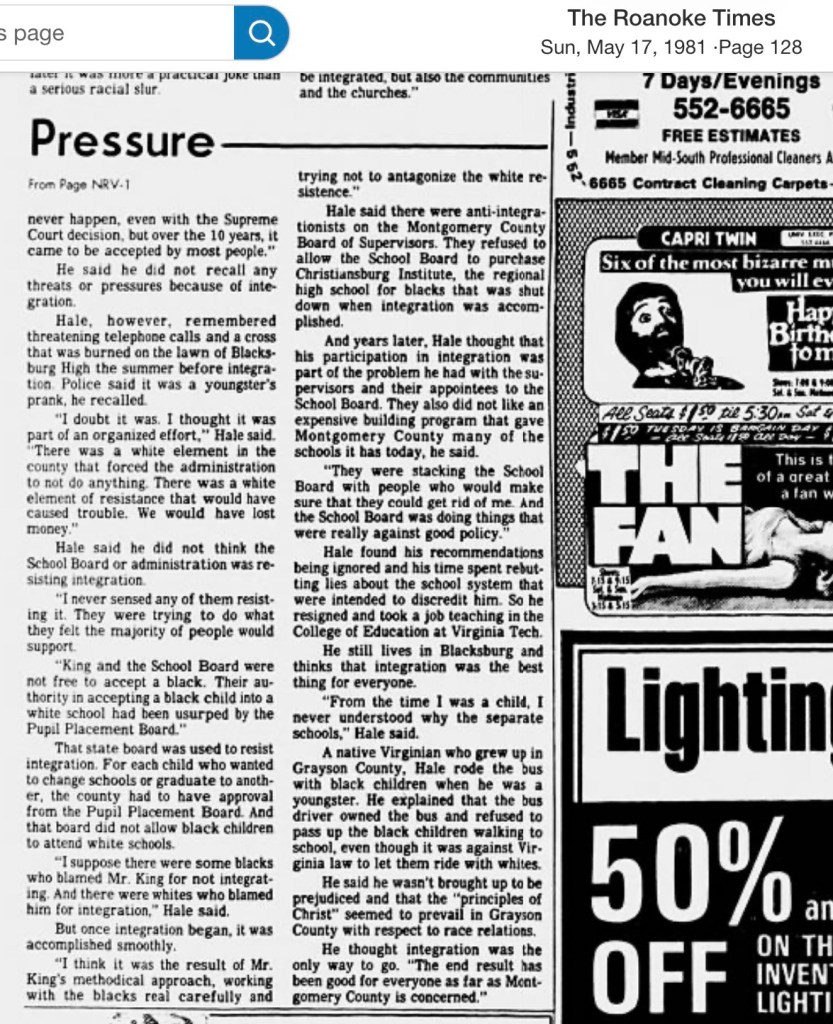
The second article, “Educators Reveal Pressures,” examined desegregation from the perspective of Superintendent Raynard T. Hale and former Superintendent Evans King. Hale recalled the hostility surrounding the approach of integration, including threatening telephone calls and a cross burned on the lawn of Blacksburg High School the summer before desegregation. Although police characterized the incident as “a youngster’s prank,” Hale disagreed, recalling, “I doubt it was. I thought it was an organized effort.”
Hale and King also described the constraints imposed by Virginia’s Pupil Placement Board and the U.S. Department of Health, Education, and Welfare. They emphasized that local superintendents had little flexibility in implementing desegregation policies. At the same time, federal officials tied compliance to the continuation of significant funding streams, including support associated with educating children connected to the Radford Army Ammunition Plant, as well as Title I and vocational education funds. Their recollections highlighted the complex intersection of local decision-making, state authority, and federal enforcement during the desegregation era.
The third article, ”‘White Only’ Didn’t Refer to Ice Cream,” returned to the experiences of Mary Ann Mattus and her decades-long commitment to civil rights. The article recounted the founding of the Montgomery County chapter of the Virginia Council on Human Relations in 1955, an interracial organization established by Mattus and local clergy. The coalition included Rev. Archie Richmond of the AME Church in New Town and Rev. B. Lloyd of the Episcopal Church, who worked together to promote racial understanding, challenge segregation, and foster dialogue within the community years before public school integration became a reality.
Taken together, these articles provide a valuable retrospective on Montgomery County’s desegregation experience.
25 Feb 1979 Roanoke Times25 Feb 1979 Roanoke Times17 May 1981 Roanoke Times17 May 1981 Roanoke Times17 May 1981 Roanoke Times
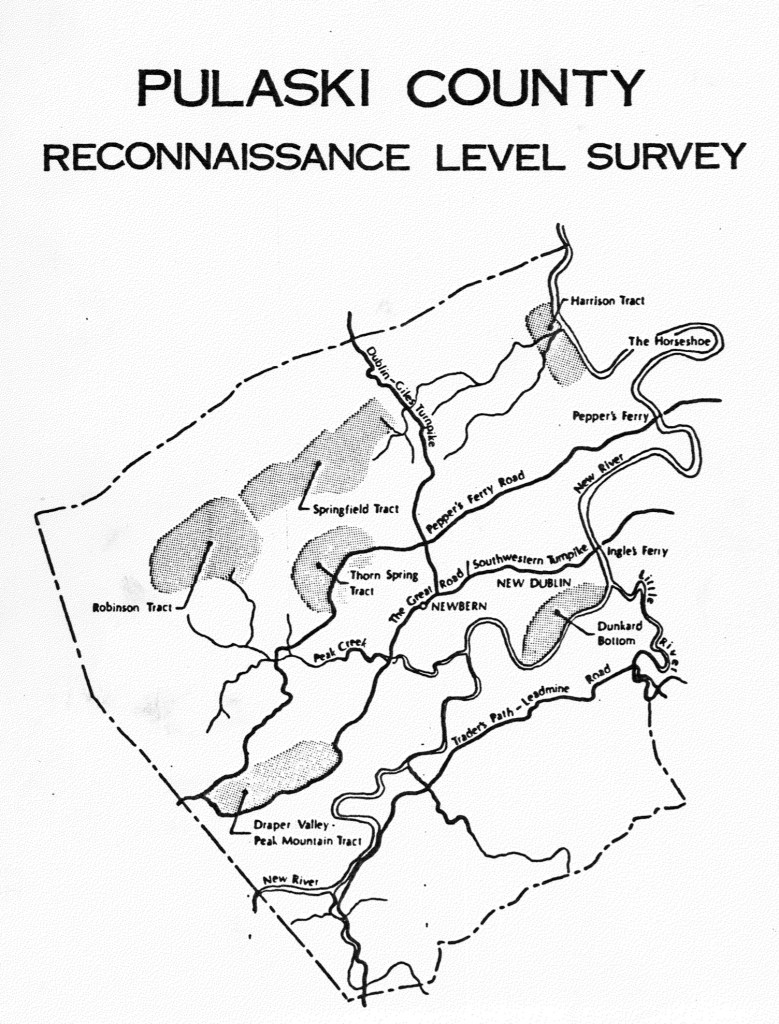
Pulaski County Reconnaissance Survey, created by Gibson Worsham, Dan Pezzoni, and many others, is such a valuable resource. It provides vital insights into African American history in Southwest Virginia and the greater Central Appalachian region, helping us better understand the interconnected stories that shaped our communities.
Montgomery County, Virginia, has never existed in isolation.
The people who have lived here—whether by choice, through enslavement or servitude, or as Indigenous communities who established towns long before European arrival—moved across boundaries freely. They traveled, traded, fought, buried their dead, and carried out the everyday work of survival across what later became county lines.
This is why the Pulaski County Reconnaissance Survey, created by Gibson Worsham, Dan Pezzoni, and many others, is such a valuable resource. It provides vital insights into African American history in Southwest Virginia and the greater Central Appalachian region, helping us better understand the interconnected stories that shaped our communities.
This report is fully searchable and contains valuable early documentation on African American schools, churches, and communities. It also includes a generalized map that highlights both early European settlements and land tracts. For example, Dunkard’s Bottom—now submerged beneath Claytor Lake—was once part of an early German settlement.
The report also identifies significant Scotch-Irish tracts such as Draper Valley/Peak Mountain, Harrison, Robinson, Springfield, and Thorn Spring. It notes the communities of Newbern and New Dublin, along with the region’s main transportation routes: Traders Path/Leadmine Road, the Great Road/Wilderness Road/Southwestern Turnpike, Peppers Ferry Road, and the Dublin/Giles Turnpike.
The report offers a clear explanation of the early Importation and Treasury Rights system used to claim land (see pages 23–24). For further detail, see F.B. Kegley, Kegley’s Virginia Frontier, Roanoke, VA: Southwest Virginia Historical Society, 1938. p. 59.
The report contains interesting data about the enslaved, noted on page 44. Also, the churches and New River Village is discussed beginning on page 56.
In Pulaski the pattern of large landholding influenced the ownership of slaves. Whereas in Montgomery County there were 2,219 slaves, and in Pulaski only 1,589 in 1859, eight slaveholders had more than fifty slaves in Pulaski while only two landowners in Montgomery possessed as many. In both counties, however, the majority of owners possessed ten or fewer slaves. During the Civil War, the Confederacy began requisitioning slaves to work in the war effort. At the beginning of the war many slaves were requisitioned and shipped to Richmond to fortify the state capital. In the following three years slaves were requisitioned four times so that by 1865 the county found it could no longer comply as it was being drained of free and slave manpower, food supplies and money.
Timeline was created for the 2030 Comprehensive Plan of Pulaski County
A Note on the Language in the County’s Comprehensive Plan
As part of Montgomery County’s 30-year Comprehensive Plan, a historical timeline was created. While the dates provided are generally accurate, the language used to describe Indigenous people and borderlands does not align with our values.
We want our readers to be aware that these depictions reflect the language of the plan’s authors—not the values or beliefs of this website. Our commitment is to present history in a way that acknowledges the dignity, presence, and contributions of all people who have lived in this region.
Note that the African American community of “New River” came to exist after emancipation.
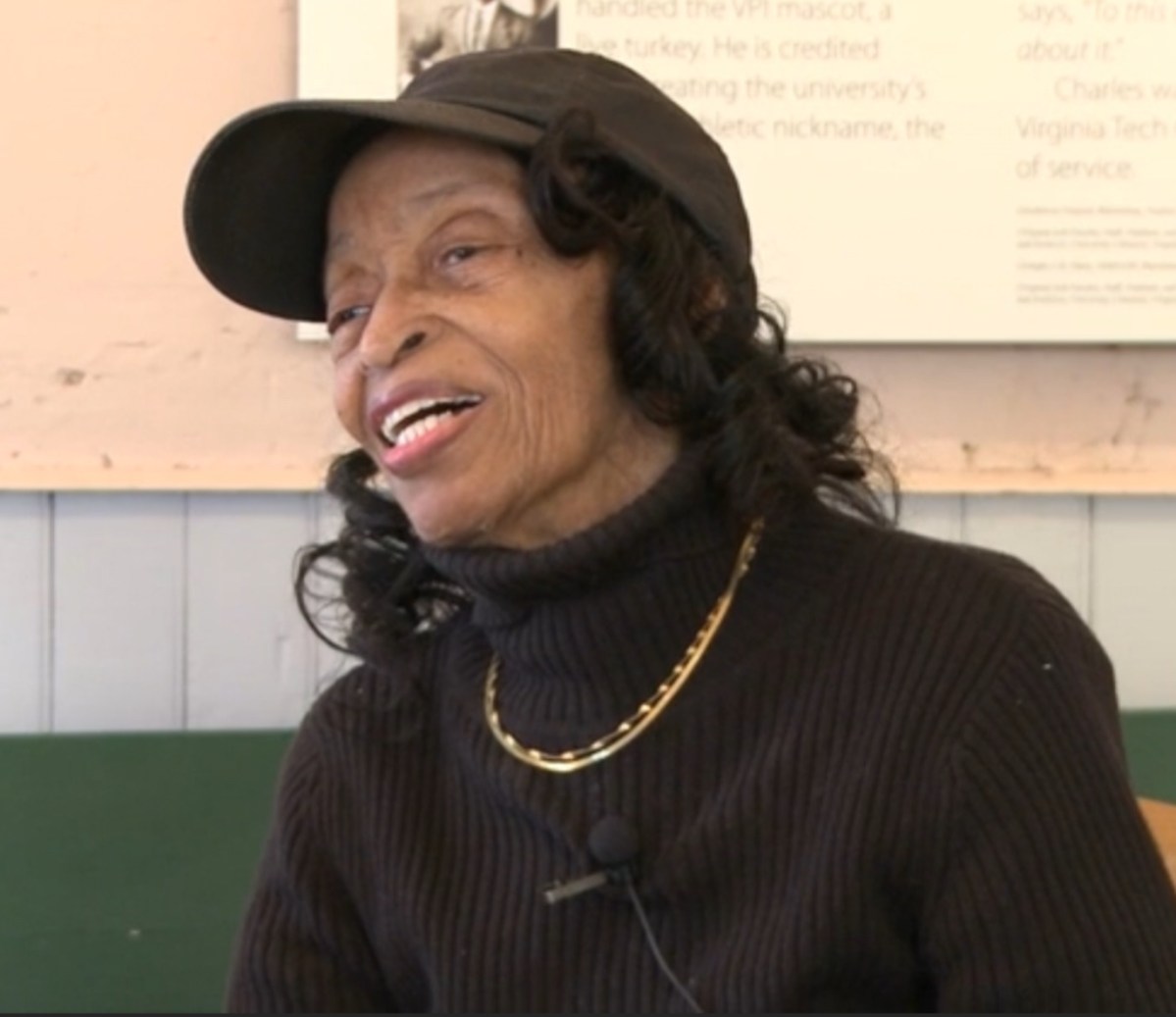
On December 17, 2013, Ms Beatrice Walker provided an oral history for Virginia Tech’s University Special Collections, recorded at the St. Luke, Odd Fellows, and Household of Ruth Hall. Beatrice played a pivotal role in saving the building and is listed as a Trustee on the deed now held by the Town of Blacksburg.
Her interview offers critical insights not found in written records, shedding light on the significant but under-documented role of Maggie Lena Walker’s Independent Order of St. Luke within the African American community of Blacksburg. It also addresses the erasure of the New Town neighborhood driven by corporate greed and the persistence of institutional racism in 21st-century Blacksburg.
Beatrice shared that Mrs. Walker’s mother, Bessie Briggs Freeman, was an active scout for the St. Luke Council, traveling to Richmond and other communities to recruit new members. It is compelling to imagine Bessie collecting, transporting, and depositing membership dues into the St. Luke Penny Bank in Richmond, further linking the local Council to the broader financial and social empowerment network, especially for women, envisioned by Maggie Lena Walker.
Topics per Timestamp (approximate time and the information within brackets are for context and clarification, not provided by the interviewee)
00:00 – Introducing Beatrice Freeman Walker: She was born in the region, possibly at Burrell Memorial Hospital in Roanoke. She noted that while Black patients could be treated at Showalter Hospital in Christiansburg, they were not allowed to stay overnight.
Beatrice grew up with her parents at 202 Jackson Street in a neighborhood known as Jackson. In this area, African American families lived on one side of the street, with their homes facing Jackson Street, while White families lived on the opposite side, facing Penn Street. Black residents also lived on nearby streets, including Bennett, Roanoke, Clay, and Wharton. That was different from New Town which was a totally segregated Black neighborhood on both sides of the street.
1:45 – The interviewer asked Mrs. Walker how her family came to settle in Blacksburg. She explained that her father [Alonzo Walker, Sr.]was originally from Statesville, North Carolina, but she was unsure of what brought him to Blacksburg. Mrs. Walker mentioned that she believed Black residents were allowed to live on Jackson Street beginning around 1867.
1:52 – When asked how her family came to live in Blacksburg, Mrs. Walker explained that her father, Alonzo Freeman Sr., was born in Statesville, North Carolina. He eventually settled in Jacksonville in 1867, establishing roots that led to the family’s connection with the area.
3:16 – As noted earlier in the interview, the Jackson and Bennett Street neighborhood was segregated. Mrs. Walker explained that while Black families faced Jackson Street, white families generally faced Penn Street. [he Siebold family had a Jackson Street address but, like the Effinger and Sites families, their homes faced Penn Street.] In addition to Jackson Street, Black residents also lived on Wharton, Clay, Roanoke, and Lee Streets. While Black and white children often played together, tensions typically arose among the parents.
5:40 – Children were expected to contribute to their family by helping with chores for their parents and grandparents. Mrs. Walker’s father operated a cleaning business, while her mother, [Bessie Briggs Freeman] worked in private homes, including for Rev. Richardson of the white Episcopal Church located at the corner of Church and Jackson Streets, and for the Red Cross. When a Black parent passed away, her mother coordinated with the Red Cross to bring their soldier child home for the funeral. She also worked for Jim Devine at VPI and was responsible for preparing communion at the Christian and Episcopal Church. [Major General John M. Devine, ret. became Commandant of Cadets in 1952]
7:14 – Bessie B. Freeman played a significant role in the Independent Order of St. Luke [specifically with St. Frances Council #235 of Blacksburg] by traveling throughout the region to recruit members for the organization. She journeyed with members from other St. Luke Councils in places like Richmond, South Boston, and Roanoke, who joined her in Blacksburg for these vital recruitment efforts. Mrs. Walker believed her mother and her companions traveled by car.
Mrs. Walker explained that the St. Luke organization was founded by Mary Prout of Baltimore, Maryland, to assist newly freed individuals who were often left to die on roadways or faced significant challenges in securing basic necessities. [The organization provided critical support such as food, clothing, jobs, and life-and-death assistance.]
Mrs. Walker discovered documents belonging to her mother related to St. Luke’s work and gave them to Terry Nichols [Blacksburg Museum].
11:15 – She noted, “Most of the people in Blacksburg were St. Luke’s, not Odd Fellows, and that’s why the hall was built.” The St. Luke Council included both men and women, and their meetings were held upstairs in what was considered a sacred space. She also mentioned that the Masons and Eastern Star shared the use of the hall.
12:14 – Downstairs, the hall hosted various events to raise funds, including dances, bingo parties, sock hops, weenie roasts, and even “man-only” weddings (held at both the hall and the church). Dinners were also organized to pay for building fund and support members traveling to Convocation in North Carolina or Union meetings in Richmond.
14:18 – Mrs. Walker explained that, due to the small African American population in this rural area, the two churches in town—the AME and Baptist churches—collaborated on events such as picnics. Her mother was a member of the First Baptist Church on Clay Street, while her father belonged to St. Paul AME Church on Penn Street. The Baptist church held its services in the evening, while the AME church held morning services, allowing them to attend services at both churches.
15:05 – The churches organized picnics at parks in places like Staunton, Natural Bridge, Mill Mountain Star, and Wytheville. On one occasion, their minister, Rev. Archibald Richmond, was arrested during a picnic at the Virginia State Park in Wytheville. The group was asked to move to the Black section of the park, but they refused. As a result, Rev. Richmond was arrested. He was released later the same day by members of the church.
17:15 – Another story of resistance involved a bus station sit-in led by Rev. Richmond. At the time, Black people were required to buy their bus tickets at the back door and were not allowed to wait or eat in the station. Rev. Richmond helped lead a sit-in to challenge this discriminatory practice. He also played a key role in integrating the schools. [In Montgomery County, Black children weren’t outright barred from attending high school, but each child had to apply to the school board for permission, often accompanied by a public petition. The bus station was where the Hokie House Bar and Restaurant is now located.]
18:35 – Rev. Archie Richmond the leader of the St Paul AME and Rev. Ellison Smyth of the Blacksburg Presbyterian Church were both members of the NAACP in the area. They worked together to challenge local systemic racism, particularly in relation to the segregation of schools and public spaces.
19:26 – Mrs Walker was a member of the St Paul AME church.
19:45 – “The story of St. Luke’s hasn’t been told enough. All you hear about is the Odd Fellows, but you don’t hear anything about St. Luke’s… that’s the part that’s so interesting, St. Luke’s, because they were the ones who had the insurance.” Mrs. Walker also mentioned, “Maggie L. Walker is the one who created all kinds of opportunities for Black people to learn different trades and jobs.”
Mrs. Walker’s sister, Nannie Bell Walker Snell, attended Bluefield State College for two years but didn’t enjoy it. Instead, she went on to attend Apex Cosmetology School in Richmond, which was part of St. Luke’s initiative to provide job training for women.
21:45 – Maggie Lena Walker’s vision was, “A penny makes a dollar.” She became the first Black woman to serve as president of a bank. Members of St. Luke’s were required to contribute a minimum of 10 cents. The bank allowed individuals to borrow money to fund their children’s education and also offered life insurance.
“It’s so interesting, but nobody knows about it because it hasn’t been told—like it should be told.”
Mrs. Walker’s mother worked alongside Mr. Carrington from South Boston, who visited the area. Dorothy Turner became the Secretary after Maggie Walker’s death, and Ruth Hilton of Roanoke was also involved. She was busy. [*see information below about these people]
26:49 – When reflecting on Blacksburg, Mrs. Walker expressed strong feelings about the town’s history. In 1998, the town’s branding was “Blacksburg: A Special Place for 200 Years,” but Mrs. Walker disagreed, stating, “It is not a special place, it is a greedy place.” She continued, “They just took the land from the Blacks. After one Black would leave, Whites take over and would have apartments the next year.”
27:36 – “Just like my property was taken when my parents died. Fire department decided they wanted that land and sell or condemn.” Mrs. Walker explained that her family’s property stretched from Jackson Street to the creek, which made it highly sought after by the town. However, the family was unfairly treated during the sale, especially when they were offered a much lower price than the property’s true value.
29:20 – The brick house next to the Freemans’ home [Sears family] was moved to Roanoke Street because the family also faced the same treatment.
30.00 – Her father owned many pieces of property including Roanoke and a large tract of land known as Paradise View, which stretched from what is now Nellie’s Cave Road (formerly called Grissom Lane) to the area west of Woodland Hills subdivision. It served as a weekend retreat for Black families, offering space to play croquet and badminton, enjoy picnics, and relax. A house on the property was home to a white couple who maintained the grounds and assisted the weekend guests.
She described the beauty of the area, remarking on the abundance of flowering trees throughout the town and the plentiful fruit, including the distinctive Green Gage plums.
35:00 – Mrs. Walker recalled how segregation did not bother her, though shopkeepers would follow her whenever she entered a white-owned store, reflecting the racial challenges she faced. She worked for Mr. Kidd at Spudnuts Donut Shop, located next to the Lyric Theatre, which later became Carol Lee Donuts. If a white teenage girl spoke with a Black boy, the parents sent their daughter to St Albans, a mental health hospital. Shifting to descriptions of life at the time, she noted that most homes had large gardens, often with chickens and even a cow.
After her father, Alonzo Sr., closed his cleaning business, he went to work for John Warren, the owner of Sanderson’s Cleaners on South Main Street. She mentioned that her father kept a shop ledger, which Lonnie might still have. In his business, he cleaned suits for $2, repaired clothing, and even sold suits that he purchased in Gainsborough.
Mrs. Walker also remembered the skating rink on Airport Road, located next to a seafood restaurant, where dances were regularly held. On Barger Street, there were several Black-owned businesses, including Kip’s Shoe Repair Shop. Kip also owned another shop on the southwest corner of Jackson and Church streets. A Black owned clothes cleaners was located near the VPI cadet dorms.
45:46 – “Hard to believe that Blacksburg has changed so much,” Mrs. Walker reflected, recalling many landmarks from the 1950s and 60s and comparing them to what she saw in 2013. She mentioned several notable places, including Dr. Roop’s house at the northeast corner of Jackson and Main Streets, Faculty Row, and the houses along North Main Street. She also remembered Mr. Sears’ barber shop, which was located to the right of the Lyric Theatre and later became Carol Lee Donuts. Other landmarks included Kip Wade’s shoe repair shop on Jackson Street, and Lewis [?] who ran a cleaners on the south side of East Roanoke Street near Woolwine.
Families from that same neighborhood included the Pages, Warrens, Carrolls, Saunders, Colemans, and the Taylors from West Virginia, along with Chip Price, who provided taxi service. She also recalled the Clay Street dance hall, the Moon Glow, and Laura Anderson, who was 106 years old in 1976 and the oldest person in the county at that time.
55:32 – In this part of the interview, Mrs. Walker recounted how the building was saved when someone brought the Town engineers’ condemnation notice to the public’s attention, sparking community action to preserve the structure. Christine Price, Ethyl Dobyns, and Mrs. Walker were all involved in the effort.
1:00:43 – The hall has always been in use and never left unattended. Mr. Price, a local contractor, stored lumber in the hall, and later a woodworker converted the space into a workshop. In exchange for maintaining the building, these men were allowed to utilize it rent-free. However, when Mr. Price was overseeing the building, Mrs. Dobyns discovered that the original framed charter, pictures, chairs, and documents were scattered on the second floor, and several items, including one of the podiums, were missing.
1:05:38 – The interviewer asked if desegregation brought any changes to the St. Luke and Odd Fellows organizations in Blacksburg. Mrs. Walker was emphatic in her response, stating that there was no change to the organization, implying that racial attitudes had not shifted. She noted that some of the Museum’s pamphlet was problematic.
1:10:13 – Mr. Floyd Hobeson Meade trained a turkey to gobble every time the VPI football team scored a goal. Mrs. Walker mentioned his death in 1941 after he was struck by a car on Airport Road. Tragically, he died because the local hospital refused to treat Black patients, forcing Meade to be transported to Jefferson Hospital, which delayed his care and put him in greater peril.
1:15:34 – The discussion turned to the segregation of the local theater, the Lyric. Mrs. Walker described how Black patrons were required to use a separate entrance that led to a designated balcony, highlighting the racial divisions that were enforced even in entertainment spaces.
1:20:00 – Mrs. Walker was the youngest of four siblings, one of two girls alongside three brothers. Two of her siblings, Alonzo and Nannie Bell, attended the segregated Lucy Addison High School in Roanoke. Each Sunday afternoon, the family would visit their aunt in Roanoke, where Alonzo and Nannie Bell stayed during the school week. They returned home on Fridays to spend the weekend with the family. Alonzo became the principal of the Clay Street grade school.
1:21:44 – Beatrice Freeman, Mrs. Walker’s mother, operated an ice cream parlor in a shop attached to their home, located just north of the house near the stream. Later, this shop was repurposed as a beauty salon run by Nannie Bell, Mrs. Walker’s older sister. Nannie Bell had trained at the renowned Apex Beauty School in Richmond.
1:23:14 – Mrs. Walker attended the segregated Clay Street Grade School and was surprised to learn that the Blacksburg Museum was unaware of its history. She recalled how parents had to raise funds to purchase a heating furnace, as the local public school board failed to provide one—a basic necessity one might expect from a public institution. The school consisted of two rooms divided by a sliding door, allowing the space to accommodate both lower and upper grades. Two teachers taught the students, and a small kitchen was located at the back of the building.
1:27:00 – The St. Luke regalia included a distinctive hat that newly initiated members were required to purchase within 90 days of joining.
1:28:02 – Christiansburg Institute welcomed students from as far away as New York, Philadelphia, and Martinsville. However, Mrs. Walker and her siblings attended as day students, commuting daily by taxi.
1:36:10 – In 1943, during her senior year at Christiansburg Institute in Cambria—a regional African American high school serving Montgomery County, Radford, Pulaski, and Giles, with both boarding and day students—Mrs. Walker took the U.S. Civil Service exam. Upon passing, she accepted a job in Washington, D.C. in 1945. Her older sister, Nannie Bell, also worked in Washington as a coder. Prior to this, Mrs. Walker had attended business school in Roanoke after attending West Virginia State for a short time.
1:46:04 – Irving Peddrew III boarding with William and Jannie Hoge, Town racism.
1:50:34 – Mrs. Walker explained why many children of Black families left the area in search of quality employment opportunities, noting that local jobs were often preferentially given to family members. She mentioned knowing Charlie L. Yates at VPI and described the various jobs she held in Blacksburg. Among these was her connection to the Tutwiler Hotel and Boarding House. Mrs. Walker’s children included Leo, William, and Delores.
1:52:22 – The interviewer asked Mrs. Walker if she was familiar with the Montgomery and Pulaski Education Welfare Association, a Black organization active in 1948 that registered Black voters, including Warren Carroll. Mrs. Walker acknowledged that she was aware of the organization but was not personally involved.
1:54:00 – The topic of Friendship Gardens, promoted by the local Black Garden Club, was discussed. Mrs. Walker was familiar with the initiative but did not participate.
1:58:11 – The conversation shifted to the election of President Obama and the racism that surfaced across the nation during this historic event.
For the remainder of the recording, the interviewer asked Mrs. Walker if there was anything else she wanted to add. She expressed her concern that the history of St. Luke was excluded from the narrative presented by the Museum committee, which unsettled her. Over time, St. Luke was incorporated into the name of the hall alongside the Odd Fellows, but only after Mrs. Walker pushed back against Terry Nichols. She stressed that St. Luke was vital to the local African American community, so much so that its members performed ceremonial rites at funerals for their fellow members.
Notes of Context
In the interview Mrs Walker mentions three people who worked with her mother (time stamp 21:45). Mr J.S. Carrington is mentioned in the National Park Service Finding Aid, page 32, Series III: Insurance, subseries A: Deputy Commissions and Assignments, Box 04, for 1943, 1948, 1950. He was also listed on page 39, Box 07, Folder 34 under death claim investigations, 1956.
Dorothy V. Turner is mentioned on the same page, 1966.
On August 4, 1902, Maggie Lena Walker herself founded the St. Frances Council #235, a significant event as she typically delegated the establishment of local Councils in the Independent Order of St. Luke to others.
St Luke, Odd Fellows & Household of Ruth Hall, 203 Gilbert St, Blacksburg, Virginia (Courtesy of Jody Daniels)Badge from the Blacksburg St Frances #235 Council (Courtesy of BMCF)
Maggie L. Walker National Historic Site Connection
The Maggie L. Walker National Historic Site, located in the Jackson Ward neighborhood of Richmond, is owned and operated by the National Park Service. Its archives house a wealth of information, much of which has yet to be digitized or made available online.
On August 4, 1902, Maggie Lena Walker herself founded the St. Frances Council #235, a significant event as she typically delegated the establishment of local Councils in the Independent Order of St. Luke to others. This raises the question: did she visit Blacksburg personally to work with the African American community there? While we currently lack direct documentation to confirm this, there are intriguing connections to consider.
In 1914, Mrs. Walker served on committees of the “Negro Organization Society of Virginia” alongside Edgar A. Long, and in 1932, she served with A.M. Walker on the “Better Home and America” committee. Both Long and A.M. Walker were principals of Christiansburg Institute in nearby Cambria. Furthermore, when the St. Frances Council was established in 1902, Charles Lives Marshal was principal of the school.
These links between Mrs. Walker and influential African American educators in the region suggest the possibility of her involvement with Blacksburg’s community. The search for documentation to confirm her visit continues, but her influence and connections remain an integral part of the story.
The Walton Act of 1894 and the 1902 New Virginia State Constitution – Tools of Voter Suppression
Dan Thorpe’s book, Facing Freedom, provides valuable historical context on how the state legislature curtailed the rights and freedoms of African Americans in Montgomery County. The Walton Act of 1894, presented as a measure to reduce election corruption, required localities to implement a secret written ballot system. This effectively disenfranchised illiterate voters, disproportionately targeting African Americans and many local white men, under the guise of reform.
Further voter suppression was codified in the new Virginia State Constitution, which went into effect in July 1902. It introduced literacy and tax-paying requirements for voting, systematically disenfranchising large segments of the local population.
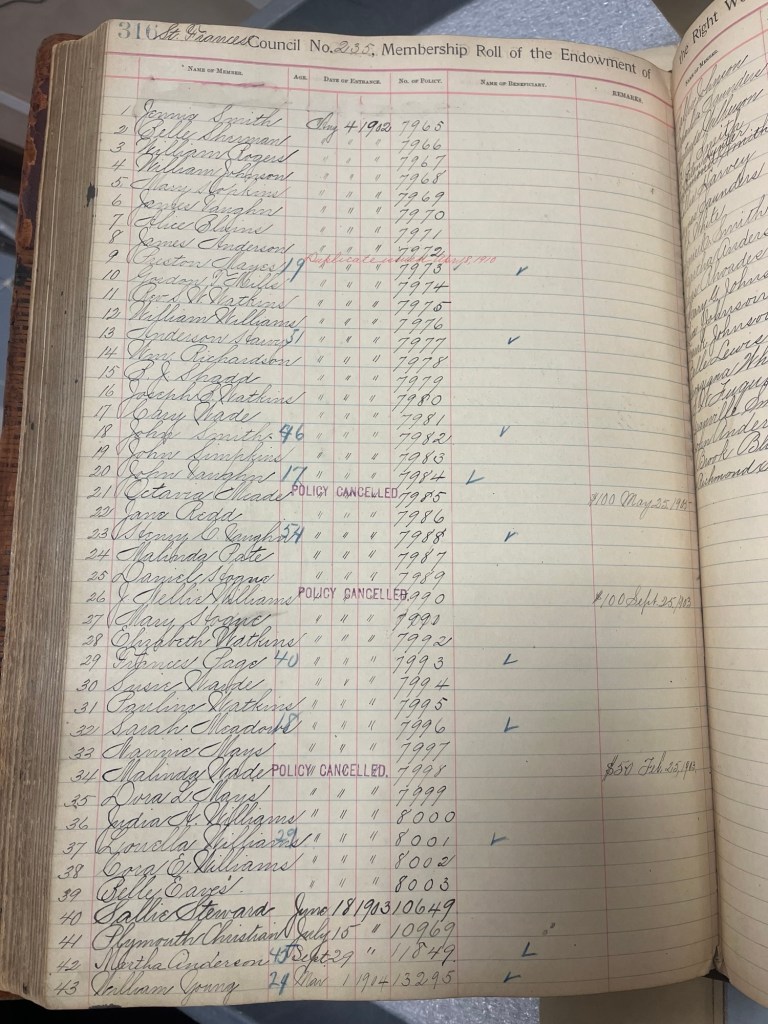
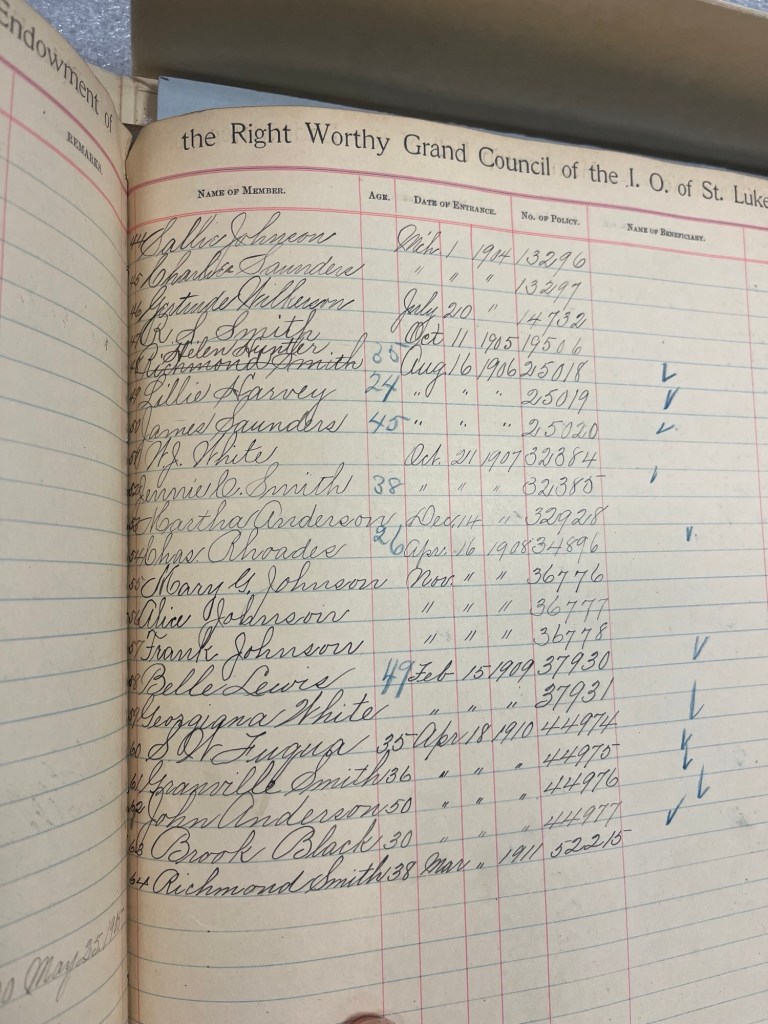
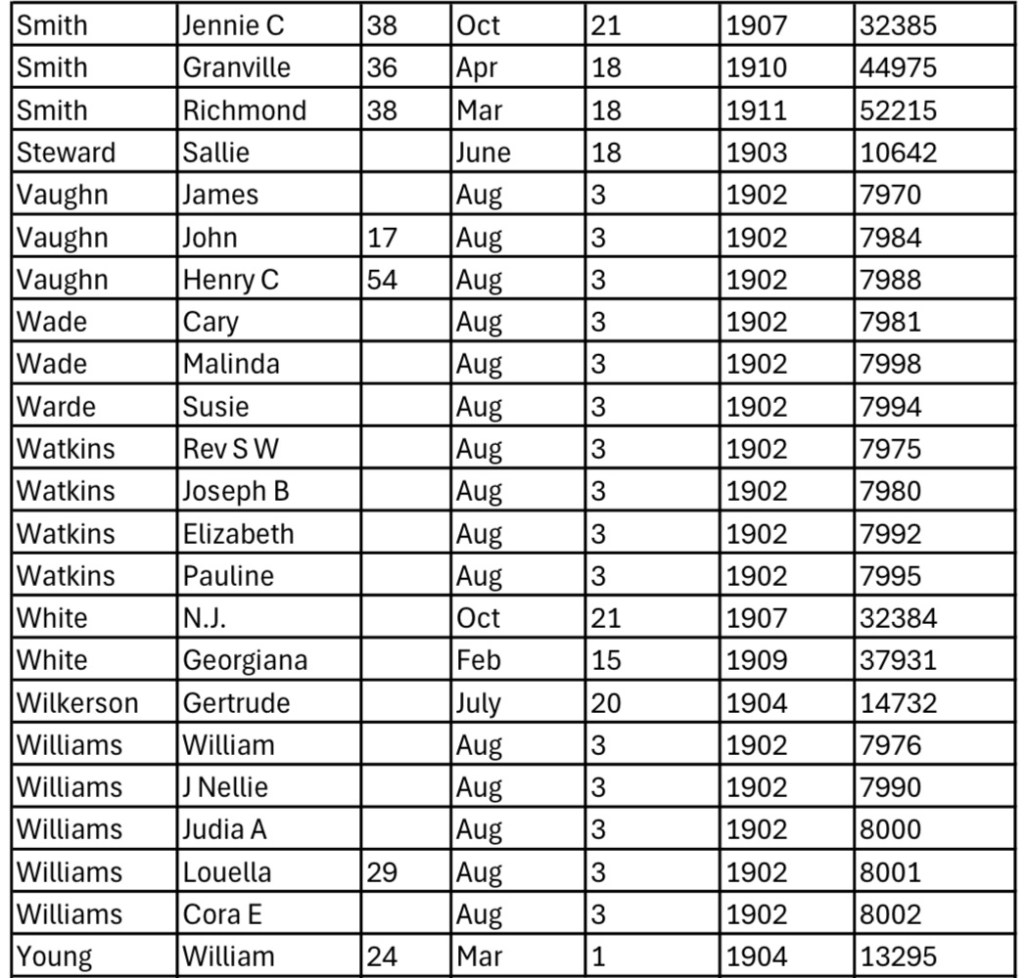
Notably, this legislative shift coincided with Maggie L. Walker’s creation of the St. Frances Council in Blacksburg. The Council’s membership ledger shows that 60% of its initial members signed up on August 3, 1902, just one month after the new voting restrictions became law. Of these members, 55% were women. This timing highlights the Council’s potential role as a unifying force and a means of empowerment in a community grappling with the loss of political rights.
Uncovering Hidden Histories: The St. Luke Ledger and Its Legacy in the New River Valley
This invaluable ledger is preserved at the Maggie L. Walker National Historic Site in Richmond, Virginia. Unfortunately, it has not been digitized or made available online. The ledger includes the names of families residing in the Blacksburg District, which, at the time, extended east to Ellett Valley, south to Yellow Sulphur Springs, west to the New River, and north to Brush Mountain. As a result, it provides a rare and significant snapshot of individuals—primarily women—who may not appear in other historical records.
This document is more than a membership list; it is a record of people who signed life insurance policies, committing to monthly payments to secure financial stability for their families after their death. The majority of these members were women, demonstrating the critical role they played in building community wealth and hope.
The two pages of this ledger tell a hidden story of the region, preserved in the attic of the Independent Order of St. Luke’s building in Richmond since the organization disbanded in 1984. The ledger also contains information about other Councils established in the New River Valley. These Councils did not operate in isolation; they were interconnected through railroad travel, linking Blacksburg with Councils in Pulaski, Dublin, Christiansburg, Salem, and Roanoke.
The Friends of the St. Luke, Odd Fellows, and Household of Ruth are committed to uncovering and sharing the history revealed by these ledgers. Their efforts will honor the individuals who deeded property, designed, built, and gave meaning to the Hall at 203 Gilbert Street, preserving the stories of our shared regional history for future generations.
Maggie L. Walker Historic Site virtual exhibit and objects. Please ask for permission from the National Park Service if you wish to publish the images.
St Frances Council, #235, pages 361-362, Membership Roll 1897-1911 (Courtesy of Maggie L. Walker National Historic Site)St Frances Council, #235, pages 361-362, Membership Roll 1897-1911 (Courtesy of Maggie L. Walker National Historic Site)Transcription of Membership Roll from 1902 to 1911, page 2Transcription of Membership Roll from 1902 to 1911, page 1
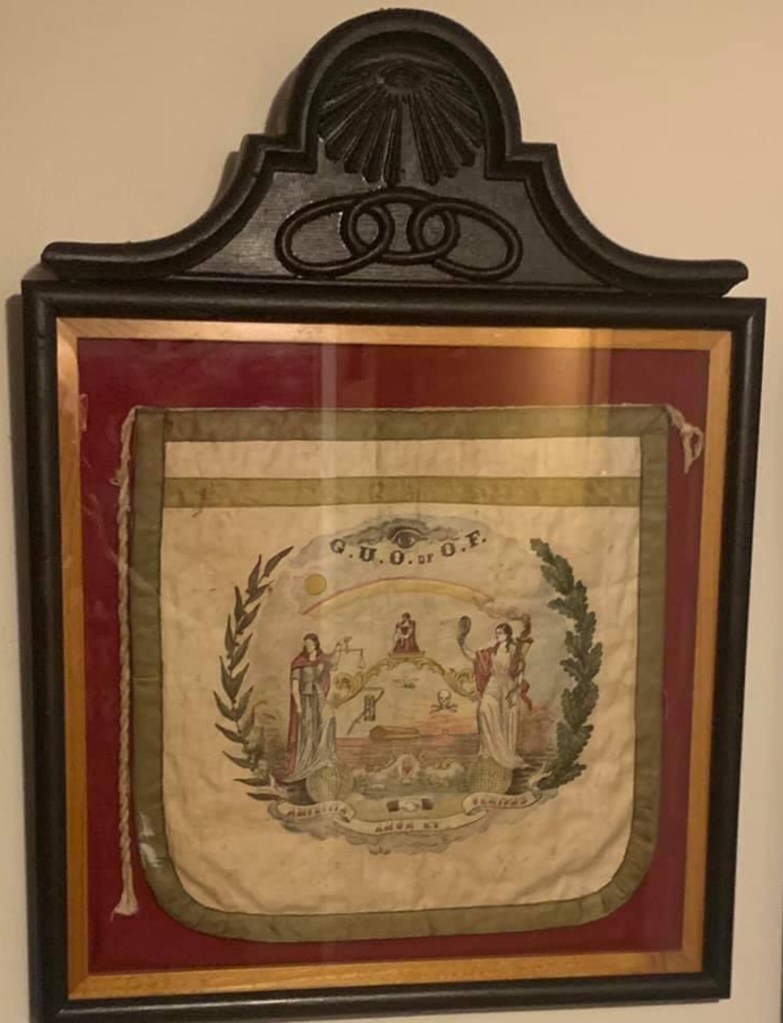
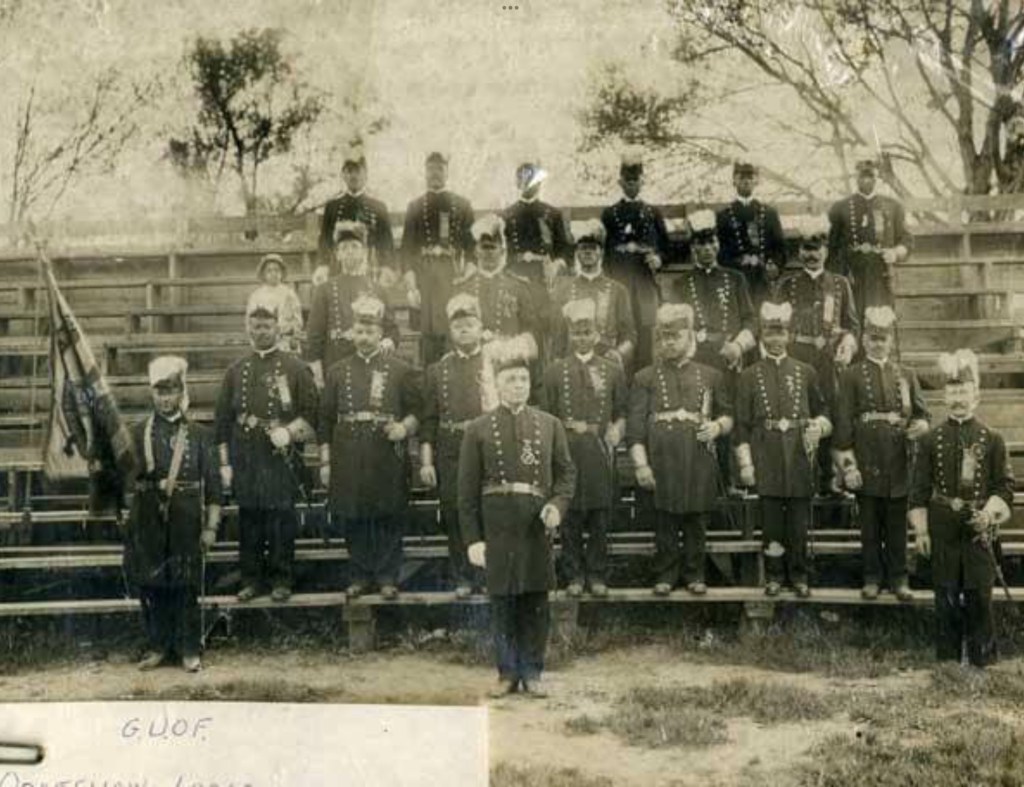
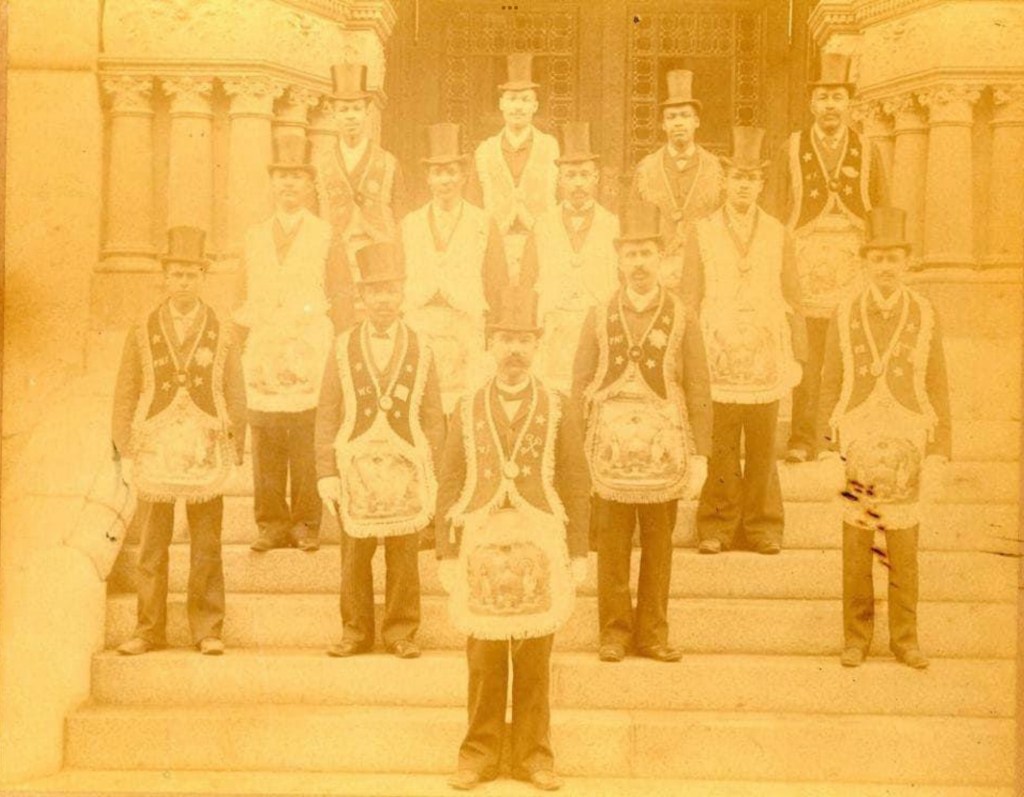
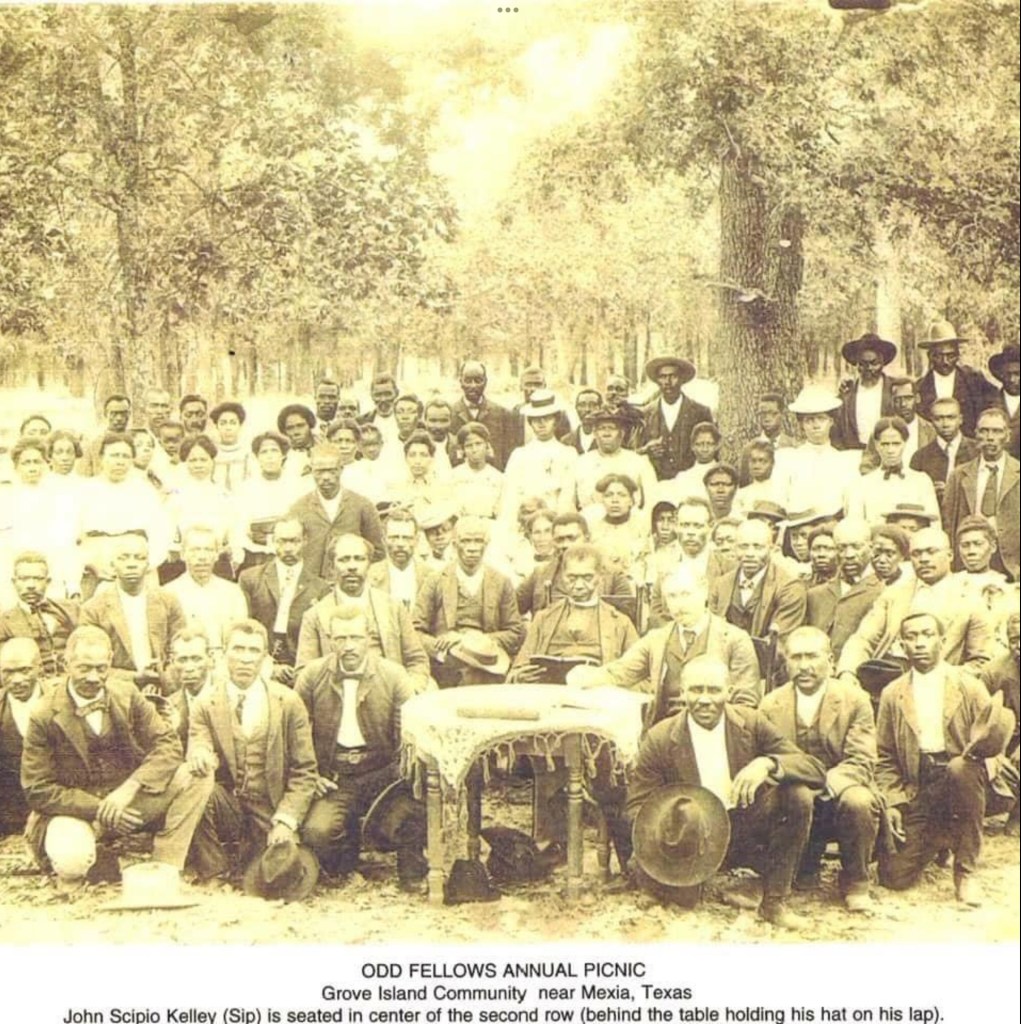
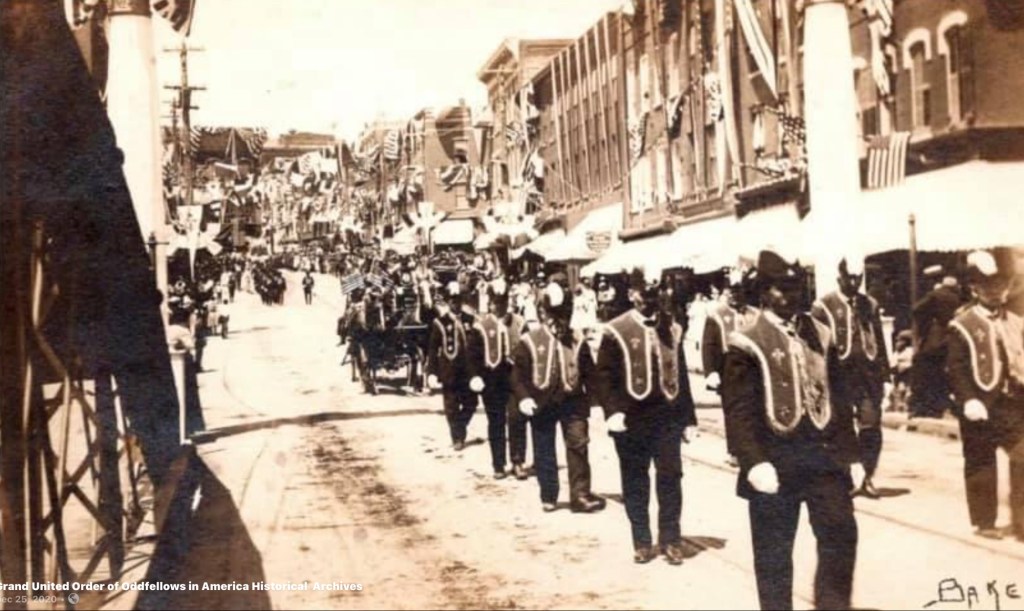
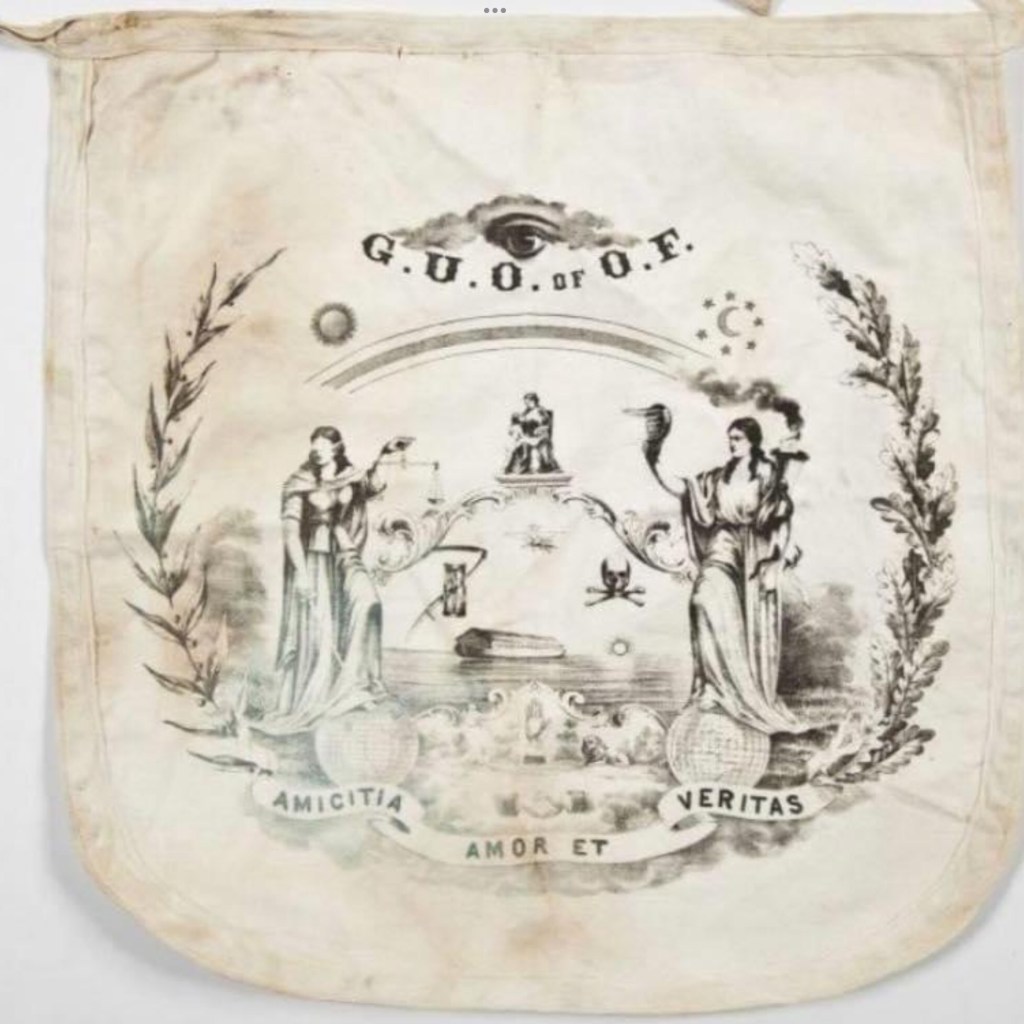
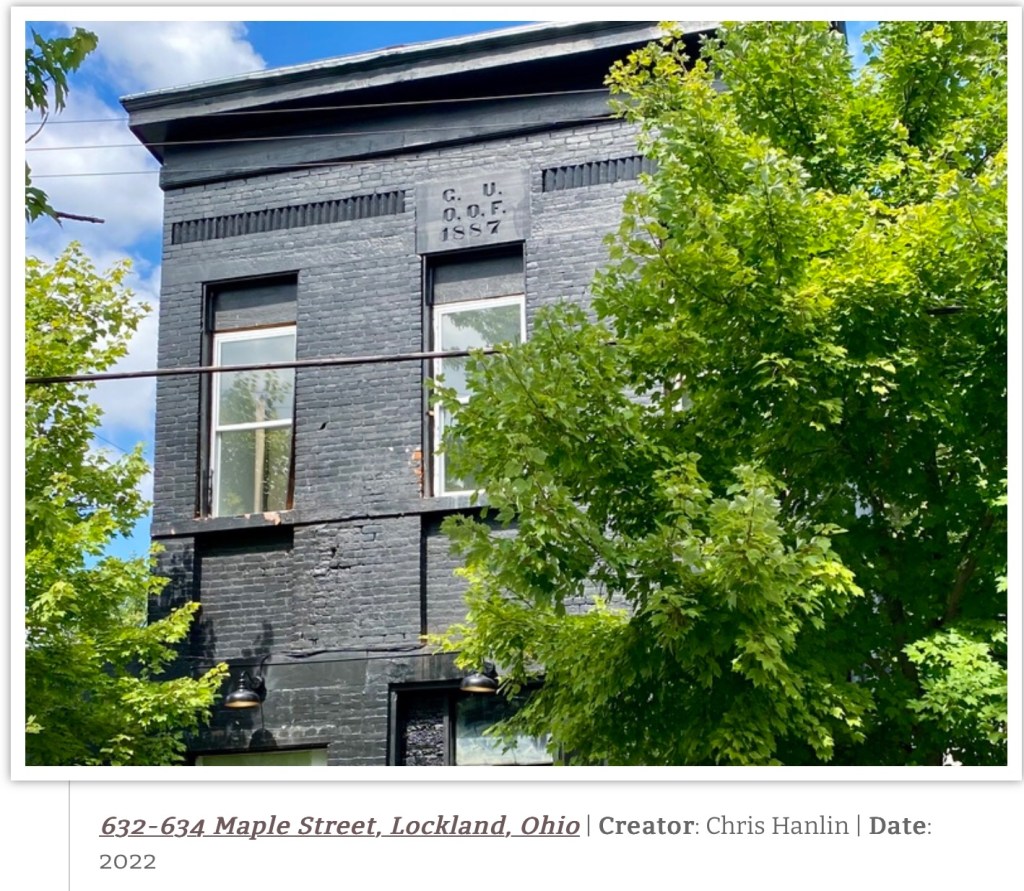
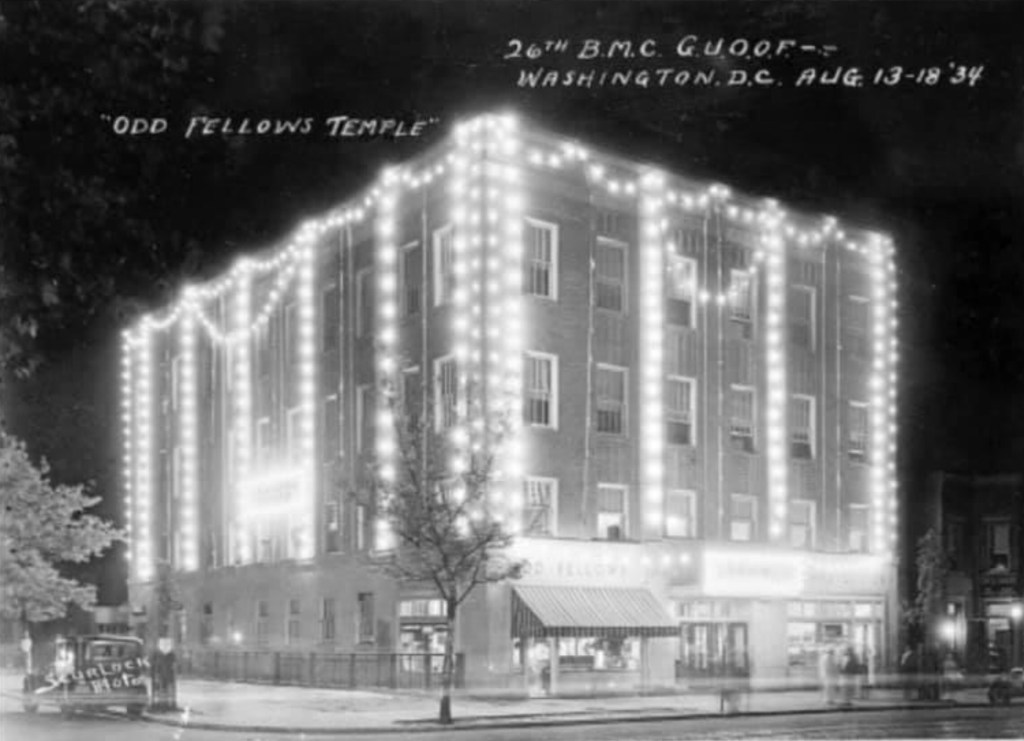
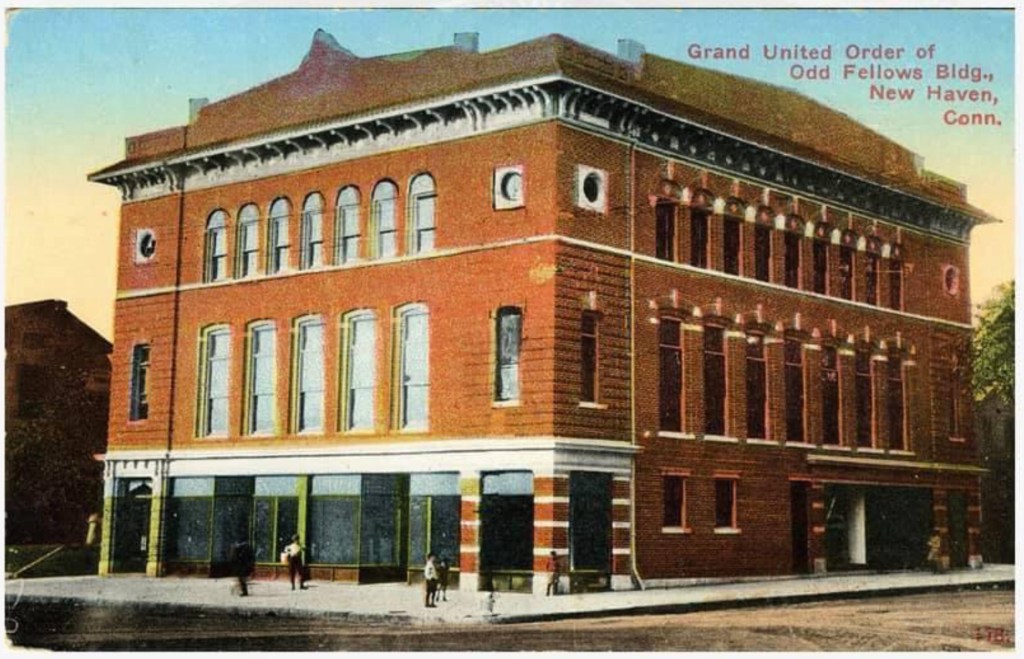
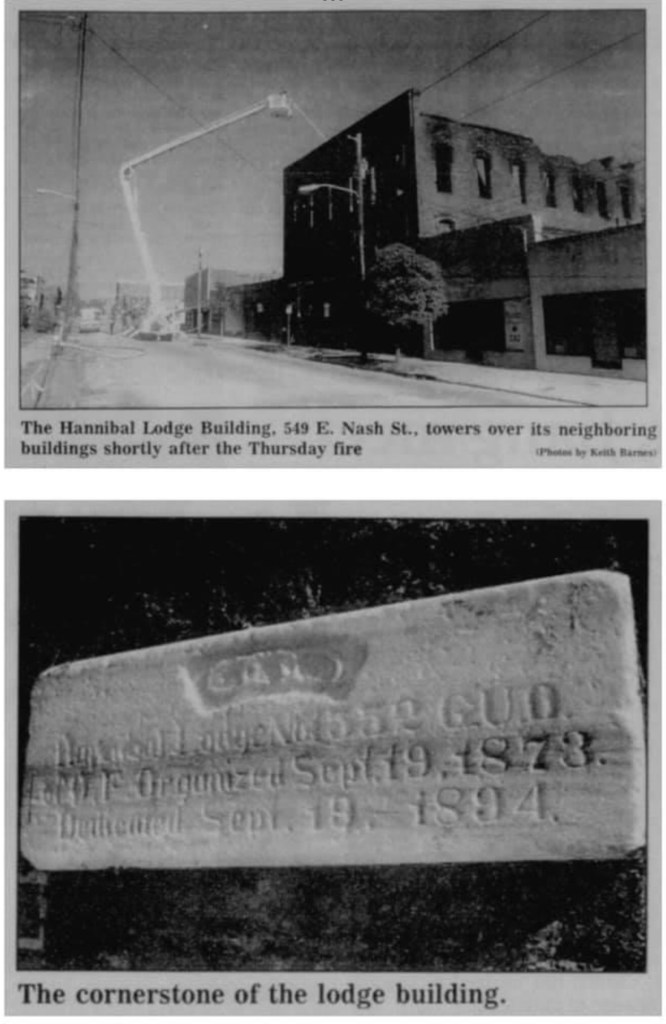
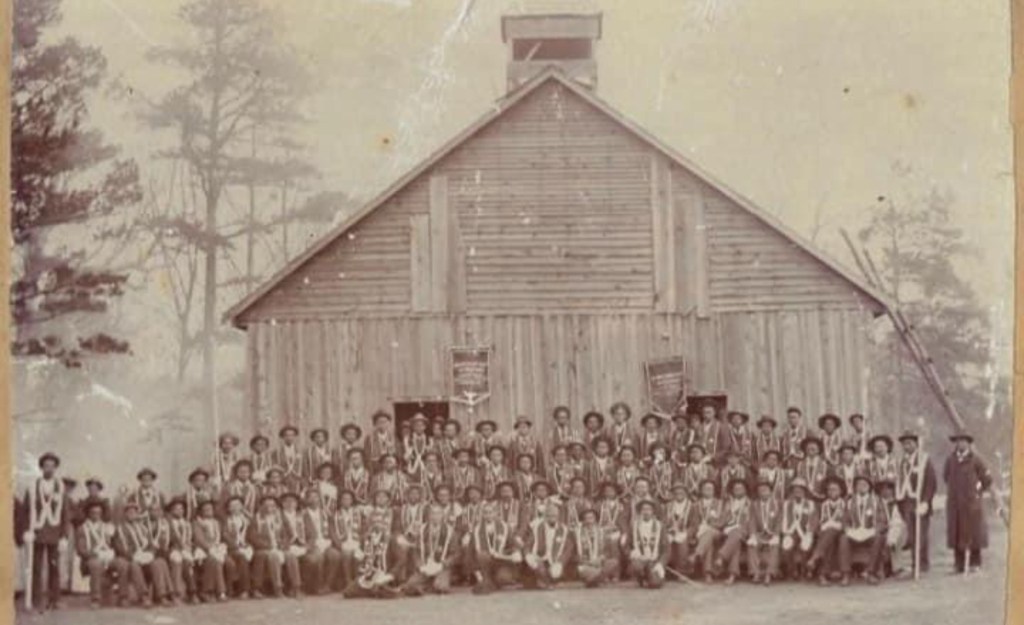
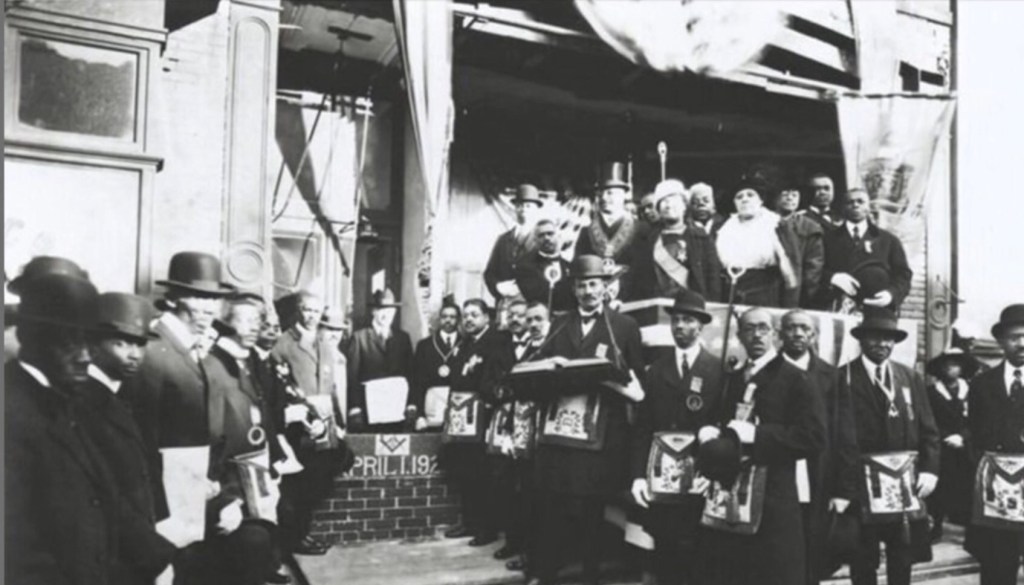
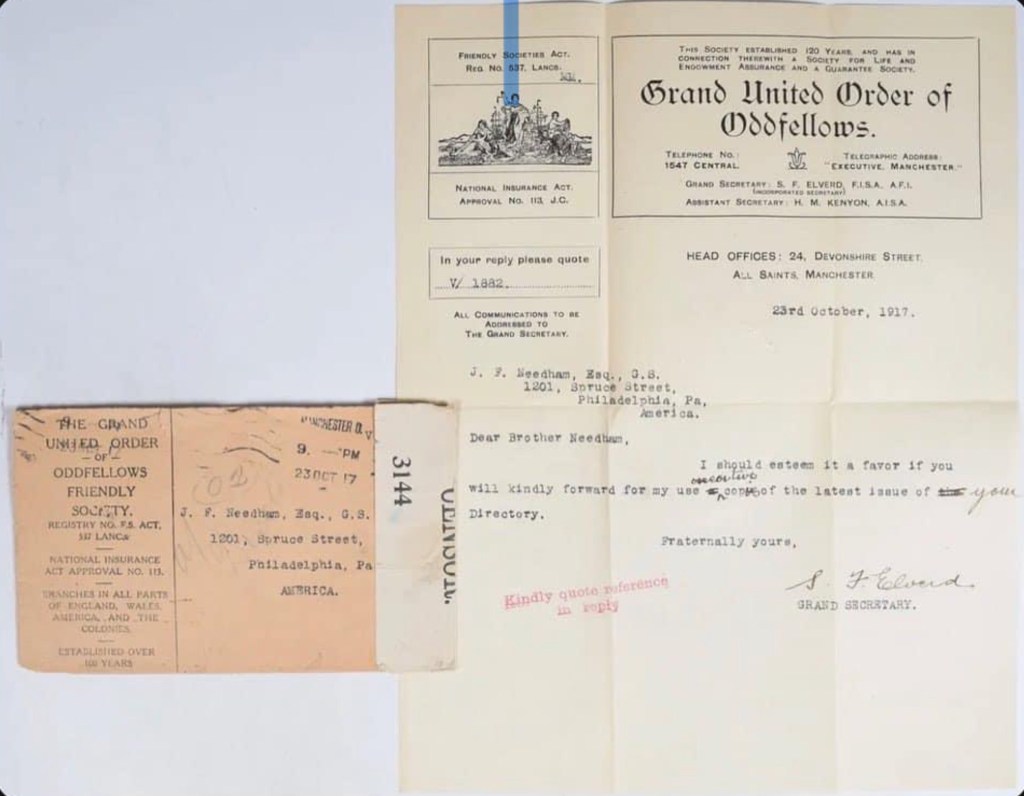
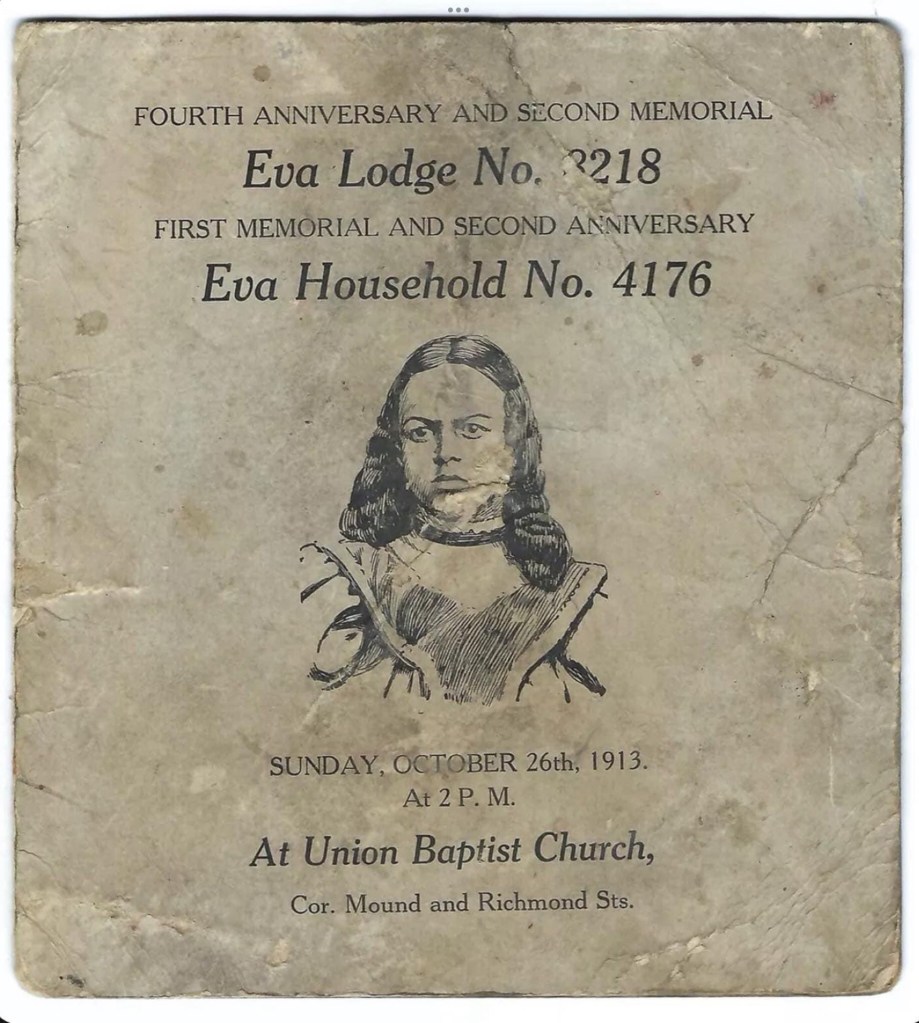
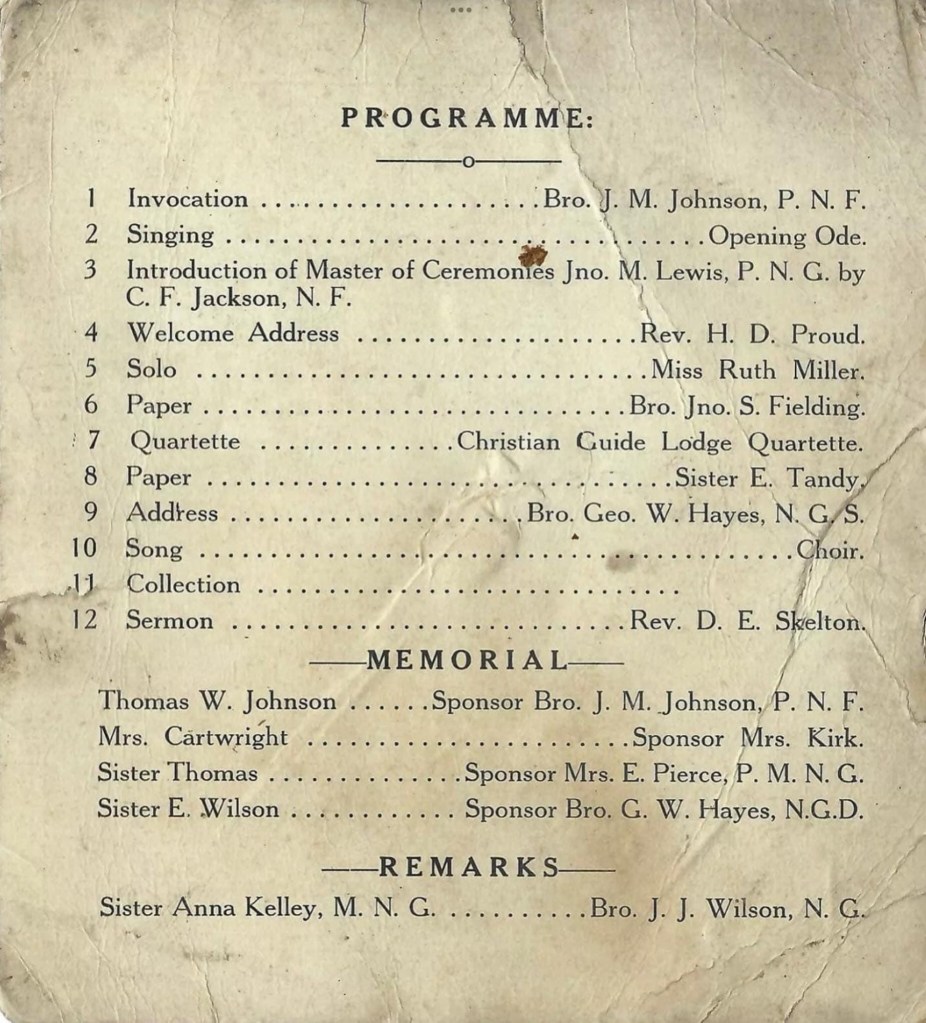
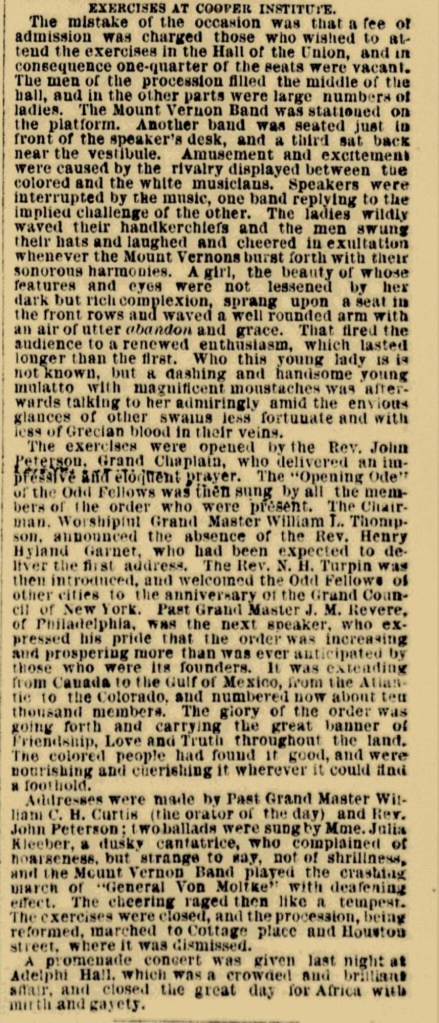
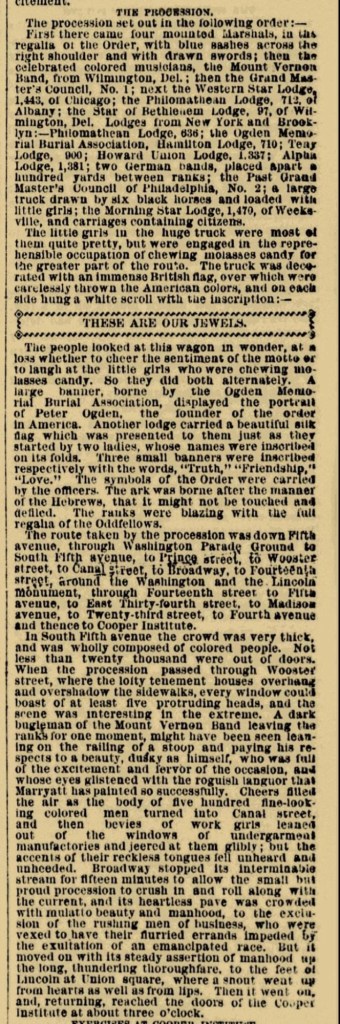
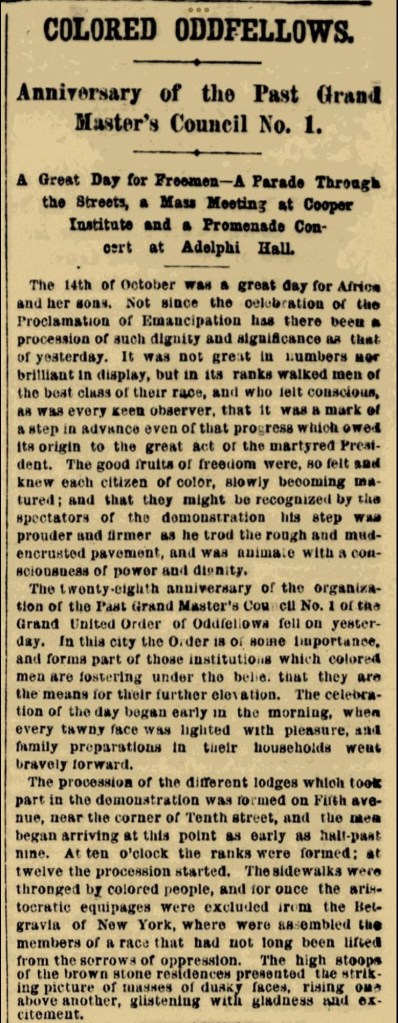
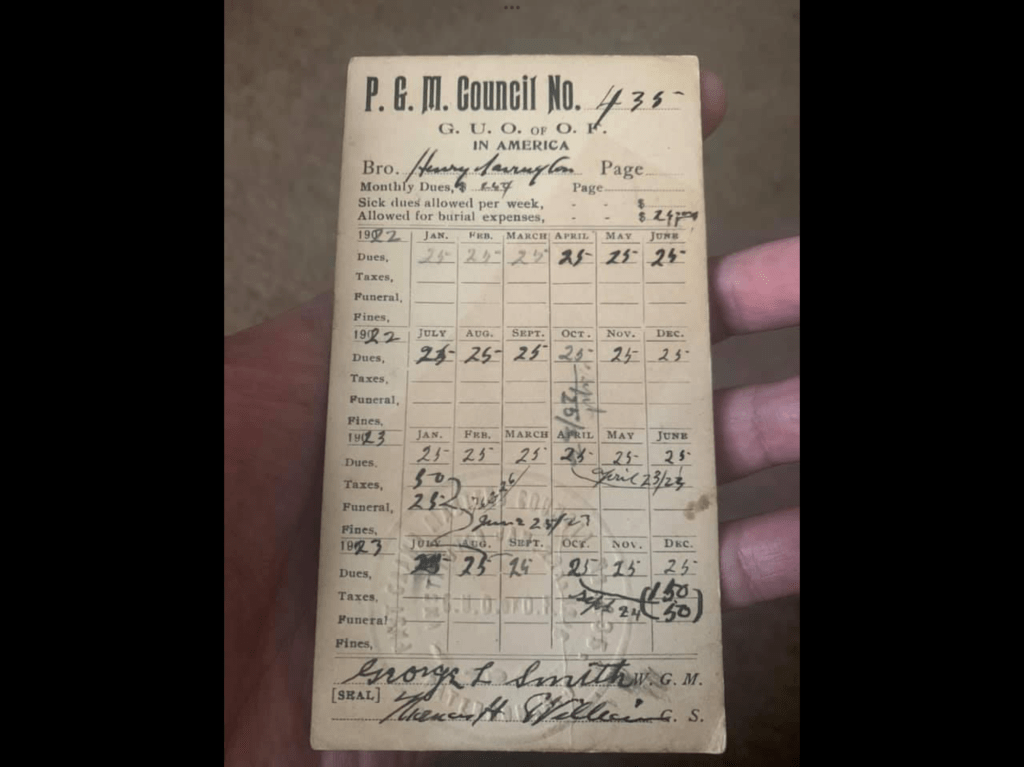
This webpage showcases a photo gallery of rare images featuring ceremonial regalia, equipment, documents, and leaders associated with the Grand United Order of Odd Fellows. While some images lack provenance, they offer valuable visual references for how members of the Blacksburg order may have appeared, especially since no living individuals can provide that information. (Many of these images were collected from eBay, Northern Star Lodge Facebook (No 715 NS) and other places.
Sandy Spring, MD – The Grand United Order of Odd Fellows Lodge No. 6430 has undergone a stunning renovation. Their mission-driven use of the building serves as an inspiring model that could be replicated in Blacksburg. The restoration of the building involved the Advisory Council of Preservation. Check out their Facebook page
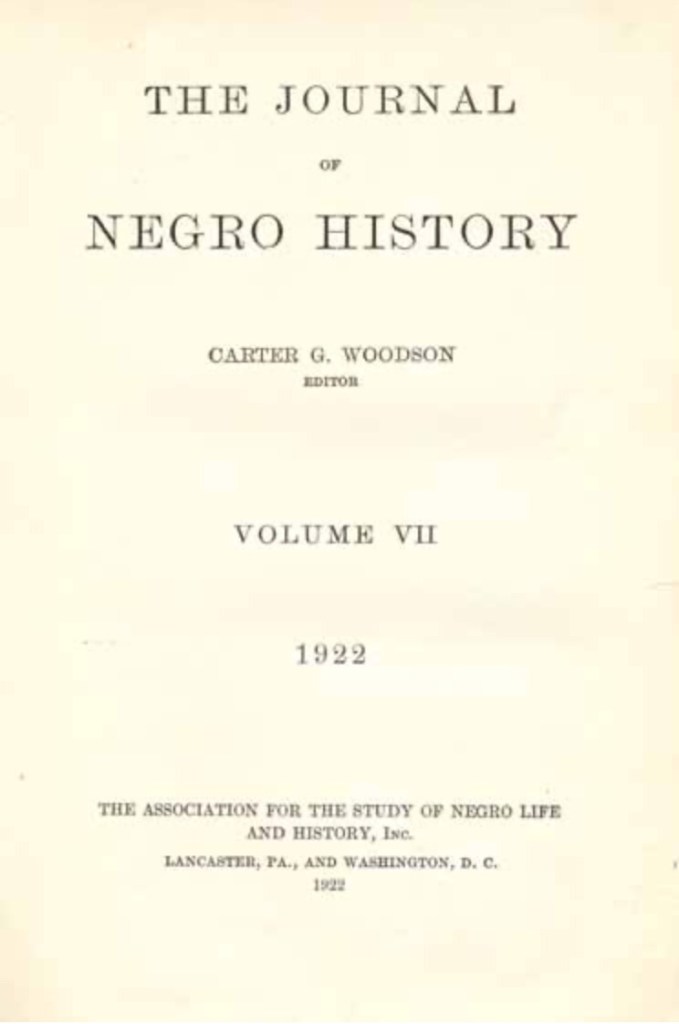
The First Negro Churches in the District of Columbia, John W. Cromwell, 64-106 p., Lancaster, Pa.; Washington, D. C. The Association for the Study of Negro Life and History, Inc., 1917 From the Journal of Negro History 7, no.1 (January 1922), 64-106. Call number E185 .J86 v. 7 1922 (Davis Library, University of North Carolina at Chapel Hill)
Many names associated with Montgomery County, Virginia: Anderson, Bell, Green, Hunter, Johnson, Muse, Saunders, Stewart, Taylor, Walker
Odd Fellows as well as the history of the establishment of churches in the District of Columbia.
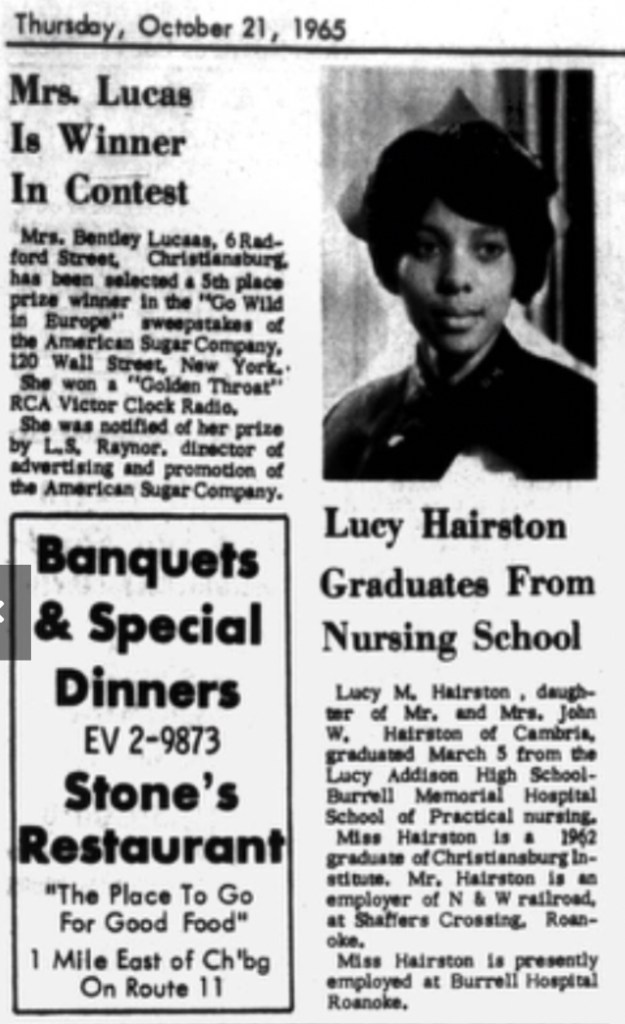
“Lucy M. Hairston, daughter of Mr. And Mrs. John W. Hairston of Cambria, graduated March 5 from the Lucy Addison High School-Burrell Memorial Hospital School of Practical nursing.
Miss Hairston is a 1962 graduate of Christiansburg Institute. Mr. Hairston is an employer of N & W railroad, at Schaffer’s Crossing, Roanoke.
Miss Hairston is presently employed at Burrell Hospital”