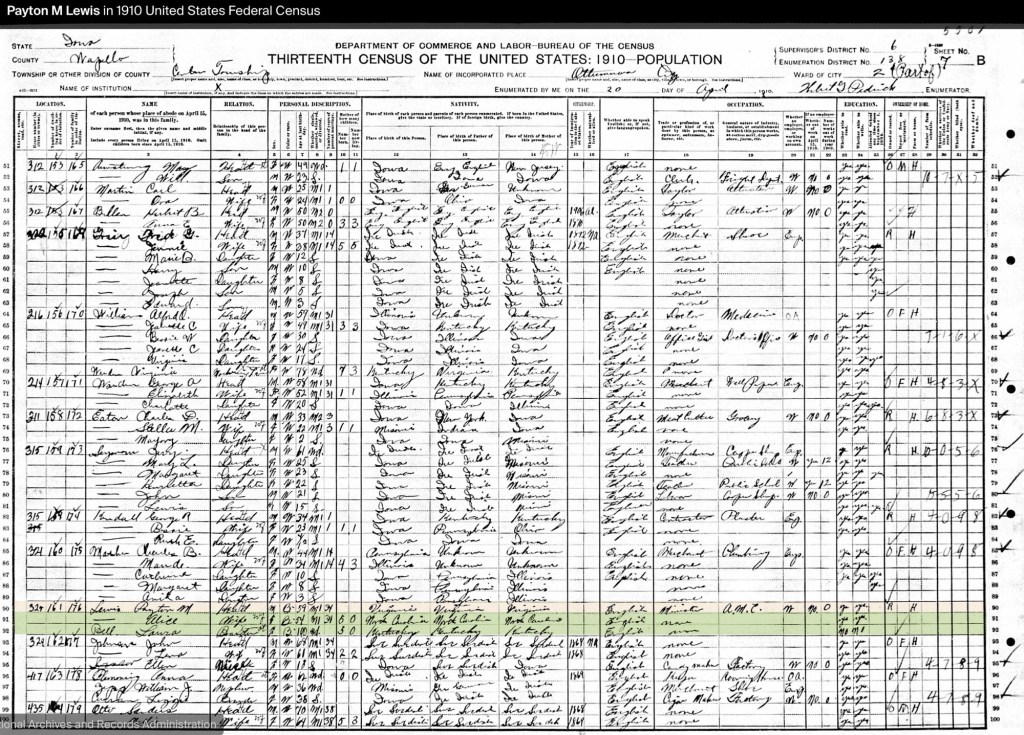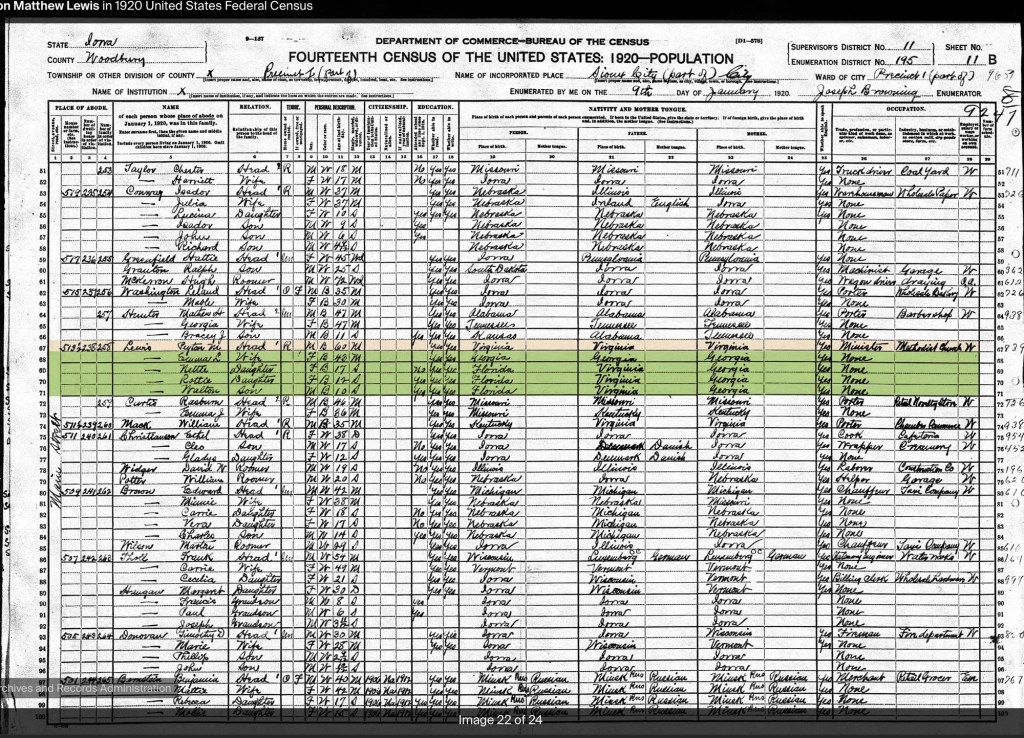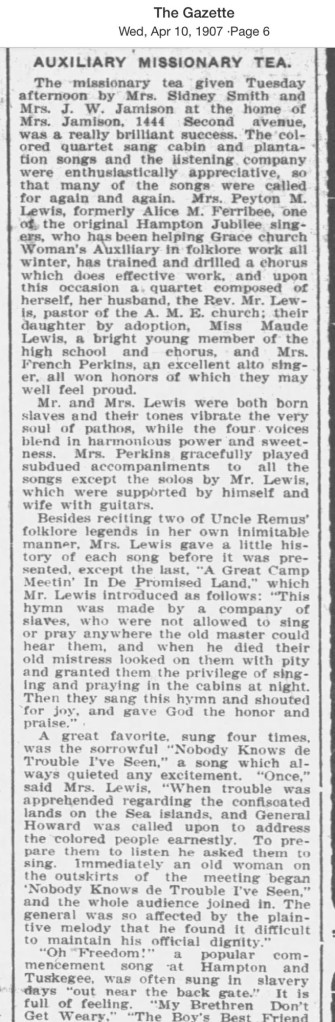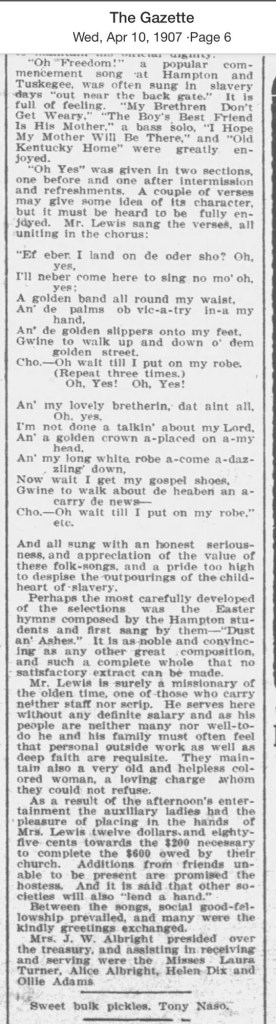
Rev. Peyton Matthew Lewis: From Enslavement in Virginia to Teacher, Minister, and Community Leader

These firsthand recollections provide a rare glimpse into the daily realities of slavery in western Virginia. After emancipation, Lewis became part of the second class to attend Hampton Institute, graduating as valedictorian in 1873. He returned to Bedford County as its first Black public school teacher before dedicating more than 50 years to ministry in the African Methodist Episcopal (AME) Church—a remarkable journey from enslavement to educator and community leader.

Journal of the Roanoke Historical Society, Vol 7/#2, page 50-52

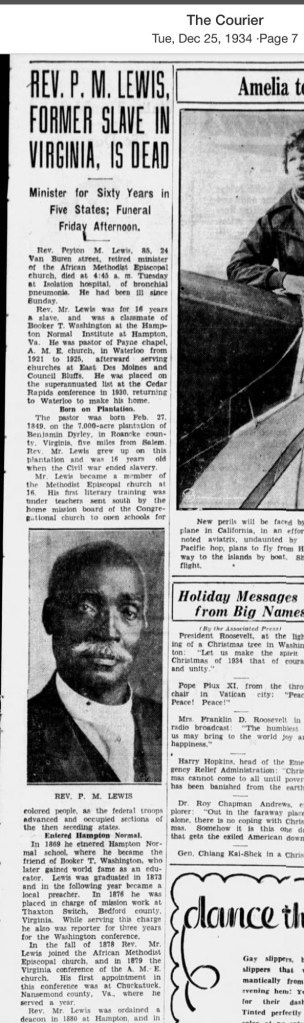
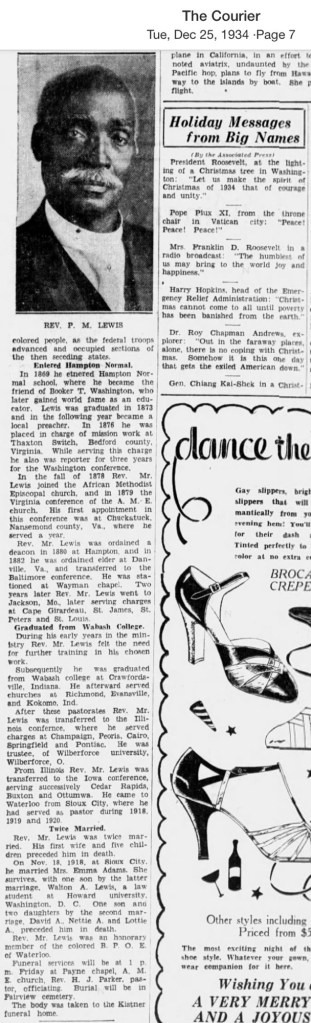
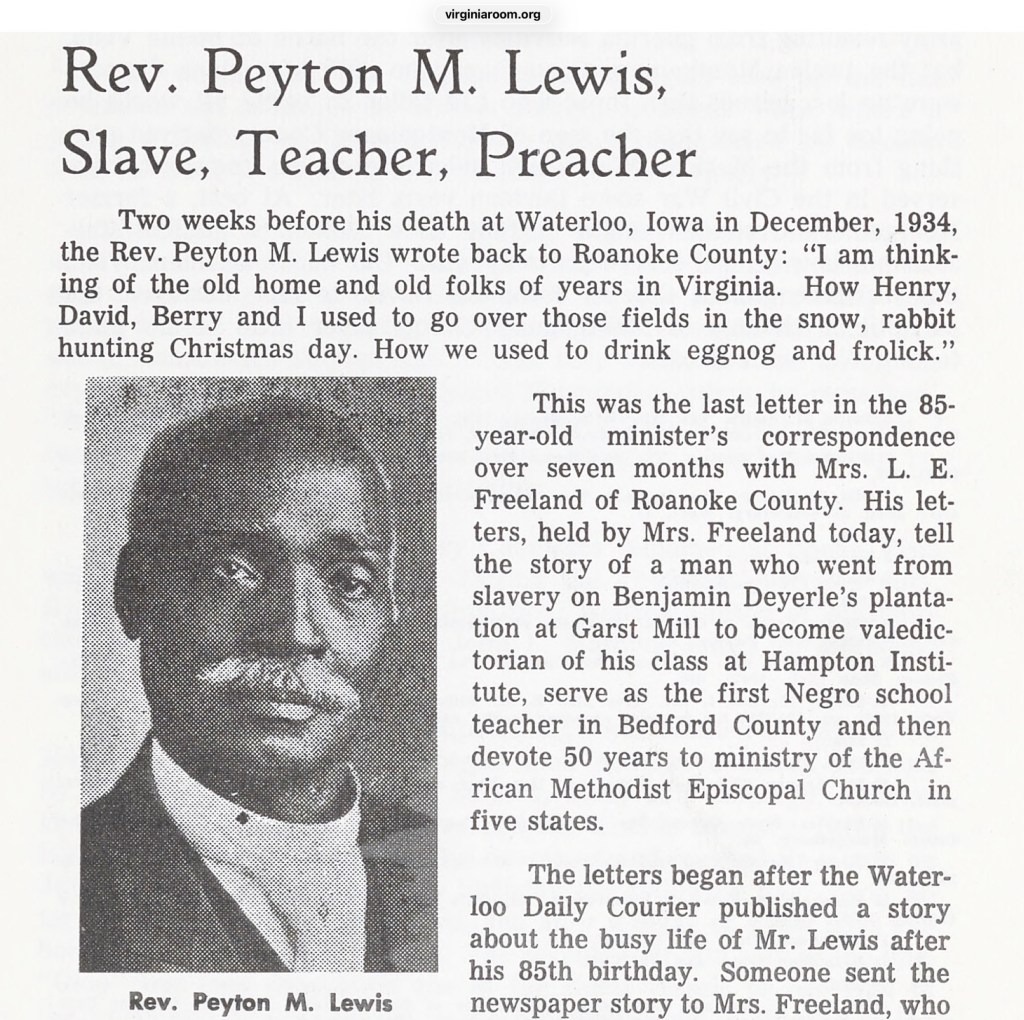
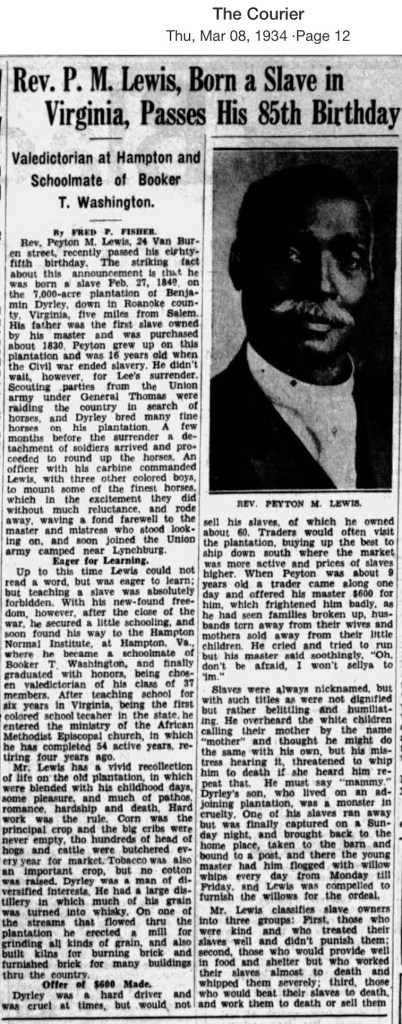
One remarkable story tucked away in the Journal of the Roanoke Historical Society (Vol. 7, p. 50) follows the extraordinary life of Rev. Peyton M. Lewis (1849–1934), whose own recollections of slavery were first published in the Waterloo Daily Courier of Iowa in 1934. His life traces an inspiring journey from enslavement in Bedford County, Virginia, to becoming an educator, minister, and respected leader.

Peyton M. Lewis was born enslaved in 1849 on the plantation of Benjamin and Julia Deyerle near Garst Mill in Bedford County. His father, Charles Lewis, was a highly skilled brick maker and distiller who, along with his brother Peyton, had been purchased by Benjamin Deyerle in Richmond. Benjamin Deyerle was one of western Virginia’s best-known builders, responsible for constructing brick homes, mills, public buildings, and a large whiskey distillery throughout the South West Virginia, including Blacksburg and Christiansburg.

Lewis vividly described the work he performed while enslaved. As a boy he molded bricks, hauled flour and whiskey with a two-team ox wagon, and cleaned and polished the family’s shoes. He also recalled that Uncle Dick and Richard Taylor served as carriage drivers for the Deyerle family. His memories provide a rare first-person account of everyday labor on a western Virginia plantation.

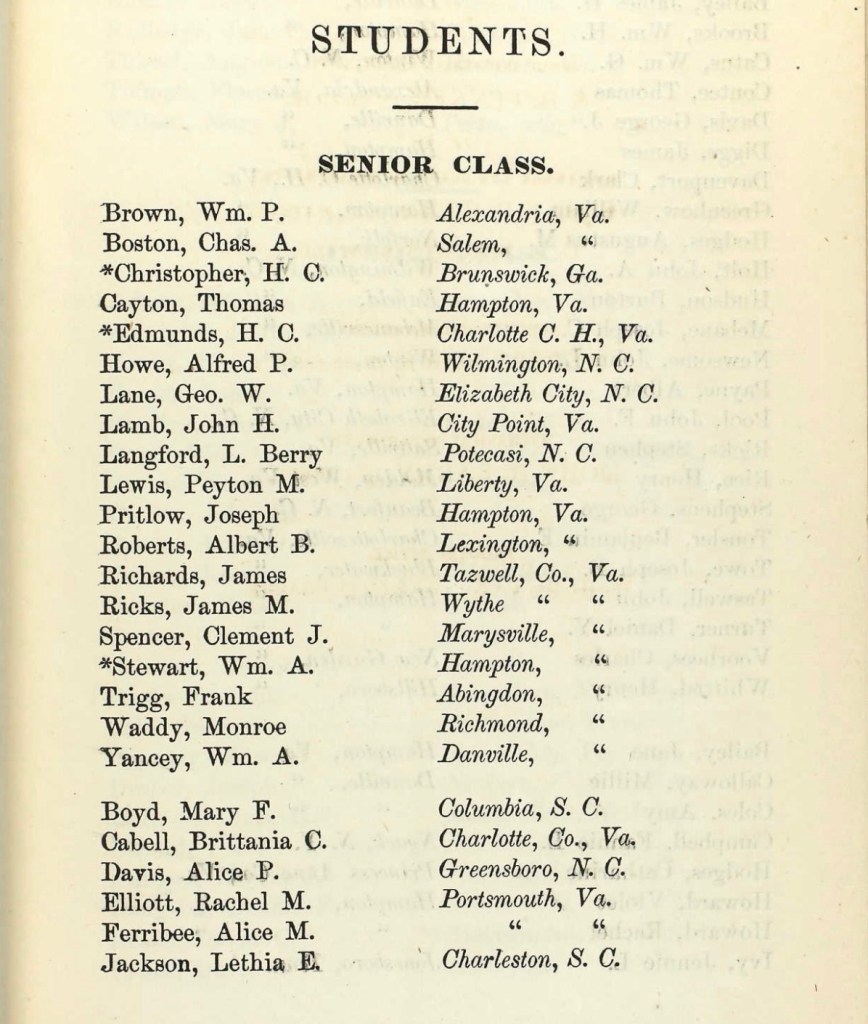
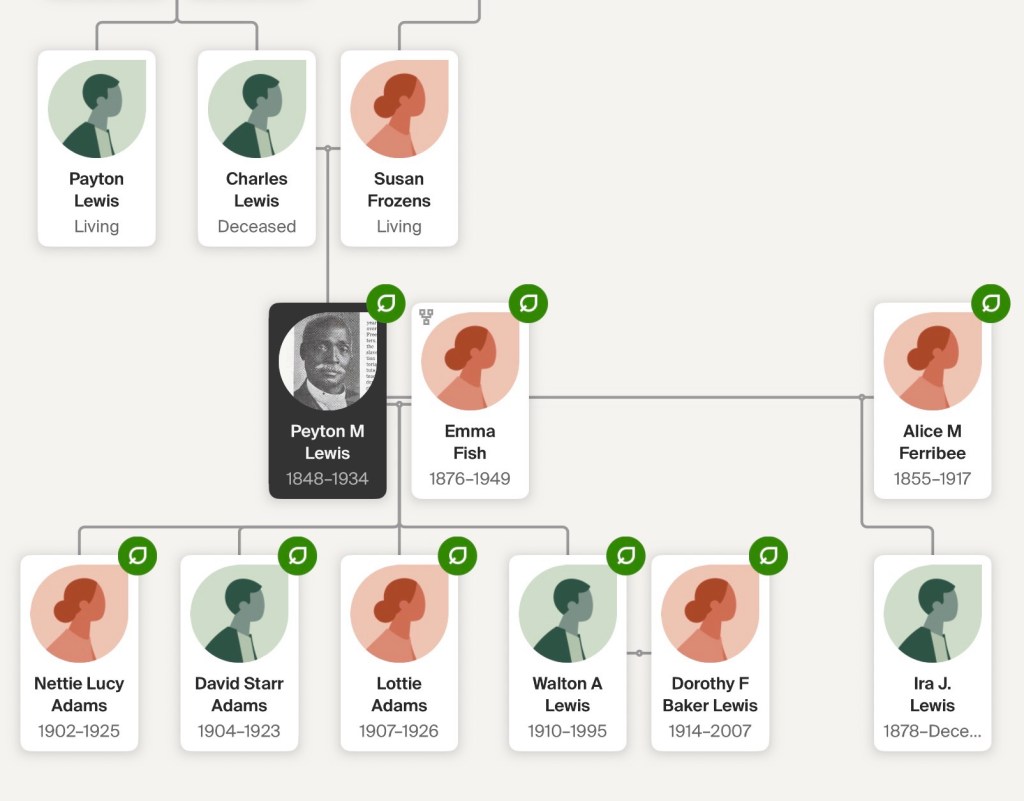
Freedom came in 1865 when Peyton was 16 years old, opening opportunities that had previously been denied him. Lewis participated in mission schooling for formerly enslaved children, where a teacher recognized his abilities and encouraged him to continue his education at the newly founded Hampton Normal and Agricultural Institute. Entering only a year after the school opened, he graduated in 1873 as valedictorian of a class of just seventeen students. There he met fellow student Alice Ferribee (1855-1917) of Elizabeth City, North Carolina, whom he married shortly after graduation.

Returning to Bedford County, Lewis became the county’s first Black public school teacher. He wrote candidly about the challenges of establishing schools during Reconstruction, often teaching in log churches and abandoned cabins because no schoolhouses existed. In an 1893 Hampton alumni publication, he reported having taught more than 600 children, with at least eleven of his former students becoming teachers themselves. His work took him to Liberty (now Bedford), Thaxton Switch, and Bunker Hill, where he helped lay the foundation for public education in Black communities.

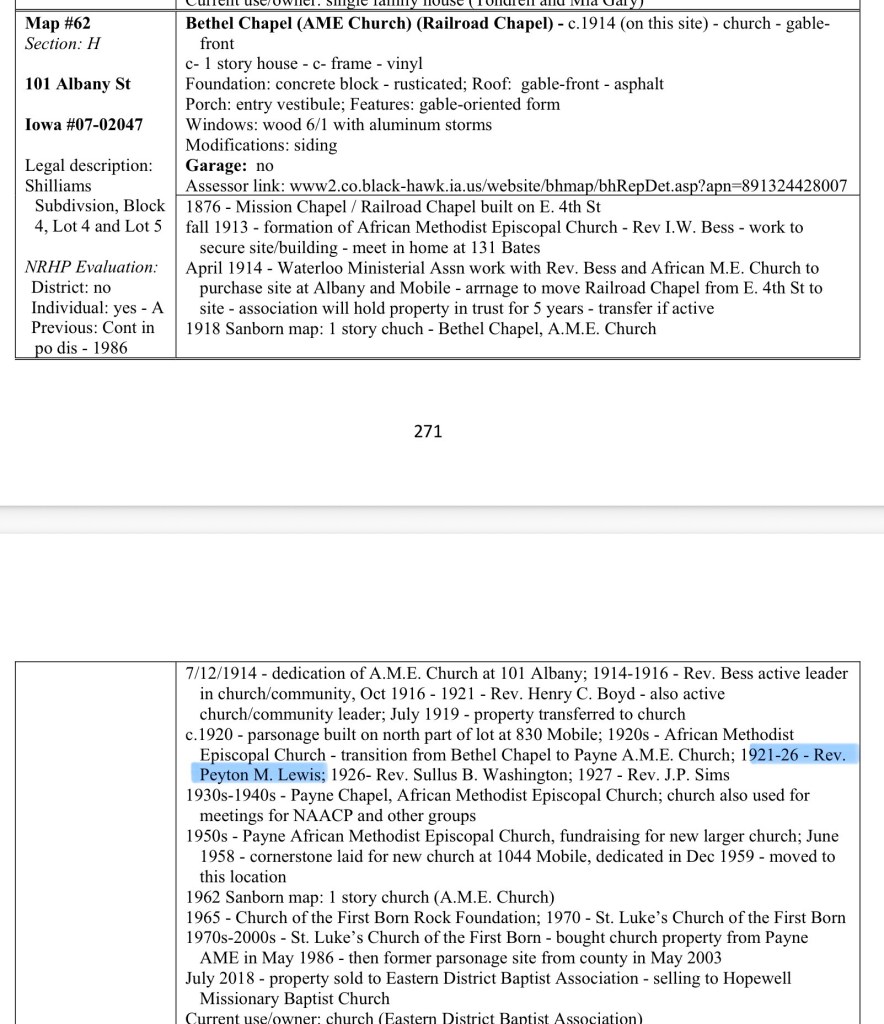
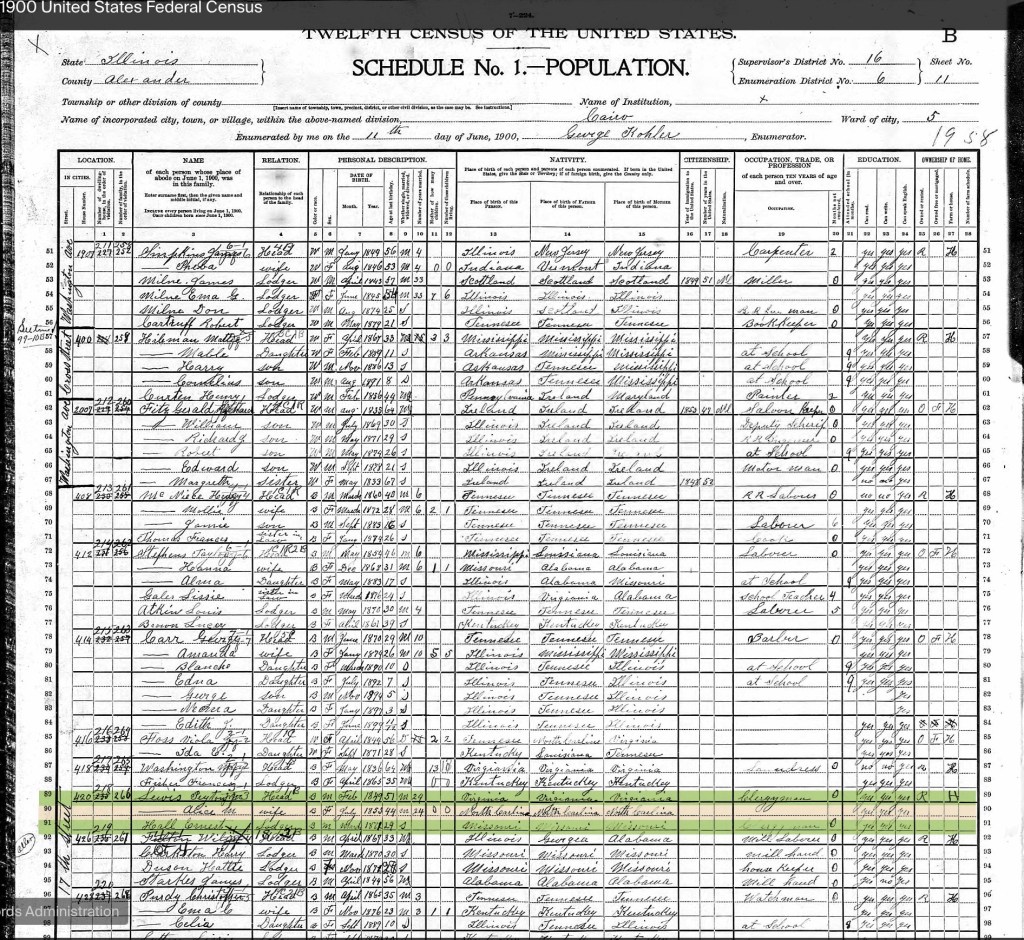
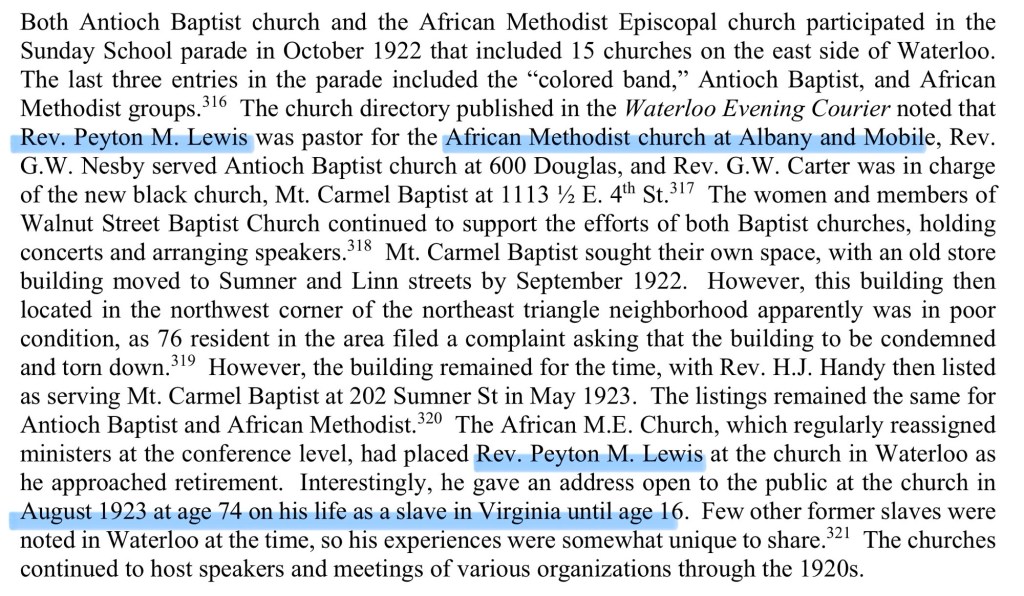
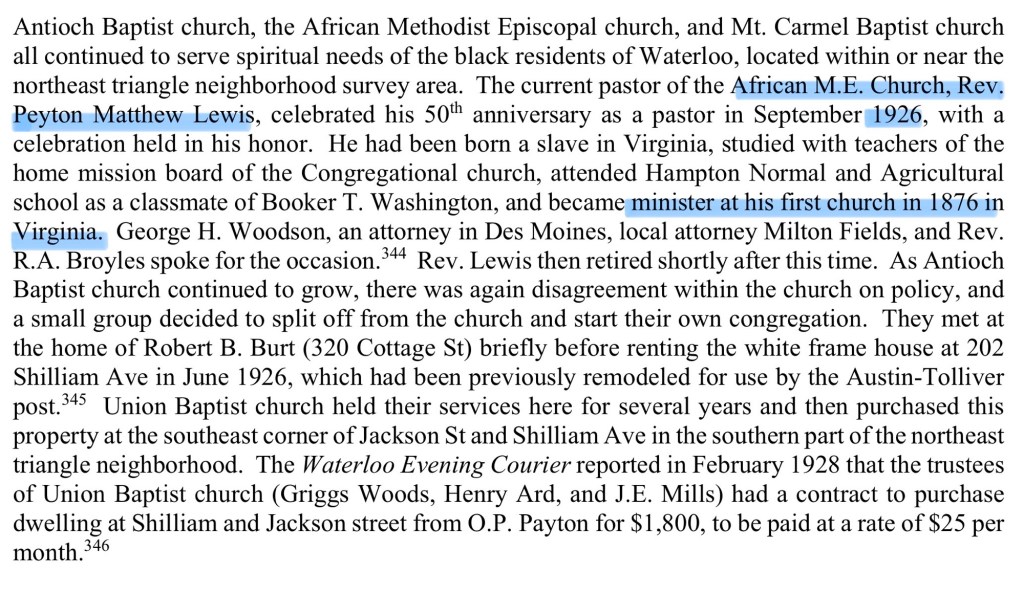
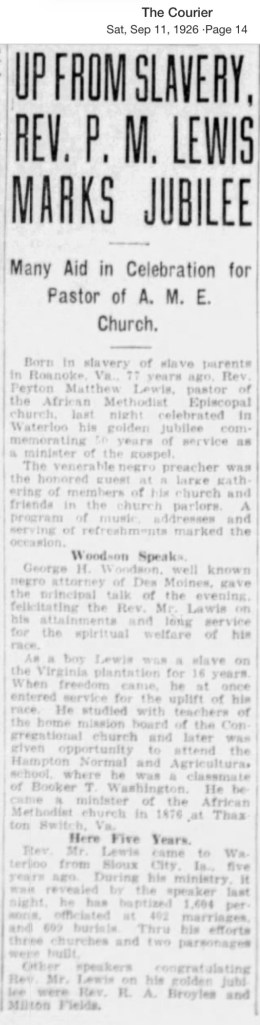
Lewis later attended Wabash College in Indiana and was ordained as a minister in the African Methodist Episcopal (AME) Church. His ministry spanned more than fifty years across several states. By 1926, the citizens of Waterloo, Iowa, celebrated his fiftieth anniversary in the ministry, noting that his first wife, Alice Ferribee for Elizabeth City, NC, had been a year ahead of Booker T. Washington at Hampton and he had devoted his life to education and the church. (⁠cityofwaterlooiowa.com)

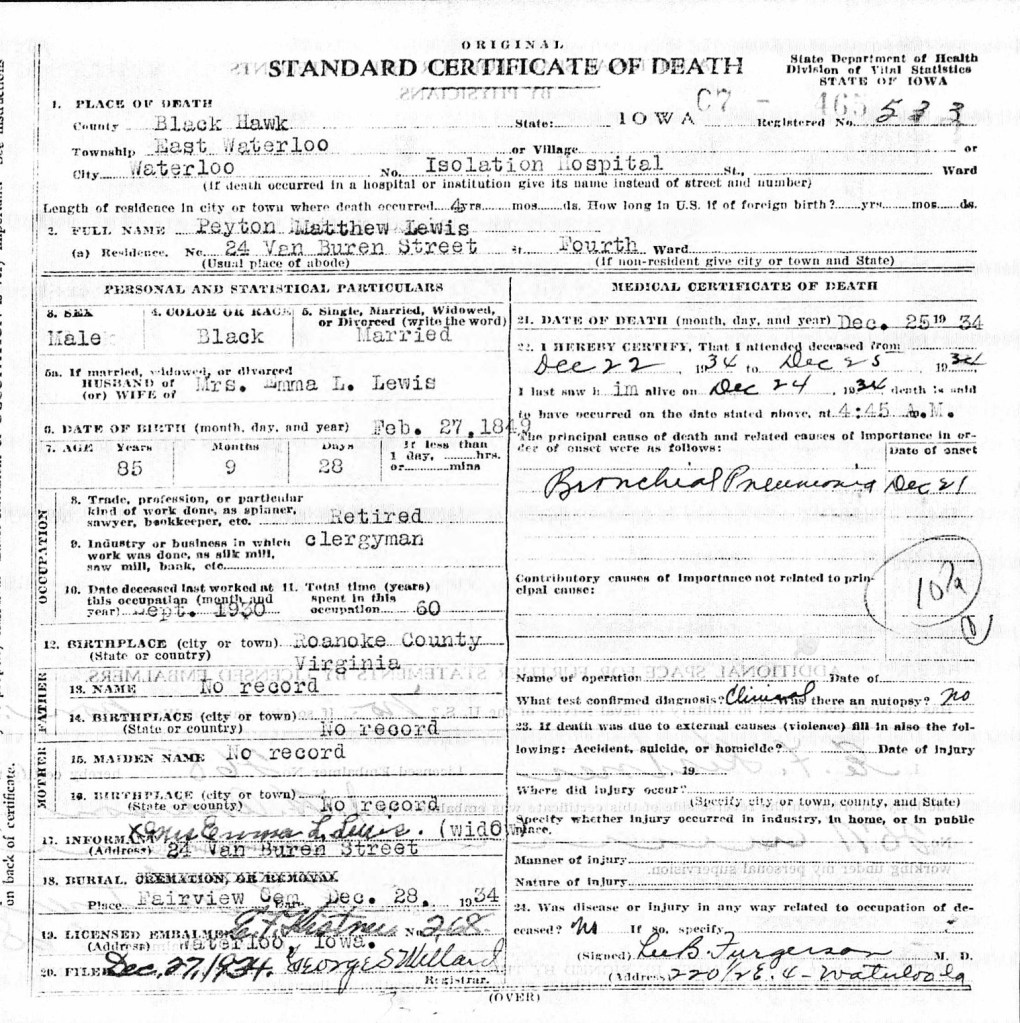
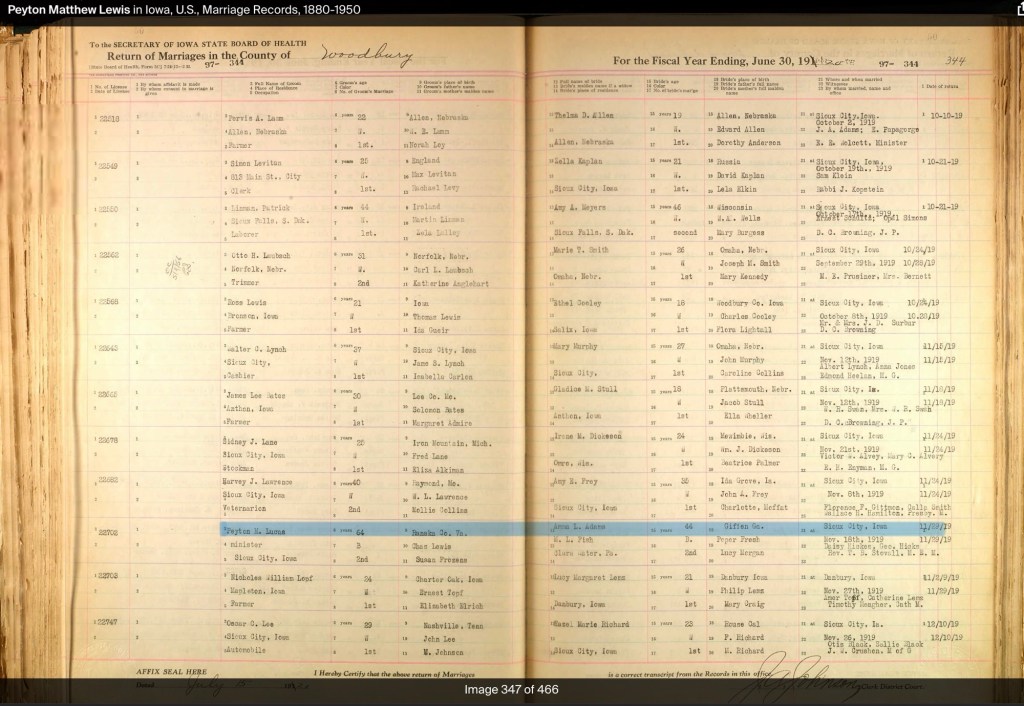
Rev. Peyton M. Lewis died in Waterloo, Iowa, in December 1934. Like many African Americans who left Virginia during the late nineteenth and early twentieth centuries, he settled in Iowa seeking greater economic opportunity and a community less constrained by the racial oppression of the Jim Crow South.
Further Research

Rev. Lewis’s story appears to extend well beyond the published article. Surviving correspondence between Lewis and descendants of the Deyerle family is preserved by the Roanoke Historical Society, Virginia Room. These letters include his reflections on growing up enslaved, his family, and memories of Christmas celebrations and work on the Deyerle plantation. They offer an invaluable first-person record of slavery and Reconstruction in western Virginia and deserve wider study.

Why Rev. Peyton M. Lewis’s Story Matters to Montgomery County

Although Rev. Peyton M. Lewis spent much of his life in neighboring Bedford County, his story has important connections to Montgomery County’s history.

First, the Lewis surname appears in historical records throughout Montgomery County, raising the question of whether there may be family connections worth exploring. Further genealogical research could reveal relationships between the Bedford County Lewis family and other African American families living in Montgomery County after emancipation.

Second, Lewis’s firsthand descriptions of establishing schools for formerly enslaved children closely mirror what was happening in Montgomery County during Reconstruction. He recalled struggling to find suitable places to teach, often relying on log churches and cabins because dedicated school buildings did not yet exist. Similar challenges unfolded here. Blacksburg’s first school for Black children, serving grades one through seven, met in the former Presbyterian Union Church on East Clay Street, on land adjacent to the Edwin Amiss estate (later owned by the Palmer family). In Christiansburg, Freedmen’s Bureau superintendent Capt. Charles Schaefer documented the difficulty of securing a building for a Black school, noting the reluctance of white property owners to rent space for African American education.

Firsthand narratives from formerly enslaved people in Montgomery County are exceedingly rare. Because of this, accounts like Rev. Lewis’s become especially valuable. While his experiences occurred just across the county line, they provide a vivid, personal window into the challenges of emancipation, education, and community building that were shared across southwest Virginia. His recollections help us better understand the historical experiences of people in Montgomery County when local voices from the period have not survived.

Taken together, these regional stories allow us to reconstruct a more complete and truthful history of Reconstruction in the New River and Roanoke valleys—one that recognizes the determination of newly freed African Americans to build schools, educate their children, and create opportunities despite significant resistance.
Genealogical Importance of Southern Confederacy Documents for African American Research

When researching African American genealogy, particularly in the South, it can be challenging to trace family history due to the lack of comprehensive records. However, some of this information can be found in an unexpected place: the Civil War documents of the Southern Confederacy and the United States Military.

When researching African American genealogy, particularly in the South, it can be challenging to trace family history due to the lack of comprehensive records. However, some of this information can be found in an unexpected place: the Civil War documents of the Southern Confederacy and the US Military.

The book Virginia’s Black Confederates: Essays and Rosters by Greg Eanes highlights this, providing primary source documents that list the roles free and enslaved Black men, women, and children performed for the Southern war complex. These records, while written from a perspective that upholds the Confederacy’s narrative, contain valuable data for tracing African American ancestry.

The information in the post is found within this book. Eanes, Greg. Virginia’s Black Confederates: Essays and Rosters 2014. Civil War Sesquicentennial Edition, 2nd Edition.

Virginia 11th Regiment and Montgomery County

This regiment was established in Lynchburg, VA in May 1861 and put into service in July that same year. It was comprised of men from Botetourt, Campbell, Culpeper, Fauquier, Montgomery, and Rockbridge Counties. The free and un-free Blacks associated with this regiment may be listed in the regimental documents.

Eane’s Compilation of of Jobs Performed by Free & Enslaved (pgs 22-23)

  • Body Servant – “Assist with care, cleanliness, and order as assigned quarters, uniforms, and military personal equipment; Help to purchase, prepare, and serve food and beverages in the General Officer’s quarters.”
  • Cook – “Preparation and service of food in field or garrison food service operations.”
  • Teamster – “Motor Transport Operators” and “Cargo Specialist.”
  • Laborer-Breastwork – “Combat Engineer” and “Carpentry and Masonry Specialist.”
  • Laborer – Railroad – “Railway Equipment Repairers”, “Railway Section Repairers”, and “Railway Operations Crewmember.”
  • Laborer – Burial Details – “…recovery, collection, evacuation, establishment of tentative identification” of the body and possessions.
  • Hostler – “comprehensive care for government owned animals.”
  • Hospital Steward/Nurse – provide movement and care for injured people.
  • Musician – professional Army band
  • Blacksmith – “fabrication, repair and modification of metallic and nonmetallic parts.”
  • Mechanic – “maintenance and repair on artillery, small arms; store ammunition.”
  • Carpenter – “Perform general heavy carpentry, structural steel and masonry duties.”
  • Boatman – “..navigation, cargo operations and supervising other Soldiers on Army watercraft.”
  • Laundress – “supervising and performing laundry…”
  • Preacher – “Support Unit Ministry Team”
  • Scouts/Spies – “..reconnaissance…”

Compiled Service Records

Service records provide valuable information. They are available in paid sources, Ancestry.com or Fold.com and in Familysearch.org.

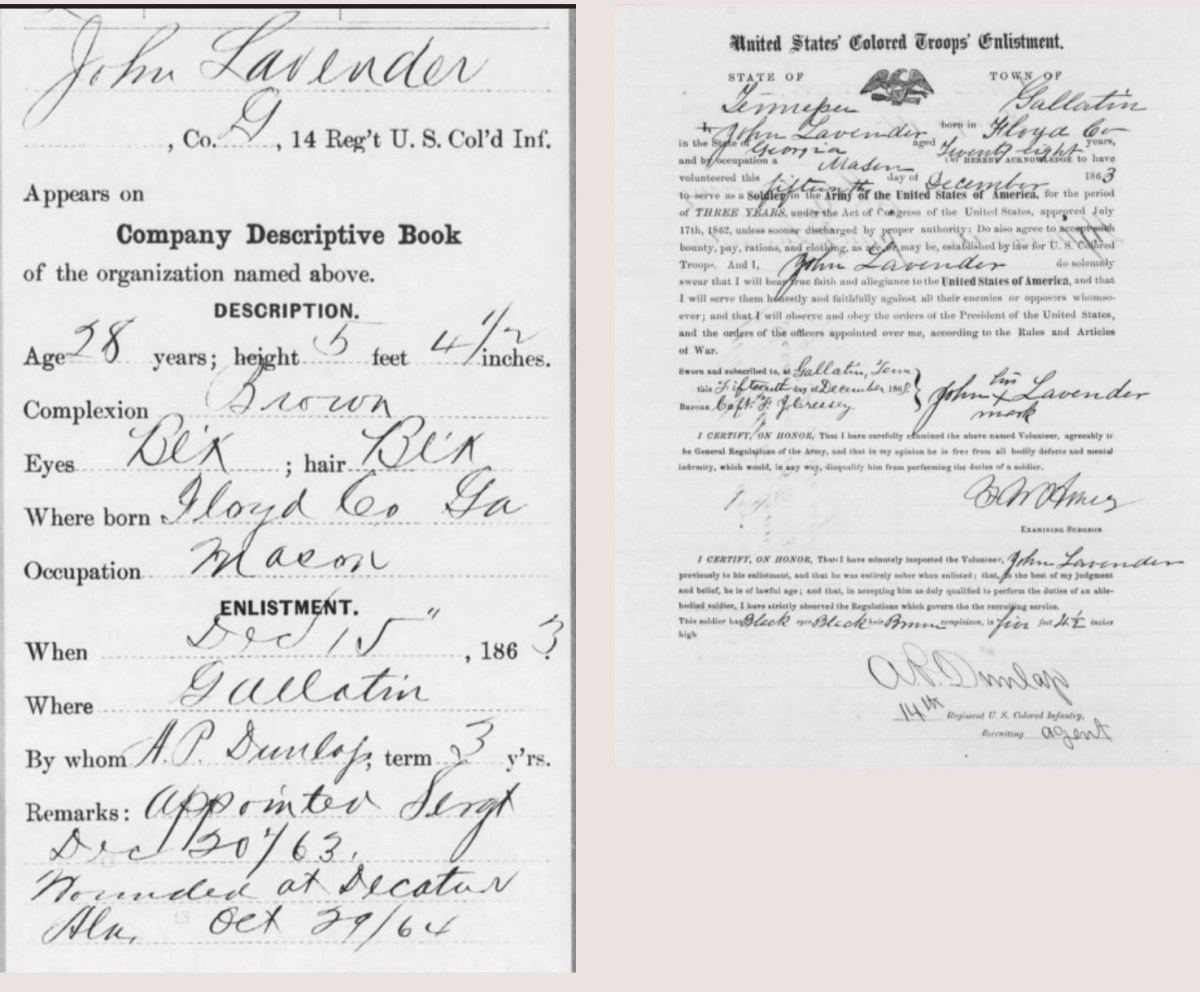
John Lavender Service Record, US Colored Troops, enlisted 15 Dec 1883. Blacksburg Resident after 1974.

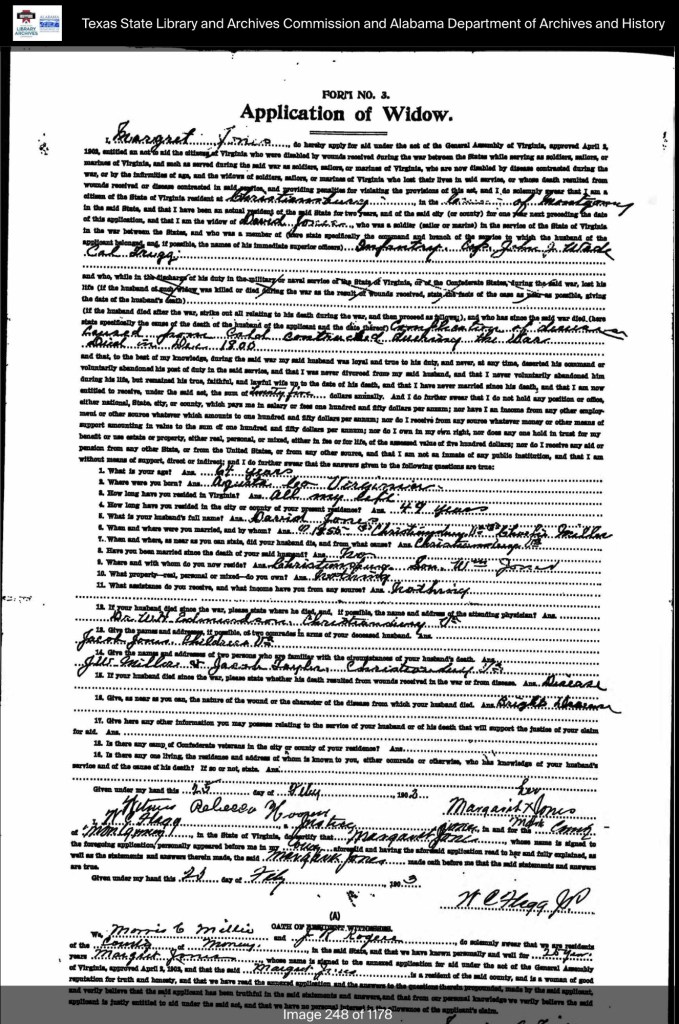
Pension Applications of the Confederacy and US Military

Confederate Pension Acts for Virginia were enacted between 1888 and 1934. On 14 of March, 1924 the act centered on servants granted pensions. “The 1928 Act broadened recognized duties to include performance of guard duty, burring Confederate dead, working in railroad shops, blacksmith shops or hospitals” (Page 26).

The pension records can be found at the Library of Virginia and on Ancestry.com (subscription required).

National Archive article on how to use the Pension Records, “Union Pension Files Giving Voice to Former Slaves”

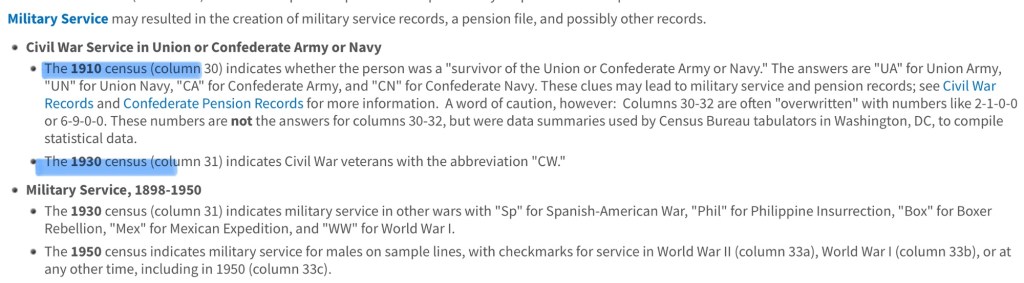
The 1910 (see image) and 1930 (CW) census indicates that the person was a veteran. The National Archives provides a helpful list of codes that were used.


Confederate Soldiers’ Home Application for Admissions Records

Found in the Library of Virginia digital collection or this link .


The American Civil War Museum

The archives of the museum maintain a large holding, some of which is digitized.

Confederate Certificate of Service – Freemen and Enslaved.

According to Eanes on page 113, the Army of the Confederate States adopted (1861) Form #4, the Certificate of Service. This was used for both free and unfree persons. Where these are located? We have not found an online source, yet.

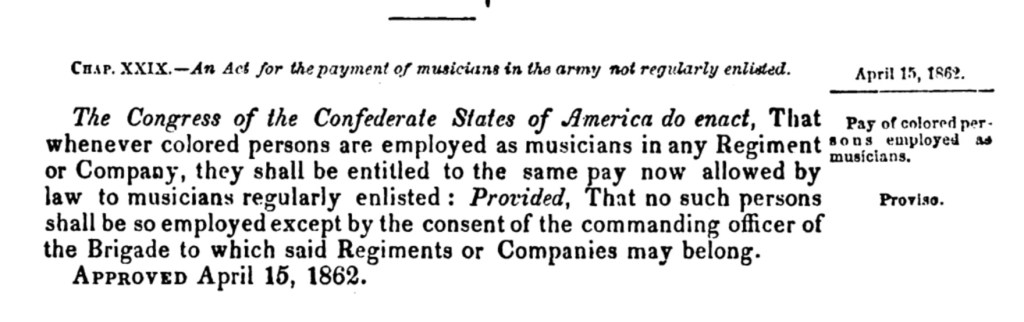
Public laws of the Confederate States of America, first Congress, 1862-1864 / [edited by James M. Matthews].

Primary source of the Acts of the Confederate Congress, Public laws of the Confederate States of America, first Congress, 1862-1864 / [edited by James M. Matthews]

Chapter XXIX – An Act for the payment of musicians in the Army no regularly enlisted.” Page 29 (book, not pdf)
Chapter LXIV – An Act for the enlistment of Cooks in the Army”. Page 48 (book, not pdf)
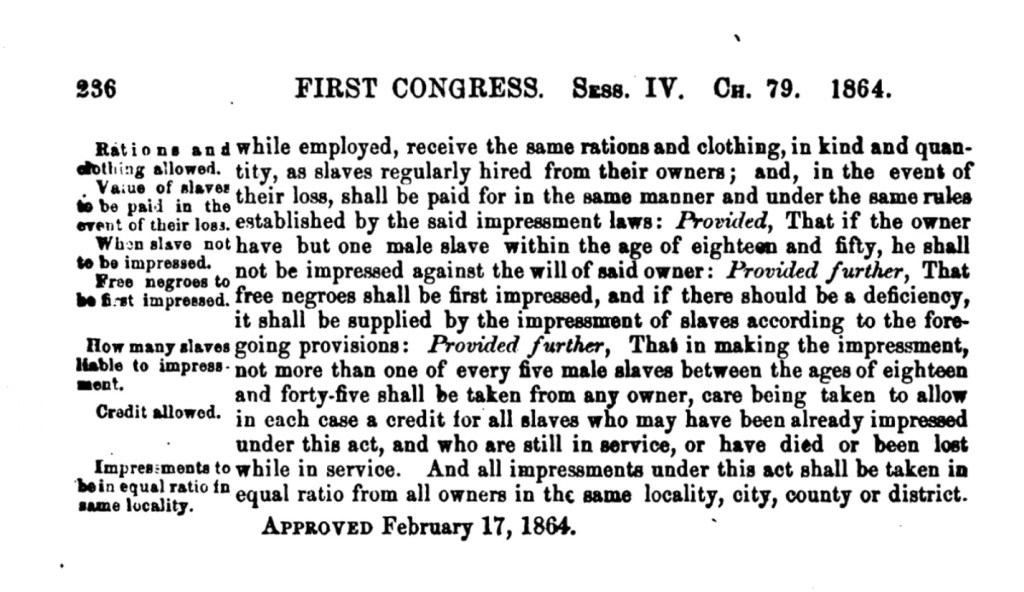
“Chapter LXXIX – An Act to increase the efficiency of the Army by employment of free negroes and slaves in certain capacities” Page 235-236 (book, not pdf)

Reports of Charles Stoever Schaeffer

Linda Killen transcribed the reports of Brevet-Captain Charles S. Schaeffer who held the post of agent for the Bureau of Refugee, Freedmen and Abandoned Lands during the early years of Reconstruction. More information about Schaeffer can be found at Christiansburg Institute, Inc.. Schaeffer sent this list of African American Freedmen to his reporting officer, Bvt. Brig. Genl. O. Brown, dated 15 March 1867 (page 18). Minnis Headen (Hadean) was listed on the deeds as Trustee for the Hill School and Christiansburg African Baptist Church.

  • “C. Minnis Hadean – Age 40 – Blacksmith – Christiansburg Va. – can read, write and cipher – one of the best colored men in the state.”
  • John Campbell – Age 40 – Farmer – Big Springs Depot Mont’y Co. Va – can read and write – owns property – was free before the war.
  • Peter Noulen (?) – Assistant to a Machinist – Depot of the Va. & Tenn. R.R. – Central Depot, [Radford], Mont’y Co. Va. – can read a little.
  • Sampson Gleaves – Age 35 – Farmhand – Christiansburg P.O. Lives one mile from town – Can read (and write a little).
  • Robert D. Jones – Age 30 – Farmer – Christiansburg P.O. Lives six miles from town – Can read and write.
  • Felix Johnson – Age 30 – Brick Layer – Christiansburg P.O. Lives in the direction of Blacksburg Va. – Can read and write.
  • John P. Taylor – Age 35 – Farmhand – Christiansburg P.O. Lives in the direction of the White Sulphur Springs – Can read & write.
  • Richard Taylor – Age 65 – Farmer & Preacher – Christiansburg P.O. – Lives near Blacksburg Mont’y Co. Va. – Cannot read nor write, but is quite intelligent.