Montgomery County’s Changing Borders & the African American Story

The Formation of Montgomery County, Virginia and Why it Matters to Regional African American History

When Virginia’s earliest European colonial settlers first pushed westward beyond the Blue Ridge Mountains, they entered the border lands already inhabited by Indigenous peoples for thousands of years. As Europeans laid claim to these territories in the 18th century, Virginia’s county boundaries began shifting rapidly to keep pace and the need for local governance.

At first, all of western Virginia was considered part of vast counties based far to the east. Augusta County, created in 1738, stretched from the Blue Ridge to the Mississippi River—a landmass so large it was nearly impossible to govern effectively. As settlement expanded, Augusta was gradually carved into smaller counties.

Botetourt County was created in 1770 out of Augusta, and just two years later, in 1772, Fincastle County was formed to cover the far southwest. But Fincastle itself was short-lived: in 1776, it was split into three new counties—Montgomery, Washington, and Kentucky (the latter eventually becoming the Commonwealth of Kentucky).

Thus, Montgomery County was officially established in 1776, named in honor of General Richard Montgomery, a Revolutionary War hero.

Like most early counties, Montgomery did not remain the same size for long. As population grew and communities demanded closer courts and local representation, Montgomery’s original boundaries were gradually reduced.

1790: Wythe County was formed from Montgomery. 1790: Parts of Montgomery contributed to the creation of Kanawha County (now in West Virginia). 1806: Giles County was carved from Montgomery, Monroe, Wythe, and Tazewell. 1806–1830s: Additional shifts continued, with Montgomery giving land to Floyd (1831), Pulaski (1839), and others.

By the mid-19th century, Montgomery County had taken on the approximate shape we recognize today.

Why this matters

Tracing these changing boundaries shows how the western border lands of Virginia evolved from a vast Indigenous landscape into the network of counties we know today. When we study Montgomery County’s formation and its changing borders, we are not only tracking political geography—we’re also uncovering how those shifts shaped the daily realities of enslaved people and freedmen. The “line on a map” often meant the difference between where families were recorded, where they could live, and how they could begin to claim freedom and opportunity.

County seats like Christiansburg were not only centers of trade and government but also the location of the slave market and the courthouse records that tracked the lives of enslaved people. After emancipation, those same courts became the places where freedmen registered marriages, secured contracts, and sought land. As county lines shifted, so too did the jurisdictions that controlled access to justice, opportunity, and community life.

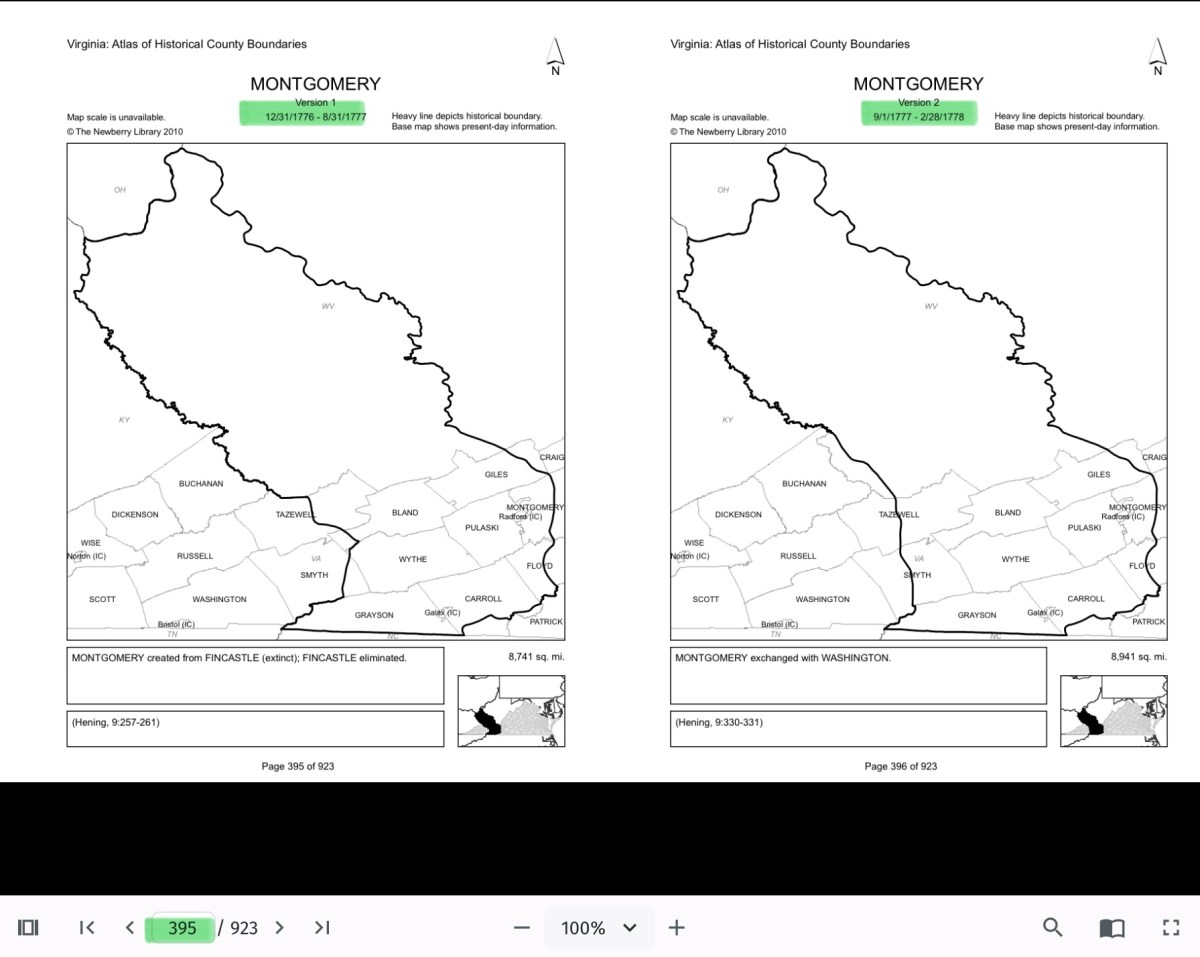
The flip book of maps below is a helpful resource to understand how the boundaries changed with time. Virginia Atlas of Historical County Boundaries. Begin on page 395.
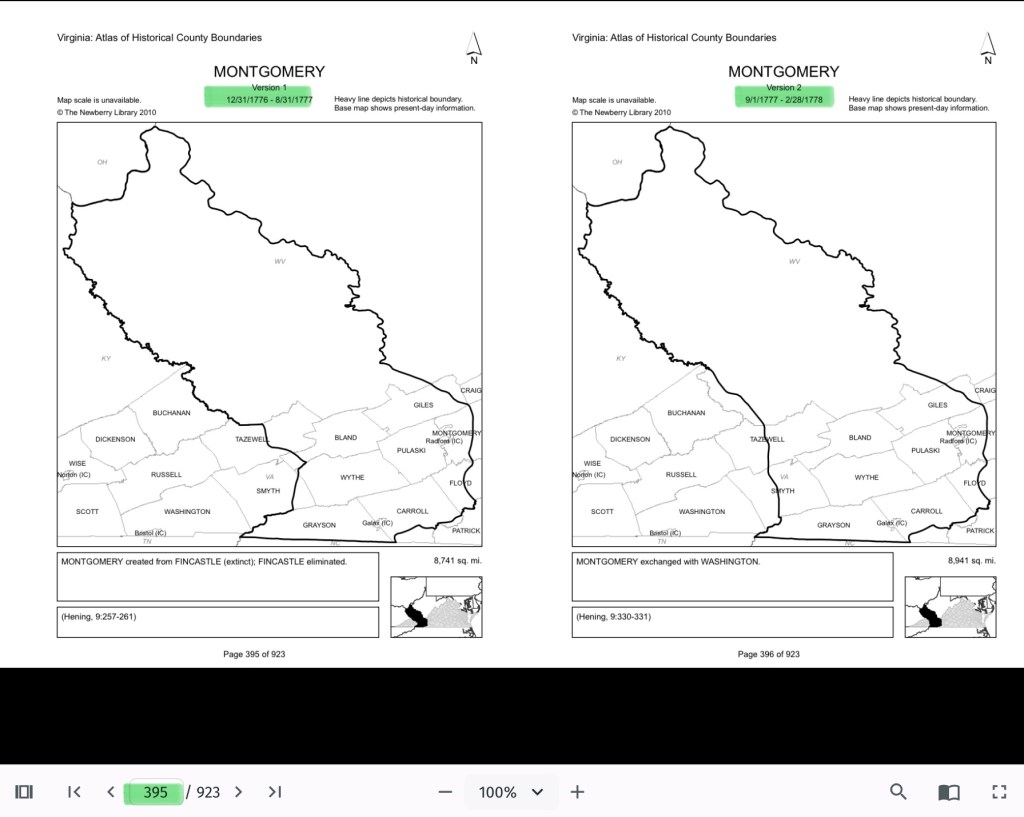
Virginia Atlas of Historical County Boundaries

Further Discussion on How Shifting Boundaries Change Lives

Laws & Records

When county boundaries changed, so did the courthouse where records were kept. For enslaved people, this meant that bills of sale, wills, deeds, and manumission papers might end up filed under different counties as the boundaries shifted. After emancipation, the same was true for marriage licenses, labor contracts, and land purchases by freedmen. This scattering of records makes it both complicated when tracing family histories.

Shaping Community, Labor & Education

County lines determined where enslaved people were forced to labor, where patrols were organized, and where courts enforced slavery laws. After emancipation, those same boundaries shaped freedmen’s access to work, land, and schools. For example, as new counties like Giles or Pulaski were created from Montgomery, Freeman might find themselves suddenly in a different jurisdiction, dealing with a new local power structure.

Education also reflected these divisions. Freedmen near Christiansburg had better access to schools supported by the Freedmen’s Bureau, while those in rural reaches of the county received little help.

Courts and Law

During slavery, county seats (like Christiansburg) were centers of trade, law, and the slave market. Enslaved people were taken to county courts for sales, trials, and punishment. After emancipation, those same county seats became the centers where freedmen registered marriages, secured legal recognition, and later sought protection under Reconstruction policies.

Land, Freedom, and Mobility

For freedmen, land ownership was key to independence. But access to land varied widely from one county to another, depending on who owned large estates, which lands were subdivided, and how local officials treated Black landholders. County boundaries thus shaped the possibilities of building self-sustaining communities after emancipation.

More Maps

Montgomery County Resources

Montgomery County, Virginia Resources and the Formation of the County Over Time

National Register of Historic Places Application – 1989

National Register of Historic Places Application – 1989

This searchable document is a rich source of information about the county and its wider connections. For example, it notes that the New River boatmen once lived on Kent Farm, where they were enslaved by James Randle and Margaret Cloyd Kent prior to emancipation (see page 13). Additional details about Kentland and these freedmen can be found in the following postings: Historic Kentland and Historic Wake Forest

The names of some of the black boatmen of 19th-century Montgomery County include Frank Bannister (who was a boatman on the James River before the Civil War), Calvin Bannister, Roland Stuart, George Brown, and Lewis Smith.


Montgomery County Reconnaissance Level Survey, 1986

This report that was written by Gibson Worsham, Dan Pezzoni, Charlotte Worsham, David Roenizer, and others. It addresses the following: 1) Overview of the county’s history, 2) A comprehensive inventory of significant structures and sites in the county and 3) Maps delineating the location of said structures and sites. Similar to the report above, this is a wealth of information about the county.


More information can be found on this website: Gatherings Blacksburg History


The Formation of Montgomery County, Virginia and Why it Matters to African American History of the Region

When Virginia’s earliest European colonial settlers first pushed westward beyond the Blue Ridge Mountains, they entered the border lands already inhabited by Native peoples for thousands of years. As Europeans laid claim to these territories in the 18th century, Virginia’s county boundaries began shifting rapidly to keep pace and the need for local governance.

At first, all of western Virginia was considered part of vast counties based far to the east. Augusta County, created in 1738, stretched from the Blue Ridge to the Mississippi River—a landmass so large it was nearly impossible to govern effectively. As settlement expanded, Augusta was gradually carved into smaller counties.

Botetourt County was created in 1770 out of Augusta, and just two years later, in 1772, Fincastle County was formed to cover the far southwest. But Fincastle itself was short-lived: in 1776, it was split into three new counties—Montgomery, Washington, and Kentucky (the latter eventually becoming the Commonwealth of Kentucky).

Thus, Montgomery County was officially established in 1776, named in honor of General Richard Montgomery, a Revolutionary War hero.

Like most early counties, Montgomery did not remain the same size for long. As population grew and communities demanded closer courts and local representation, Montgomery’s original boundaries were gradually reduced.

  • 1790: Wythe County was formed from Montgomery.
  • 1790: Parts of Montgomery contributed to the creation of Kanawha County (now in West Virginia).
  • 1806: Giles County was carved from Montgomery, Monroe, Wythe, and Tazewell.
  • 1831: Montgomery giving land to Floyd
  • 1839: Montgomery giving land to Pulaski
  • 1892: City of Radford

By the mid-19th century, Montgomery County had taken on the approximate shape we recognize today.

Why This Matters

Tracing these changing boundaries shows how the western border lands of Virginia evolved from a vast Indigenous landscape into the network of counties we know today. When we study Montgomery County’s formation and its changing borders, we are not only tracking political geography—we’re also uncovering how those shifts shaped the daily realities of enslaved people and freedmen. The “line on a map” often meant the difference between where families were recorded, where they could live, and how they could begin to claim freedom and opportunity.

County seats like Christiansburg were not only centers of trade and government but also of the slave market and the courthouse records that tracked the lives of enslaved people. After emancipation, those same courts became the places where freedmen registered marriages, secured contracts, and sought land. As county lines shifted, so too did the jurisdictions that controlled access to justice, opportunity, and community life.

The flip book of maps below is a helpful resource to understand how the boundaries changed with time. Begin on page 395.

Virginia Atlas of Historical County Boundaries

Frederick Douglass and the Meaning of Independence

On July 5, 1852, Frederick Douglass delivered his powerful speech, “What to the Slave Is the Fourth of July?” to the Rochester Ladies’ Anti-Slavery Society at Corinthian Hall in Rochester, New York. In it, he confronted the meaning of Independence Day from the perspective of those still enslaved, asking what freedom could mean in a nation that denied it to millions.

On July 5, 1852, Frederick Douglass delivered his powerful speech, “What to the Slave Is the Fourth of July?” to the Rochester Ladies’ Anti-Slavery Society at Corinthian Hall in Rochester, New York. In it, he confronted the meaning of Independence Day from the perspective of those still enslaved, asking what freedom could mean in a nation that denied it to millions.

The copies of both the full version and excerpts are available.

Excerpt Versions

Full Versions

Audio Versions

Context and Biographical Information

Back Story Radio – excellent production and provides insightful context to the time and place.

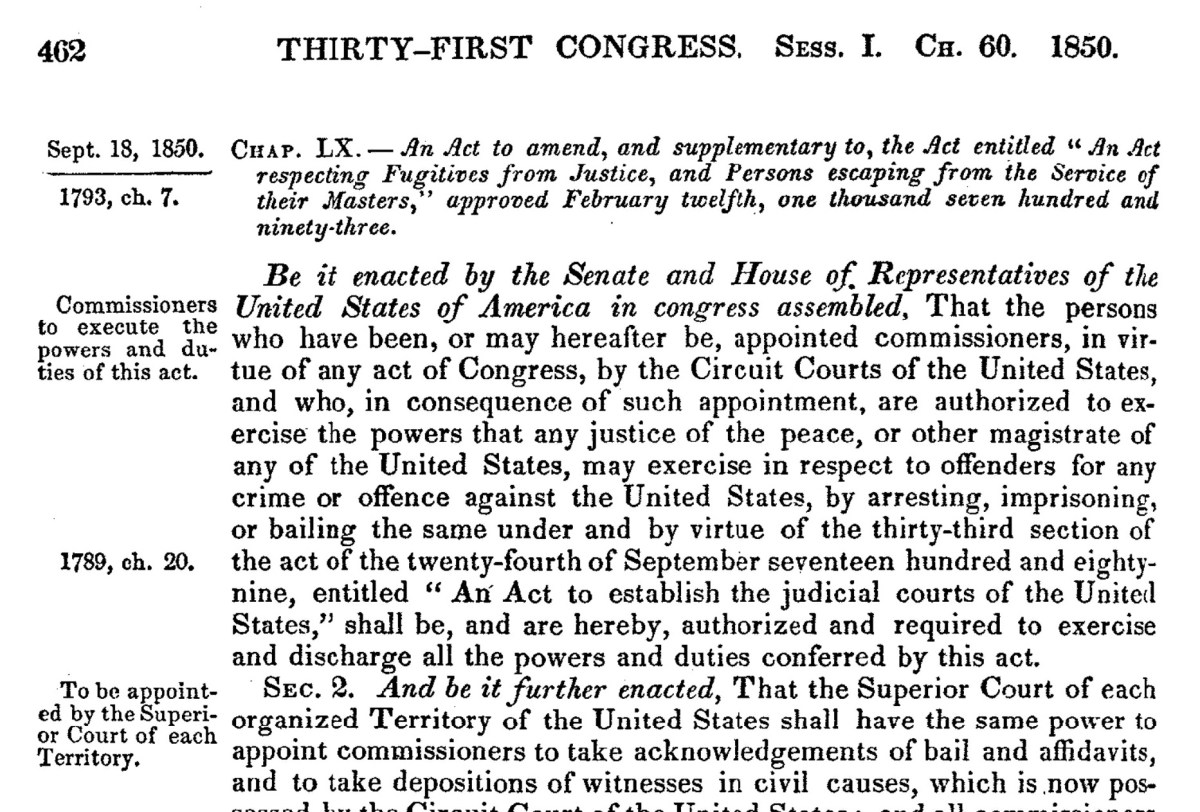
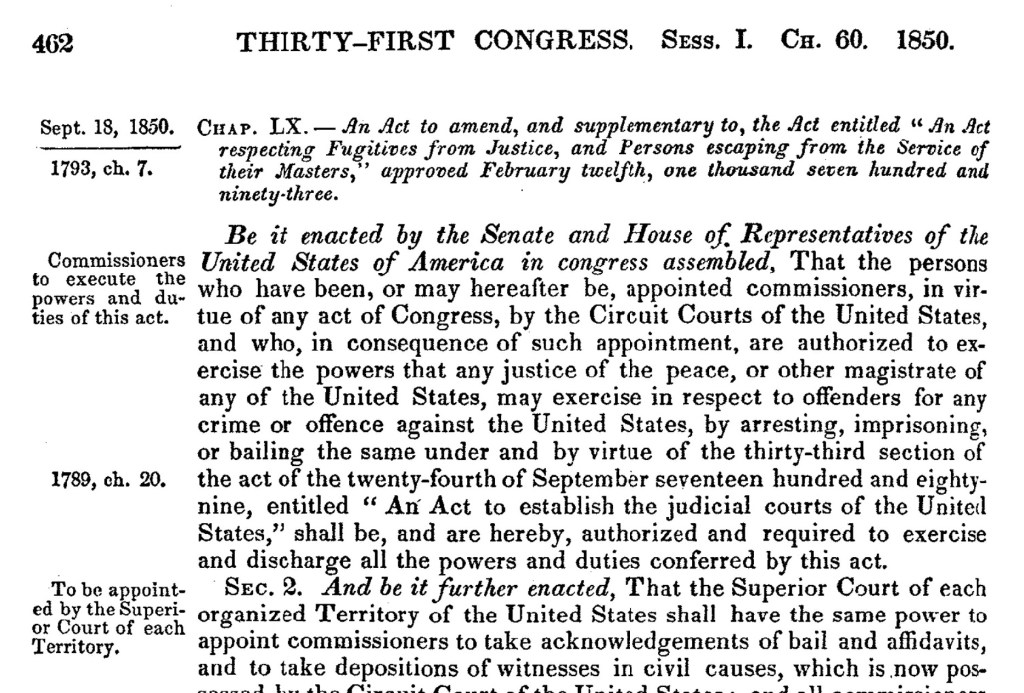
The Compromise of 1850 included the Fugitive Slave Act, a federal law signed just two years before Mr. Douglass’s 1852 speech. As historian Eric Foner has noted, this act demonstrates that pro-slavery states were willing to abandon their usual defense of states’ rights when it came to protecting the institution of chattel slavery. Eric Foner on the Fugitive Slave Act.

The U.S. Statutes at Large, Volume 9 (1845-1847), 29th through 31st Congress.

EdSiteMent , National Endowment for the Humanities, provides information, context and lesson plans.

Library of Congress, papers and documents of Frederick Douglass

Original Biographies that are available online

Timeline of Mr Douglass’ life, presented by the Library of Congress. Brief Summary Based on the Library of Congress

Frederick Douglass married Anna Murray in 1838. Together, they had five children: Rosetta (1839), Lewis Henry (1840), Frederick Jr. (dates vary, likely born around 1842–1843), Charles Remond (1844), and Annie (1849). The family moved to Rochester, New York in 1847, where Douglass continued his abolitionist work.

In 1859, following the failed John Brown raid, Douglass fled briefly to Canada to avoid arrest, returning in 1860—the same year his daughter Annie died. That year, Abraham Lincoln was elected president, and South Carolina became the first state to secede from the Union.

During the Civil War, slavery was abolished in Washington, D.C. in 1862, and the Emancipation Proclamation took effect in 1863, freeing enslaved people in Confederate states. That year, Douglass met with President Lincoln to advocate for Black soldiers and equal treatment.

On April 9, 1865, General Lee surrendered to Grant, effectively ending the Civil War. Lincoln was assassinated five days later. The 13th Amendment, abolishing slavery, was ratified later that year.

Douglass remained active during Reconstruction, fighting for civil rights and women’s suffrage. In 1870, the 15th Amendment guaranteed the right to vote regardless of race. That same year, after a suspicious fire at their Rochester home, the Douglass family moved to Washington, D.C., where Douglass was nominated for vice president by the Equal Rights Party, alongside presidential candidate Victoria Woodhull.

In 1874, Douglass became president of the Freedmen’s Savings Bank in a final effort to save the institution, which was failing and held the savings of many newly freed people. In 1875, Congress passed a Civil Rights Act to combat public discrimination, but in 1883 the U.S. Supreme Court rules the act was unconstitutional.

By 1877, Douglass had been appointed U.S. Marshal for the District of Columbia and later purchased a home in Anacostia (now Cedar Hill). Anna Murray Douglass, his wife of 43 years, died in 1881. He married Helen Pitts in 1884.

From 1889 to 1891, Douglass served as U.S. minister to Haiti and chargé d’affaires to Santo Domingo. He died unexpectedly in 1895.

Quotes From “What To A Slave Is the Fourth of July?”

Now, take the Constitution according to its plain reading, and I defy the presentation of a single proslavery clause in it.  On the other hand it will be found to contain principles and purposes, entirely hostile to the existence of slavery. . . . 

Great streams are not easily turned from channels, worn deep in the course of ages. They may sometimes rise in quiet and stately majesty, and inundate the land, refreshing and fertilizing the earth with their mysterious properties. They may also rise in wrath and fury, and bear away, on their angry waves, the accumulated wealth of years of toil and hardship. They, however, gradually flow back to the same old channel, and flow on as serenely as ever. But, while the river may not be turned aside, it may dry up, and leave nothing behind but the withered branch, and the unsightly rock, to howl in the abyss—sweeping wind, the sad tale of departed glory. As with rivers so with nations.

The Merry Tree

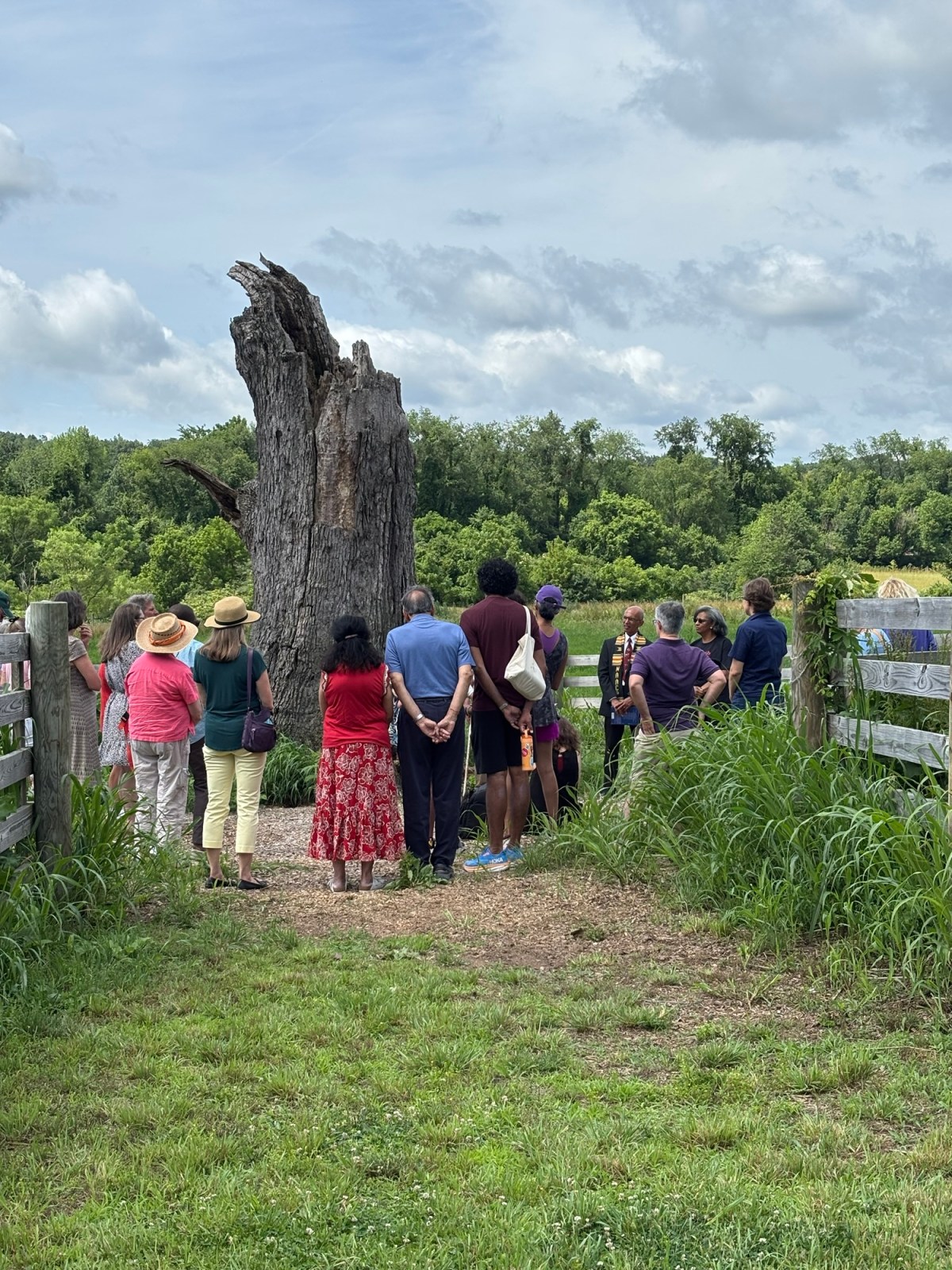
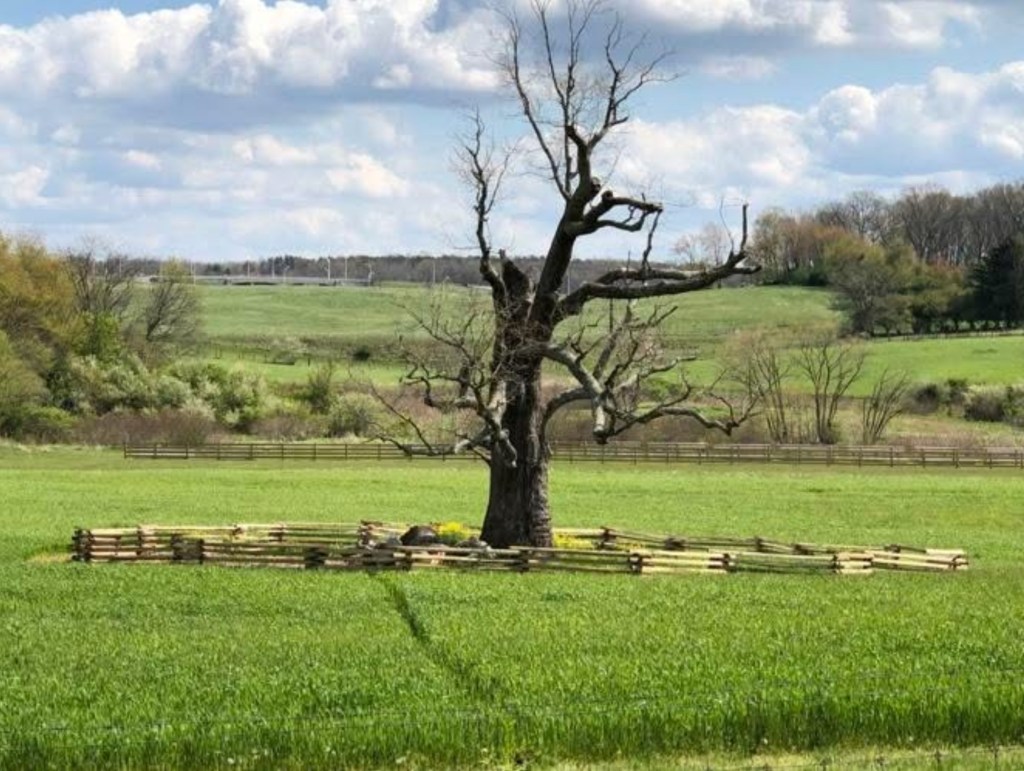
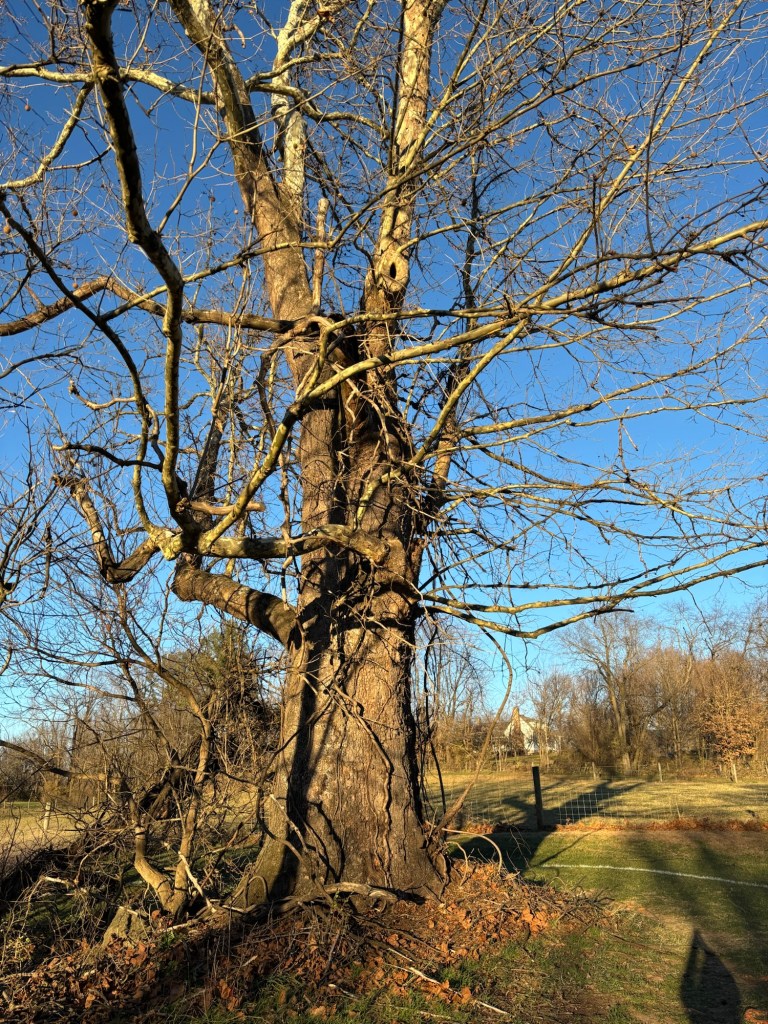
The Merry Tree, now a broken and weathered stump southeast of the Preston home, once stood as a silent witness to over a century of enslavement. It remains a sacred place where descendants return to honor their ancestors. We are gathering stories, photos, and memories connected to this tree. Let’s preserve its powerful legacy.

Help Us Tell the Story of the Merry Tree

For over a century, the Merry Tree stood as a silent witness to the lives of the 226 people enslaved by the Preston family at Smithfield, Blacksburg, Virginia. Planted near the time the Prestons built their home, this tree bore witness to generations of forced labor, family separation, resistance, and endurance. Though now reduced to a broken and weathered stump, the Merry Tree remains a place of deep meaning—especially for the descendants of those once enslaved, who return here to remember, honor, and reflect.

We are seeking to gather as much information, memory, and meaning as possible about this special tree. Did your family speak of it? Do you have photos, stories, or oral history connected to the Merry Tree? Whether you are a descendant, community member, or researcher, your voice matters in helping us preserve and understand the role this sacred place played in Black history in Montgomery County.

Please share what you know. Together, we can ensure the story of the Merry Tree—and those who stood beneath it—is never forgotten.

#MerryTree #BlackHistory #SmithfieldVoices #CommunityMemory #TruthTelling

https://themerrytree.vt.domains

https://news.vt.edu/articles/2022/03/unirel-merryoak.html

https://youtu.be/MRtNTU6f5Ao?si=M82B2-3mk2GNea19

https://fb.watch/Al2YW58dry/?fs=e

https://fb.watch/Al2_CTJG-s/?fs=e

https://news.vt.edu/videos/k/2024/08/1_tznvjyyu.html

https://www.wfxrtv.com/news/local-news/new-river-valley-local-news/merry-oak-tree-brings-dozens-together-to-remember-enslaved-families/

https://historicsmithfield.wordpress.com/2017/02/28/merry-oak/?fbclid=IwQ0xDSwLCMlZleHRuA2FlbQIxMQABHv0vjeN0Bf21sot8c_kdCGs34nl7HL1kqw3D79M5olBaYuk-obb_VAJ2ggBQ_aem_hTV02h4a8q1x_cCGxX_nBA

https://montcova.com/2024/08/02/historic-smithfield-dedicates-merry-oak-bench/

https://www.wvtf.org/news/2025-06-19/juneteenth-event-honors-226-people-who-were-enslaved-at-smithfield-plantation

https://virginiahumanities.org/events/2022/03/1872-forward-vt/

https://virginiahumanities.org/2022/08/more-than-a-fraction-the-power-of-the-merry-tree/

https://morethanafraction.com/uploads/1/3/2/3/132308734/drkmoseleyhobbs_cp.pdf

Witness Tree – Sycamore Guarding the Spring

This enormous sycamore stands just east of the spring that once provided potable water for the people living on the Smithfield property. The spring lies a considerable distance from the house and closer to the old Merry Oak. One can only imagine the countless gallons of water enslaved people carried from that spring to the white house on the knoll over nearly a century. Like the Merry Tree, this sycamore may have held significance for the men, women, and children forced to labor here—its presence a silent witness to their daily lives.

Genealogy of Slavery – Center for Studying Stricture of Race – Roanoke College

This website serves as an important resource for understanding the history and legacy of slavery in our region. It contains information collected from Roanoke County sources about more than 4,000 enslaved individuals.

https://www.roanoke.edu/a-z/center_for_studying_structures_of_race/projects_x71825

Genealogy of Slavery – Center for Studying Stricture of Race – Roanoke College

This website serves as an important resource for understanding the history and legacy of slavery in our region. It contains information collected from Roanoke County sources about more than 4,000 enslaved individuals. Many of the family names of enslaved African Americans recorded here also appear in neighboring Montgomery County, making this work deeply relevant to our local history. In addition, the family names of many individuals who enslaved others are found in the Roanoke primary sources.

The purpose of this page is to document and connect these shared names, with the hope of bringing to light the lives of those too often lost to history and deepening our understanding of the enduring legacy of slavery in Montgomery County and beyond.

More names will be added with time.

Family Names of Enslaved African Americans in Montgomery County

Brown

  • William Brown – enslaved by William Watts. “In IAS Book 4, the partition of the lands and other property of Edward Watts, William Brown is listed among the enslaved individuals that were bequeathed to Edward Watts’s daughter, Alice W. Morris. A value of $1,700.00 was placed on William Brown.”; Inventory, Appraisements, and Sales Book 4, Roanoke County Archives.

Calloway

Campbell

  • George Campbell – “George Campbell was listed in an indenture agreement: “…bind unto the said Lewis Zirkle a boy of colour named George Campbell until he arrives to the free age of twenty one which will be on the 25th day of June 1854.”
    In the Common Law book, it was ordered that the Overseers of the Poor bind out George, “a boy of color,” to Lewis Zinkle.”;
    Common Law Orders – A – May 1838 – May 1840, Roanoke County Archives.

Saunders/Sanders

Family Names of Enslavers in Montgomery County

Evans

  • Elizabeth Evans (List of first names of people they enslaved), “Elizabeth was listed in Michael Shepard’s property appraisement as having purchased enslaved people after Michael’s death. In the record, Elizabeth purchase” the enslaved people Joe, Nancy, and an unrecorded named child for $675.00.” She was possible daughter of Jonathan Evans. “Elizabeth’s son was William Evans and her husband was William W. Evans.”; Common Law Orders – B – June 1840 – July 1843, Roanoke County Archives

Kent

Kyle

Oliver

Wyatts

Geography of Slavery Project

“The Geography of Slavery project presents full transcriptions and images of all runaway and captured ads for slaves and servants placed in Virginia newspapers from 1736 to 1790, and is in the process of compiling advertisements well into the nineteenth century. In addition, the project offers a number of other documents related to slaves, servants, and slaveholders, including court records, other newspaper notices, slaveholder correspondence, and assorted literature about slavery and indentured servitude.”

Example: Virginia Gazette or American Advertiser (Hayes),
Richmond, July 17, 1784.

June 22, 1784. TAKEN UP, by John T. Sayers, living in Montgomery County, and committed to gaol, a Negro man who calls himself TOM, and says he belongs to Captain V. Harrison, in Loudoun County, in this State; he is an outlandish fellow, talks broken English, is about 25 years of age, and is about five feet four inches high. Had on when he was taken up, an old blue coat, jacket and leather leggins, and has large scars on his face, and on his neck. Whoever owns the said Negro is requested to come, pay charges, and take him away. WALTER CROCKETT, Sheriff of Montgomery County.

Genealogical Importance of Southern Confederacy Documents for African American Research

When researching African American genealogy, particularly in the South, it can be challenging to trace family history due to the lack of comprehensive records. However, some of this information can be found in an unexpected place: the Civil War documents of the Southern Confederacy and the United States Military.

When researching African American genealogy, particularly in the South, it can be challenging to trace family history due to the lack of comprehensive records. However, some of this information can be found in an unexpected place: the Civil War documents of the Southern Confederacy and the US Military.

The book Virginia’s Black Confederates: Essays and Rosters by Greg Eanes highlights this, providing primary source documents that list the roles free and enslaved Black men, women, and children performed for the Southern war complex. These records, while written from a perspective that upholds the Confederacy’s narrative, contain valuable data for tracing African American ancestry.

The information in the post is found within this book. Eanes, Greg. Virginia’s Black Confederates: Essays and Rosters 2014. Civil War Sesquicentennial Edition, 2nd Edition.

Virginia 11th Regiment and Montgomery County

This regiment was established in Lynchburg, VA in May 1861 and put into service in July that same year. It was comprised of men from Botetourt, Campbell, Culpeper, Fauquier, Montgomery, and Rockbridge Counties. The free and un-free Blacks associated with this regiment may be listed in the regimental documents.

Eane’s Compilation of of Jobs Performed by Free & Enslaved (pgs 22-23)

  • Body Servant – “Assist with care, cleanliness, and order as assigned quarters, uniforms, and military personal equipment; Help to purchase, prepare, and serve food and beverages in the General Officer’s quarters.”
  • Cook – “Preparation and service of food in field or garrison food service operations.”
  • Teamster – “Motor Transport Operators” and “Cargo Specialist.”
  • Laborer-Breastwork – “Combat Engineer” and “Carpentry and Masonry Specialist.”
  • Laborer – Railroad – “Railway Equipment Repairers”, “Railway Section Repairers”, and “Railway Operations Crewmember.”
  • Laborer – Burial Details – “…recovery, collection, evacuation, establishment of tentative identification” of the body and possessions.
  • Hostler – “comprehensive care for government owned animals.”
  • Hospital Steward/Nurse – provide movement and care for injured people.
  • Musician – professional Army band
  • Blacksmith – “fabrication, repair and modification of metallic and nonmetallic parts.”
  • Mechanic – “maintenance and repair on artillery, small arms; store ammunition.”
  • Carpenter – “Perform general heavy carpentry, structural steel and masonry duties.”
  • Boatman – “..navigation, cargo operations and supervising other Soldiers on Army watercraft.”
  • Laundress – “supervising and performing laundry…”
  • Preacher – “Support Unit Ministry Team”
  • Scouts/Spies – “..reconnaissance…”

Compiled Service Records

Service records provide valuable information. They are available in paid sources, Ancestry.com or Fold.com and in Familysearch.org.

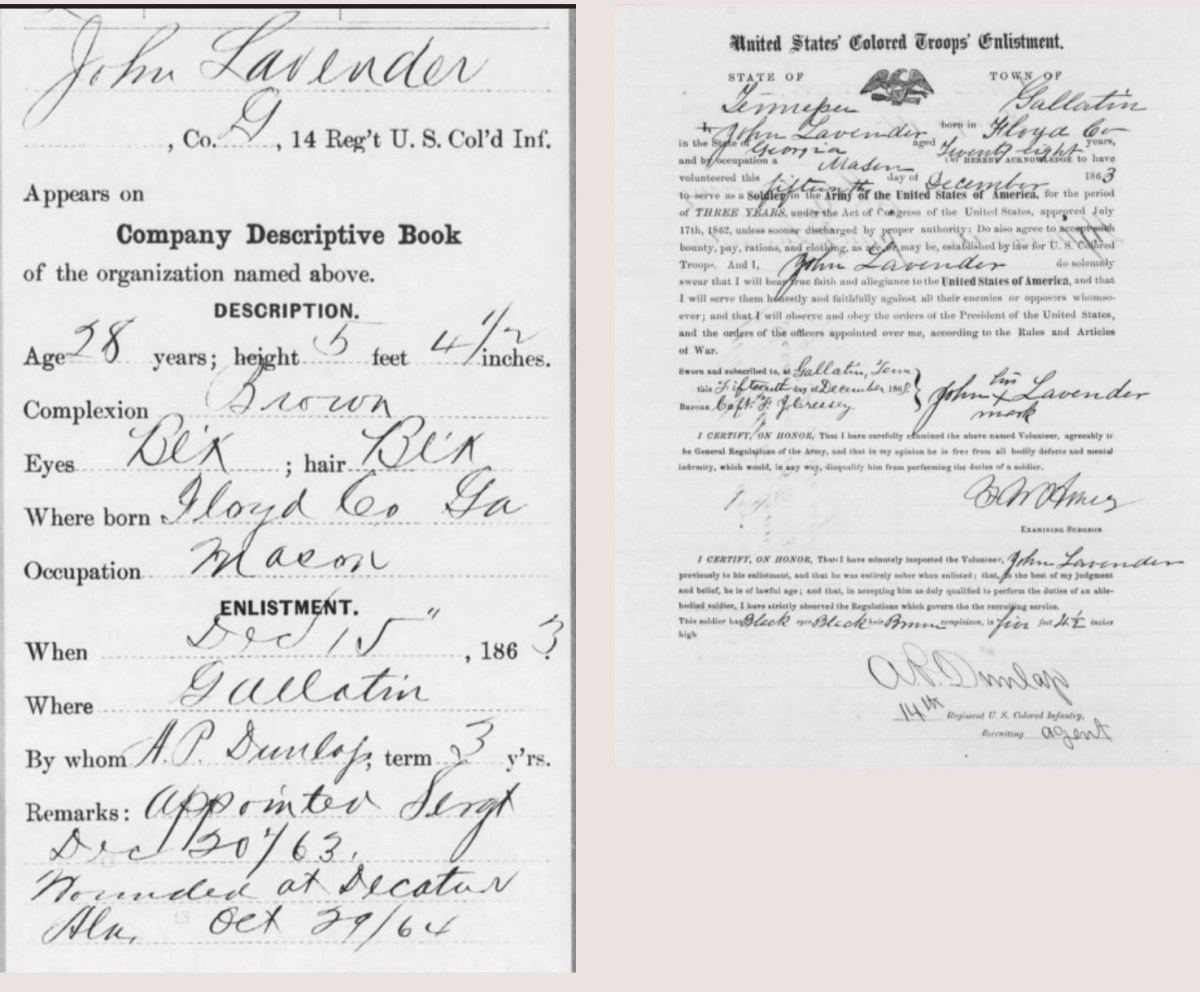
John Lavender Service Record, US Colored Troops, enlisted 15 Dec 1883. Blacksburg Resident after 1974.

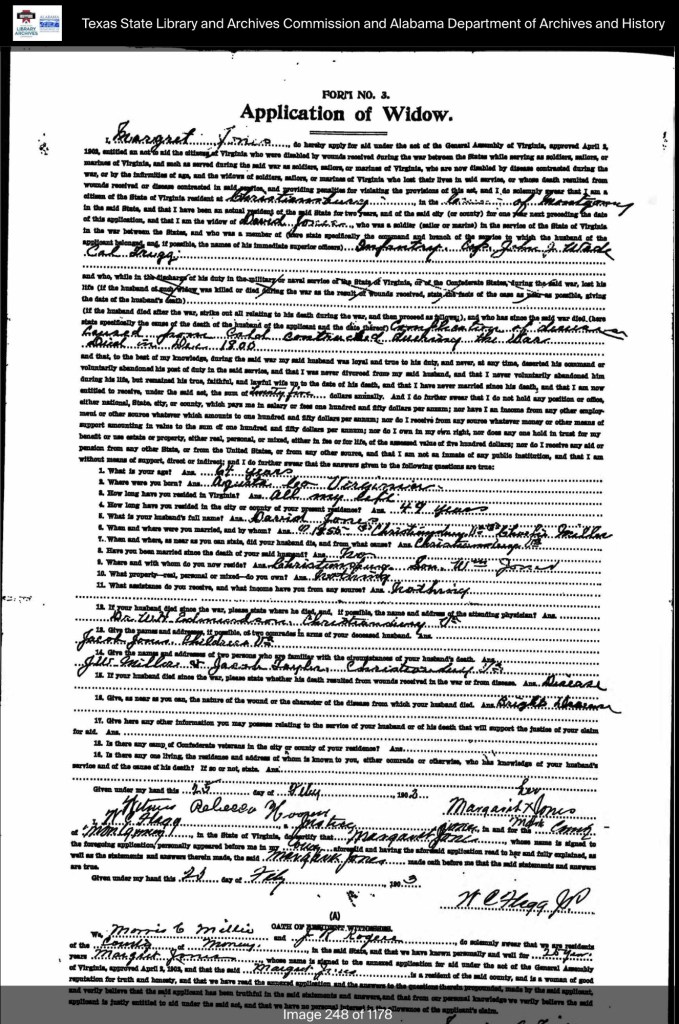
Pension Applications of the Confederacy and US Military

Confederate Pension Acts for Virginia were enacted between 1888 and 1934. On 14 of March, 1924 the act centered on servants granted pensions. “The 1928 Act broadened recognized duties to include performance of guard duty, burring Confederate dead, working in railroad shops, blacksmith shops or hospitals” (Page 26).

The pension records can be found at the Library of Virginia and on Ancestry.com (subscription required).

National Archive article on how to use the Pension Records, “Union Pension Files Giving Voice to Former Slaves”

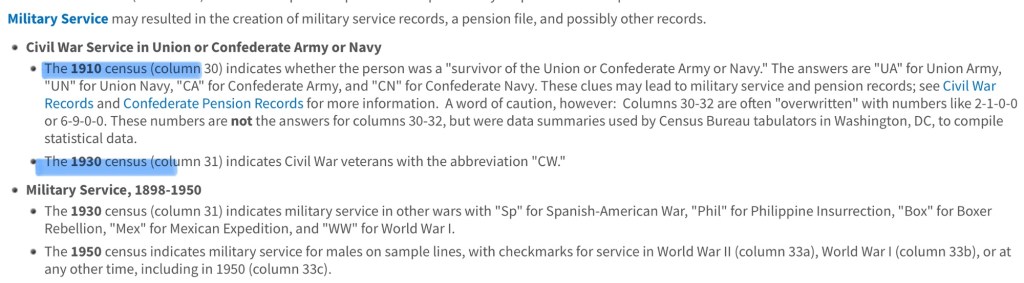
The 1910 (see image) and 1930 (CW) census indicates that the person was a veteran. The National Archives provides a helpful list of codes that were used.


Confederate Soldiers’ Home Application for Admissions Records

Found in the Library of Virginia digital collection or this link .


The American Civil War Museum

The archives of the museum maintain a large holding, some of which is digitized.

Confederate Certificate of Service – Freemen and Enslaved.

According to Eanes on page 113, the Army of the Confederate States adopted (1861) Form #4, the Certificate of Service. This was used for both free and unfree persons. Where these are located? We have not found an online source, yet.

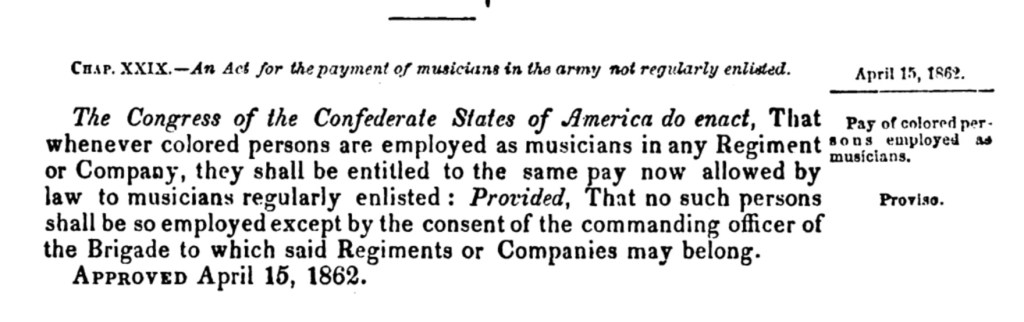
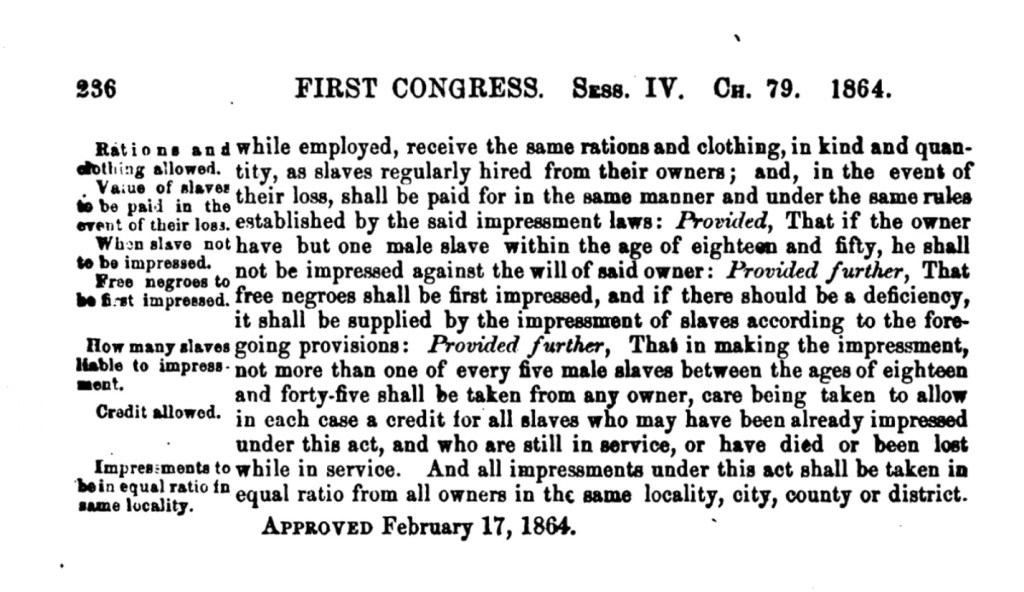
Public laws of the Confederate States of America, first Congress, 1862-1864 / [edited by James M. Matthews].

Primary source of the Acts of the Confederate Congress, Public laws of the Confederate States of America, first Congress, 1862-1864 / [edited by James M. Matthews]

Chapter XXIX – An Act for the payment of musicians in the Army no regularly enlisted.” Page 29 (book, not pdf)
Chapter LXIV – An Act for the enlistment of Cooks in the Army”. Page 48 (book, not pdf)
“Chapter LXXIX – An Act to increase the efficiency of the Army by employment of free negroes and slaves in certain capacities” Page 235-236 (book, not pdf)

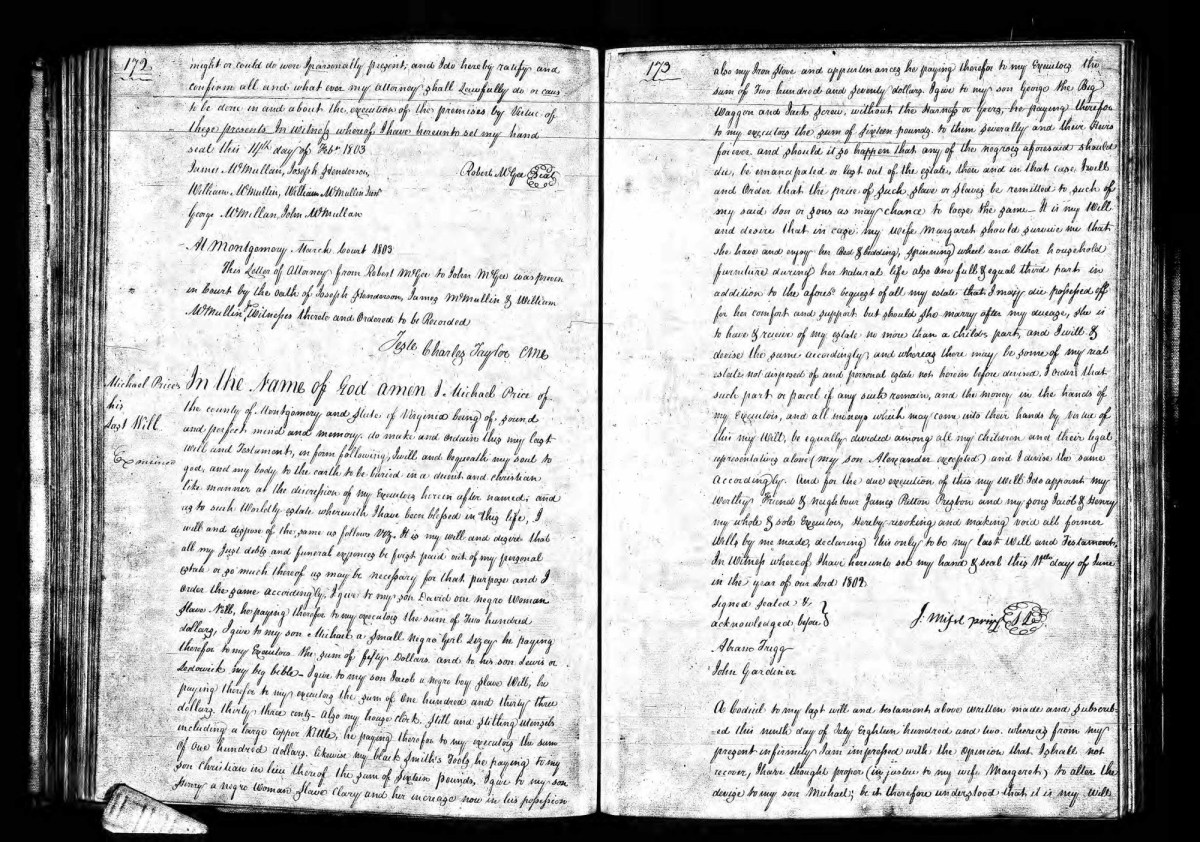
Enslaved People Named in Wills: Enslaved by Michael Price (1718-1802, father) and Michael Price (1748-1839, son)

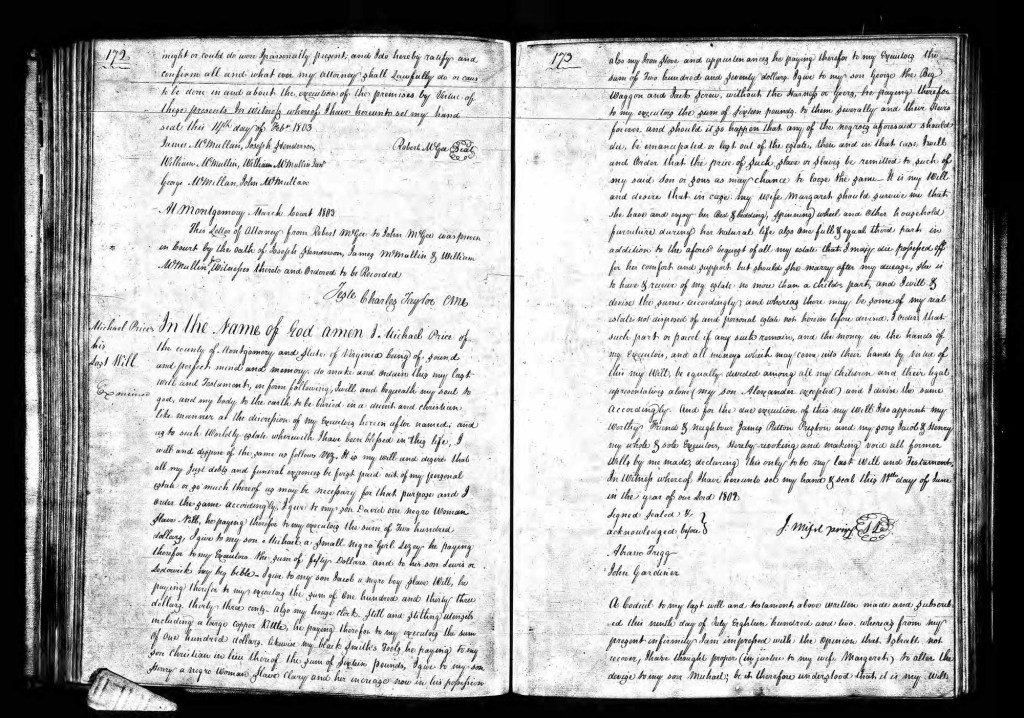
Michael Price (1718-1802) Will

Michael Price wrote his will on 11 June 1802, witnesses by Abram Trigg and John Gardiner. James Patton Preston and his sons, Jacob and Henry Price were his executors. The will was proved on 09 July 1802. According to the 1788 Tax list, Michale was taxed for two enslaved people.

Summary

  • Son David inherited an enslaved woman named Nall for $200.
  • Son Michael inherited a small girl, Lizey for $50
  • Son Jacob inherited Will, paying $133
  • Perry inherited Clary with her “increase.”

Michael Price (1748-1839) Will

Michael Price wrote his will on 12 March 1835. witnessed by Jacob Shell, Jacob Harless, and Samuel Smith. The executors were Alexander Price (son), David Keister, Phillip Harless, and Peter Keister, proved on 12 March 1839. According to the 1788 Tax list, Michale held no enslaved people.

Summary

  • Wife, Esther Francisco Price inherited Liz and her two children, Maria and Ben. Upon Esther’s death she may “dispose” of Maria and/or Ben, but Liz was to be retained by the family. Liz was given the choice of which child she would become property.
  • Son Alexander inherited David and Sam.

Livey was alive in 1802 and was passed to Michael Price’s son, also named Michael. When Michael Price died in 1839, a woman named Liv and her two children, Maria and Ben, were mentioned in his estate. After his death, Liv was inherited by Esther Francisco Price, who was living with her son, Alexander Price.

Further research is needed to trace the lives of those held in bondage by the early Price family.

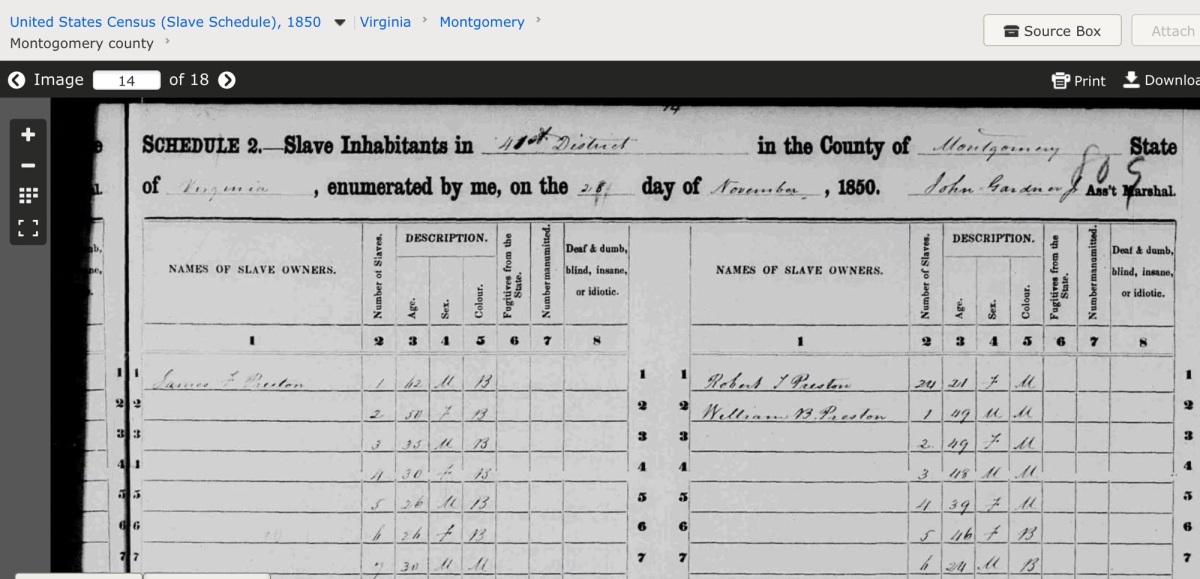
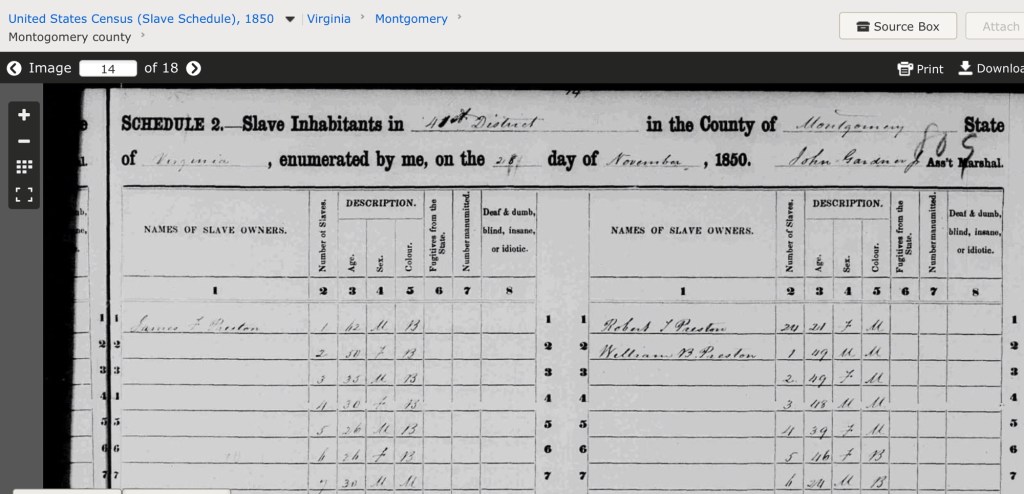
1850 US Federal Census, Slave Schedule for Montgomery County, VA

Family Search version is free but have to create an account:

https://www.familysearch.org/search/collection/1420440

If you’re searching for a specific enslaved individual, please note that their names are generally not listed, except in rare instances. To browse the records, enter the names Preston, Hoge, or Wade (all enslavers), and then navigate through the document.

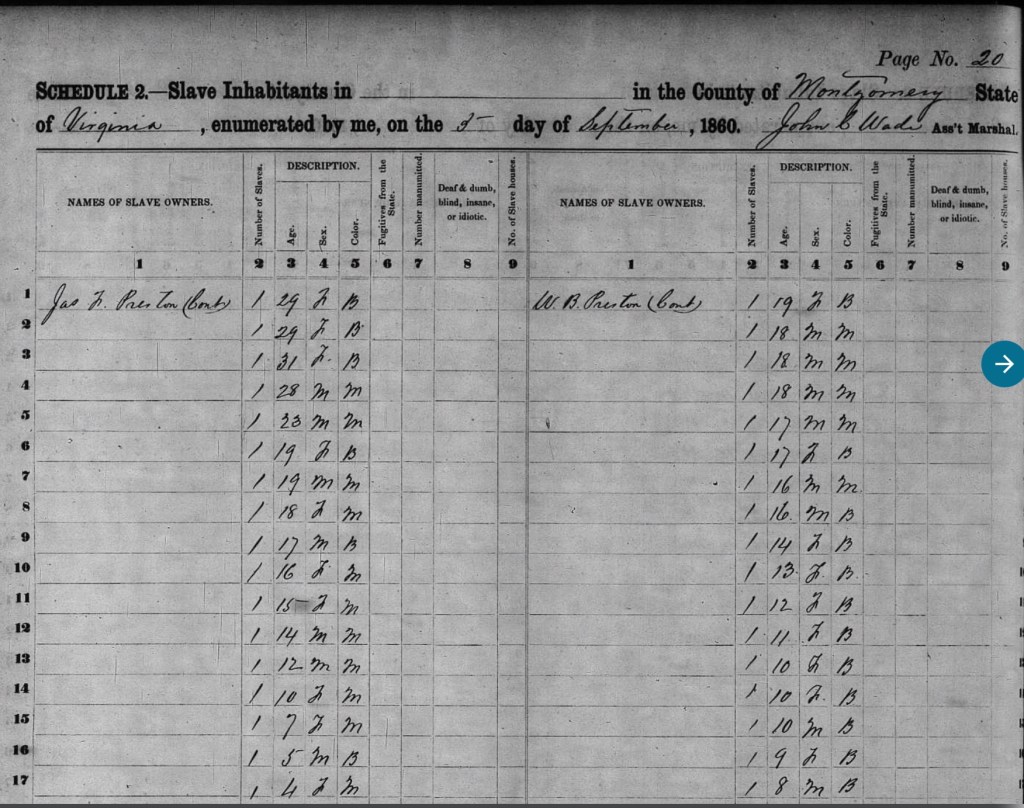
1860 US Federal Census, Slave Schedule for Montgomery County, VA

Ancestry.com Access A subscription is needed

Family Search version is free but have to create an account: https://www.familysearch.org/search/collection/3161105

If you’re searching for a specific enslaved individual, please note that their names are generally not listed, except in rare instances. To browse the records, enter the names Preston, Hoge, or Wade (all enslavers), and then navigate through the document.