Gatherings

Celebrating Alvin Duval Lester’s Photography

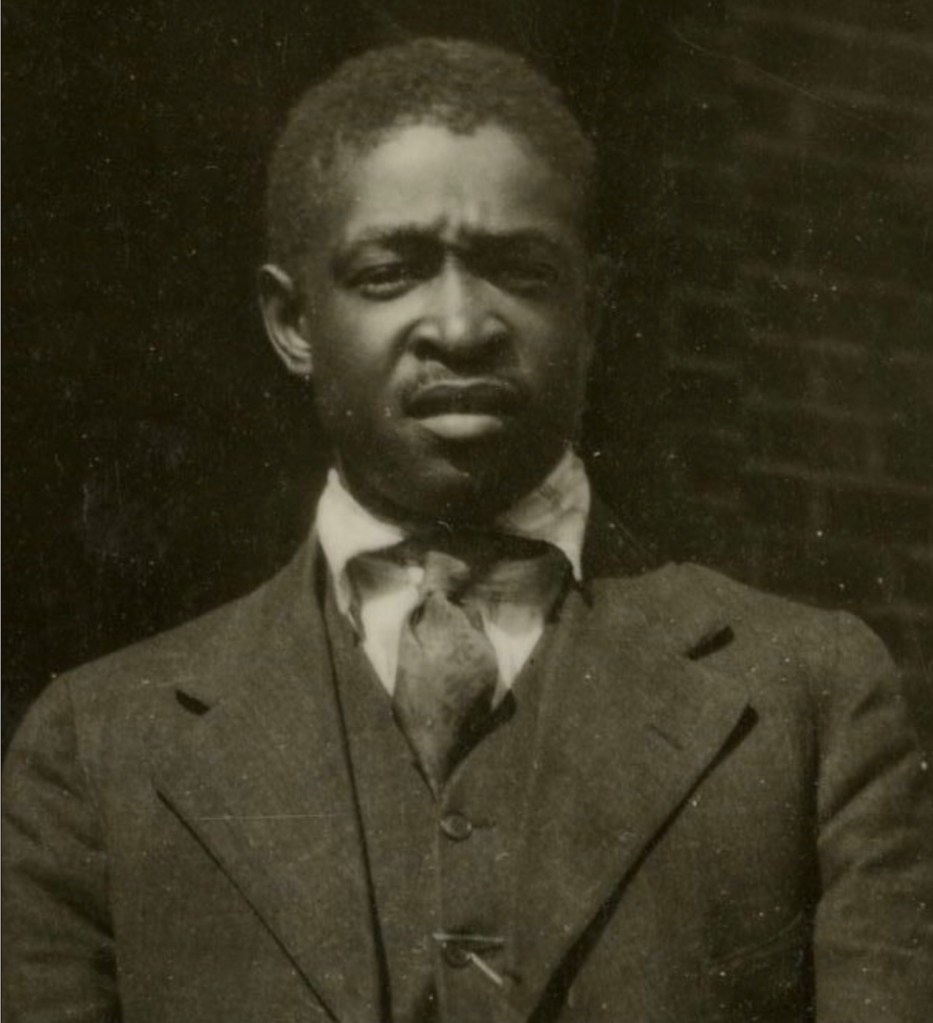
Alvin Duval Lester (b. 1947) grew up in Christiansburg and later documented life in Richmond’s Jackson Ward through photography. His 1980s–90s images are featured in Alvin Lester: Portraits of Jackson Ward and Beyond, on view at the Virginia Museum of Fine Arts through March 30, 2026.

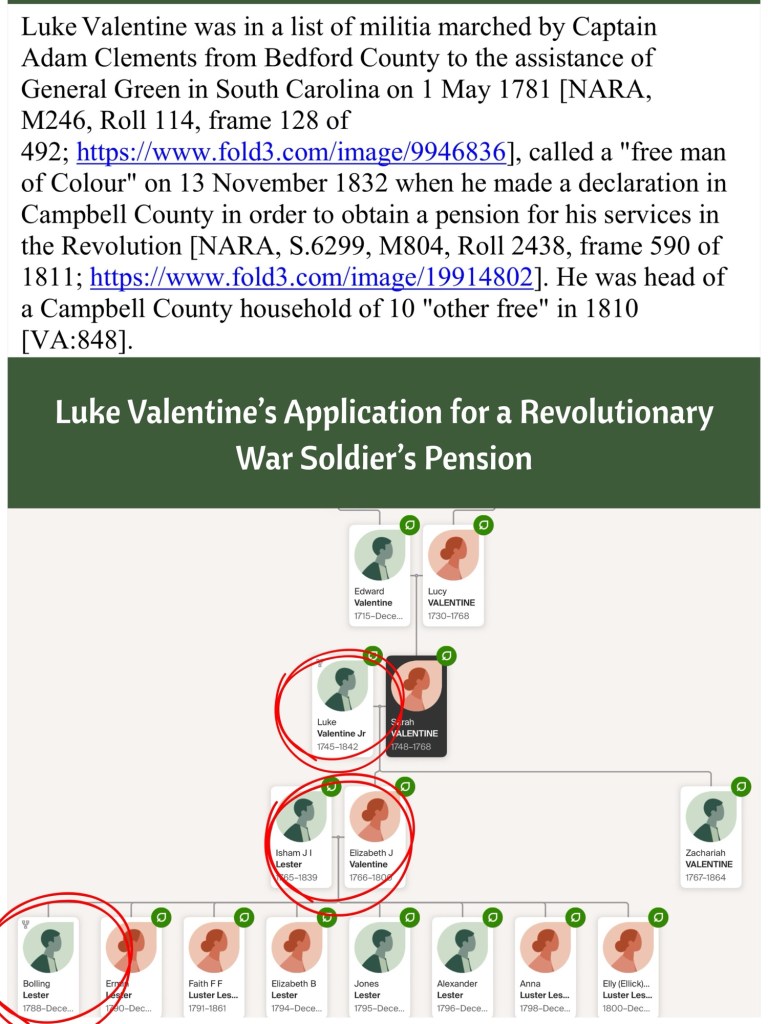
Lester’s family history spans at least five generations of free Black Virginians. Among his ancestors is Luke Valentine, who served in the Revolutionary War, marching from Bedford County to South Carolina in May 1781.

Courtesy of VMFA Museum

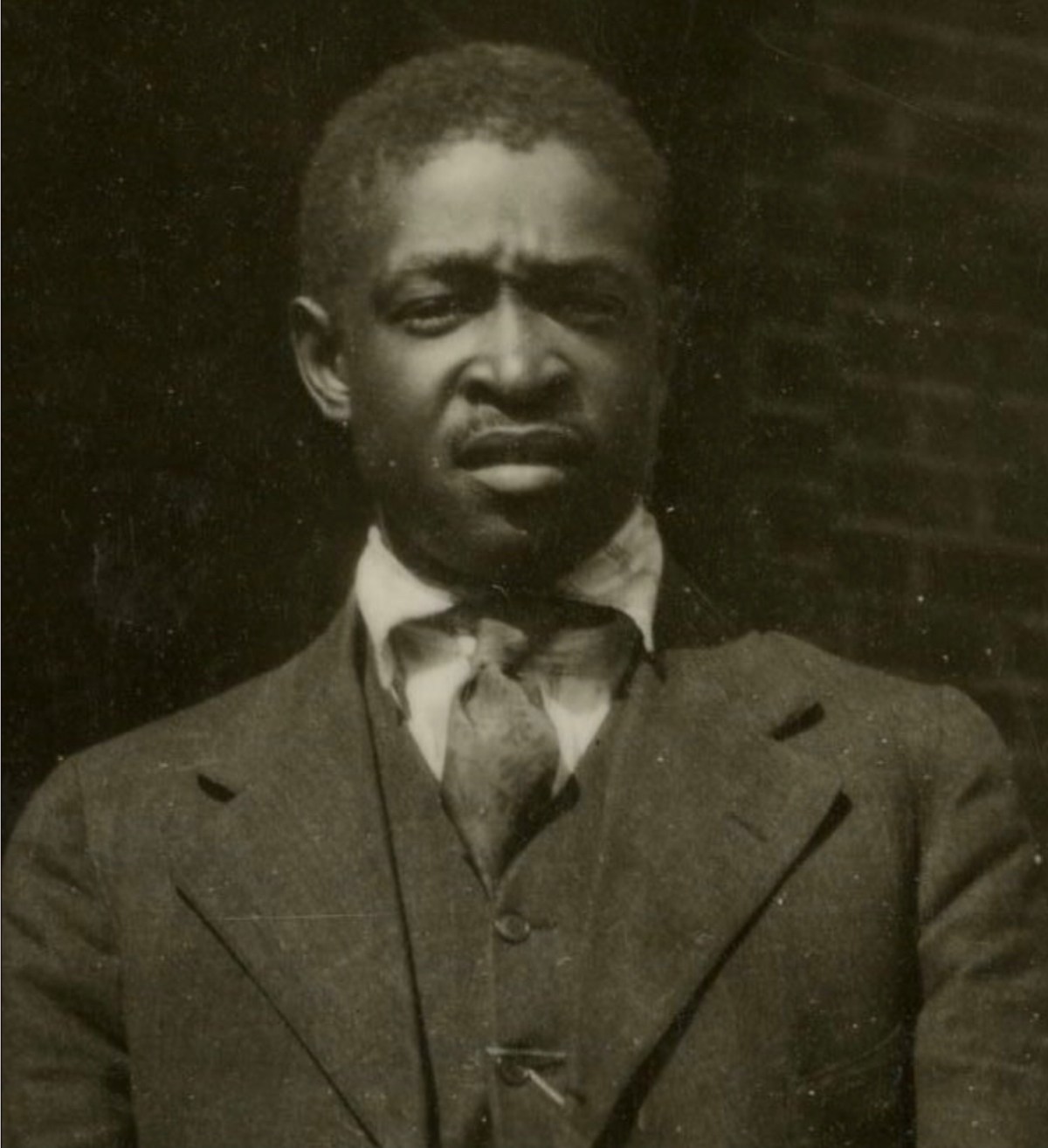
Alvin Duval Lester (b. 1947) is another example of the deep connections between Montgomery County families and Jackson Ward in Richmond. Raised in Christiansburg, Virginia, Alvin later documented life in Richmond through his photography. His images of Jackson Ward in the 1980s–90s were featured in the exhibit Alvin Lester: Portraits of Jackson Ward and Beyond. The Virginia Museum of Fine Arts exhibit will run until March 30, 2026 in the Photography Gallery, Richmond, Virginia. Facebook post by the Virginia Museum of Fine Arts

Alvin’s family history can be traced through at least five generations of free Black ancestors. His fourth-great-grandfather, Isham Lester (1765–1839), was listed as free in the 1810 U.S. Census for Lunenburg County. His son Bolling Lester, and grandson John C. Lester, were also born free there. By the 1860 U.S. Census, Bolling Lester had moved his family to Dry Valley in Montgomery County.
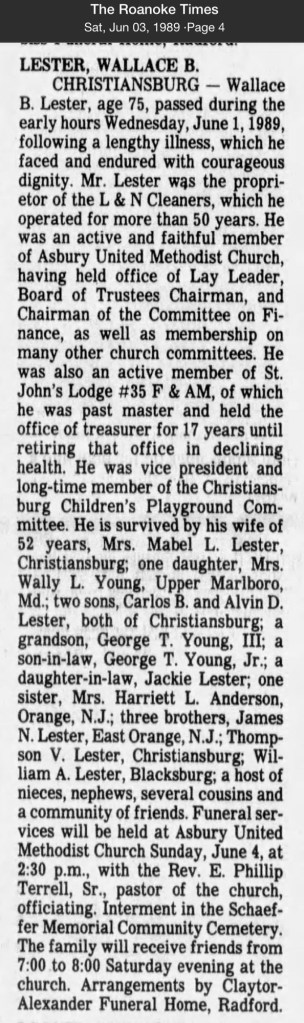
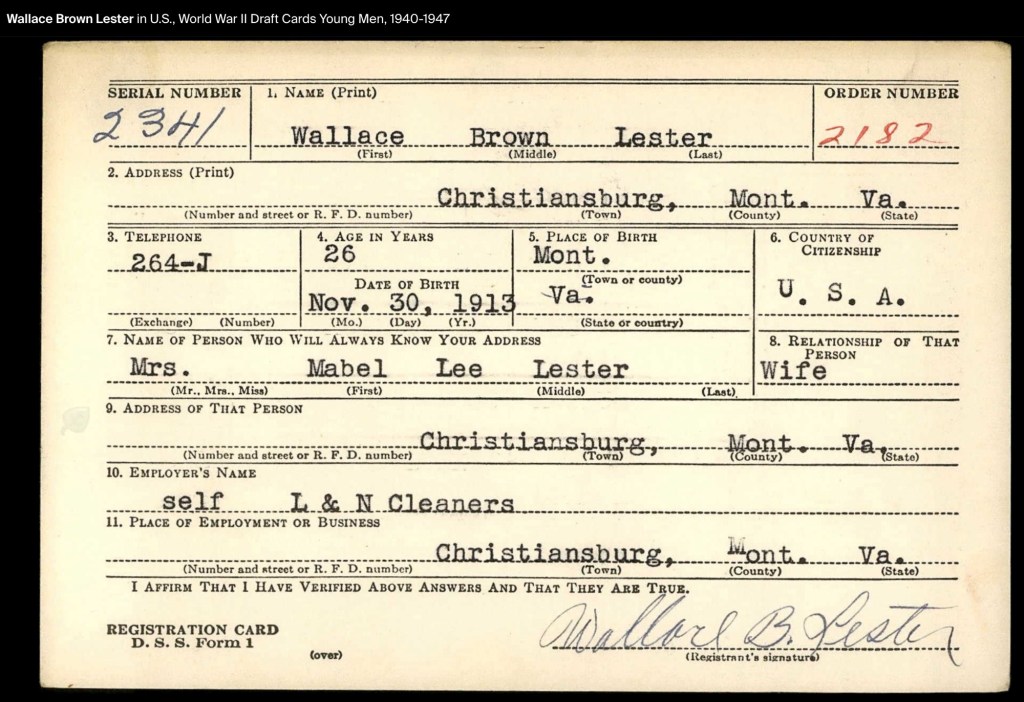
Alvin’s father, Wallace Brown Lester (1913–1989), married Mabel Lee Saunders on June 17, 1937, in Floyd County. The couple lived in Christiansburg, where Wallace owned L&N Cleaners. Alvin’s paternal grandparents were James Niles Wilson Lester (1880–1941) and Fannie Baker Thompson Lester (1886–1987). Fannie was the daughter of Herbert Thompson and Harriett Kincanon. James was the son of John C. Lester (1837–1924) and Annie Pate Lester (1843–1915), both born free in Lunenburg County, Virginia. John C.’s parents were Bolling Lester (1788–?) and Rebecca Barber (1790–1845).

Alvin’s great-uncle, John Wynes Lester (1885–1961), taught, farmed and worked as a carpenter at Christiansburg Institute. He and his wife lived on campus until his death. He is buried in the school’s cemetery.

Luke Valentine, Free Black, Application for Revolutionary War Pension
During the American Revolutionary War, free Black men in Virginia played a meaningful—though often overlooked—role in the fight for independence. From the earliest days of the conflict, free Blacks served in militias, state troops, and Continental units, particularly as manpower shortages grew. Virginia law restricted enslaved people from bearing arms, but free Black men could enlist, serve as substitutes, or be mustered alongside white soldiers, especially in local militia companies.

By the later years of the war, Virginia increasingly relied on these men for defense and campaigns beyond the colony’s borders. Their service included marching long distances, guarding supply lines, engaging Loyalist forces, and fighting in the southern theater, where the war was especially intense in 1780–1781.

Luke Valentine, fifth-great grandfather of Alvin Lester’s, is one such example. He appears on a roster of men led by Captain Adam Clements of Bedford County, Virginia, who marched to South Carolina beginning May 1, 1781. This was a critical moment in the war, as Patriot forces sought to counter British advances in the South. Valentine’s inclusion on this roster places him among the free Black Virginians who answered the call to serve far from home in support of American independence.

After the war, some free Black veterans, including Luke Valentine, applied for Revolutionary War pensions. These applications are vital historical records, offering rare documentation of Black military service and affirming that free Blacks were not only present but active participants in the founding struggle of the United States.

Searching for Their Name – Cambria, VA

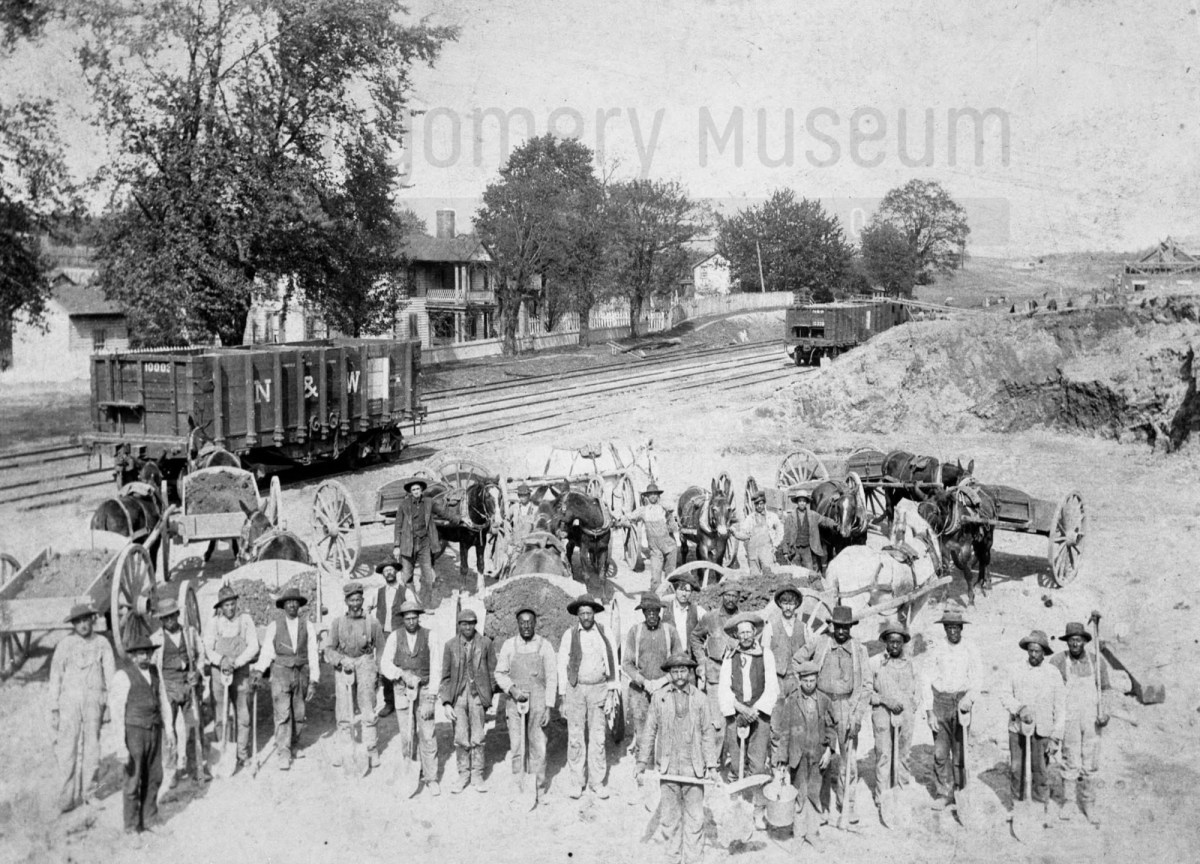
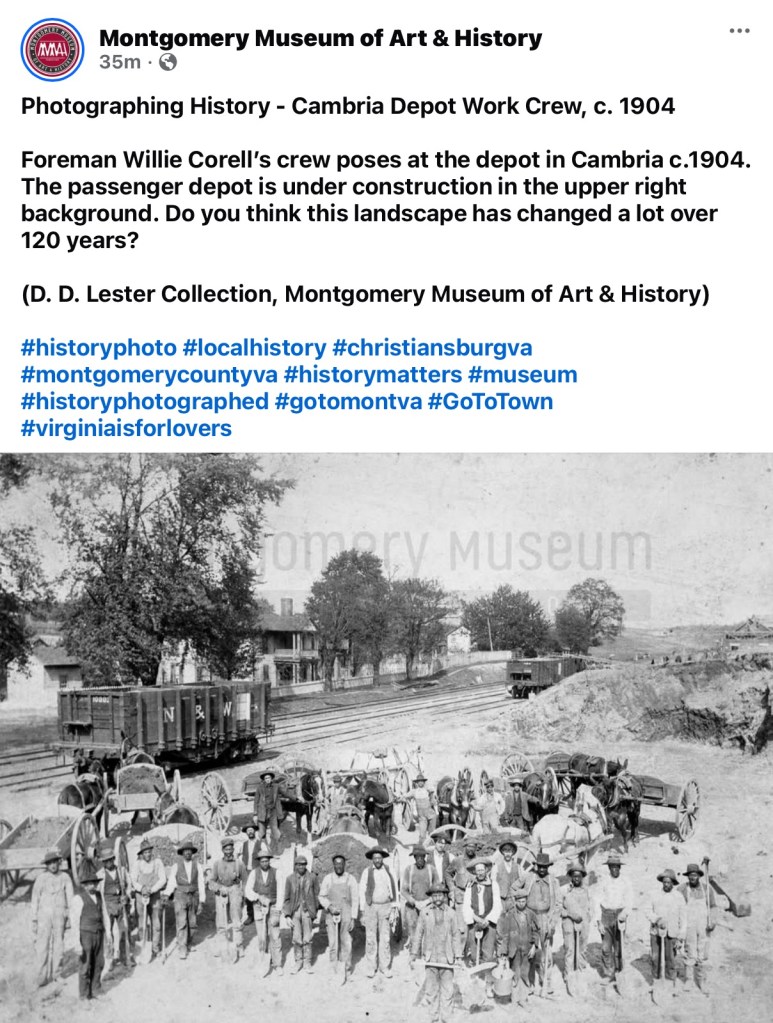
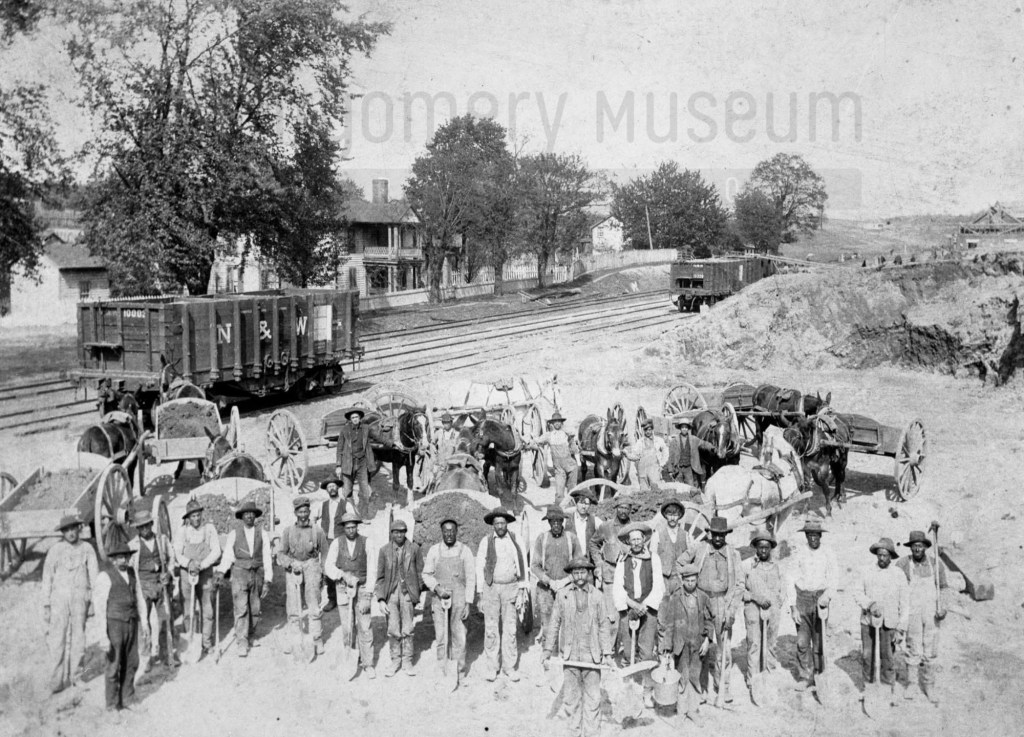
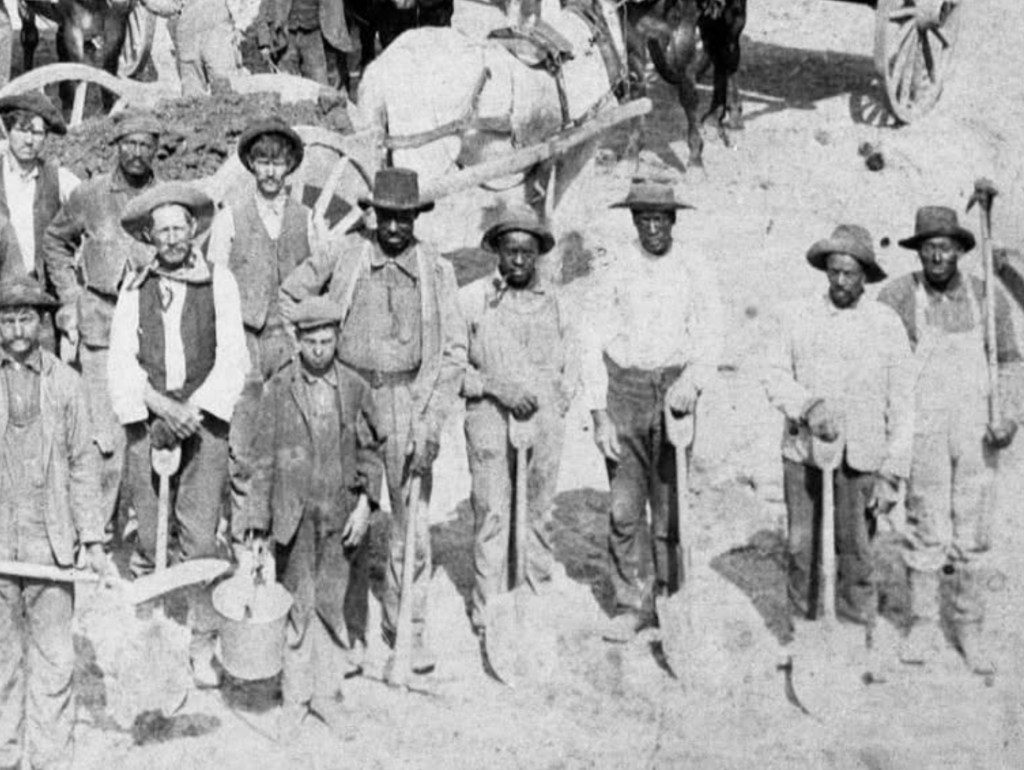
In 1904, a mixed-race crew built the new Cambria, Virginia Depot passenger station. Their faces were captured, but their names were not. As we search census records and explore new tools like AI facial recognition, we hope to uncover who they were — the hands and lives behind this piece of our shared history.

This 1904 photograph captures a work crew—Black and white men together—building the new passenger station for the Cambria, Virginia Depot. It’s a remarkable image of shared labor and community effort during a time of deep segregation.

Yet, like so many images from the early 20th century, the men remain unnamed, except for the foreman, Willie Corell. Their faces look back at us across more than a century, but their identities have been lost to time. Who were they? What were their lives like?

With advancing technology, tools like AI facial recognition may one day help uncover their names and family connections. Until then, our research turns to the 1900 and 1910 census records, where we hope to find traces of the African American laborers who helped shape the Cambria community and build this station that still stands as part of our shared history.

If you have family stories, photographs, or names that might help identify these men, we would love to hear from you. Each clue brings us closer to giving them the recognition they deserve.

Church: Rough and Ready in Childress, Virginia

The exact location of this church in the Childress area remains unknown. A 1940 school map shows nearby schools but lists only Pine Woods, a Rosenwald-funded African American school. Because schools were often built near churches, the map—and the noted Shelburne home—may offer clues to where the congregation once gathered.

Rough & Ready Church in Childress, Va – Roanoke Times, 05 August 1923, page 20

The exact location of this church in the Childress area is unknown. A 1940 school map identifies local schools but does not mark any African American schools, except Pine Woods School, which was built with Rosenwald funds. In many communities, schools were often situated near churches, so their locations can offer valuable clues. A Shelburne home also appears on this map, suggesting possible connections within the neighborhood.

The Roanoke Times, 05 August 1923, page 20

During a violent electrical storm Monday, lightning struck a son of Authur Shelburne near the colored church “Rough & Ready.”

Searching for Her Name – Lawrence Family Photo

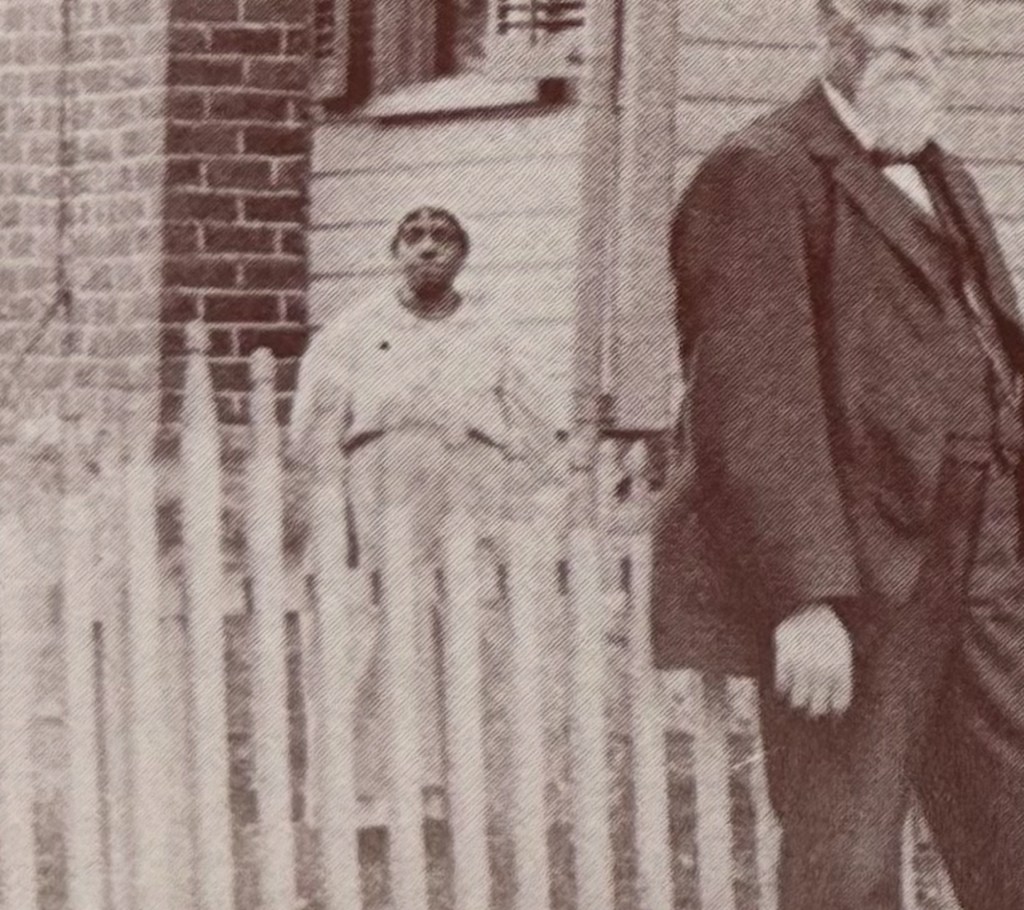
Behind the Lawrence family’s fence on Five Points Road in Riner stands an unidentified African American woman—her name unrecorded, her story unknown. She appears behind Canaan and Mollie Weaver Lawrence, whose wealth came from farming, commerce, and the post office in the late 1800s.

Searching for Her Name

In this photograph, taken in Riner, Virginia, a white family stands proudly in front of their home on Five Points Road, Riner, Virginia. Behind the fence, partially obscured, stands an unidentified African American woman—someone whose name and story have not yet been recorded.

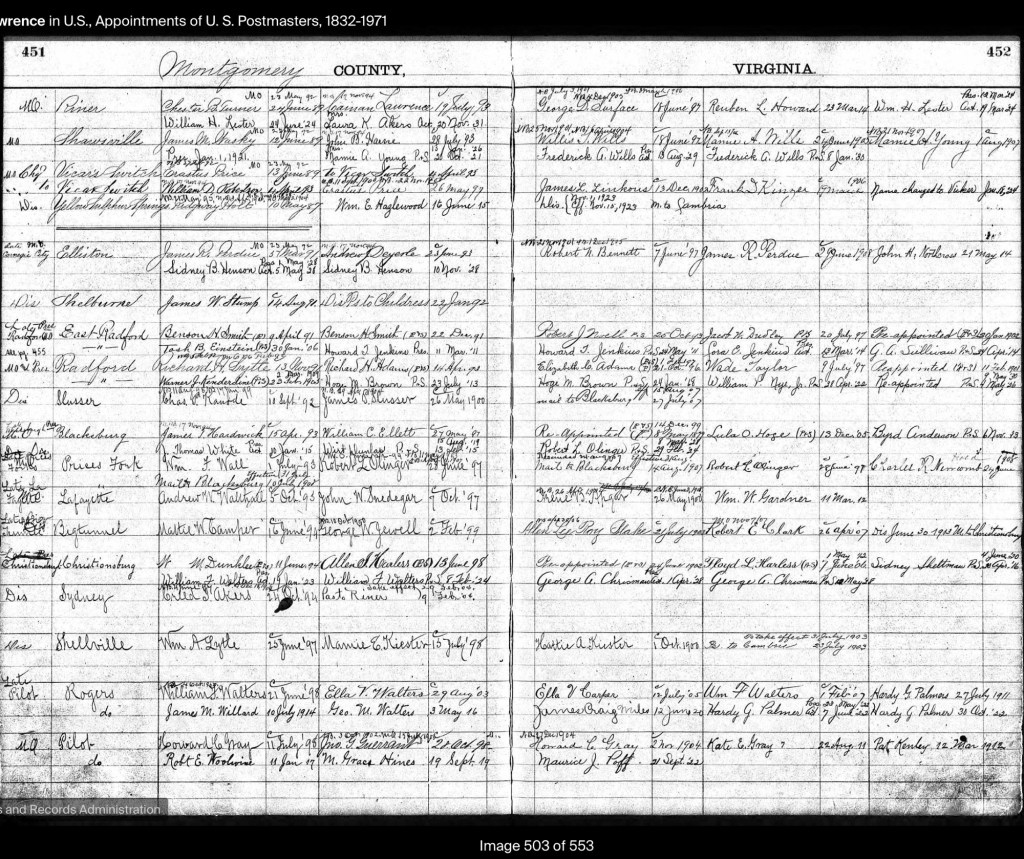
She is pictured behind Canaan (1840–1905) and Mollie E. Weaver Lawrence (1838–1931), whose home and farm once stood at this site. Canaan, a Confederate veteran, was listed as a farmer, D.G. merchant, and postmaster in 1893—the sources of the family’s prosperity. Born in Floyd County, he moved to Auburn by the 1870 census. Mollie, born in Auburn, remained there her entire life.

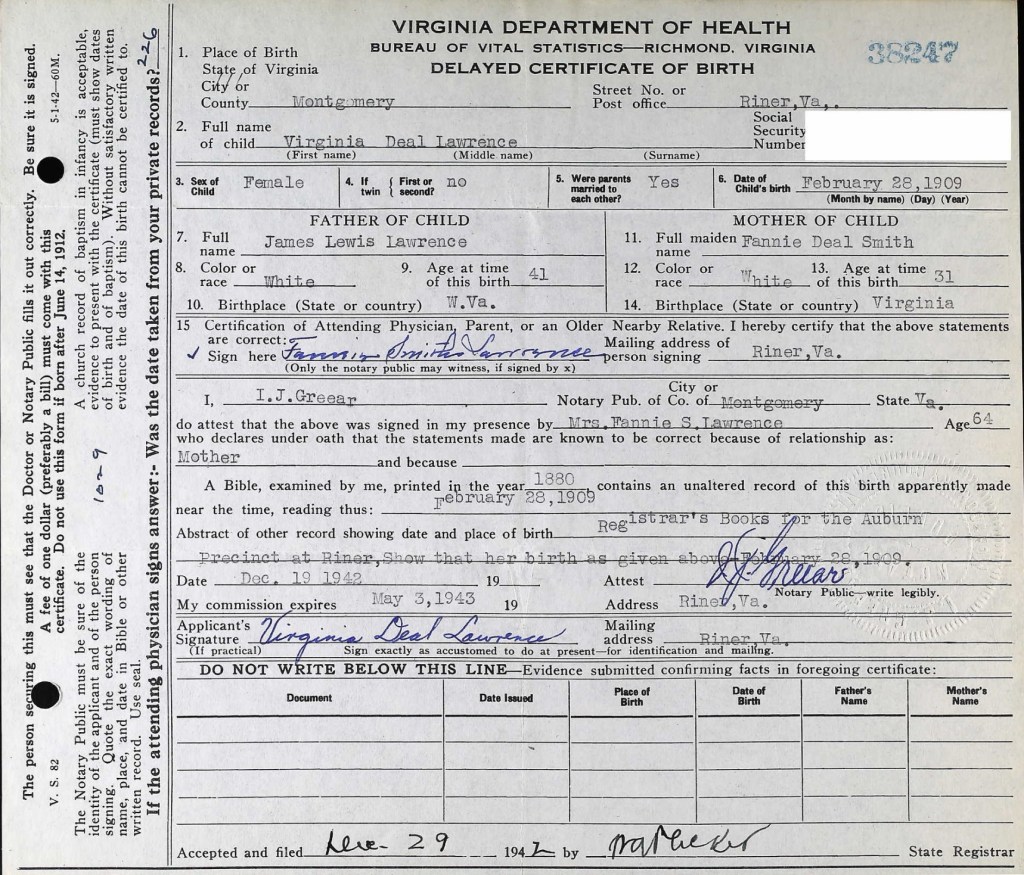
This photograph was shared by their granddaughter, Virginia Deal Lawrence, a longtime teacher at Auburn Elementary School, who preserved many family images and documents. Despite a search through census and local records, the woman’s name remains unknown.

We will continue to look through Virginia Deal’s papers and scrapbooks in hopes of finding a clue.

If you recognize this woman or know anything about the African American community connected to the Lawrence family, please contact us—we would be honored to record her name and story.

Please let us know if you can identify this woman behind the fence.

The Fisk University Rosenwald School Digital Collection is Now Public!

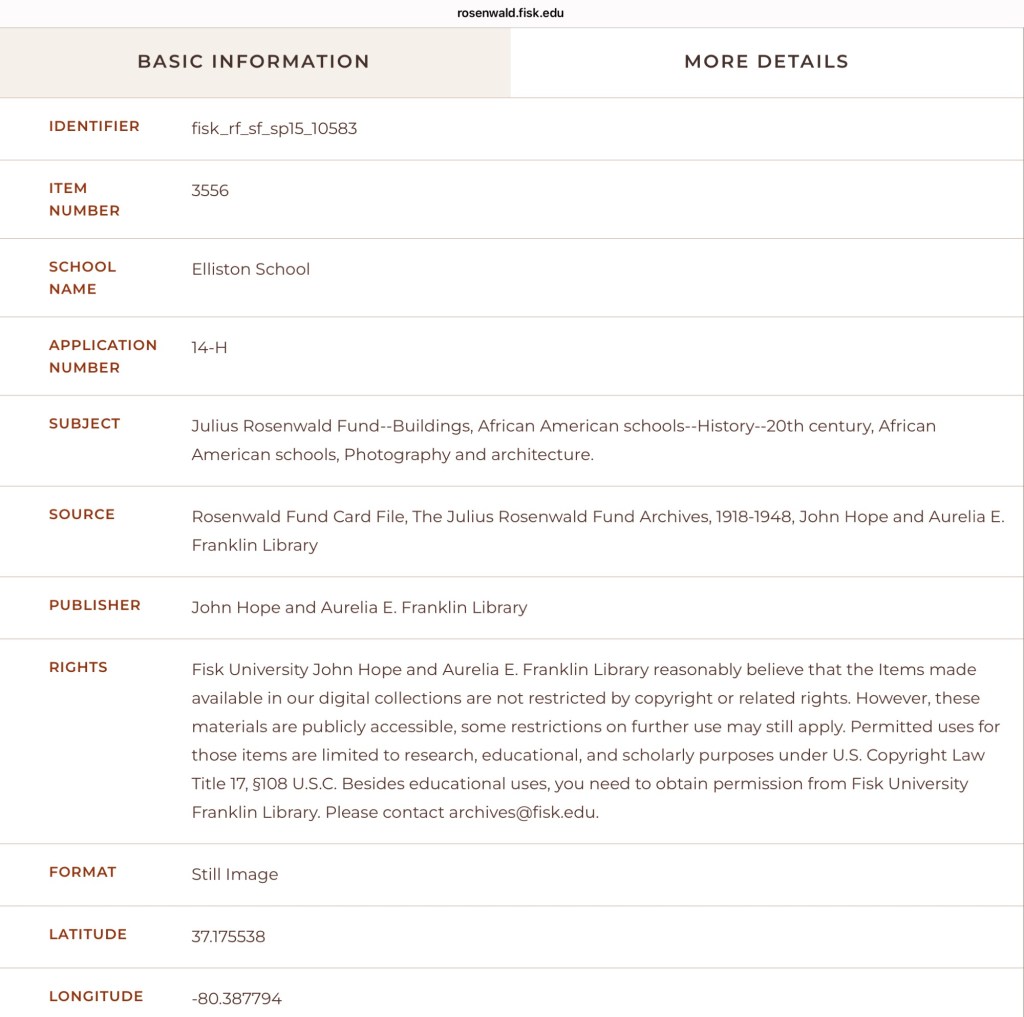
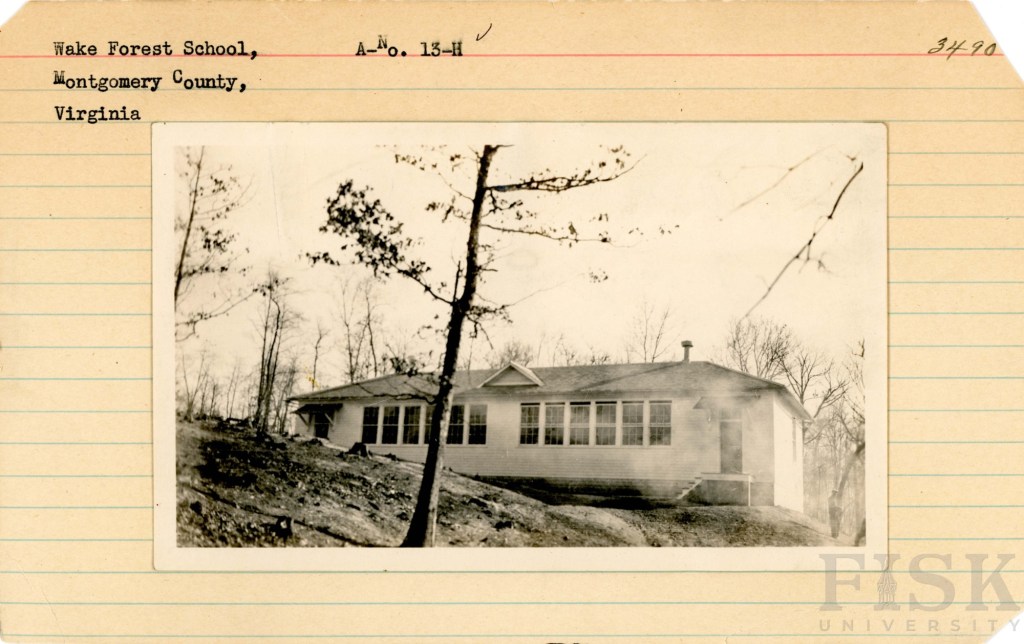
Fisk University has released its Rosenwald School Digital Collection, preserving and sharing the history of these vital institutions. In Montgomery County, the collection highlights schools built through the determination of African American communities in Elliston, Pine Woods, Shawsville, and Wake Forest.

Fisk University has made its Rosenwald School Digital Collection publicly accessible, a significant step in preserving and sharing the history of these important institutions. For Montgomery County, the collection documents the Rosenwald Schools established through the determination and vision of African American communities in Elliston, Pine (Piney) Woods near Riner, Shawsville, and Wake Forest.

Although only the Wake Forest school remains today—adapted for use as a private residence—the collection ensures that the legacy of all three schools endures. These schools stand as a testament to community leadership, resilience, and the transformative power of education during the early twentieth century.

The Story of Rosenwald Schools

The website (scroll down) offers a wealth of information: the story of Julius Rosenwald and his vision, the purpose of the school fund, the significance of the school designs, and the requirement that African American communities contribute a share of the cost. Visitors will also find maps, photographs, and documentation of schools across the region and beyond.

Elliston School

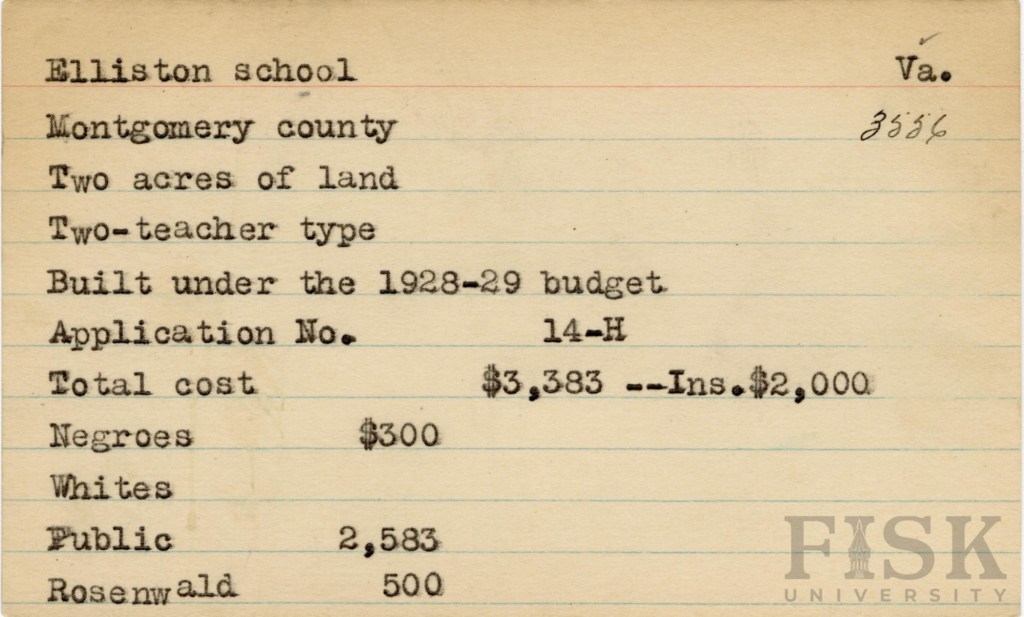
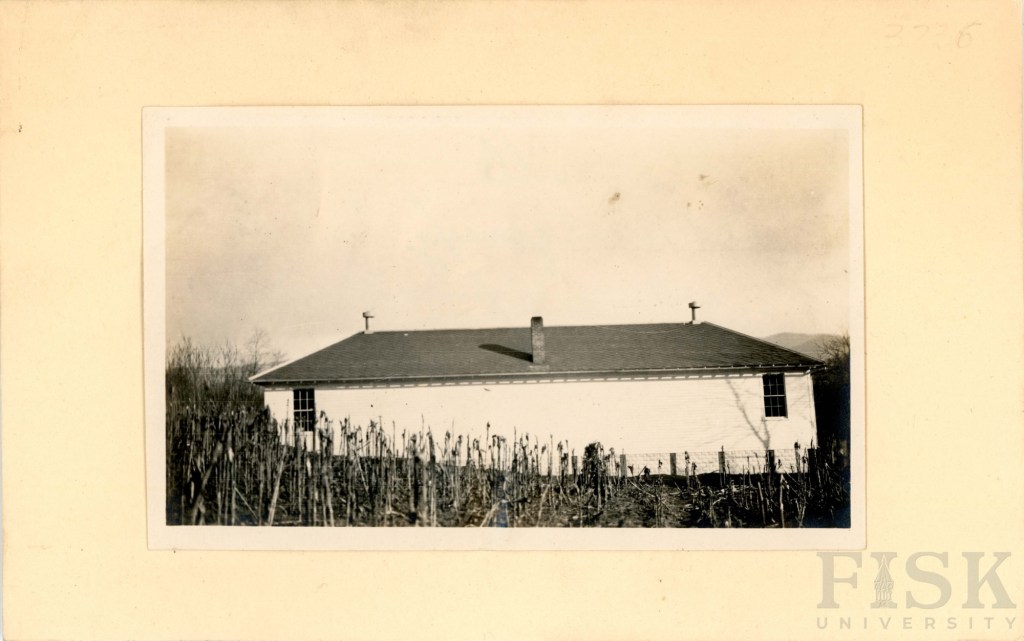
Built in 1928–1929, the Elliston Rosenwald School reflects the determination of the local African American community to provide better educational opportunities for their children. Families in Elliston raised $300 toward the project, which was matched by $500 from the Rosenwald Fund and $2,583 from the Montgomery County School Board.

The school stood on two acres of land and housed two classrooms, each with its own teacher. The school was located on Brake Road, in the Allegheny School District. The legacy: the Elliston Rosenwald School was a center of learning, community, and pride during an era when access to education was hard-won.

Pine Woods School

The Pine Woods Rosenwald School (Piney Woods) was built in a two-teacher design under the supervision of Tuskegee University. The school was sited on Piney Woods Road, in the Auburn School District. While the exact construction date is unknown, records indicate the total cost was $1,075. Of that amount, the Rosenwald Fund contributed $300, the African American community raised $275, and the Montgomery County School Board provided $500.

Unlike white schools of the period, which were fully funded by the School Board, African American families were required to make direct financial contributions toward the construction of their schools. This inequity underscores both the systemic barriers they faced and the extraordinary commitment of the Pine Woods community to ensuring education for their children.

Shawsville School

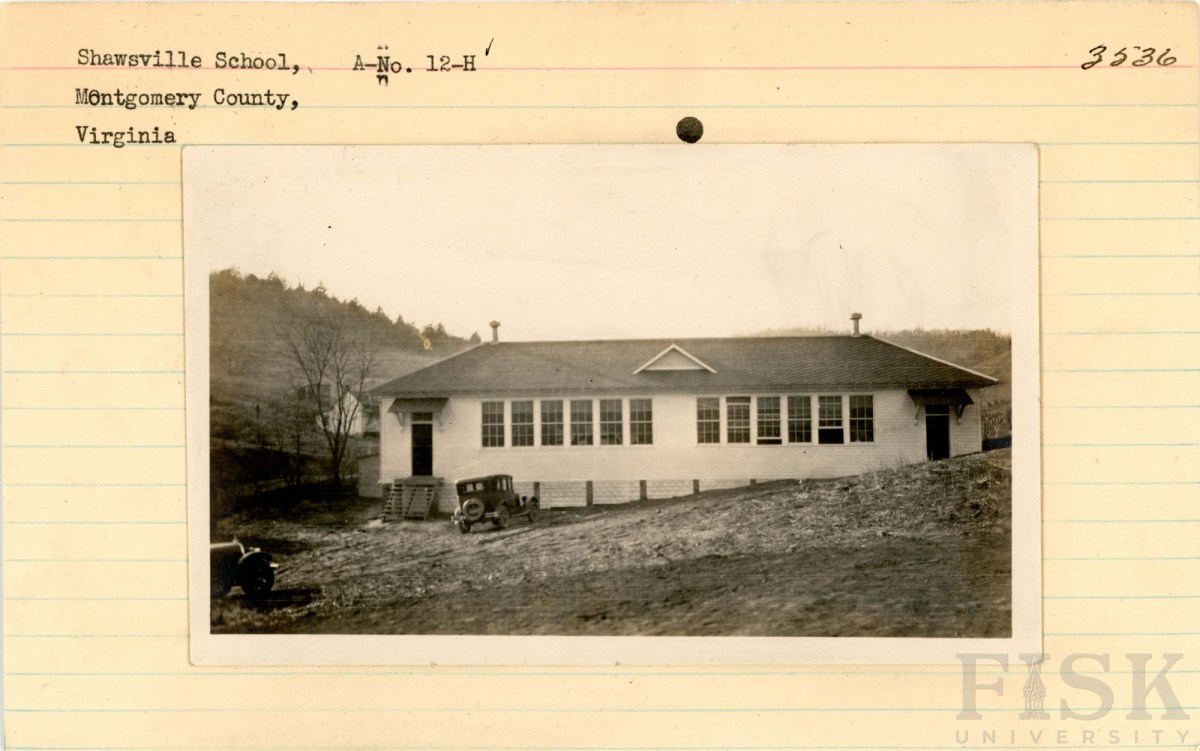
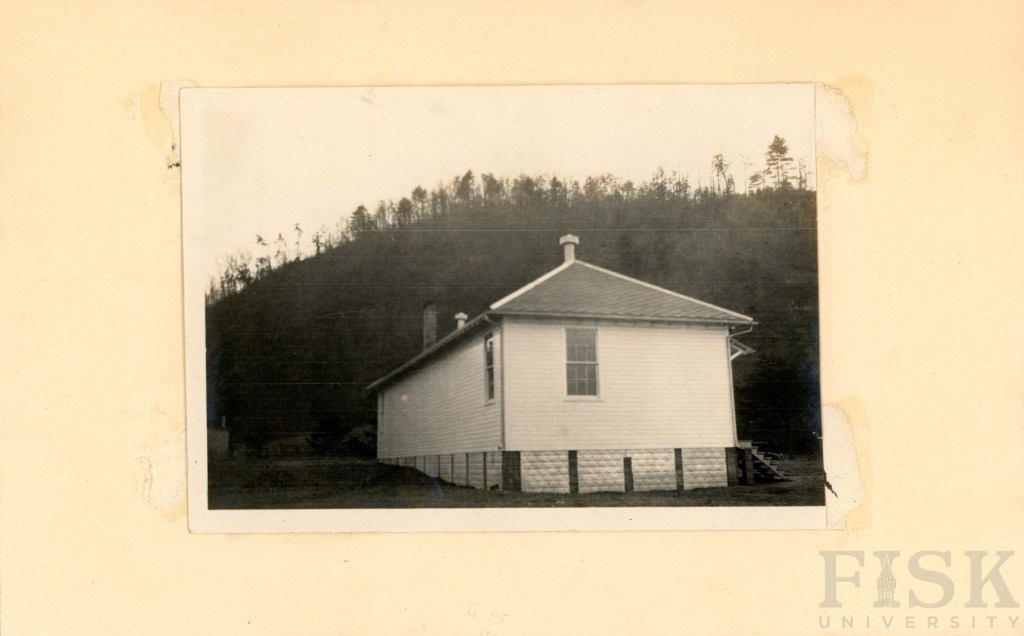
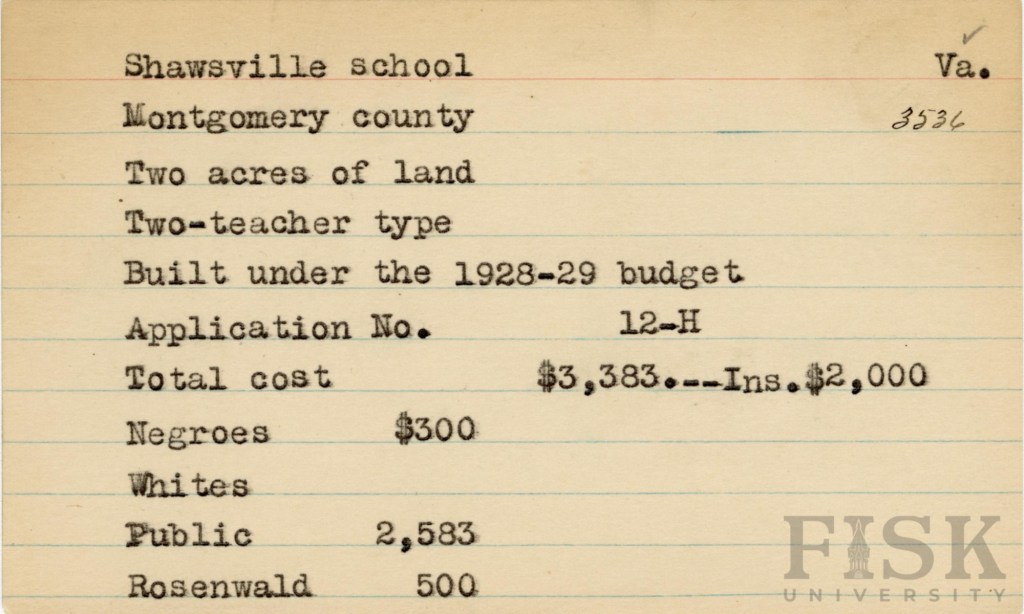
Constructed between 1928 and 1929, the Shawsville Rosenwald School followed a two-teacher design overseen by the Montgomery County School Board. The total cost of $3,383 was shared among the Rosenwald Fund ($500), the African American community ($300), and the Montgomery County School Board ($2,583).

At the time, Shawsville, of the Allegheny School District, was a thriving hub, energized by railroad service and new road (US Route 11) construction projects. These opportunities drew African American laborers and rail workers to the area, many of whom invested their limited resources into building a school for their children. Their contributions—financial and communal—stand as a testament to the determination of Shawsville’s African American families to secure education despite inequities in public funding.

Wake Forest School

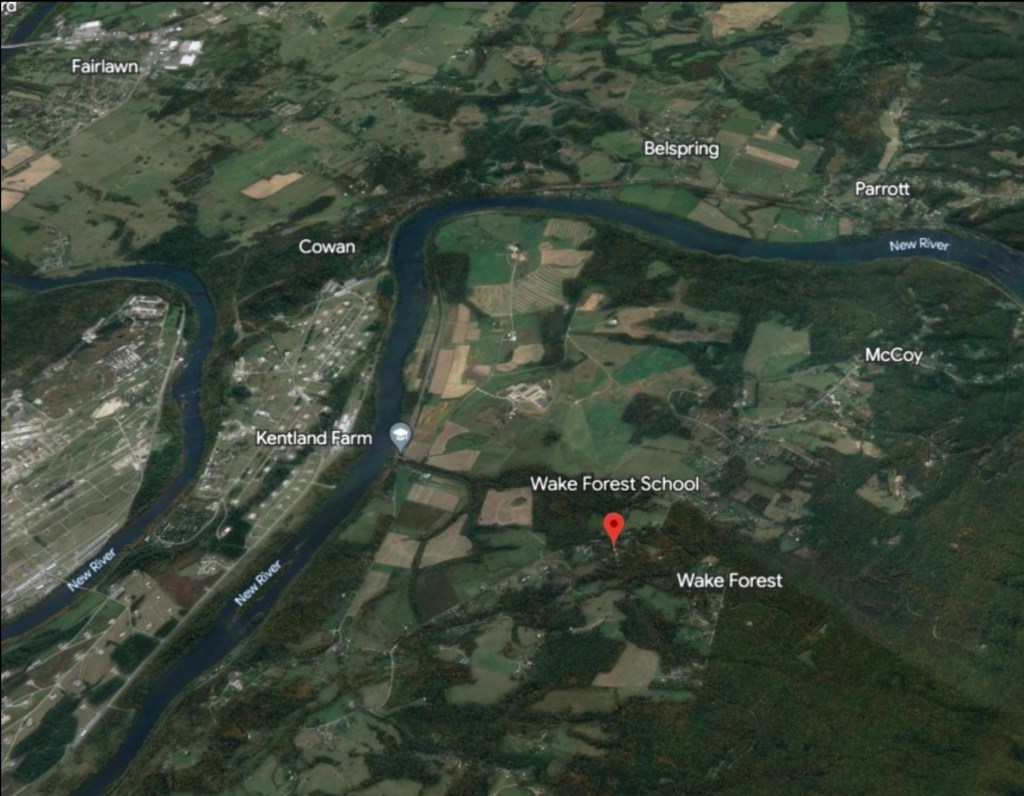
Constructed between 1928 and 1929, the Wake Forest Rosenwald School followed a two-teacher design on a two-acre site, in the Blacksburg School District, overseen by the Montgomery County School Board. The project cost $3,383, with funding shared by the Rosenwald Fund ($500), the African American community ($426 in 1928, about $7,500 in today’s value), and the Montgomery County School Board ($2,457). This school is now a private residence.

The Wake Forest community at this time was made up of independent farmers, farm laborers, boatmen, railroad workers, teamsters, and domestic workers. As coal extraction began to rise and reshape the region’s economy, African American families recognized that education would be essential for their children’s future. By pooling their resources—despite economic hardship—they ensured access to schooling that could open paths beyond the limits of labor and provide new opportunities for the next generation.

Hidden Histories: Family Stories Beyond Montgomery County

Hidden Histories: Family Stories Beyond Montgomery County

When researching local history, we often come across carefully documented African American family histories that have no direct link to Montgomery County, Virginia. These stories are too valuable to leave hidden.

This page will share those findings so they might reach descendants searching for their past. Even without local ties, they speak to the wider story of resilience, migration, and community.

If you recognize a name or place, we invite you to connect—your memory could help bring another family’s history to light.


BRUMMAGE FAMILY

During our research on the Brumage family, we visited with the Clarence Brummage family in Homestead, FL. We were warmly greeted and all the information he could recall was told to me. 

On our return to California, I stopped at the Morman Library in Salt Lake City to see what records could be found and how far back I could take the family. I will start with the family of Clarence.

Clarence Brummage was born 16 June 1920 in Cochran, Georgia. His father was Tom (Booten) Brummage and his mother was Josephine Clark. Clarence was in the army during World War II. He married Everlena Trammeall, 31 October 1950 in Collins, Georgia. Daughter of Roy Trammeal, Everlena was born 16 March 1926 and was killed in a car accident 3 November 1977 in Homestead, FL.

Clarence and Everlena had nine children: Clarence Jr., b. 3 October 1952, Jeanette, b. 17 January 1956, Evelyn Ann, b. 26 April 1957, Ina Mae, b. 26 May 1958, in Cochran, Georgia, Dwight Wayne, b. 16 January 1961, Decatur, Alabama, Dorothy Jean, b. 7 August 1962, Pensacola, Florida, Michael Anthony, b. 9 March 1964, Daytona Beach, Florida, Josephine, b. 14 September 1965, Miami, Florida, and Donald Lee, b. 1 March 1968, Miami, Florida.

Clarence said he was raised by Dornest (Donna) Grandhoun and that she gave him the name of Brummage. Tom (Booten) Brummage worked for John Anderson in Cochran and Clarence remembers him as being 7 ft. tall.

Clarence has a sister, Sarah Lee Brummage Kemp who lives in Cochran. His mother Josephine Clark died in Florida. Josephine’s mother’s name was Sarah Woodfork and they all attended the Mt. Zion Baptist Church in Cochran.

On the 1900 census in Pulaski County (later changed to Beckley County in 1912 [Georgia]) Georgina Brummage, b. October 1854 is listed with sons Miles, b.March 1882 and Thomas, b. November 1890. I am assuming that Thomas is the father of Clarence. They were living in the Colhran district. Also in the same area is Hannah Jackson, b. 1867, her children were Wilson Brummage, b. November 1883, Lou Brummage, b. June 1885 and Charity Brummage, b. July 1888.

The family of Charley Brummage, born December 1877, his wife Zilla, b. June 1876, and their daughter Vinie, b. September 1899. This family lived Della Brummage, age 37, b. January 1863. Her children Anna Lee, b. April 1896. They lived in Hawkinsville.

1882, Lizzie, b. August 1885, John b. November 1887, Jeffries, b. November. In Ward County, Georgia, I found Amie Brumage with sons David, Henry, Bogene, and daughters Neppie, Nora and Lulu E. 

1990 census was burned so I next read the 1880 census. On this census I found the following. Trank Brummage, age 25, living in Pulaski County, he was working for Reuben Waters. Frank was single, a laborer, maimed, crippled or disabled, could not read or write, his parents were born in Georgia. There were no Brummages listed in Pulaski County in 1870 or 1860 so where Frank Brummage obtained the name of Brummage is a mystery. At least I found Tom (Booten) Brummage. I had hoped to find where this family, at one time, were slaves to a Brummage family but I could not find any proof of this.

I did call a James Brumage in Newport, Virginia and he was also black. He did not know where he obtained the name of Brumage.

Someone with the name of Brumage/Brummage had to be in the area during the Civil War or shortly afterward for the name to be taken by the families I found.

The Year 1961—Blacksburg High School Leads County in Desegregation

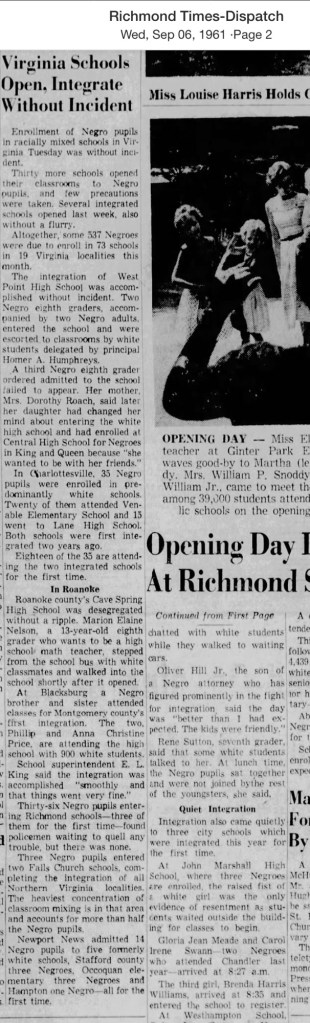
In 1961, Blacksburg High School became the first in Montgomery County to admit African American students, paving the way for full integration of all county high schools by 1966.

Montgomery County, Virginia, was slow to dismantle enforced racial separation in its schools, not doing so until September 1961. Neighboring counties followed a similar pace—Floyd in January 1961 and Pulaski in September 1961. (Martin, Black Education in Montgomery County 1939–1966, Virginia Tech master’s thesis, 1996).

After the U.S. Supreme Court’s 1954 Brown v. Board of Education ruling outlawed segregation, Montgomery County resisted. The school board leaned on “states’ rights” arguments and used tactics from Virginia’s Gray Commission—such as controlling student assignments and offering tuition grants to white families—to delay integration for years.

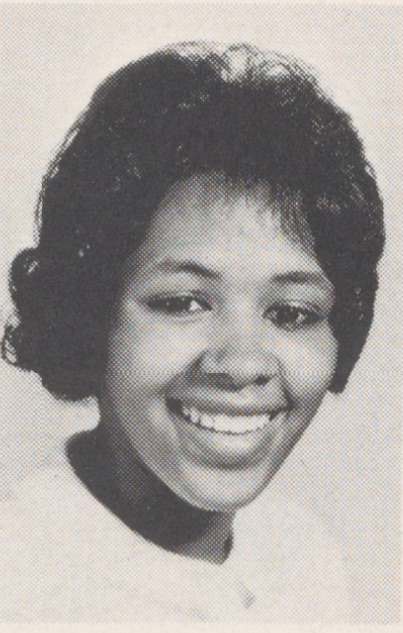
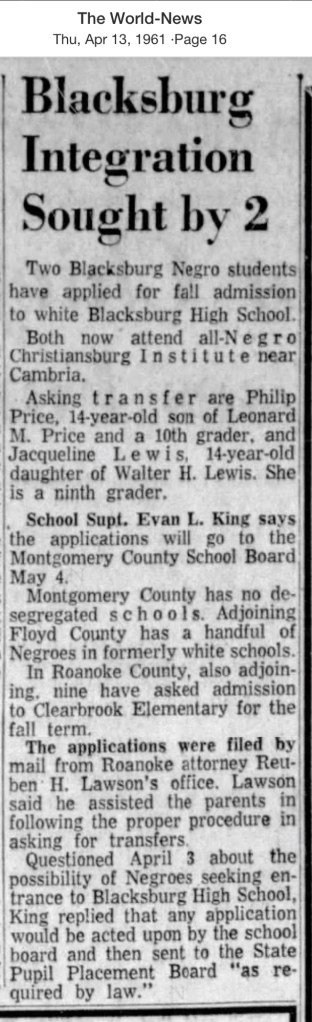
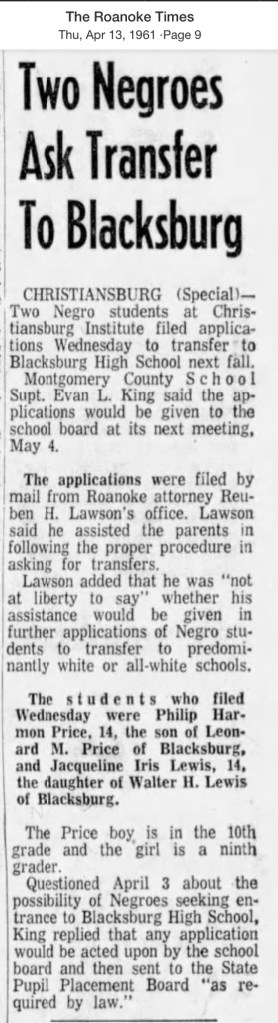
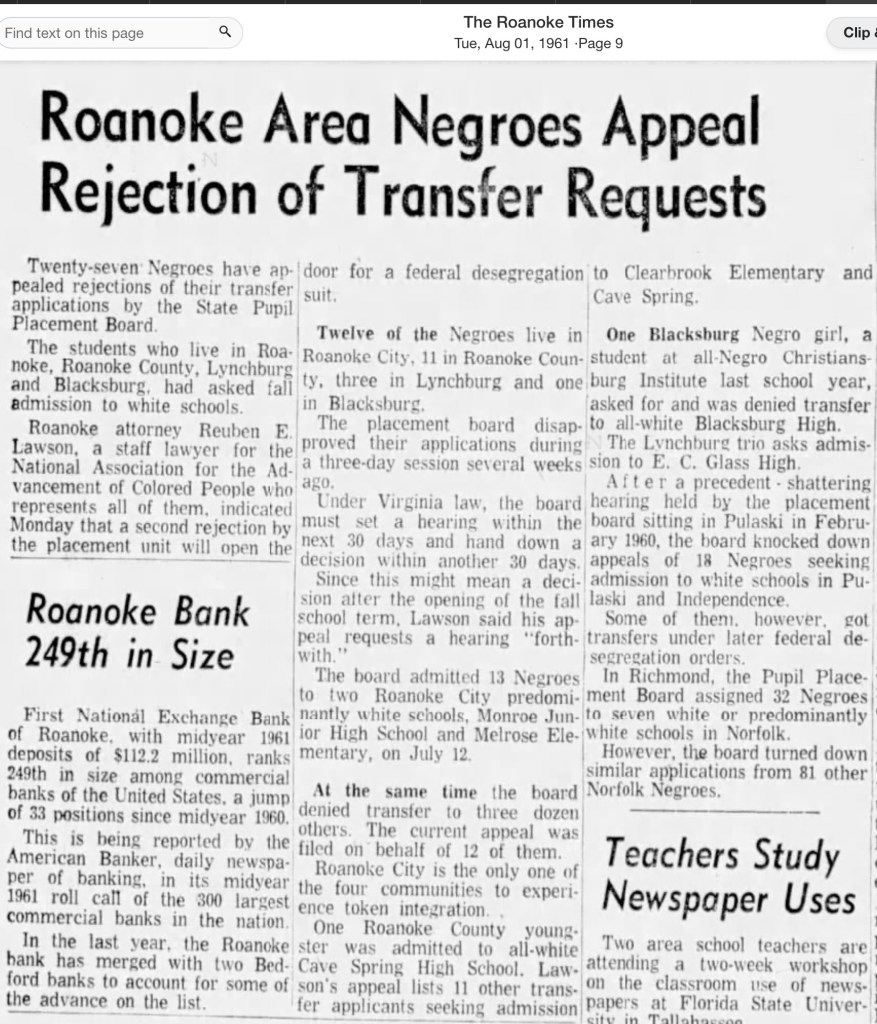
Amidst this resistance, three students from Christiansburg Institute applied to transfer to the all-white Blacksburg High School, which then enrolled about 900 students. They were siblings Phillip H. Price (15) and Ann Christine Price (13), along with Jacqueline Iris Lewis (14). With support from NAACP attorney Reuben E. Lawson of Roanoke, their applications went before the State Pupil Placement Board. Phillip and Ann Christine were admitted for the 1961 school year, but Jacqueline’s request was denied on the grounds of “academic standards”—a requirement never applied to white students.

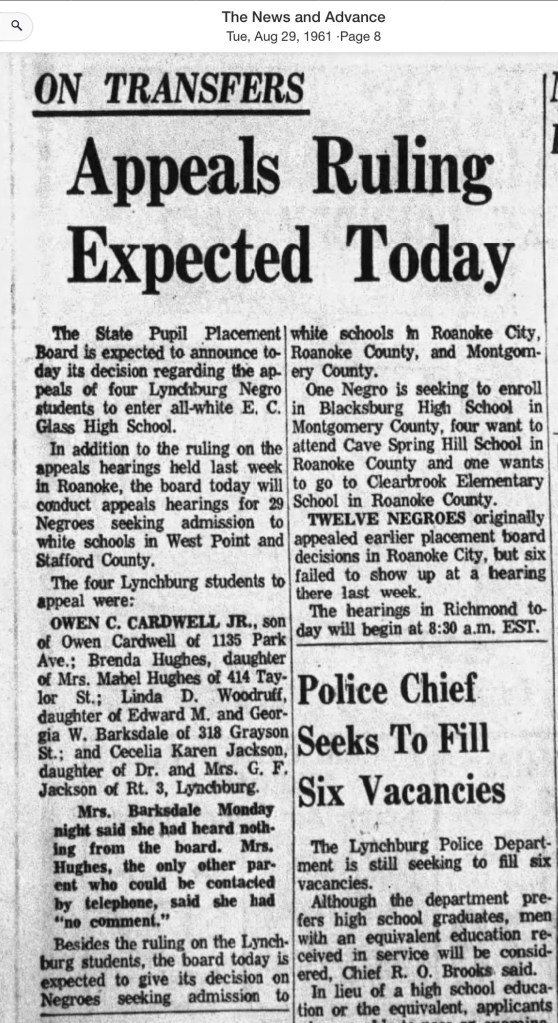
On August 23, 1961, Jacqueline and her father, Walter H. Lewis, traveled to Roanoke for the hearing, an intimidating experience for a 14-year-old. The Board delayed its ruling for a week before denying her appeal. That fall, Jacqueline remained at Christiansburg Institute.

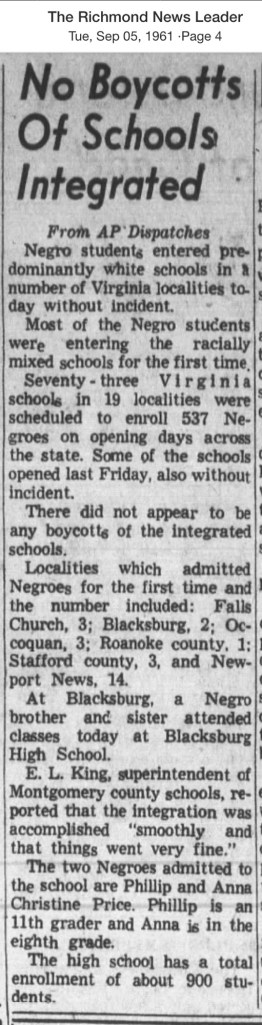
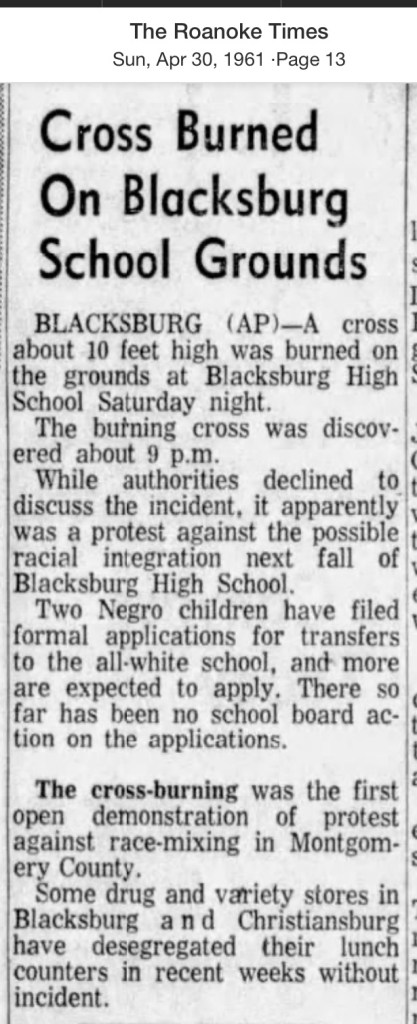
That September, Phillip and Ann Christine Price became the first Black students to integrate Montgomery County schools when they walked into Blacksburg High. According to researcher Tracy A. Martin, they were not alone—their white neighbors walked beside them in solidarity. This act of courage followed a chilling warning: on April 29, 1961, a ten-foot burning cross had been discovered on the school grounds, South Main Street.

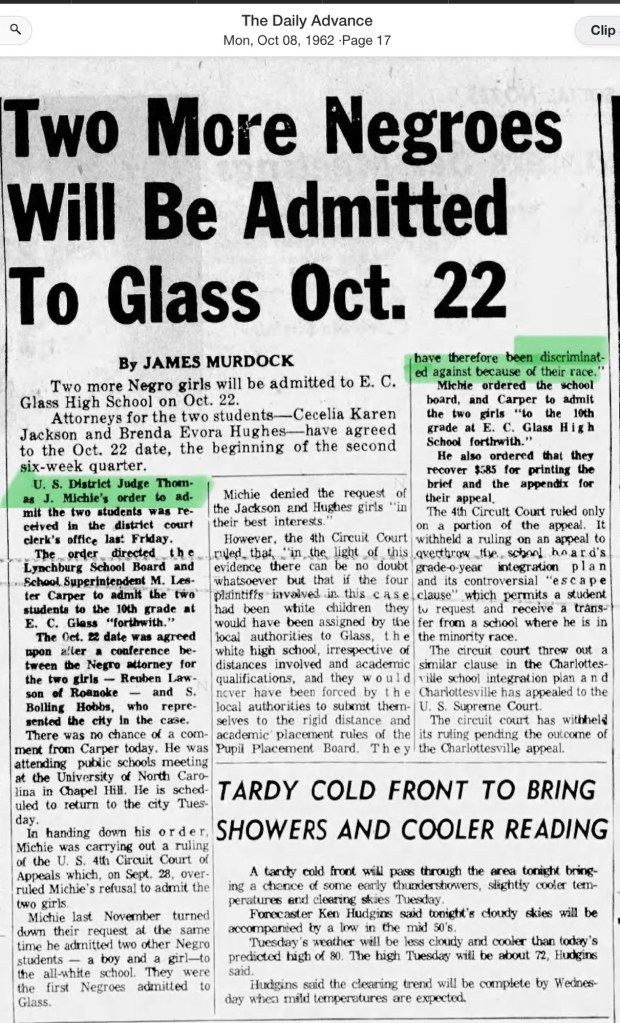
In 1962, the school board again delayed the application process for two more students seeking admission. Yearbooks from 1961–1964 suggest that the Price siblings were the only African American students at Blacksburg High during those early years. In the years that followed, more students of color began to appear in the yearbooks. By 1966, the school board closed Christiansburg Institute, and all of the county’s white high schools were finally opened to every student.

Newspaper Articles

April 1961

July 1961

August 1961

September 1961

1962 Application of Two Young Women, the Courts Ruling

Montgomery County’s Changing Borders & the African American Story

The Formation of Montgomery County, Virginia and Why it Matters to Regional African American History

When Virginia’s earliest European colonial settlers first pushed westward beyond the Blue Ridge Mountains, they entered the border lands already inhabited by Indigenous peoples for thousands of years. As Europeans laid claim to these territories in the 18th century, Virginia’s county boundaries began shifting rapidly to keep pace and the need for local governance.

At first, all of western Virginia was considered part of vast counties based far to the east. Augusta County, created in 1738, stretched from the Blue Ridge to the Mississippi River—a landmass so large it was nearly impossible to govern effectively. As settlement expanded, Augusta was gradually carved into smaller counties.

Botetourt County was created in 1770 out of Augusta, and just two years later, in 1772, Fincastle County was formed to cover the far southwest. But Fincastle itself was short-lived: in 1776, it was split into three new counties—Montgomery, Washington, and Kentucky (the latter eventually becoming the Commonwealth of Kentucky).

Thus, Montgomery County was officially established in 1776, named in honor of General Richard Montgomery, a Revolutionary War hero.

Like most early counties, Montgomery did not remain the same size for long. As population grew and communities demanded closer courts and local representation, Montgomery’s original boundaries were gradually reduced.

1790: Wythe County was formed from Montgomery. 1790: Parts of Montgomery contributed to the creation of Kanawha County (now in West Virginia). 1806: Giles County was carved from Montgomery, Monroe, Wythe, and Tazewell. 1806–1830s: Additional shifts continued, with Montgomery giving land to Floyd (1831), Pulaski (1839), and others.

By the mid-19th century, Montgomery County had taken on the approximate shape we recognize today.

Why this matters

Tracing these changing boundaries shows how the western border lands of Virginia evolved from a vast Indigenous landscape into the network of counties we know today. When we study Montgomery County’s formation and its changing borders, we are not only tracking political geography—we’re also uncovering how those shifts shaped the daily realities of enslaved people and freedmen. The “line on a map” often meant the difference between where families were recorded, where they could live, and how they could begin to claim freedom and opportunity.

County seats like Christiansburg were not only centers of trade and government but also the location of the slave market and the courthouse records that tracked the lives of enslaved people. After emancipation, those same courts became the places where freedmen registered marriages, secured contracts, and sought land. As county lines shifted, so too did the jurisdictions that controlled access to justice, opportunity, and community life.

The flip book of maps below is a helpful resource to understand how the boundaries changed with time. Virginia Atlas of Historical County Boundaries. Begin on page 395.

Virginia Atlas of Historical County Boundaries

Further Discussion on How Shifting Boundaries Change Lives

Laws & Records

When county boundaries changed, so did the courthouse where records were kept. For enslaved people, this meant that bills of sale, wills, deeds, and manumission papers might end up filed under different counties as the boundaries shifted. After emancipation, the same was true for marriage licenses, labor contracts, and land purchases by freedmen. This scattering of records makes it both complicated when tracing family histories.

Shaping Community, Labor & Education

County lines determined where enslaved people were forced to labor, where patrols were organized, and where courts enforced slavery laws. After emancipation, those same boundaries shaped freedmen’s access to work, land, and schools. For example, as new counties like Giles or Pulaski were created from Montgomery, Freeman might find themselves suddenly in a different jurisdiction, dealing with a new local power structure.

Education also reflected these divisions. Freedmen near Christiansburg had better access to schools supported by the Freedmen’s Bureau, while those in rural reaches of the county received little help.

Courts and Law

During slavery, county seats (like Christiansburg) were centers of trade, law, and the slave market. Enslaved people were taken to county courts for sales, trials, and punishment. After emancipation, those same county seats became the centers where freedmen registered marriages, secured legal recognition, and later sought protection under Reconstruction policies.

Land, Freedom, and Mobility

For freedmen, land ownership was key to independence. But access to land varied widely from one county to another, depending on who owned large estates, which lands were subdivided, and how local officials treated Black landholders. County boundaries thus shaped the possibilities of building self-sustaining communities after emancipation.

More Maps

Montgomery County Resources

Montgomery County, Virginia Resources and the Formation of the County Over Time

National Register of Historic Places Application – 1989

National Register of Historic Places Application – 1989

This searchable document is a rich source of information about the county and its wider connections. For example, it notes that the New River boatmen once lived on Kent Farm, where they were enslaved by James Randle and Margaret Cloyd Kent prior to emancipation (see page 13). Additional details about Kentland and these freedmen can be found in the following postings: Historic Kentland and Historic Wake Forest

The names of some of the black boatmen of 19th-century Montgomery County include Frank Bannister (who was a boatman on the James River before the Civil War), Calvin Bannister, Roland Stuart, George Brown, and Lewis Smith.


Montgomery County Reconnaissance Level Survey, 1986

This report that was written by Gibson Worsham, Dan Pezzoni, Charlotte Worsham, David Roenizer, and others. It addresses the following: 1) Overview of the county’s history, 2) A comprehensive inventory of significant structures and sites in the county and 3) Maps delineating the location of said structures and sites. Similar to the report above, this is a wealth of information about the county.


More information can be found on this website: Gatherings Blacksburg History


The Formation of Montgomery County, Virginia and Why it Matters to African American History of the Region

When Virginia’s earliest European colonial settlers first pushed westward beyond the Blue Ridge Mountains, they entered the border lands already inhabited by Native peoples for thousands of years. As Europeans laid claim to these territories in the 18th century, Virginia’s county boundaries began shifting rapidly to keep pace and the need for local governance.

At first, all of western Virginia was considered part of vast counties based far to the east. Augusta County, created in 1738, stretched from the Blue Ridge to the Mississippi River—a landmass so large it was nearly impossible to govern effectively. As settlement expanded, Augusta was gradually carved into smaller counties.

Botetourt County was created in 1770 out of Augusta, and just two years later, in 1772, Fincastle County was formed to cover the far southwest. But Fincastle itself was short-lived: in 1776, it was split into three new counties—Montgomery, Washington, and Kentucky (the latter eventually becoming the Commonwealth of Kentucky).

Thus, Montgomery County was officially established in 1776, named in honor of General Richard Montgomery, a Revolutionary War hero.

Like most early counties, Montgomery did not remain the same size for long. As population grew and communities demanded closer courts and local representation, Montgomery’s original boundaries were gradually reduced.

  • 1790: Wythe County was formed from Montgomery.
  • 1790: Parts of Montgomery contributed to the creation of Kanawha County (now in West Virginia).
  • 1806: Giles County was carved from Montgomery, Monroe, Wythe, and Tazewell.
  • 1831: Montgomery giving land to Floyd
  • 1839: Montgomery giving land to Pulaski
  • 1892: City of Radford

By the mid-19th century, Montgomery County had taken on the approximate shape we recognize today.

Why This Matters

Tracing these changing boundaries shows how the western border lands of Virginia evolved from a vast Indigenous landscape into the network of counties we know today. When we study Montgomery County’s formation and its changing borders, we are not only tracking political geography—we’re also uncovering how those shifts shaped the daily realities of enslaved people and freedmen. The “line on a map” often meant the difference between where families were recorded, where they could live, and how they could begin to claim freedom and opportunity.

County seats like Christiansburg were not only centers of trade and government but also of the slave market and the courthouse records that tracked the lives of enslaved people. After emancipation, those same courts became the places where freedmen registered marriages, secured contracts, and sought land. As county lines shifted, so too did the jurisdictions that controlled access to justice, opportunity, and community life.

The flip book of maps below is a helpful resource to understand how the boundaries changed with time. Begin on page 395.

Virginia Atlas of Historical County Boundaries

Pulaski County Resource

Pulaski County Reconnaissance Survey, created by Gibson Worsham, Dan Pezzoni, and many others, is such a valuable resource. It provides vital insights into African American history in Southwest Virginia and the greater Central Appalachian region, helping us better understand the interconnected stories that shaped our communities.

Montgomery County, Virginia, has never existed in isolation.

The people who have lived here—whether by choice, through enslavement or servitude, or as Indigenous communities who established towns long before European arrival—moved across boundaries freely. They traveled, traded, fought, buried their dead, and carried out the everyday work of survival across what later became county lines.

This is why the Pulaski County Reconnaissance Survey, created by Gibson Worsham, Dan Pezzoni, and many others, is such a valuable resource. It provides vital insights into African American history in Southwest Virginia and the greater Central Appalachian region, helping us better understand the interconnected stories that shaped our communities.

This report is fully searchable and contains valuable early documentation on African American schools, churches, and communities. It also includes a generalized map that highlights both early European settlements and land tracts. For example, Dunkard’s Bottom—now submerged beneath Claytor Lake—was once part of an early German settlement.

The report also identifies significant Scotch-Irish tracts such as Draper Valley/Peak Mountain, Harrison, Robinson, Springfield, and Thorn Spring. It notes the communities of Newbern and New Dublin, along with the region’s main transportation routes: Traders Path/Leadmine Road, the Great Road/Wilderness Road/Southwestern Turnpike, Peppers Ferry Road, and the Dublin/Giles Turnpike.

The report offers a clear explanation of the early Importation and Treasury Rights system used to claim land (see pages 23–24). For further detail, see F.B. Kegley, Kegley’s Virginia Frontier, Roanoke, VA: Southwest Virginia Historical Society, 1938. p. 59.

Read the full Pulaski County Reconnaissance Survey report ›

By Gibson Worsham, Dan Pezzoni, Leslie Naranjo-Lupoid, Joseph T Koelbel, Dan Rotenizer, Charlotte Worsham, Vicky Goad, CA Cooper-Ruska

Pulaski County Reconnaissance Level Survey Document, 1985 by Gibson Worsham, Dan Pezzoni and others.

The report contains interesting data about the enslaved, noted on page 44. Also, the churches and New River Village is discussed beginning on page 56.

In Pulaski the pattern of large landholding influenced the ownership of slaves. Whereas in Montgomery County there were 2,219 slaves, and in Pulaski only 1,589 in 1859, eight slaveholders had more than fifty slaves in Pulaski while only two landowners in Montgomery possessed as many. In both counties, however, the majority of owners possessed ten or fewer slaves. During the Civil War, the Confederacy began requisitioning slaves to work in the war effort. At the beginning of the war many slaves were requisitioned and shipped to Richmond to fortify the state capital. In the following three years slaves were requisitioned four times so that by 1865 the county found it could no longer comply as it was being drained of free and slave manpower, food supplies and money.

Map of Pulaski County noting the mines, more importantly the African American village of “New River”

Pulaski Timeline

Timeline was created for the 2030 Comprehensive Plan of Pulaski County

A Note on the Language in the County’s Comprehensive Plan

As part of Montgomery County’s 30-year Comprehensive Plan, a historical timeline was created. While the dates provided are generally accurate, the language used to describe Indigenous people and borderlands does not align with our values.

We want our readers to be aware that these depictions reflect the language of the plan’s authors—not the values or beliefs of this website. Our commitment is to present history in a way that acknowledges the dignity, presence, and contributions of all people who have lived in this region.

Note that the African American community of “New River” came to exist after emancipation.

Pulaski Newspapers

Virginia Tech Collection