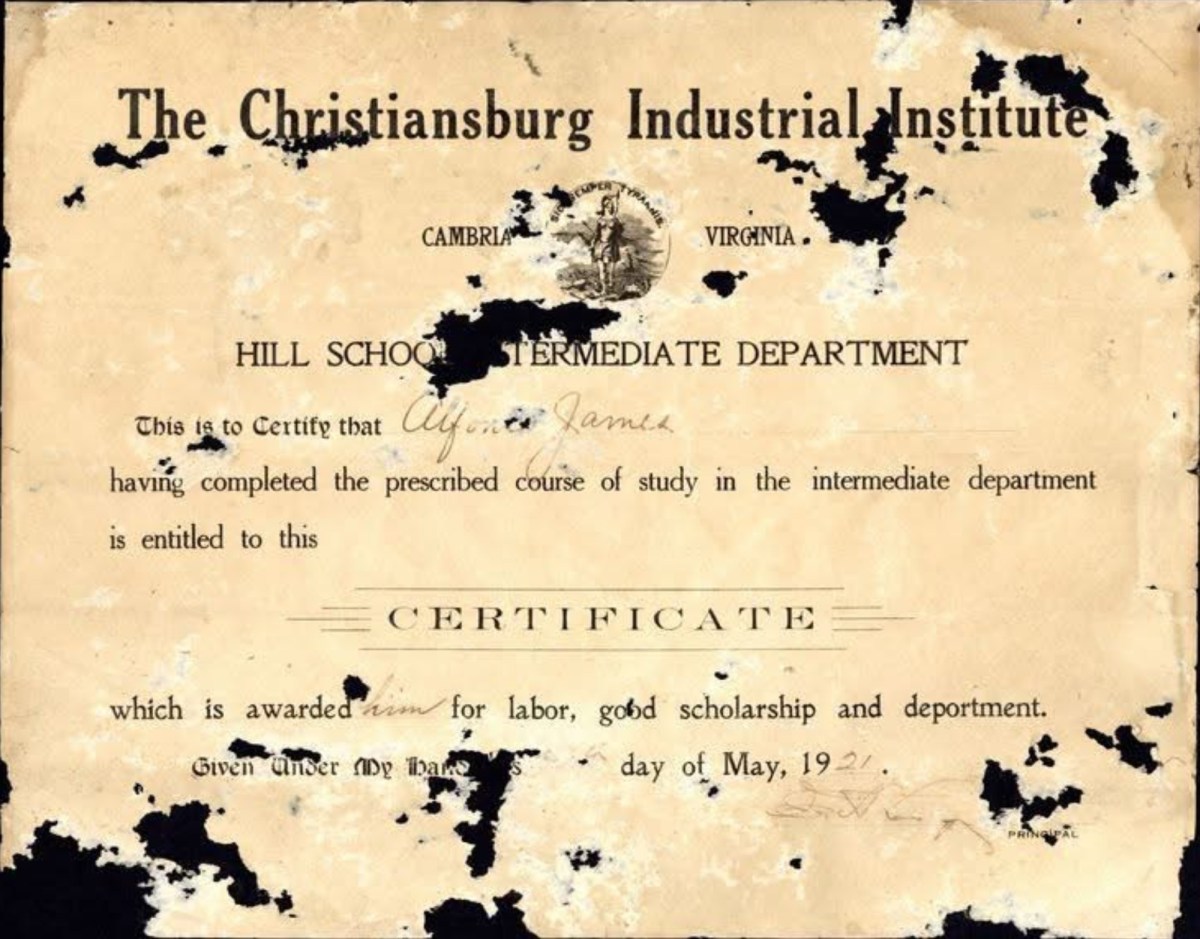
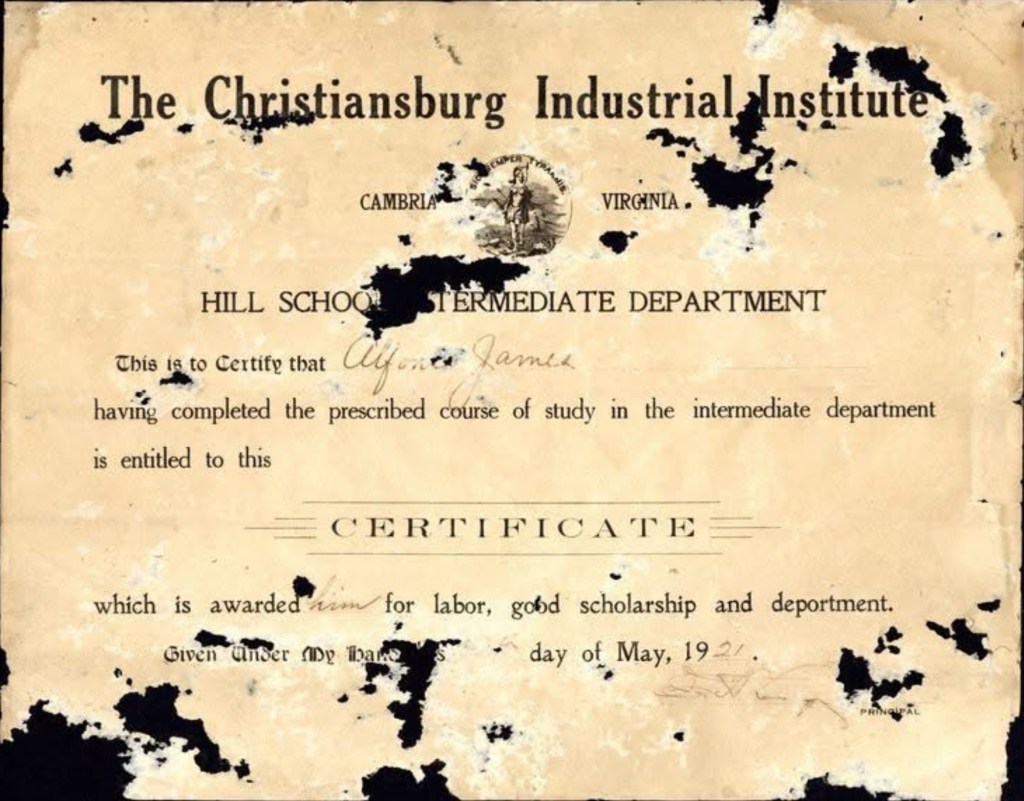
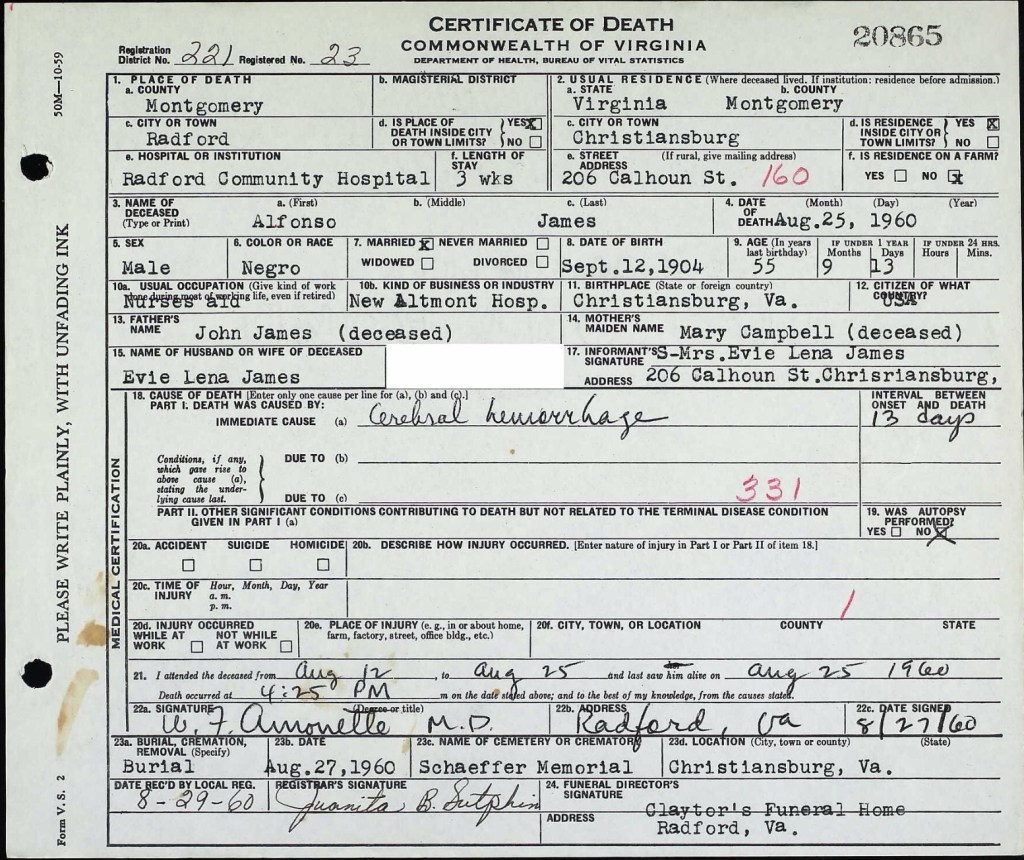
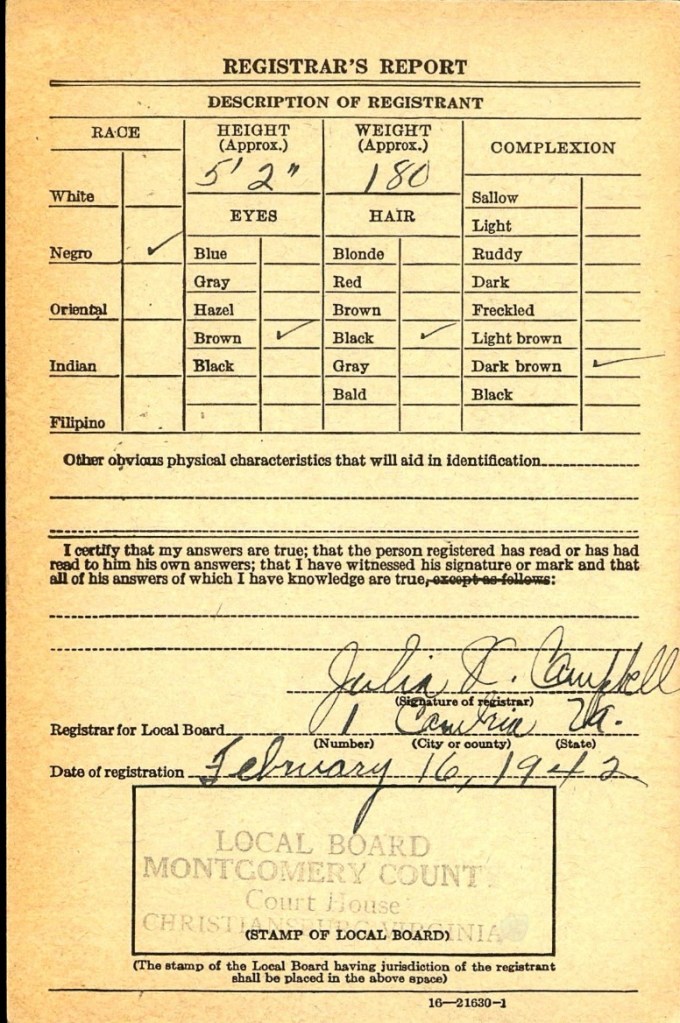
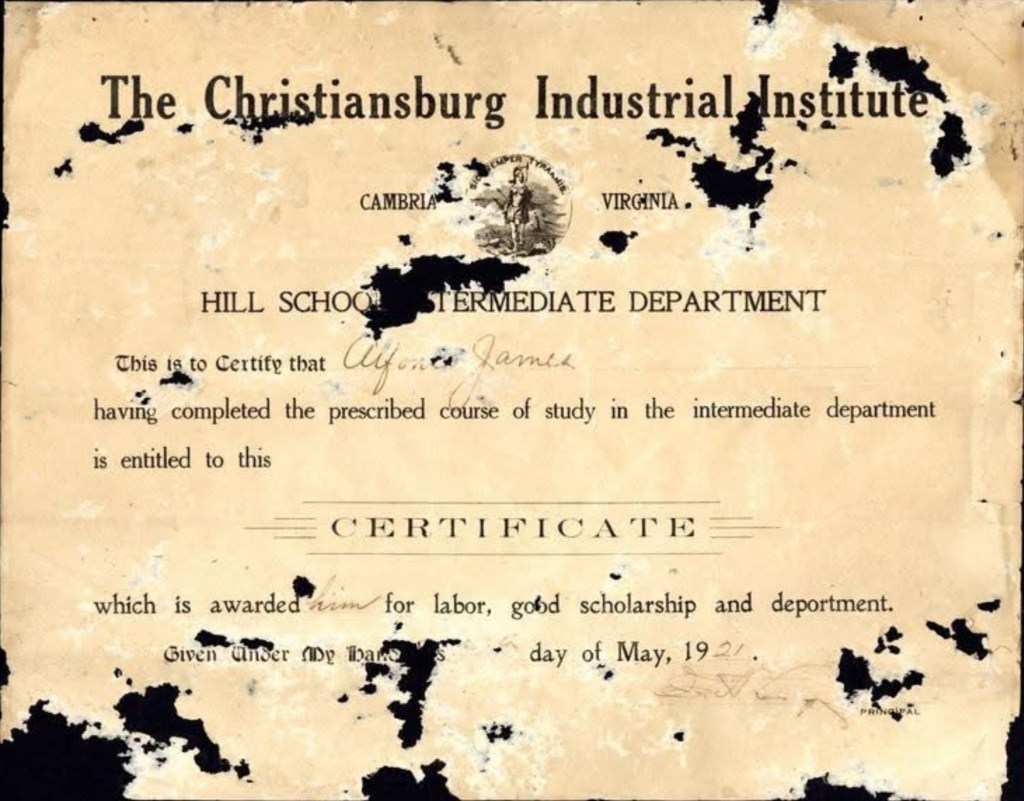
Alfonzo James, born in 1904, was the eldest of three children to John and Mary Campbell James. He graduated from the Hill School in Christiansburg in May 1921.
His father, John James, was born in Pennsylvania and, according to the 1900 U.S. Census, lived as a boarder with Principal Charles L. Marshall of the Christiansburg Institute at the age of 15. This household also included Edgar A. Long, his wife and daughter, Louis Brown (16 years old), and William Gray, a teacher.
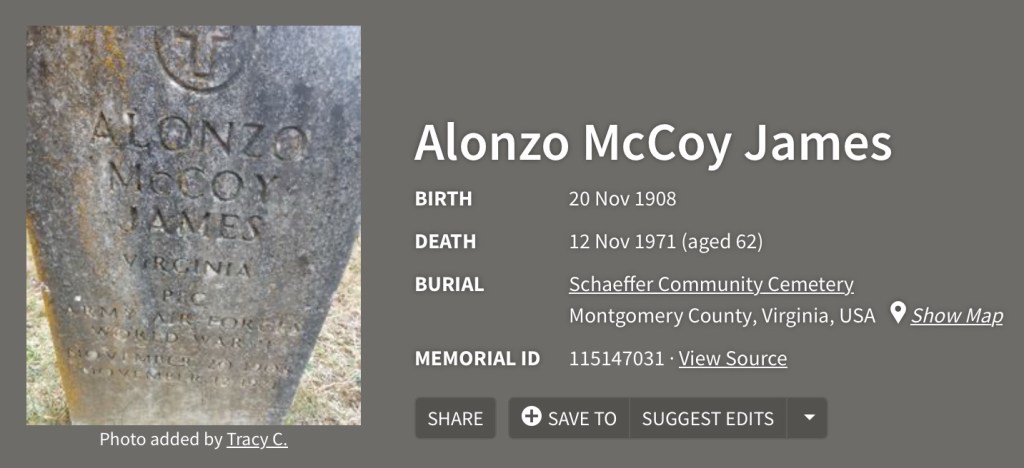
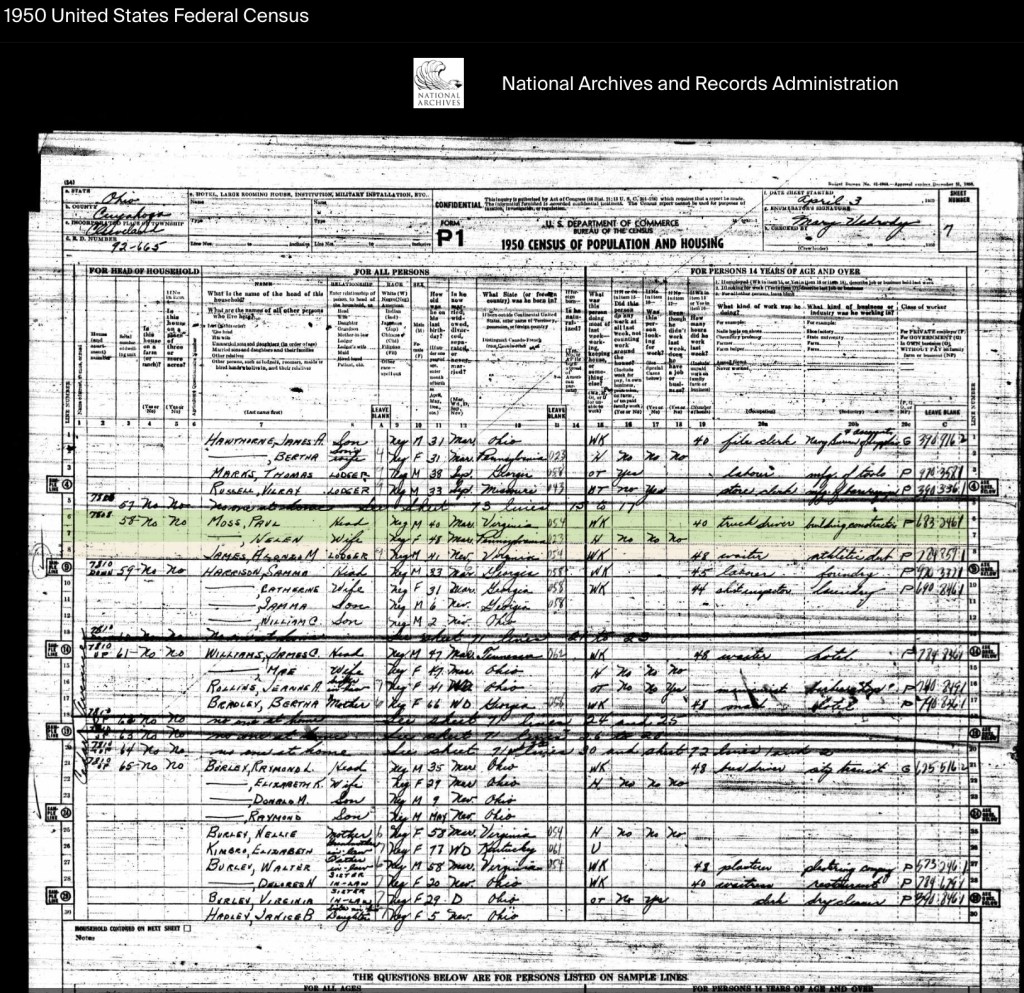
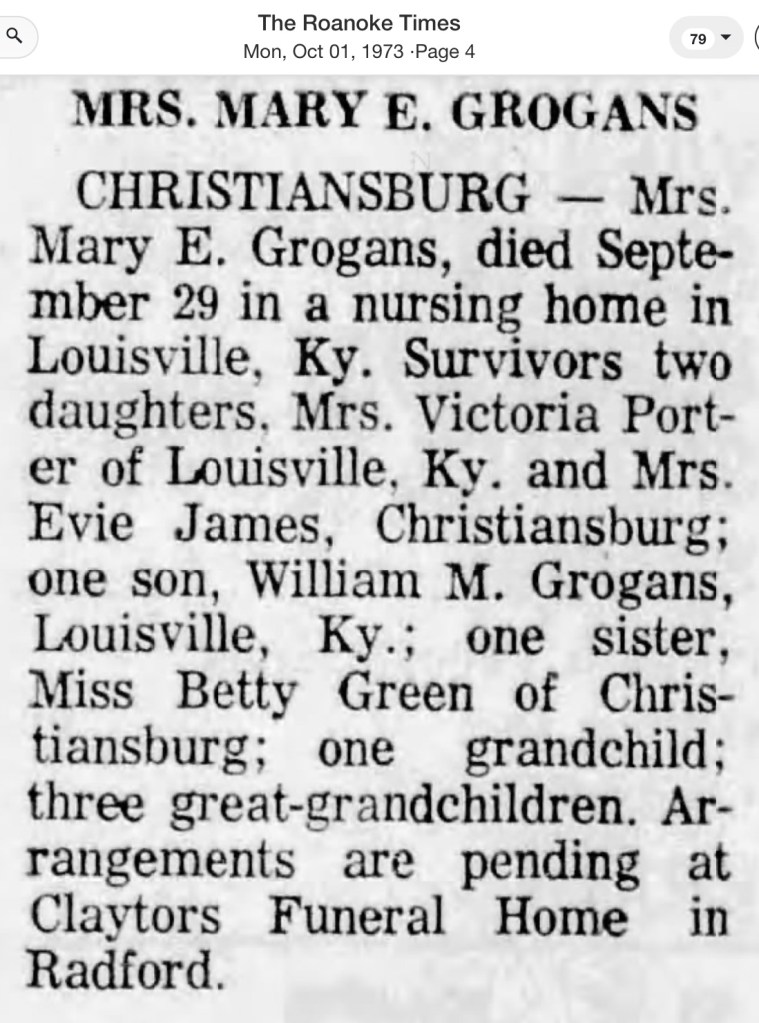
In the 1930 census, Alfonzo was recorded as a public school teacher. Over the years, he held various roles at the New Altamont Hospital in Christiansburg, working as a waiter and eventually as a nurse’s aide by the time of his passing in 1960. In 1946, he married Evie Lena Grogans. He was survived by his two brothers, Robert M. James and Alonzo McCoy James. Evie Grogans James passed away in 1977 and was a valued baker, recognized as Employee of the Month at Radford College.
Alfonzo’s diploma stands as a testament to his commitment to education and service. Preserving this certificate would honor his legacy and ensure that his contributions to the community are remembered.
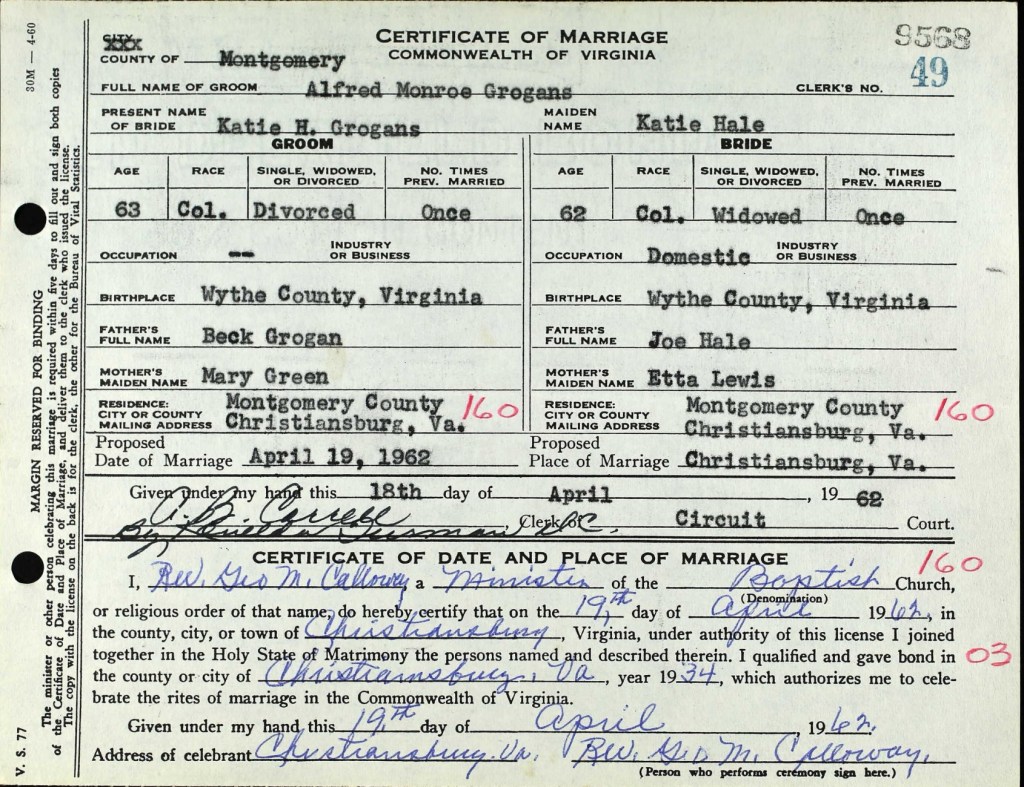
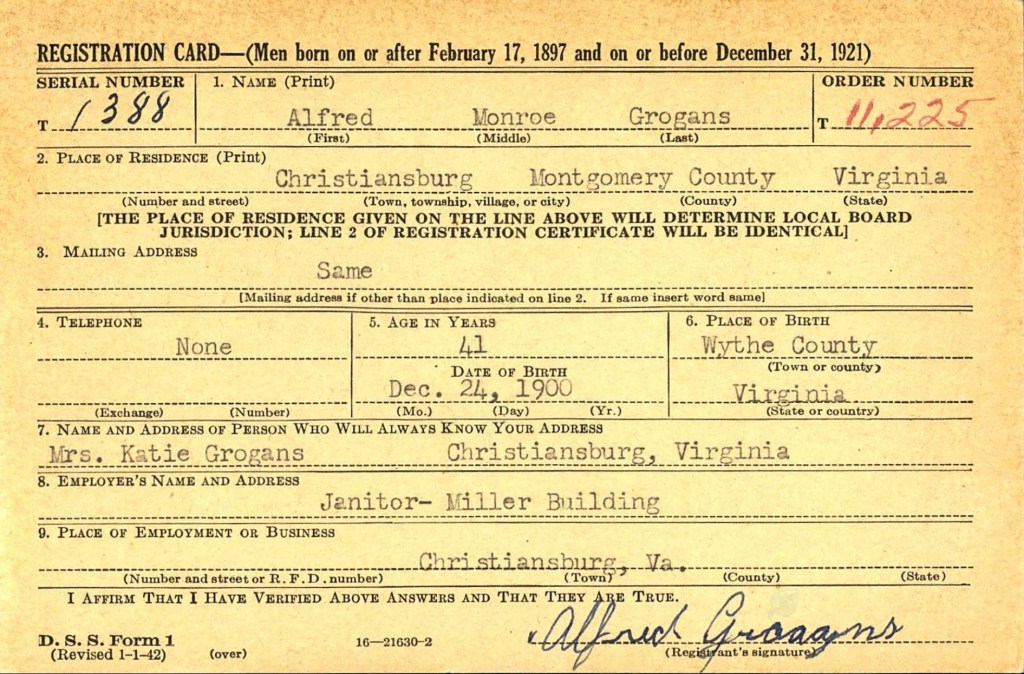
Courtesy of Christiansburg Institute Digital ArchiveAlfonso James Death Certificate1900 US Census, John James, Alfonso’s father, in Charles L. Marshall Household1910 US Census, Mary James with her children and sister, Daisy Campbell1920 US Census, Daisy Campbell and her sister’s children: Alfonso, Robert and AlonzoAlfonso JamesAlfonso JamesAlonzo James, brother of Alfonso JamesAlonzo James, brother of Alfonso JamesAlonzo James, brother of Alfonso JamesAlonzo James, brother of Alfonso James1950 US Census, Alonzo McCoy James1950 US Census, Alfonso and Evie JamesMary Green Grogans, mother of Evie Grogans JamesEvie Grogans JamesEvie Grogans JamesWedding Certificate, Alfonzo and EvieEvie Grogans James Brother of Evie Grogans JamesBrother of Evie Grogans JamesBrother of Evie Grogans JamesBrother of Evie Grogans JamesBrother of Evie Grogans JamesMother of Evie Grogans JamesAlfonso James Hill School, Christiansburg Industrial Institute, Diploma
On August 4, 1902, Maggie Lena Walker herself founded the St. Frances Council #235, a significant event as she typically delegated the establishment of local Councils in the Independent Order of St. Luke to others.
St Luke, Odd Fellows & Household of Ruth Hall, 203 Gilbert St, Blacksburg, Virginia (Courtesy of Jody Daniels)Badge from the Blacksburg St Frances #235 Council (Courtesy of BMCF)
Maggie L. Walker National Historic Site Connection
The Maggie L. Walker National Historic Site, located in the Jackson Ward neighborhood of Richmond, is owned and operated by the National Park Service. Its archives house a wealth of information, much of which has yet to be digitized or made available online.
On August 4, 1902, Maggie Lena Walker herself founded the St. Frances Council #235, a significant event as she typically delegated the establishment of local Councils in the Independent Order of St. Luke to others. This raises the question: did she visit Blacksburg personally to work with the African American community there? While we currently lack direct documentation to confirm this, there are intriguing connections to consider.
In 1914, Mrs. Walker served on committees of the “Negro Organization Society of Virginia” alongside Edgar A. Long, and in 1932, she served with A.M. Walker on the “Better Home and America” committee. Both Long and A.M. Walker were principals of Christiansburg Institute in nearby Cambria. Furthermore, when the St. Frances Council was established in 1902, Charles Lives Marshal was principal of the school.
These links between Mrs. Walker and influential African American educators in the region suggest the possibility of her involvement with Blacksburg’s community. The search for documentation to confirm her visit continues, but her influence and connections remain an integral part of the story.
The Walton Act of 1894 and the 1902 New Virginia State Constitution – Tools of Voter Suppression
Dan Thorpe’s book, Facing Freedom, provides valuable historical context on how the state legislature curtailed the rights and freedoms of African Americans in Montgomery County. The Walton Act of 1894, presented as a measure to reduce election corruption, required localities to implement a secret written ballot system. This effectively disenfranchised illiterate voters, disproportionately targeting African Americans and many local white men, under the guise of reform.
Further voter suppression was codified in the new Virginia State Constitution, which went into effect in July 1902. It introduced literacy and tax-paying requirements for voting, systematically disenfranchising large segments of the local population.
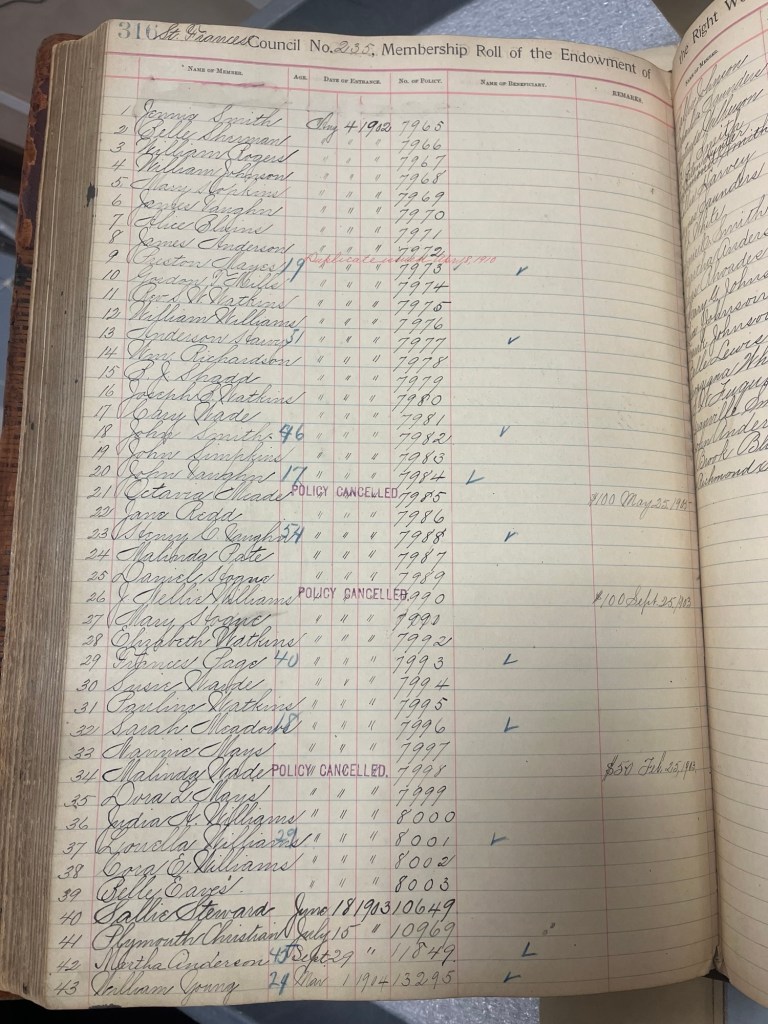
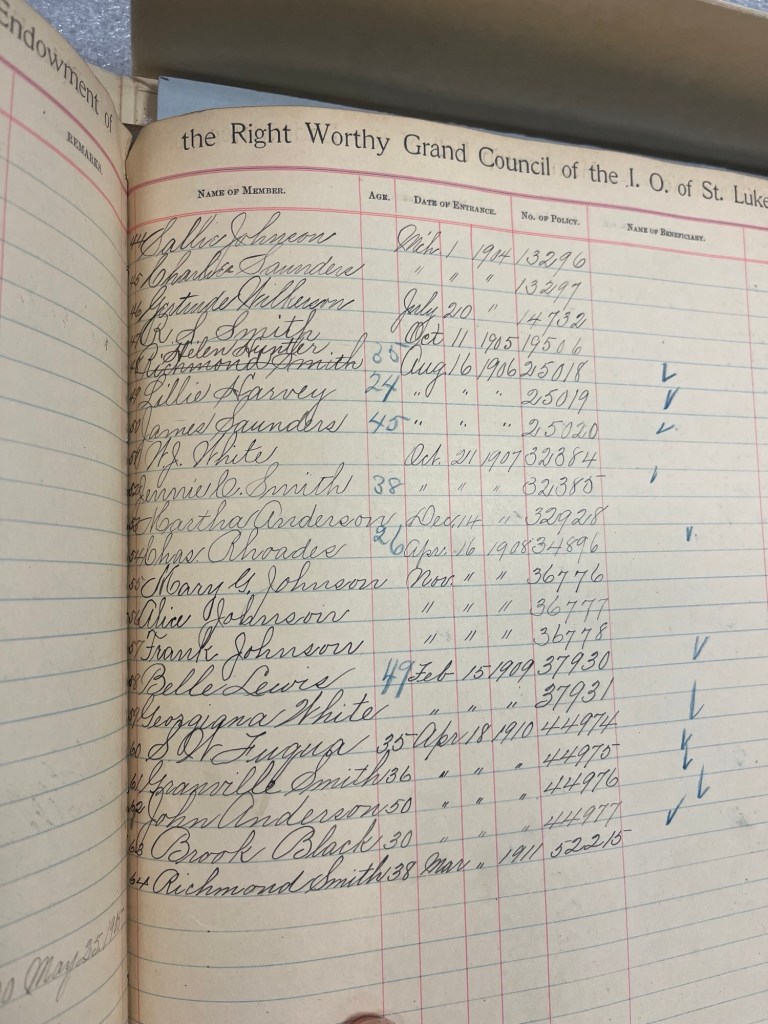
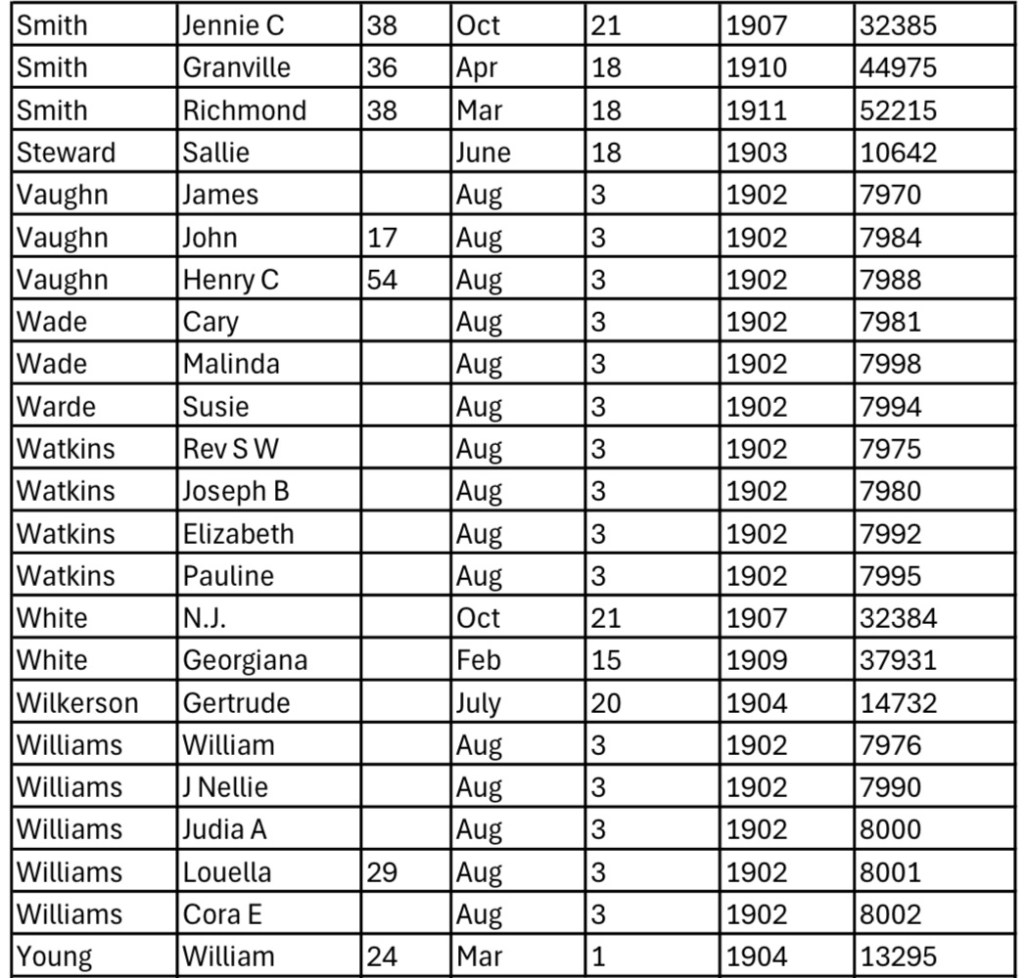
Notably, this legislative shift coincided with Maggie L. Walker’s creation of the St. Frances Council in Blacksburg. The Council’s membership ledger shows that 60% of its initial members signed up on August 3, 1902, just one month after the new voting restrictions became law. Of these members, 55% were women. This timing highlights the Council’s potential role as a unifying force and a means of empowerment in a community grappling with the loss of political rights.
Uncovering Hidden Histories: The St. Luke Ledger and Its Legacy in the New River Valley
This invaluable ledger is preserved at the Maggie L. Walker National Historic Site in Richmond, Virginia. Unfortunately, it has not been digitized or made available online. The ledger includes the names of families residing in the Blacksburg District, which, at the time, extended east to Ellett Valley, south to Yellow Sulphur Springs, west to the New River, and north to Brush Mountain. As a result, it provides a rare and significant snapshot of individuals—primarily women—who may not appear in other historical records.
This document is more than a membership list; it is a record of people who signed life insurance policies, committing to monthly payments to secure financial stability for their families after their death. The majority of these members were women, demonstrating the critical role they played in building community wealth and hope.
The two pages of this ledger tell a hidden story of the region, preserved in the attic of the Independent Order of St. Luke’s building in Richmond since the organization disbanded in 1984. The ledger also contains information about other Councils established in the New River Valley. These Councils did not operate in isolation; they were interconnected through railroad travel, linking Blacksburg with Councils in Pulaski, Dublin, Christiansburg, Salem, and Roanoke.
The Friends of the St. Luke, Odd Fellows, and Household of Ruth are committed to uncovering and sharing the history revealed by these ledgers. Their efforts will honor the individuals who deeded property, designed, built, and gave meaning to the Hall at 203 Gilbert Street, preserving the stories of our shared regional history for future generations.
Maggie L. Walker Historic Site virtual exhibit and objects. Please ask for permission from the National Park Service if you wish to publish the images.
St Frances Council, #235, pages 361-362, Membership Roll 1897-1911 (Courtesy of Maggie L. Walker National Historic Site)St Frances Council, #235, pages 361-362, Membership Roll 1897-1911 (Courtesy of Maggie L. Walker National Historic Site)Transcription of Membership Roll from 1902 to 1911, page 2Transcription of Membership Roll from 1902 to 1911, page 1
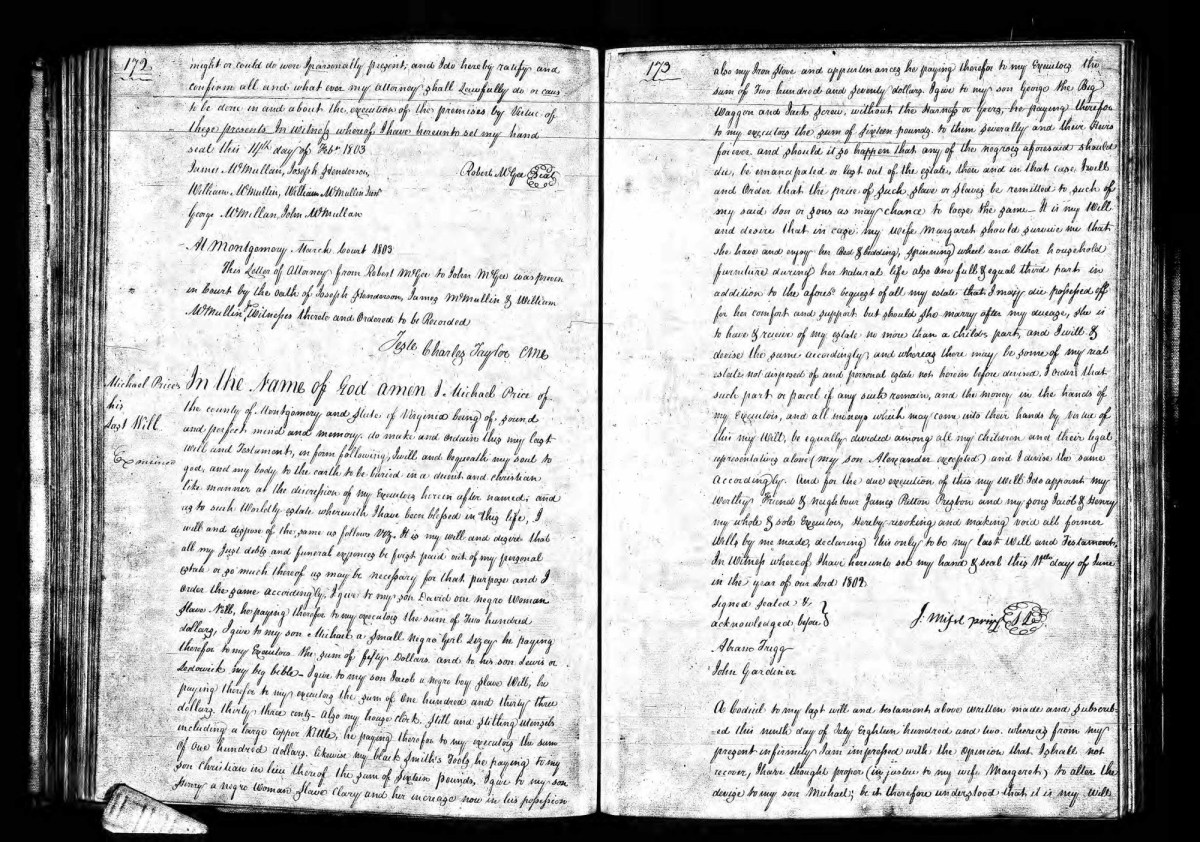
Michael Price wrote his will on 11 June 1802, witnesses by Abram Trigg and John Gardiner. James Patton Preston and his sons, Jacob and Henry Price were his executors. The will was proved on 09 July 1802. According to the 1788 Tax list, Michale was taxed for two enslaved people.
Summary
Son David inherited an enslaved woman named Nall for $200.
Son Michael inherited a small girl, Lizey for $50
Son Jacob inherited Will, paying $133
Perry inherited Clary with her “increase.”
Michael Price (1748-1839) Will
Michael Price wrote his will on 12 March 1835. witnessed by Jacob Shell, Jacob Harless, and Samuel Smith. The executors were Alexander Price (son), David Keister, Phillip Harless, and Peter Keister, proved on 12 March 1839. According to the 1788 Tax list, Michale held no enslaved people.
Summary
Wife, Esther Francisco Price inherited Liz and her two children, Maria and Ben. Upon Esther’s death she may “dispose” of Maria and/or Ben, but Liz was to be retained by the family. Liz was given the choice of which child she would become property.
Son Alexander inherited David and Sam.
Livey was alive in 1802 and was passed to Michael Price’s son, also named Michael. When Michael Price died in 1839, a woman named Liv and her two children, Maria and Ben, were mentioned in his estate. After his death, Liv was inherited by Esther Francisco Price, who was living with her son, Alexander Price.
Further research is needed to trace the lives of those held in bondage by the early Price family.
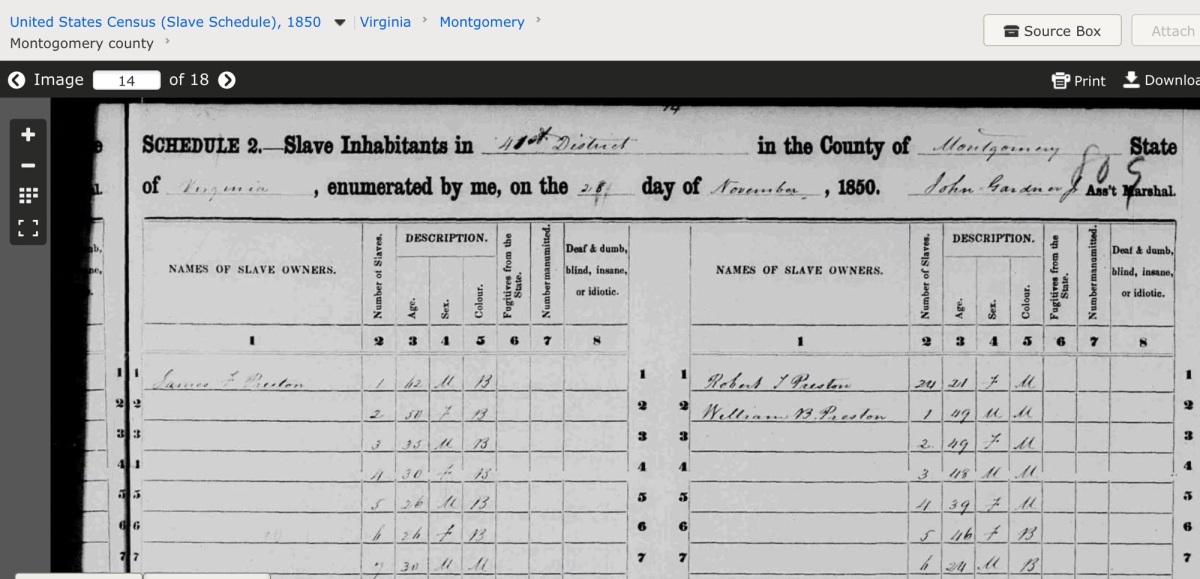
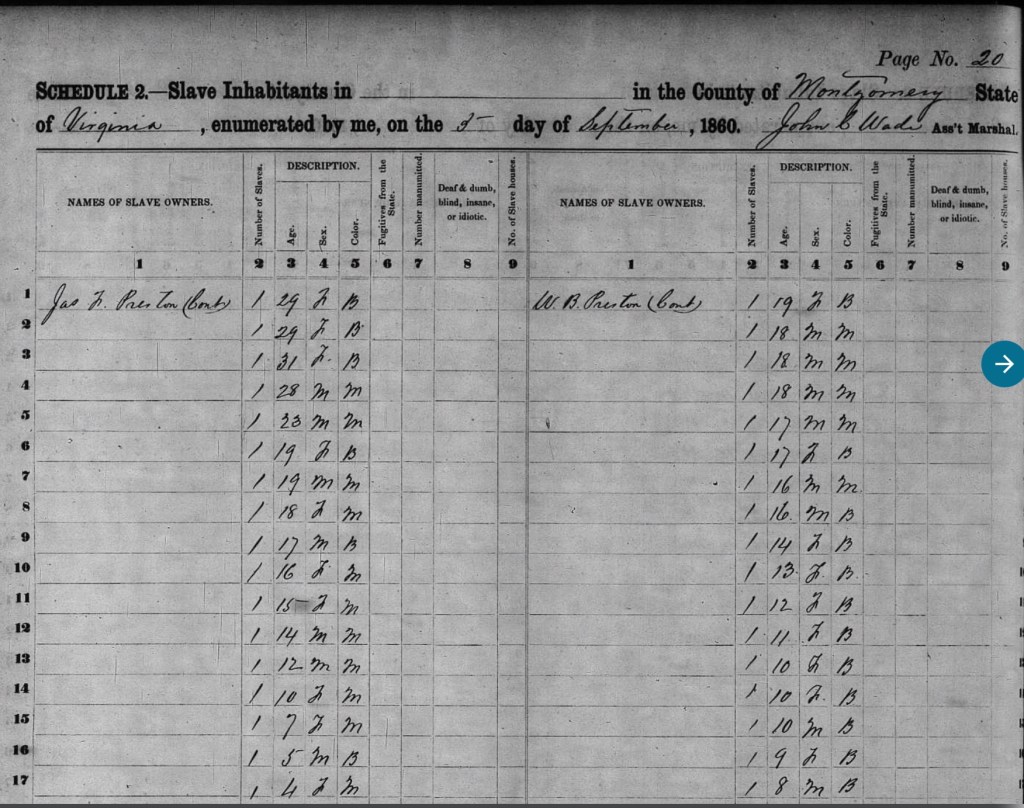
If you’re searching for a specific enslaved individual, please note that their names are generally not listed, except in rare instances. To browse the records, enter the names Preston, Hoge, or Wade (all enslavers), and then navigate through the document.
Montgomery County (Va.) Cohabitation Register. This register records the name of the husband, his age, place of birth, residence, occupation, last owner, last owner’s residence, name of the wife, her age, place of birth, residence, last owner, last owner’s residence, name of children with the ages of each, and the date of commencement of cohabitation. Of note is the wide range of localities reported as the former slaves’ places of birth
The University of Virginia Library’s Virginia Untold: The African American Narrative provides a comprehensive online archive of African American and related history. These primary sources are invaluable for researchers and genealogists. Search “Montgomery County, VA” to locate local materials, and include “Wythe County, VA,” as some Montgomery County records are held there. While the site offers search functionality, downloading PDF transcriptions allows for more targeted searching. Please note that name spellings may vary. Scroll down on this web page for additional online resources.
Montgomery County (Va.) Register of Colored Persons Cohabiting Together as Husband and Wife, 1866 Feb. 27. N.p., 1866.
This document is very valuable and now that it has been digitized it is accessible. Please read the description and historical note by the Library of Virginia: (accessed 3 March 2024)
Description Montgomery County (Va.) Register of Colored Persons of Montgomery County, State of Virginia, cohabiting together as Husband and Wife on 27th February 1866. Also commonly called Montgomery County (Va.) Cohabitation Register. This register records the name of the husband, his age, place of birth, residence, occupation, last owner, last owner’s residence, name of the wife, her age, place of birth, residence, last owner, last owner’s residence, name of children with the ages of each, and the date of commencement of cohabitation. Of note is the wide range of localities reported as the former slaves’ places of birth
Montgomery County (Va.) Register of Colored Persons Cohabiting Together as Husband and Wife, 1866 Feb. 27. N.p., 1866. Print.
Historical Note Note
Montgomery County was named for Richard Montgomery, who was killed in the American assault on Quebec late in 1775. It was formed from Fincastle County in 1776. Part of Botetourt County was added in 1789, and part of Pulaski County was added in 1842.
The Virginia legislature passed an act on 27 February 1866 to legalize the marriages of former slaves who had been cohabiting as of that date. See Virginia Acts of Assembly, 1866-1867, Chapter 18, An act to amend and re-enact the 14th section of chapter 108 of the Code of Virginia for 1860, in regard to registers of marriage; and to legalize the marriages of colored persons now cohabiting as husband and wife.
The federal Bureau of Refugees, Freedmen, and Abandoned Lands directed the Assistant Superintendents of the states to order the county clerks to make a registry of such cohabiting couples. See Circular No. 11, dated 19 March 1866, in Orders, Circulars, Circular Letters, and Letters of Instruction, vol. 2 (1866). Bureau of Refugees, Freedmen, and Abandoned Lands, Records of the Assistant Commissioner for the State of Virginia, 1865-1869. Miscellaneous reel 3880, Library of Virginia. National Archives microfilm M1048 (reel 41), Record Group 105.
Montgomery County (Va.) Register of Colored Persons Cohabiting Together as Husband and Wife, 1866 Feb. 27. N.p., 1866. Print.