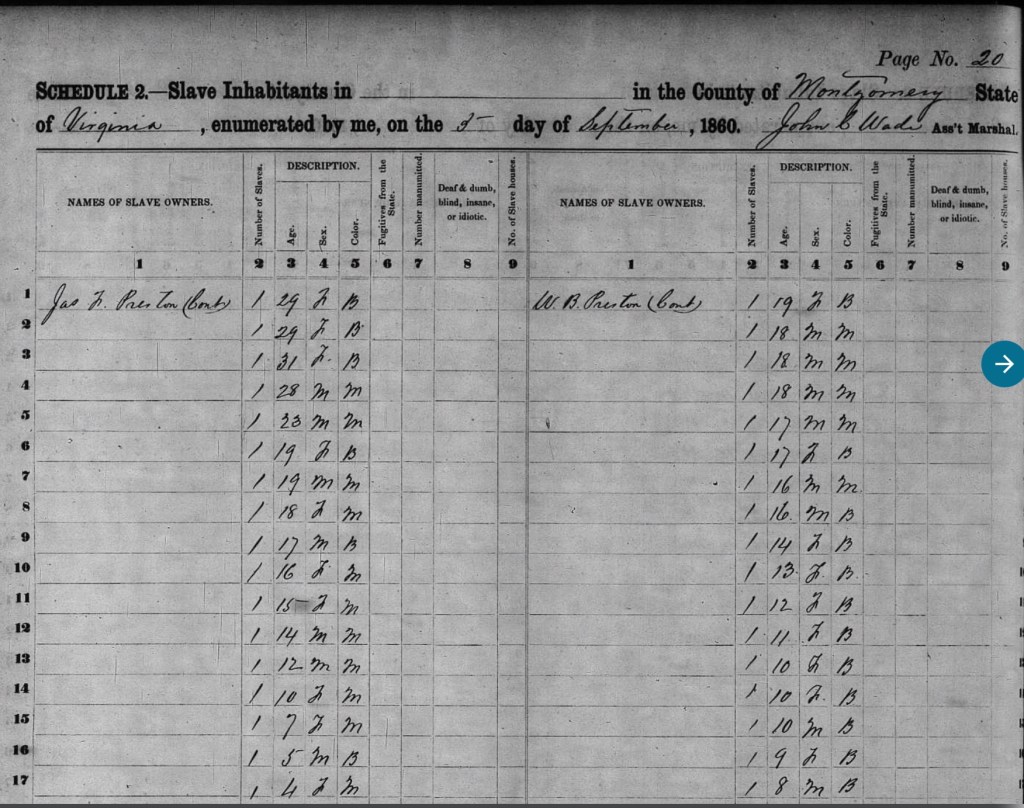
If you’re searching for a specific enslaved individual, please note that their names are generally not listed, except in rare instances. To browse the records, enter the names Preston, Hoge, or Wade (all enslavers), and then navigate through the document.
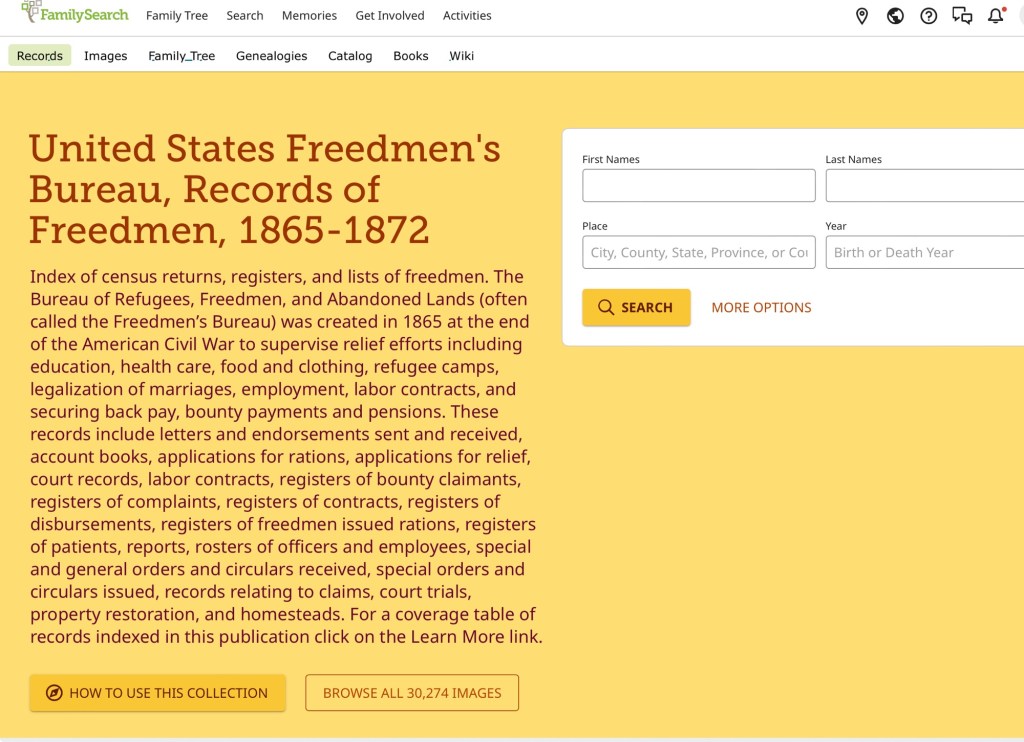
The Index of census returns, registers, and lists of freedmen is overseen by the Bureau of Refugees, Freedmen, and Abandoned Lands, commonly known as the Freedmen’s Bureau. Established in 1865 after the American Civil War, its responsibilities include supervising relief efforts such as education, healthcare, food, clothing, refugee camps, marriage legalization, employment, labor contracts, and ensuring back pay, bounty payments, and pensions.
Family Search records are free but registration is required.
Virginia, Roll 130, Registers of freedmen sent to New England states, 1866-1867
Virginia, Wytheville, Roll 198, Census returns of the black population of Montgomery, Grayson, Smyth, Giles, Roanoke, Craig, and Floyd Counties, 1865 (Images 214-412)
Virginia, Christianburg, Roll 68, Census returns of blacks in Montgomery County
Seven Year Timeline of the Bureau of Refugees, Freedmen, and Abandoned Lands (Freedmen’s Bureau): March 1865 to June 1872.
September 2, 1862: “President Lincoln issued the Preliminary Emancipation Proclamation, declaring that as of January 1, 1863 “all persons held as slaves within any State, or designated part of a State, the people whereof shall then be in rebellion against the United States shall be then, thenceforward, and forever free.”” (Library of Congress)
January 1, 1863: President Lincoln issued the Emancipation Proclamation
April 9, 1865: Lee surrenders to Grant at Appomattox, ending the Civil War.
Juneteenth, 1865 – Smithsonian’s National Museum of African American of History & Culture
National – 3 March 1865: the bureau was created by the War Department of the US Government. Commissioners and Assistant Commissioners as well as General Superintendent of Schools were established.
Virginia – June 1865 to May 1866: Orlando Brown established an office and operated as Commissioner of Virginia, in Richmond.
Virginia – 4 July 1865 to 14 April 1867: Virginia Bureau is organized into 10 districts with an Agent/Superintendent in charge.
Mont. Co – Sept 1865: Buel Carter became the 8th District’s first Superintendent, establishing an office in Christiansburg but move the office to Wythville in September of the same year.
National – Oct 1865 to Jan 1867: Rev. John W. Alvord became Inspector of Finances and Schools to address schools.
Mont. Co – May 1866: Capt Charles S. Schaeffer arrives in Christiansburg as the agent, working under Brevet Maj. George P. Sherwood became Superintendent of the 8th District in June 1866.
Virginia – May 1866 to Aug 1866: Maj. Gen. Alfred H. Terry is Assistant Commissioner, Richmond.
National – 16 July 1866: the Bureau of Freedmen is extended by Congress.
Virginia – Aug 1866 to March 1867: Maj. Gen. John M. Schofield is named Assistant Commissioner .
Virginia – 15 April 1867: The state is reorganization into 10 Sub-districts with Sub-Assistant Commissioner in charge.
Mont. Co- 15 April 1867: District 8 , the central office remained in Wythville. CA Schaeffer remained in Christiansburg.
Virginia – March 1867 to May 1869: Orlando Bowen becomes Assistant Commissioner and Superintendent of Education.
National – 6 July 1968: The Bureau of Freedmen is extended for the last time.
National – 25 July 1868: Congress removes the Bureau’s Assistant Commissioners from the states, but claim agents remain in place.
Mont. Co. – Dec 1868: Freedmen’s Bureau closes its Christiansburg office. Schaeffer retained as Assistant Superintendent of Education.
Virginia – 1 Jan 1869: the 10 Virginia districts are reorganized into 8 Education Sub Districts and Assistant Superintendent of Schools are appointed.
Virginia – 1870: New constitution was ratified which included Public School Funding for all children as a requirement. By 1870 the legislation was set to allow this to happen, though the education would be segregated.
National- Summer 1870: Superintendents of Education removed and headquarters staff reduced.
National – 30 June 1872: The Freedmen’s Bureau was terminated by Congress.
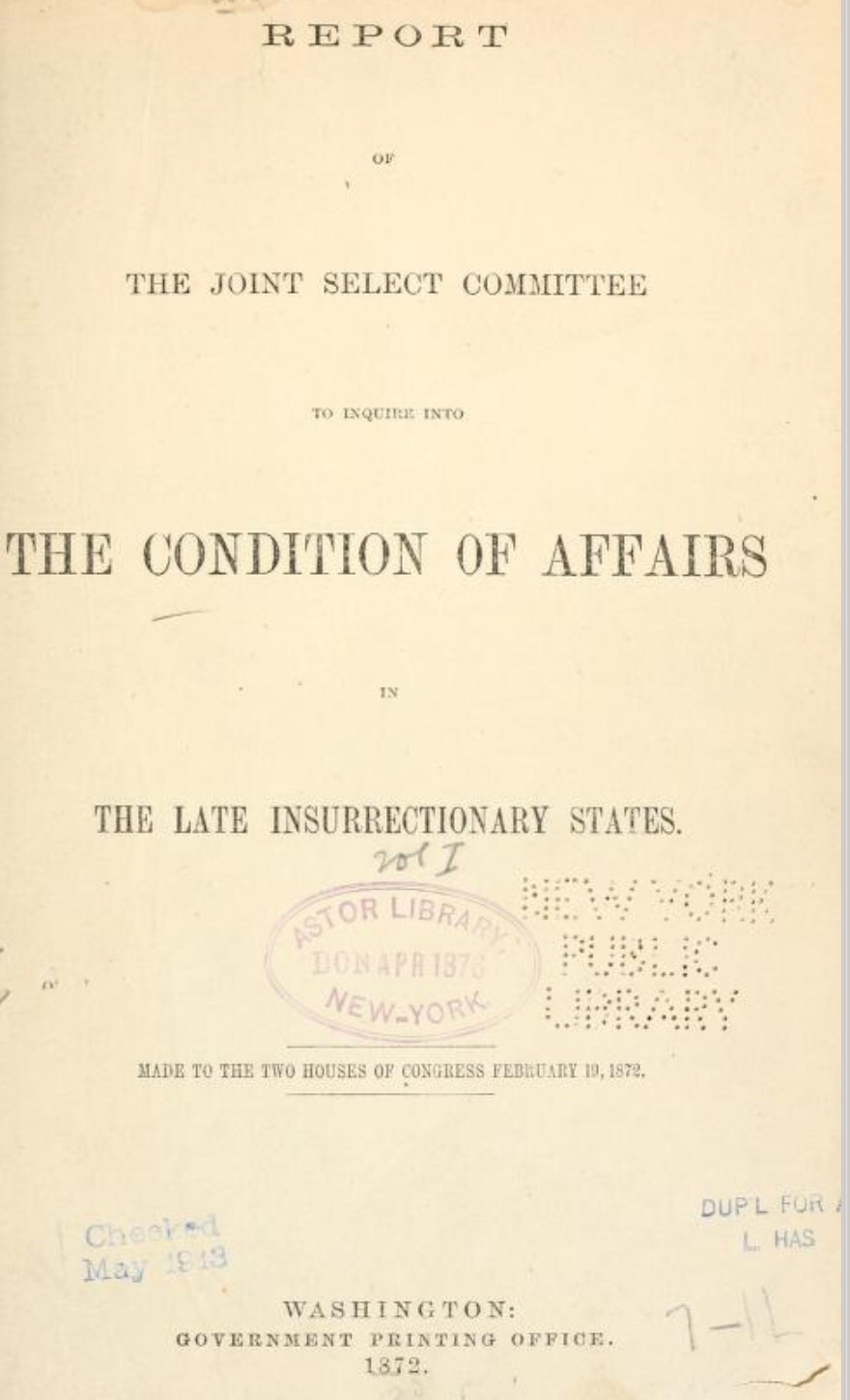
In 1872, a 13-volume compilation of reports and testimonies, including those from previously enslaved individuals, documented a Congressional committee’s investigation into the Ku Klux Klan and other insurrectionary movements in the former Confederate states.
In 1872, a 13-volume compilation of reports and testimonies, including those from previously enslaved individuals, documented a Congressional committee’s investigation into the Ku Klux Klan and other insurrectionary movements in the former Confederate states.
While Virginia is absent from this congressional report, the testimonies offer valuable insights into the beliefs, attitudes, misconceptions, and misdirections surrounding the mistreatment of newly freed people residing in the former Confederate states.
Montgomery County (Va.) Cohabitation Register. This register records the name of the husband, his age, place of birth, residence, occupation, last owner, last owner’s residence, name of the wife, her age, place of birth, residence, last owner, last owner’s residence, name of children with the ages of each, and the date of commencement of cohabitation. Of note is the wide range of localities reported as the former slaves’ places of birth
Montgomery County (Va.) Register of Colored Persons Cohabiting Together as Husband and Wife, 1866 Feb. 27. N.p., 1866. Print
This document is very valuable and now that it has been digitized it is accessible. Please read the description and historical note by the Library of Virginia: (accessed 3 March 2024)
Direct Link to the pages as images and as a transcription
Description Montgomery County (Va.) Register of Colored Persons of Montgomery County, State of Virginia, cohabiting together as Husband and Wife on 27th February 1866. Also commonly called Montgomery County (Va.) Cohabitation Register. This register records the name of the husband, his age, place of birth, residence, occupation, last owner, last owner’s residence, name of the wife, her age, place of birth, residence, last owner, last owner’s residence, name of children with the ages of each, and the date of commencement of cohabitation. Of note is the wide range of localities reported as the former slaves’ places of birth
Montgomery County (Va.) Register of Colored Persons Cohabiting Together as Husband and Wife, 1866 Feb. 27. N.p., 1866. Print.
Historical Note Note
Montgomery County was named for Richard Montgomery, who was killed in the American assault on Quebec late in 1775. It was formed from Fincastle County in 1776. Part of Botetourt County was added in 1789, and part of Pulaski County was added in 1842.
The Virginia legislature passed an act on 27 February 1866 to legalize the marriages of former slaves who had been cohabiting as of that date. See Virginia Acts of Assembly, 1866-1867, Chapter 18, An act to amend and re-enact the 14th section of chapter 108 of the Code of Virginia for 1860, in regard to registers of marriage; and to legalize the marriages of colored persons now cohabiting as husband and wife.
The federal Bureau of Refugees, Freedmen, and Abandoned Lands directed the Assistant Superintendents of the states to order the county clerks to make a registry of such cohabiting couples. See Circular No. 11, dated 19 March 1866, in Orders, Circulars, Circular Letters, and Letters of Instruction, vol. 2 (1866). Bureau of Refugees, Freedmen, and Abandoned Lands, Records of the Assistant Commissioner for the State of Virginia, 1865-1869. Miscellaneous reel 3880, Library of Virginia. National Archives microfilm M1048 (reel 41), Record Group 105.
Montgomery County (Va.) Register of Colored Persons Cohabiting Together as Husband and Wife, 1866 Feb. 27. N.p., 1866. Print.






 Gathering African American History