The exact location of this church in the Childress area remains unknown. A 1940 school map shows nearby schools but lists only Pine Woods, a Rosenwald-funded African American school. Because schools were often built near churches, the map—and the noted Shelburne home—may offer clues to where the congregation once gathered.
Rough & Ready Church in Childress, Va – Roanoke Times, 05 August 1923, page 20
The exact location of this church in the Childress area is unknown. A 1940 school map identifies local schools but does not mark any African American schools, except Pine Woods School, which was built with Rosenwald funds. In many communities, schools were often situated near churches, so their locations can offer valuable clues. A Shelburne home also appears on this map, suggesting possible connections within the neighborhood.
The Roanoke Times, 05 August 1923, page 20
During a violent electrical storm Monday, lightning struck a son of Authur Shelburne near the colored church “Rough & Ready.”
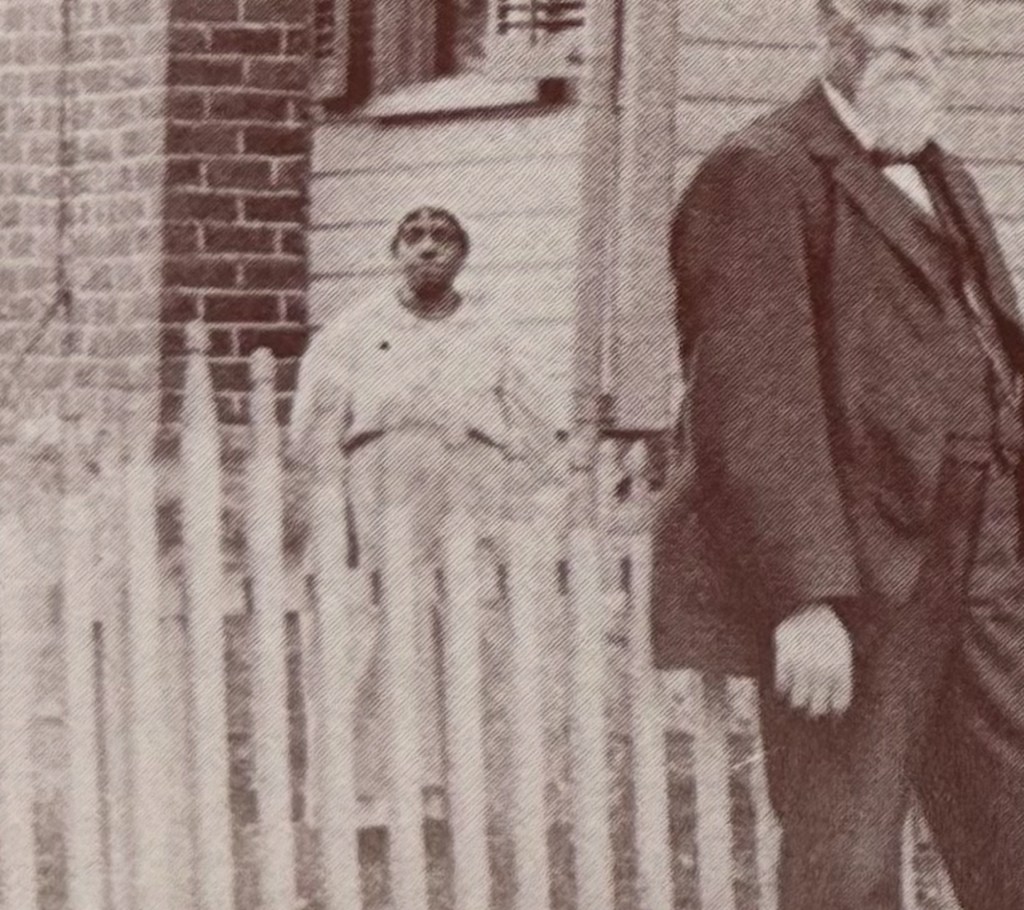
Behind the Lawrence family’s fence on Five Points Road in Riner stands an unidentified African American woman—her name unrecorded, her story unknown. She appears behind Canaan and Mollie Weaver Lawrence, whose wealth came from farming, commerce, and the post office in the late 1800s.
Searching for Her Name
In this photograph, taken in Riner, Virginia, a white family stands proudly in front of their home on Five Points Road, Riner, Virginia. Behind the fence, partially obscured, stands an unidentified African American woman—someone whose name and story have not yet been recorded.
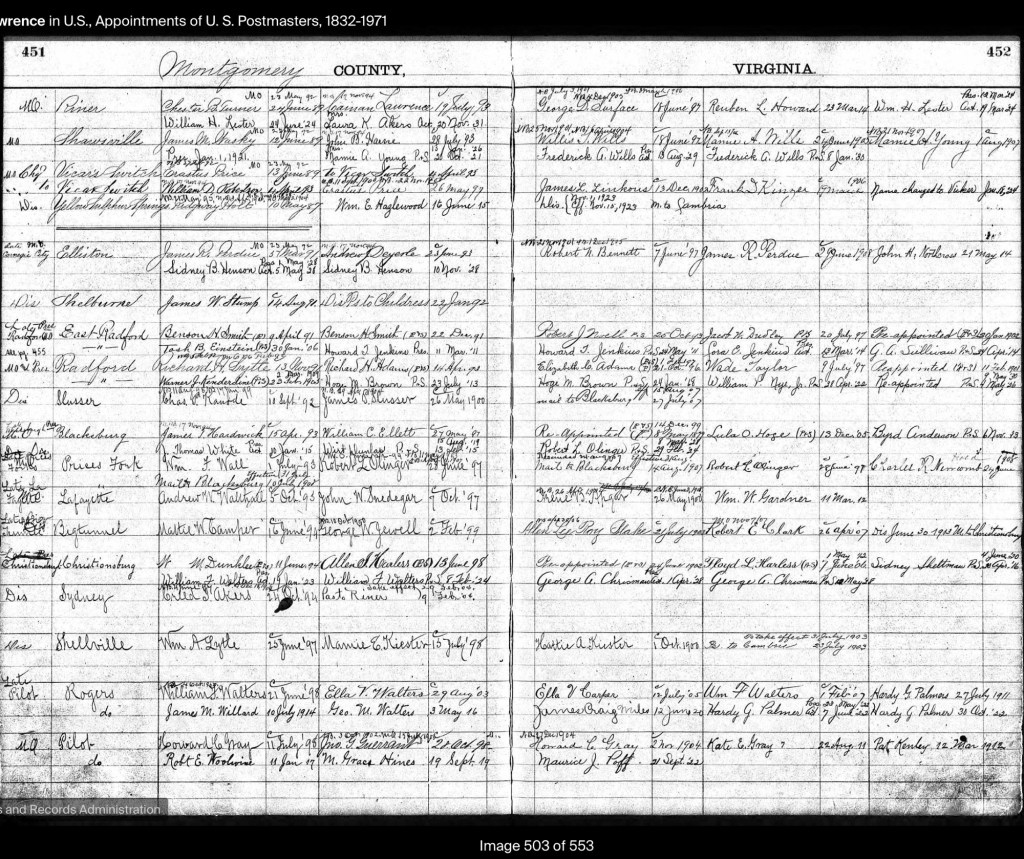
She is pictured behind Canaan (1840–1905) and Mollie E. Weaver Lawrence (1838–1931), whose home and farm once stood at this site. Canaan, a Confederate veteran, was listed as a farmer, D.G. merchant, and postmaster in 1893—the sources of the family’s prosperity. Born in Floyd County, he moved to Auburn by the 1870 census. Mollie, born in Auburn, remained there her entire life.
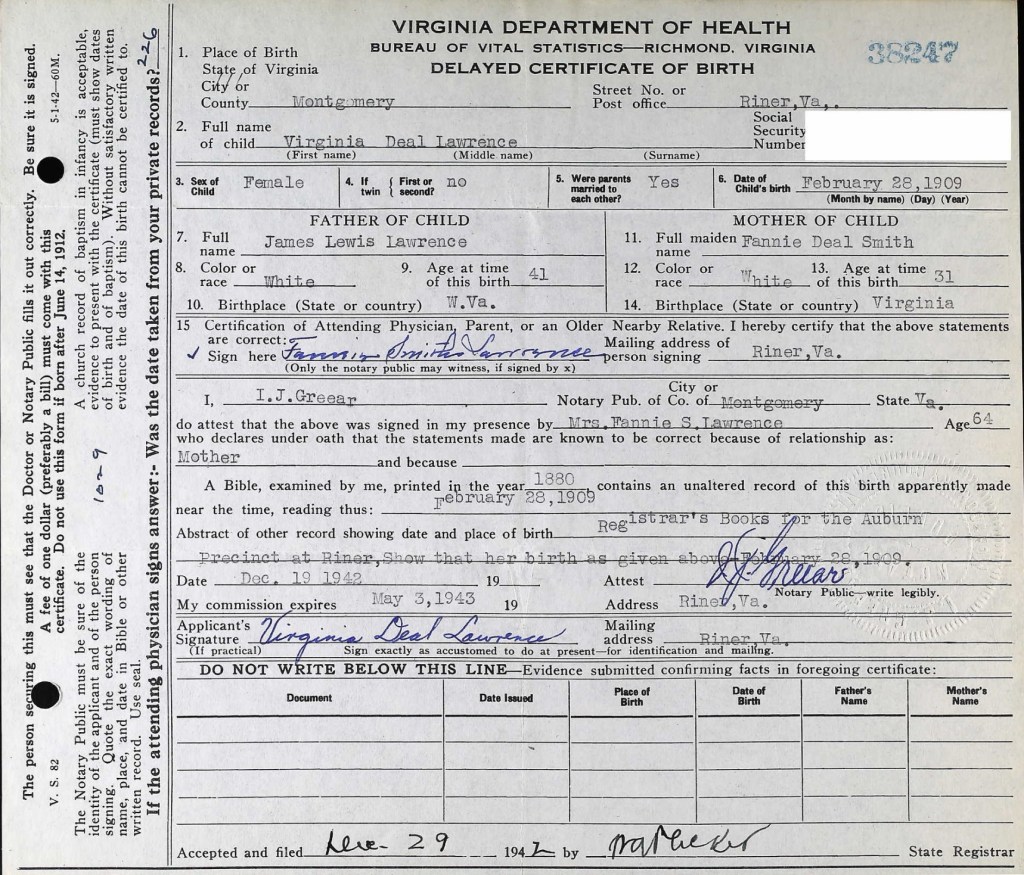
This photograph was shared by their granddaughter, Virginia Deal Lawrence, a longtime teacher at Auburn Elementary School, who preserved many family images and documents. Despite a search through census and local records, the woman’s name remains unknown.
We will continue to look through Virginia Deal’s papers and scrapbooks in hopes of finding a clue.
If you recognize this woman or know anything about the African American community connected to the Lawrence family, please contact us—we would be honored to record her name and story.
Please let us know if you can identify this woman behind the fence.Lawrence Family PhotoCanaan Lawrence1893 Canaan Lawrence was Postmaster of Riner, Va1895 Canaan Lawrence was the Postmaster in Riner, VaMollie Elizabeth Weaver Lawrence Virginia Deal Lawrence, granddaughter of Canaan and Mollie LawrenceThe Riner 1995 Calendar filled with Virginia Deal Lawrence’s photos
Montgomery County (Va.) Cohabitation Register. This register records the name of the husband, his age, place of birth, residence, occupation, last owner, last owner’s residence, name of the wife, her age, place of birth, residence, last owner, last owner’s residence, name of children with the ages of each, and the date of commencement of cohabitation. Of note is the wide range of localities reported as the former slaves’ places of birth
Montgomery County (Va.) Register of Colored Persons Cohabiting Together as Husband and Wife, 1866 Feb. 27. N.p., 1866. Print
This document is very valuable and now that it has been digitized it is accessible. Please read the description and historical note by the Library of Virginia: (accessed 3 March 2024)
Direct Link to the pages as images and as a transcription
Description Montgomery County (Va.) Register of Colored Persons of Montgomery County, State of Virginia, cohabiting together as Husband and Wife on 27th February 1866. Also commonly called Montgomery County (Va.) Cohabitation Register. This register records the name of the husband, his age, place of birth, residence, occupation, last owner, last owner’s residence, name of the wife, her age, place of birth, residence, last owner, last owner’s residence, name of children with the ages of each, and the date of commencement of cohabitation. Of note is the wide range of localities reported as the former slaves’ places of birth
Montgomery County (Va.) Register of Colored Persons Cohabiting Together as Husband and Wife, 1866 Feb. 27. N.p., 1866. Print.
Historical Note Note
Montgomery County was named for Richard Montgomery, who was killed in the American assault on Quebec late in 1775. It was formed from Fincastle County in 1776. Part of Botetourt County was added in 1789, and part of Pulaski County was added in 1842.
The Virginia legislature passed an act on 27 February 1866 to legalize the marriages of former slaves who had been cohabiting as of that date. See Virginia Acts of Assembly, 1866-1867, Chapter 18, An act to amend and re-enact the 14th section of chapter 108 of the Code of Virginia for 1860, in regard to registers of marriage; and to legalize the marriages of colored persons now cohabiting as husband and wife.
The federal Bureau of Refugees, Freedmen, and Abandoned Lands directed the Assistant Superintendents of the states to order the county clerks to make a registry of such cohabiting couples. See Circular No. 11, dated 19 March 1866, in Orders, Circulars, Circular Letters, and Letters of Instruction, vol. 2 (1866). Bureau of Refugees, Freedmen, and Abandoned Lands, Records of the Assistant Commissioner for the State of Virginia, 1865-1869. Miscellaneous reel 3880, Library of Virginia. National Archives microfilm M1048 (reel 41), Record Group 105.
Montgomery County (Va.) Register of Colored Persons Cohabiting Together as Husband and Wife, 1866 Feb. 27. N.p., 1866. Print.








 Gathering African American History