


Maggie L. Walker National Historic Site Connection
The Maggie L. Walker National Historic Site, located in the Jackson Ward neighborhood of Richmond, is owned and operated by the National Park Service. Its archives house a wealth of information, much of which has yet to be digitized or made available online.
On August 4, 1902, Maggie Lena Walker herself founded the St. Frances Council #235, a significant event as she typically delegated the establishment of local Councils in the Independent Order of St. Luke to others. This raises the question: did she visit Blacksburg personally to work with the African American community there? While we currently lack direct documentation to confirm this, there are intriguing connections to consider.
In 1914, Mrs. Walker served on committees of the “Negro Organization Society of Virginia” alongside Edgar A. Long, and in 1932, she served with A.M. Walker on the “Better Home and America” committee. Both Long and A.M. Walker were principals of Christiansburg Institute in nearby Cambria. Furthermore, when the St. Frances Council was established in 1902, Charles Lives Marshal was principal of the school.
These links between Mrs. Walker and influential African American educators in the region suggest the possibility of her involvement with Blacksburg’s community. The search for documentation to confirm her visit continues, but her influence and connections remain an integral part of the story.
The Walton Act of 1894 and the 1902 New Virginia State Constitution – Tools of Voter Suppression
Dan Thorpe’s book, Facing Freedom, provides valuable historical context on how the state legislature curtailed the rights and freedoms of African Americans in Montgomery County. The Walton Act of 1894, presented as a measure to reduce election corruption, required localities to implement a secret written ballot system. This effectively disenfranchised illiterate voters, disproportionately targeting African Americans and many local white men, under the guise of reform.
Further voter suppression was codified in the new Virginia State Constitution, which went into effect in July 1902. It introduced literacy and tax-paying requirements for voting, systematically disenfranchising large segments of the local population.
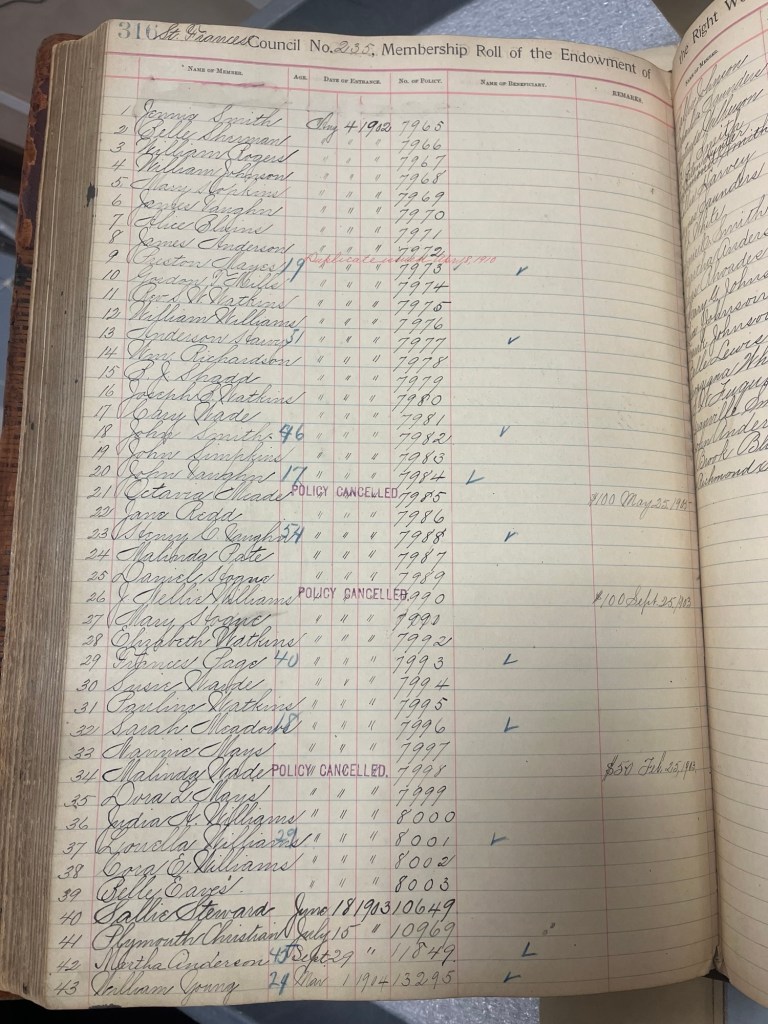
Notably, this legislative shift coincided with Maggie L. Walker’s creation of the St. Frances Council in Blacksburg. The Council’s membership ledger shows that 60% of its initial members signed up on August 3, 1902, just one month after the new voting restrictions became law. Of these members, 55% were women. This timing highlights the Council’s potential role as a unifying force and a means of empowerment in a community grappling with the loss of political rights.
Uncovering Hidden Histories: The St. Luke Ledger and Its Legacy in the New River Valley
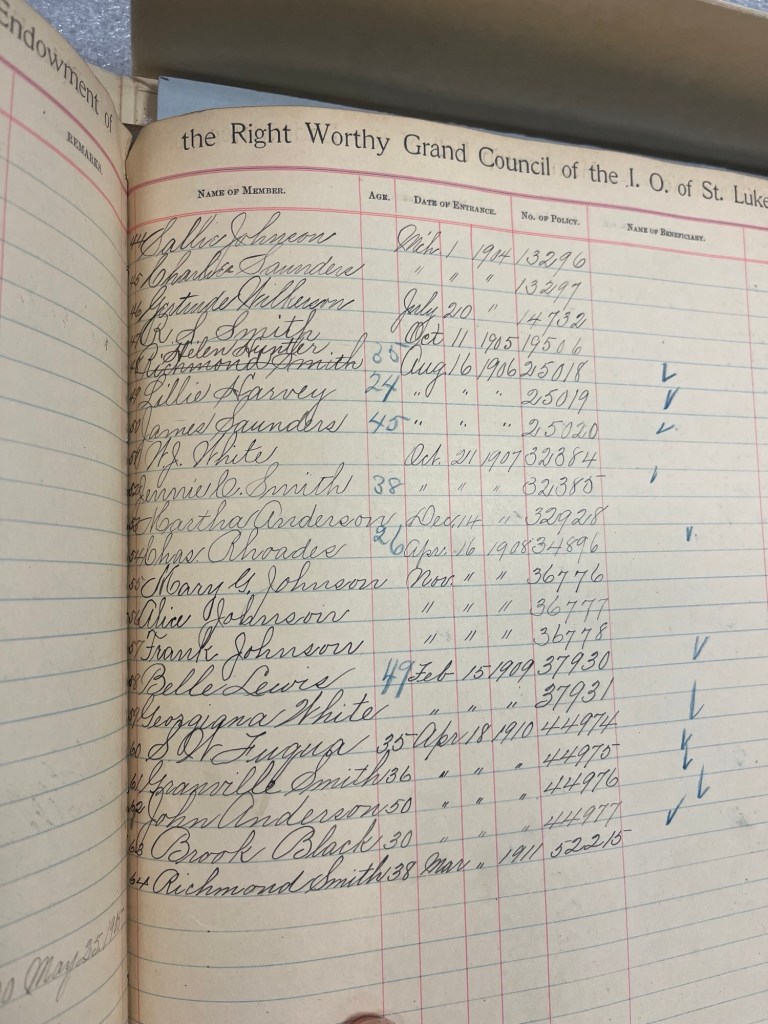
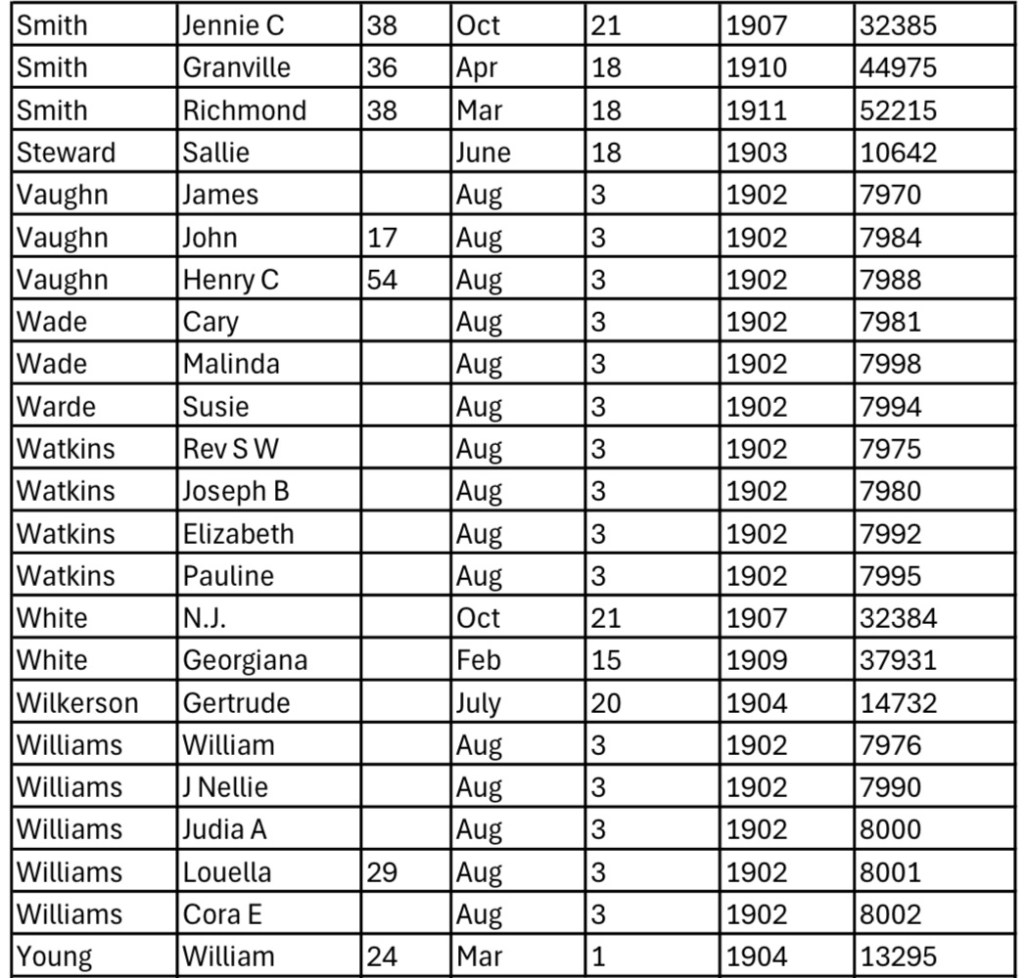
This invaluable ledger is preserved at the Maggie L. Walker National Historic Site in Richmond, Virginia. Unfortunately, it has not been digitized or made available online. The ledger includes the names of families residing in the Blacksburg District, which, at the time, extended east to Ellett Valley, south to Yellow Sulphur Springs, west to the New River, and north to Brush Mountain. As a result, it provides a rare and significant snapshot of individuals—primarily women—who may not appear in other historical records.
This document is more than a membership list; it is a record of people who signed life insurance policies, committing to monthly payments to secure financial stability for their families after their death. The majority of these members were women, demonstrating the critical role they played in building community wealth and hope.
The two pages of this ledger tell a hidden story of the region, preserved in the attic of the Independent Order of St. Luke’s building in Richmond since the organization disbanded in 1984. The ledger also contains information about other Councils established in the New River Valley. These Councils did not operate in isolation; they were interconnected through railroad travel, linking Blacksburg with Councils in Pulaski, Dublin, Christiansburg, Salem, and Roanoke.
The Friends of the St. Luke, Odd Fellows, and Household of Ruth are committed to uncovering and sharing the history revealed by these ledgers. Their efforts will honor the individuals who deeded property, designed, built, and gave meaning to the Hall at 203 Gilbert Street, preserving the stories of our shared regional history for future generations.
For more information about the history of the St Luke, Odd Fellows & Household of Ruth Hall, 203 Gilbert Street, Blacksburg, Virginia.
List of people living in New Town over time.
Sick Benefits of the Independent Order of St Luke
Beatrice Freeman Walker oral history about Maggie L. Walker and her mother, Bessie Briggs Freeman
Maggie L. Walker Historic Site virtual exhibit and objects. Please ask for permission from the National Park Service if you wish to publish the images.

 Gathering African American History