The Enslaved of Charles Black Family and the Virginia Tech Campus Legacy

Andrew, Eliza and Daniel

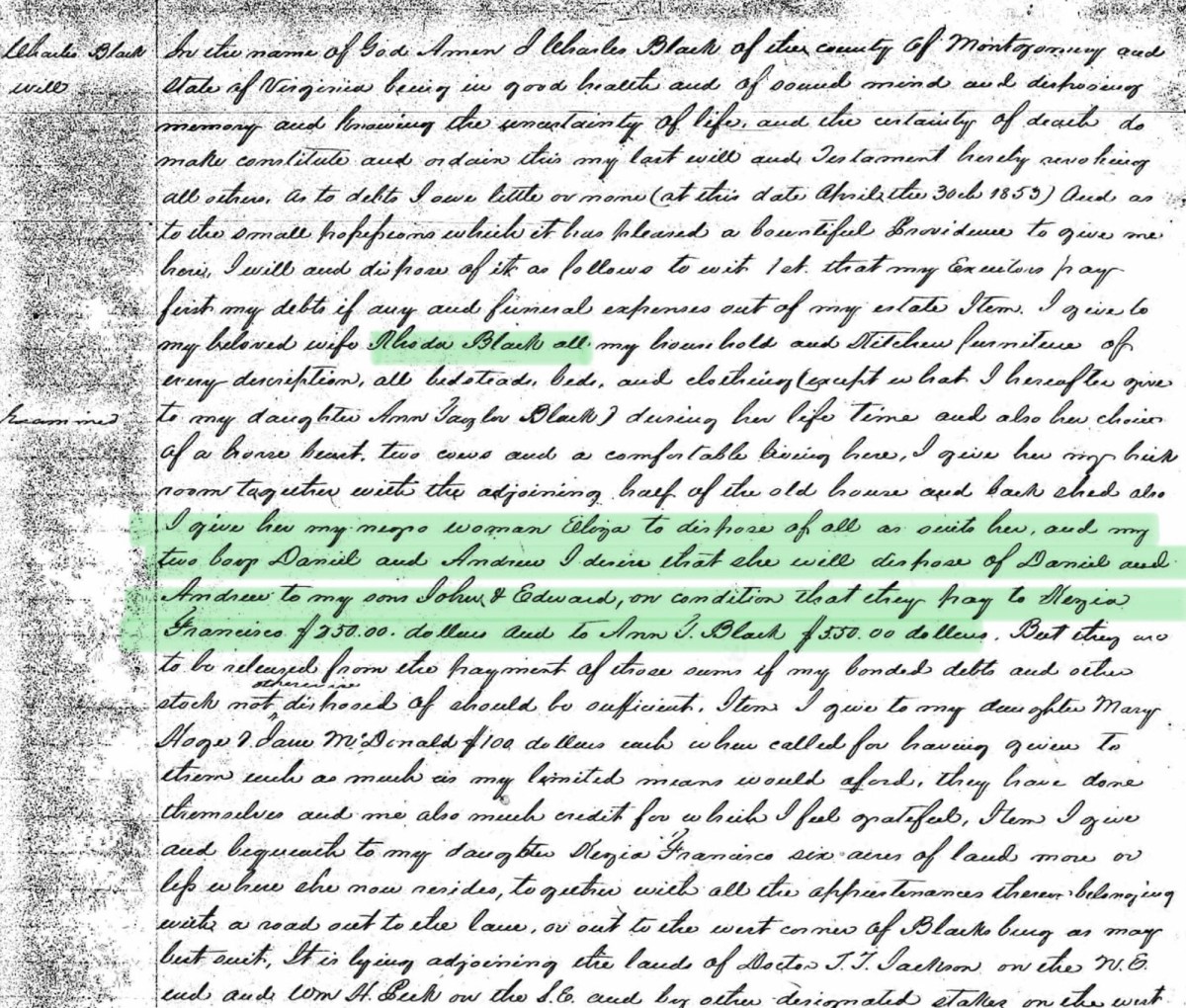
This is the last will and testament of Charles Black (1796-1853), son of John Black (1755-1845) and nephew of William Black, namesake of the Town of Blacksburg, Virginia. Charles died 1853 and his will was proved in Montgomery County, by Rice D. Montague, Clerk.

Quote: “I give her [my beloved wife Rhoda Black] my negro woman Eliza to dispose of all as suits her, and my two boys Daniel and Andrew I desire that she will dispose of Daniel and Andrew to my sons John & Edward, on condition that they pay to Kezia Francisco $750.00. dollars and to Ann T. Black $550.00 dollars.” 

Rhoda McDonald Black (1805-1859), wife and mother of Keziah Black Francisco (1830-1903), Ann Taylor “Nannie” Black (1837-1903), John Black A. (1831-1899), and Edward Black (1835-1912).

Much of Charles and Rhoda Black’s land becomes part of Virginia Tech campus after the death of Charles and Rhoda.
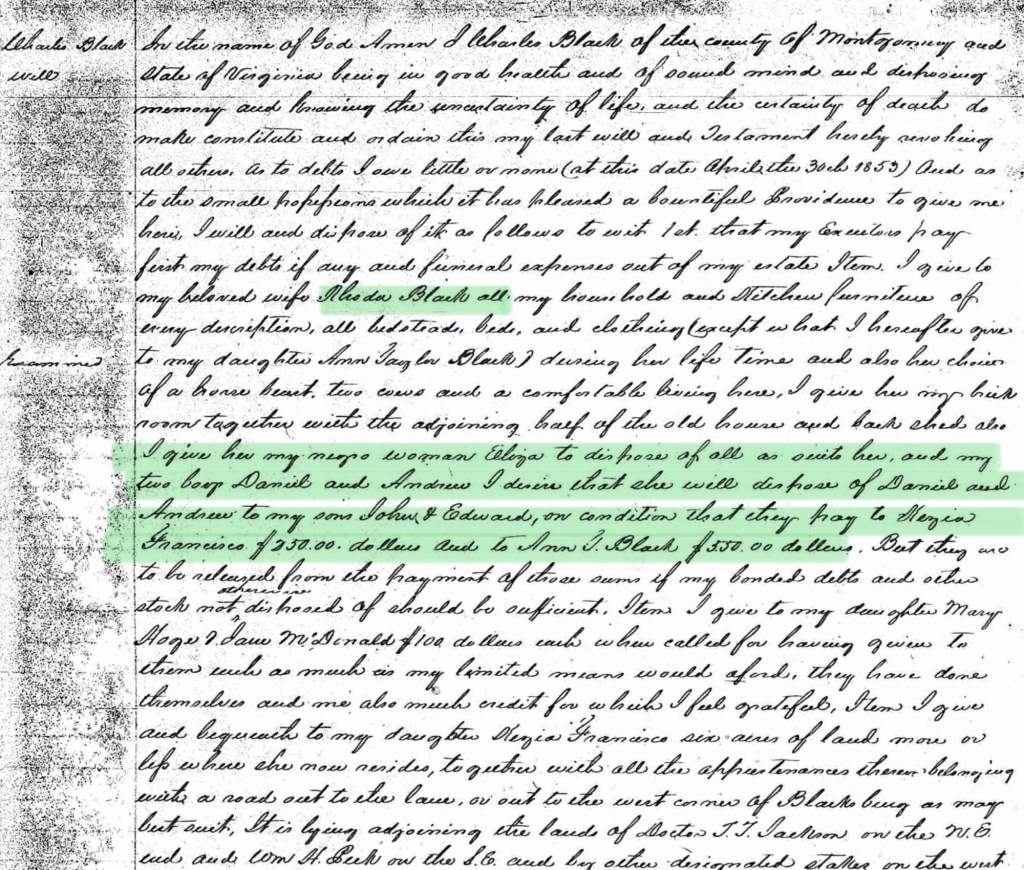
Page 1 Charles Black Last Will & Testament, Montgomery County Court House
Page 2

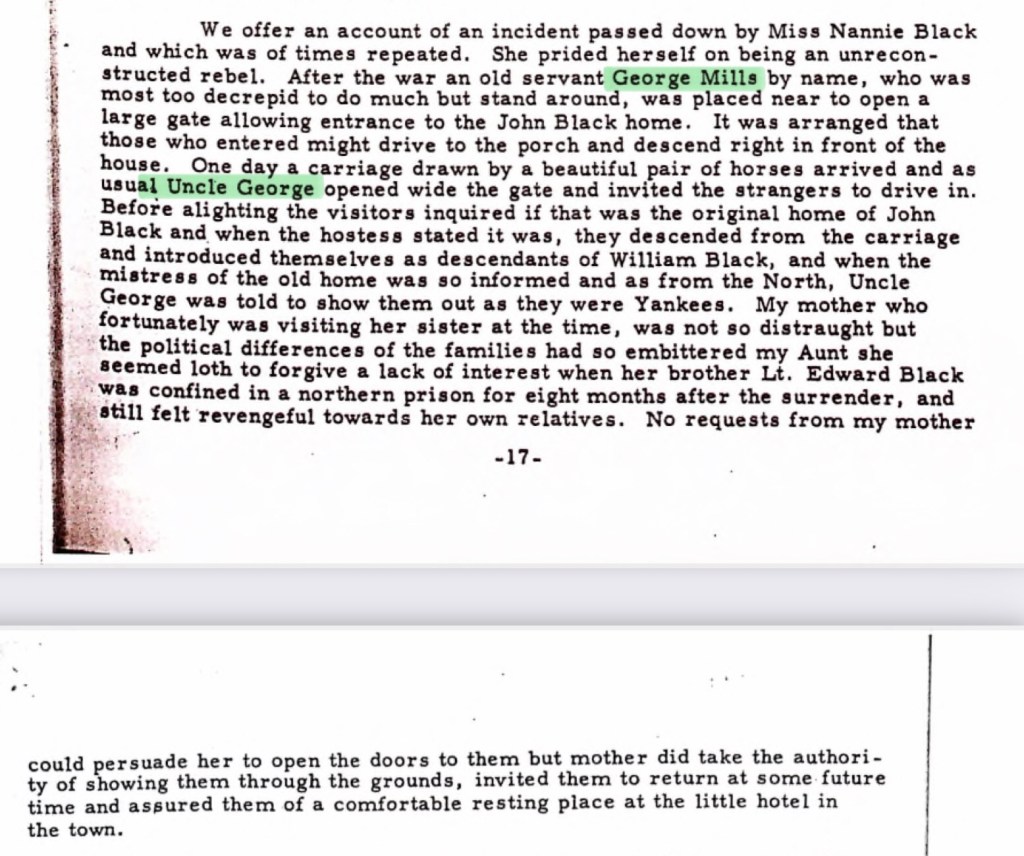
George Mills, Servant

Blacks and Other Families: A Compilation of Mrs. William Armstead Porter (née Nannie Francisco) Researcher, Genealogist, Heraldic Artist. Richmond, Virginia, 1934

George Mills is noted as “After the war an old servant George Mills by name….” in Nannie Francisco Porter’s , daughter of Keziah Black Francisco.


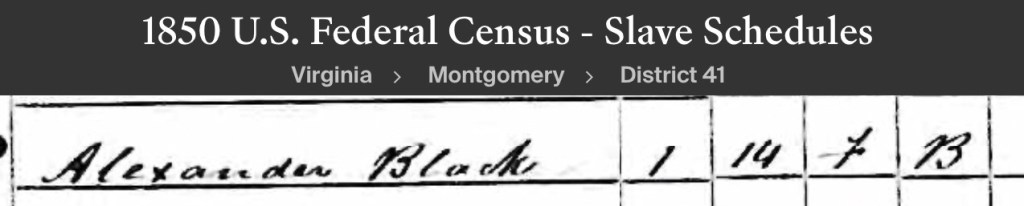
The 1850 Slave Schedule for Montgomery County does not name the people held against their will and provide a documentation of the slave owners. Charles Black’s will notes three people, a woman and two men, not four as noted below. No proof yet, but perhaps Eliza is the one listed female. Daniel and Andrew are likely one of these three people.

Alexander Black is the brother of Charles Black.


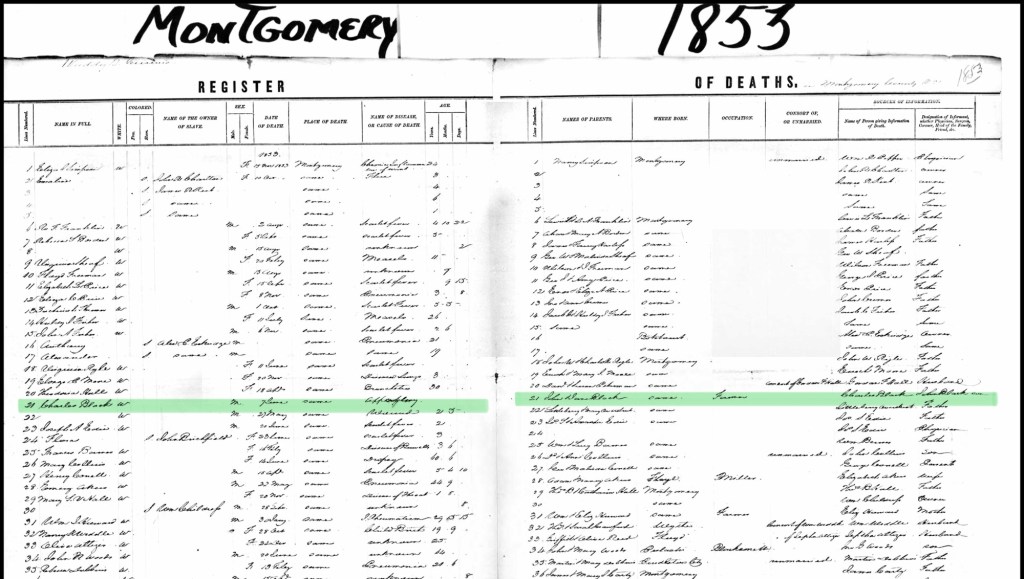
Register of Death of Enslaved by their owners

In 1853, one of Charles Black’s enslaved men reportedly died from apoplexy. This explains why his will only mentioned two men and one woman.

Montgomery County (Va.) Cohabitation Register

Montgomery County (Va.) Cohabitation Register. This register records the name of the husband, his age, place of birth, residence, occupation, last owner, last owner’s residence, name of the wife, her age, place of birth, residence, last owner, last owner’s residence, name of children with the ages of each, and the date of commencement of cohabitation. Of note is the wide range of localities reported as the former slaves’ places of birth

Montgomery County (Va.) Register of Colored Persons Cohabiting Together as Husband and Wife, 1866 Feb. 27. N.p., 1866. Print

This document is very valuable and now that it has been digitized it is accessible. Please read the description and historical note by the Library of Virginia: (accessed 3 March 2024)

Direct Link to the pages as images and as a transcription

Montgomery County, Va Register of Colored Persons Cohabiting Together as Husband & Wife, 1866 Feb. 27 – citation and supporting information.

Description
Montgomery County (Va.) Register of Colored Persons of Montgomery County, State of Virginia, cohabiting together as Husband and Wife on 27th February 1866. Also commonly called Montgomery County (Va.) Cohabitation Register. This register records the name of the husband, his age, place of birth, residence, occupation, last owner, last owner’s residence, name of the wife, her age, place of birth, residence, last owner, last owner’s residence, name of children with the ages of each, and the date of commencement of cohabitation. Of note is the wide range of localities reported as the former slaves’ places of birth

Montgomery County (Va.) Register of Colored Persons Cohabiting Together as Husband and Wife, 1866 Feb. 27. N.p., 1866. Print.

Historical Note
 Note

Montgomery County was named for Richard Montgomery, who was killed in the American assault on Quebec late in 1775. It was formed from Fincastle County in 1776. Part of Botetourt County was added in 1789, and part of Pulaski County was added in 1842.

The Virginia legislature passed an act on 27 February 1866 to legalize the marriages of former slaves who had been cohabiting as of that date. See Virginia Acts of Assembly, 1866-1867, Chapter 18, An act to amend and re-enact the 14th section of chapter 108 of the Code of Virginia for 1860, in regard to registers of marriage; and to legalize the marriages of colored persons now cohabiting as husband and wife.

The federal Bureau of Refugees, Freedmen, and Abandoned Lands directed the Assistant Superintendents of the states to order the county clerks to make a registry of such cohabiting couples. See Circular No. 11, dated 19 March 1866, in Orders, Circulars, Circular Letters, and Letters of Instruction, vol. 2 (1866). Bureau of Refugees, Freedmen, and Abandoned Lands, Records of the Assistant Commissioner for the State of Virginia, 1865-1869. Miscellaneous reel 3880, Library of Virginia. National Archives microfilm M1048 (reel 41), Record Group 105.

Montgomery County (Va.) Register of Colored Persons Cohabiting Together as Husband and Wife, 1866 Feb. 27. N.p., 1866. Print.