Celebrating Alvin Duval Lester’s Photography

Alvin Duval Lester (b. 1947) grew up in Christiansburg and later documented life in Richmond’s Jackson Ward through photography. His 1980s–90s images are featured in Alvin Lester: Portraits of Jackson Ward and Beyond, on view at the Virginia Museum of Fine Arts through March 30, 2026.

Lester’s family history spans at least five generations of free Black Virginians. Among his ancestors is Luke Valentine, who served in the Revolutionary War, marching from Bedford County to South Carolina in May 1781.

Courtesy of VMFA Museum

Alvin Duval Lester (b. 1947) is another example of the deep connections between Montgomery County families and Jackson Ward in Richmond. Raised in Christiansburg, Virginia, Alvin later documented life in Richmond through his photography. His images of Jackson Ward in the 1980s–90s were featured in the exhibit Alvin Lester: Portraits of Jackson Ward and Beyond. The Virginia Museum of Fine Arts exhibit will run until March 30, 2026 in the Photography Gallery, Richmond, Virginia. Facebook post by the Virginia Museum of Fine Arts

Alvin’s family history can be traced through at least five generations of free Black ancestors. His fourth-great-grandfather, Isham Lester (1765–1839), was listed as free in the 1810 U.S. Census for Lunenburg County. His son Bolling Lester, and grandson John C. Lester, were also born free there. By the 1860 U.S. Census, Bolling Lester had moved his family to Dry Valley in Montgomery County.

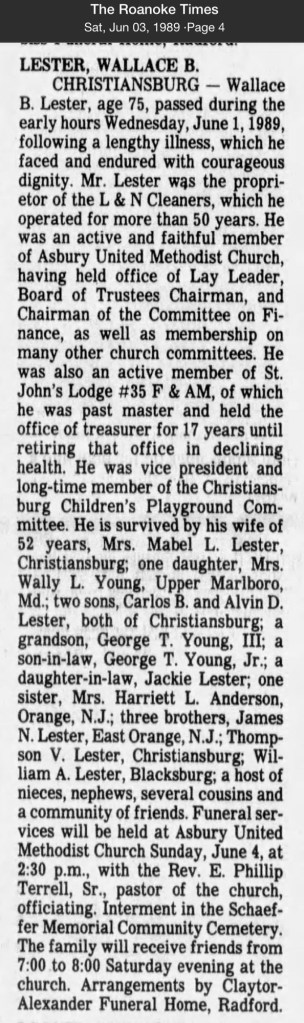
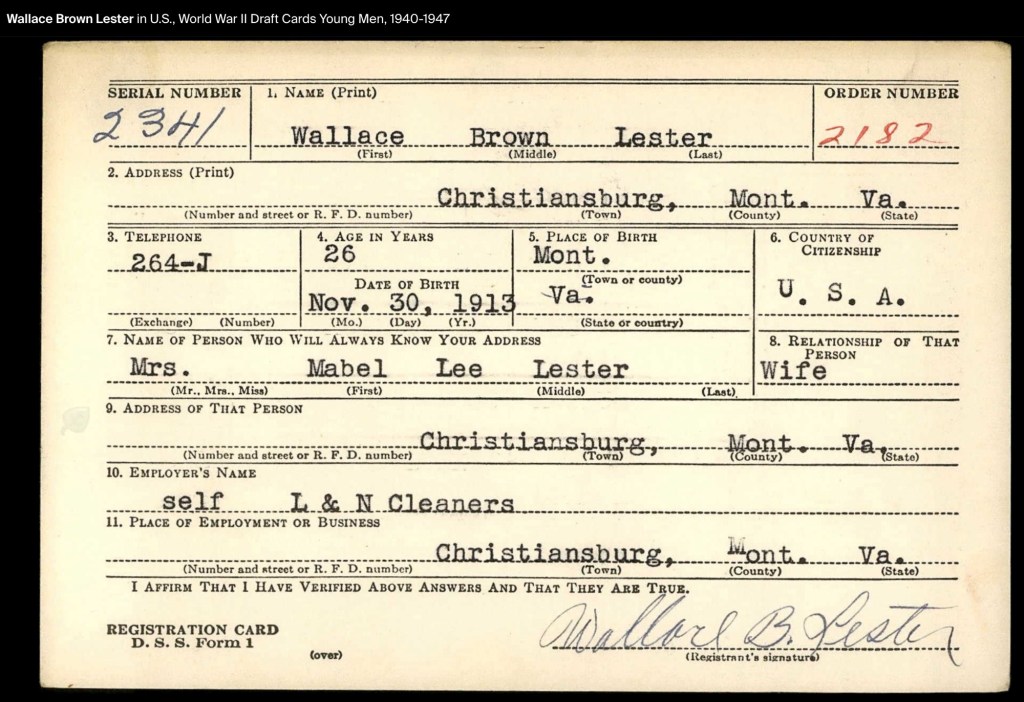
Alvin’s father, Wallace Brown Lester (1913–1989), married Mabel Lee Saunders on June 17, 1937, in Floyd County. The couple lived in Christiansburg, where Wallace owned L&N Cleaners. Alvin’s paternal grandparents were James Niles Wilson Lester (1880–1941) and Fannie Baker Thompson Lester (1886–1987). Fannie was the daughter of Herbert Thompson and Harriett Kincanon. James was the son of John C. Lester (1837–1924) and Annie Pate Lester (1843–1915), both born free in Lunenburg County, Virginia. John C.’s parents were Bolling Lester (1788–?) and Rebecca Barber (1790–1845).
Alvin’s great-uncle, John Wynes Lester (1885–1961), taught, farmed and worked as a carpenter at Christiansburg Institute. He and his wife lived on campus until his death. He is buried in the school’s cemetery.

Luke Valentine, Free Black, Application for Revolutionary War Pension

During the American Revolutionary War, free Black men in Virginia played a meaningful—though often overlooked—role in the fight for independence. From the earliest days of the conflict, free Blacks served in militias, state troops, and Continental units, particularly as manpower shortages grew. Virginia law restricted enslaved people from bearing arms, but free Black men could enlist, serve as substitutes, or be mustered alongside white soldiers, especially in local militia companies.

By the later years of the war, Virginia increasingly relied on these men for defense and campaigns beyond the colony’s borders. Their service included marching long distances, guarding supply lines, engaging Loyalist forces, and fighting in the southern theater, where the war was especially intense in 1780–1781.
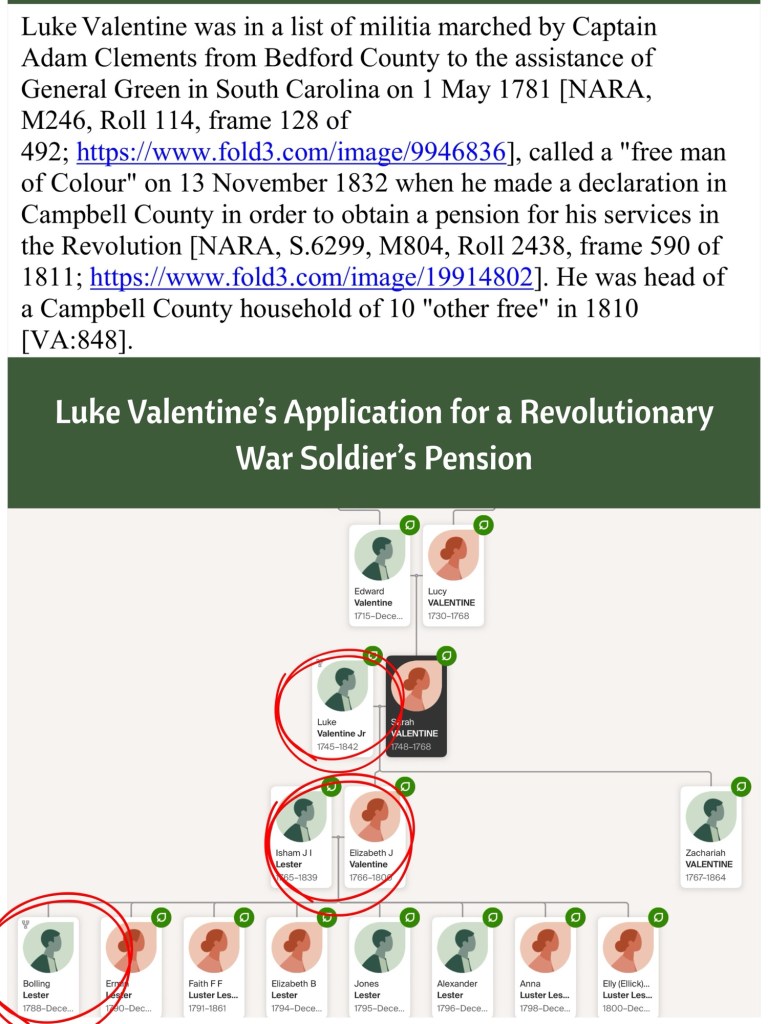
Luke Valentine, fifth-great grandfather of Alvin Lester’s, is one such example. He appears on a roster of men led by Captain Adam Clements of Bedford County, Virginia, who marched to South Carolina beginning May 1, 1781. This was a critical moment in the war, as Patriot forces sought to counter British advances in the South. Valentine’s inclusion on this roster places him among the free Black Virginians who answered the call to serve far from home in support of American independence.

After the war, some free Black veterans, including Luke Valentine, applied for Revolutionary War pensions. These applications are vital historical records, offering rare documentation of Black military service and affirming that free Blacks were not only present but active participants in the founding struggle of the United States.

Hidden Histories: Family Stories Beyond Montgomery County

Hidden Histories: Family Stories Beyond Montgomery County

When researching local history, we often come across carefully documented African American family histories that have no direct link to Montgomery County, Virginia. These stories are too valuable to leave hidden.

This page will share those findings so they might reach descendants searching for their past. Even without local ties, they speak to the wider story of resilience, migration, and community.

If you recognize a name or place, we invite you to connect—your memory could help bring another family’s history to light.


BRUMMAGE FAMILY

During our research on the Brumage family, we visited with the Clarence Brummage family in Homestead, FL. We were warmly greeted and all the information he could recall was told to me. 

On our return to California, I stopped at the Morman Library in Salt Lake City to see what records could be found and how far back I could take the family. I will start with the family of Clarence.

Clarence Brummage was born 16 June 1920 in Cochran, Georgia. His father was Tom (Booten) Brummage and his mother was Josephine Clark. Clarence was in the army during World War II. He married Everlena Trammeall, 31 October 1950 in Collins, Georgia. Daughter of Roy Trammeal, Everlena was born 16 March 1926 and was killed in a car accident 3 November 1977 in Homestead, FL.

Clarence and Everlena had nine children: Clarence Jr., b. 3 October 1952, Jeanette, b. 17 January 1956, Evelyn Ann, b. 26 April 1957, Ina Mae, b. 26 May 1958, in Cochran, Georgia, Dwight Wayne, b. 16 January 1961, Decatur, Alabama, Dorothy Jean, b. 7 August 1962, Pensacola, Florida, Michael Anthony, b. 9 March 1964, Daytona Beach, Florida, Josephine, b. 14 September 1965, Miami, Florida, and Donald Lee, b. 1 March 1968, Miami, Florida.

Clarence said he was raised by Dornest (Donna) Grandhoun and that she gave him the name of Brummage. Tom (Booten) Brummage worked for John Anderson in Cochran and Clarence remembers him as being 7 ft. tall.

Clarence has a sister, Sarah Lee Brummage Kemp who lives in Cochran. His mother Josephine Clark died in Florida. Josephine’s mother’s name was Sarah Woodfork and they all attended the Mt. Zion Baptist Church in Cochran.

On the 1900 census in Pulaski County (later changed to Beckley County in 1912 [Georgia]) Georgina Brummage, b. October 1854 is listed with sons Miles, b.March 1882 and Thomas, b. November 1890. I am assuming that Thomas is the father of Clarence. They were living in the Colhran district. Also in the same area is Hannah Jackson, b. 1867, her children were Wilson Brummage, b. November 1883, Lou Brummage, b. June 1885 and Charity Brummage, b. July 1888.

The family of Charley Brummage, born December 1877, his wife Zilla, b. June 1876, and their daughter Vinie, b. September 1899. This family lived Della Brummage, age 37, b. January 1863. Her children Anna Lee, b. April 1896. They lived in Hawkinsville.

1882, Lizzie, b. August 1885, John b. November 1887, Jeffries, b. November. In Ward County, Georgia, I found Amie Brumage with sons David, Henry, Bogene, and daughters Neppie, Nora and Lulu E. 

1990 census was burned so I next read the 1880 census. On this census I found the following. Trank Brummage, age 25, living in Pulaski County, he was working for Reuben Waters. Frank was single, a laborer, maimed, crippled or disabled, could not read or write, his parents were born in Georgia. There were no Brummages listed in Pulaski County in 1870 or 1860 so where Frank Brummage obtained the name of Brummage is a mystery. At least I found Tom (Booten) Brummage. I had hoped to find where this family, at one time, were slaves to a Brummage family but I could not find any proof of this.

I did call a James Brumage in Newport, Virginia and he was also black. He did not know where he obtained the name of Brumage.

Someone with the name of Brumage/Brummage had to be in the area during the Civil War or shortly afterward for the name to be taken by the families I found.