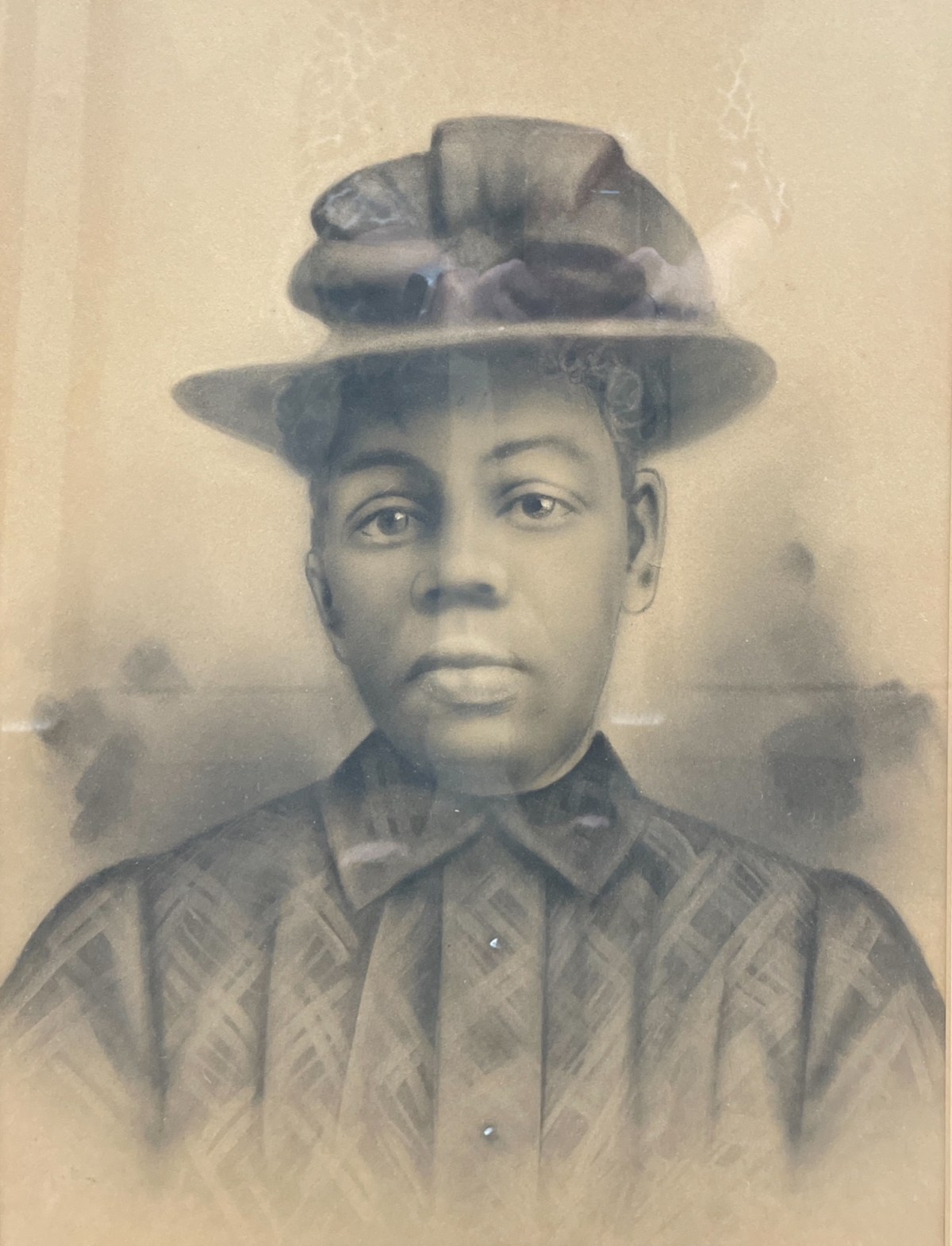
Crayon Enlargement Portraits were popular between the late 1890s and early 1900s. They provided an affordable way to capture and display large-format portraits, offering an alternative to the more expensive painted portraits of the time.
Crayon Enlargement Portraits were popular between the late 1890s and early 1900s. They provided an affordable way to capture and display large-format portraits, offering an alternative to the more expensive painted portraits of the time. The process involved taking a negative made by a local photographer and sending it to a specialist who used a solar enlarger to expose the image onto specially processed salted photographic paper. Because the enlargement process often emphasized imperfections on the negative plate, an artist would enhance the black-and-white print with pencil and crayon media, sometimes adding color.
The unidentified African American portraits featured on this website have been donated to local museums or found in antique shops. They are presented here in the hope of eventually identifying the individuals and preserving their stories.
Portrait of an unknown man (Courtesy of Montgomery Museum of Art and History)Portrait of an unknown man (Courtesy of Montgomery Museum of Art and History)Portrait of an unknown man, found in a New Town house, Blacksburg, Va (Courtesy of Montgomery Museum of Art and History)Portrait of an unknown woman (Courtesy of Montgomery Museum of Art and History)Portrait of an unknown man (Courtesy of Christiansburg Institute, Inc)Portrait of an unknown man (Courtesy of Christiansburg Institute, Inc)
This website serves as an important resource for understanding the history and legacy of slavery in our region. It contains information collected from Roanoke County sources about more than 4,000 enslaved individuals.
This website serves as an important resource for understanding the history and legacy of slavery in our region. It contains information collected from Roanoke County sources about more than 4,000 enslaved individuals. Many of the family names of enslaved African Americans recorded here also appear in neighboring Montgomery County, making this work deeply relevant to our local history. In addition, the family names of many individuals who enslaved others are found in the Roanoke primary sources.
The purpose of this page is to document and connect these shared names, with the hope of bringing to light the lives of those too often lost to history and deepening our understanding of the enduring legacy of slavery in Montgomery County and beyond.
More names will be added with time.
Family Names of Enslaved African Americans in Montgomery County
Brown
William Brown – enslaved by William Watts. “In IAS Book 4, the partition of the lands and other property of Edward Watts, William Brown is listed among the enslaved individuals that were bequeathed to Edward Watts’s daughter, Alice W. Morris. A value of $1,700.00 was placed on William Brown.”; Inventory, Appraisements, and Sales Book 4, Roanoke County Archives.
George Campbell – “George Campbell was listed in an indenture agreement: “…bind unto the said Lewis Zirkle a boy of colour named George Campbell until he arrives to the free age of twenty one which will be on the 25th day of June 1854.” In the Common Law book, it was ordered that the Overseers of the Poor bind out George, “a boy of color,” to Lewis Zinkle.”; Common Law Orders – A – May 1838 – May 1840, Roanoke County Archives.
Saunders/Sanders
Catherine Saunders – Mother of Henry Saunders; Common Law Orders – C – August 1843 – June 1848 – pgs. 227-478; Roanoke County Archives
Henry Saunders – 8 year old child of Catherine Saunders and Hercules Cuff, mention of Stephen Henry; Common Law Orders – C – August 1843 – June 1848 – pgs. 227-478; Roanoke County Archives
Magdeline Saunders – “Magdeline Saunders was listed in an indenture agreement: “unto the said Benjamin Hawley a girl of colour by the name of Magdeline Saunders until she arrives to the age of 21 years…the 22nd day of June 1858…” The Common Law book states that the Overseers of the Poor were ordered to bind out Magdalen Saunders, “a poor, colored girl” until she turned 21”; Common Law Orders – B – June 1840 – July 1843, Roanoke County Archives
Elizabeth Evans (List of first names of people they enslaved), “Elizabeth was listed in Michael Shepard’s property appraisement as having purchased enslaved people after Michael’s death. In the record, Elizabeth purchase” the enslaved people Joe, Nancy, and an unrecorded named child for $675.00.” She was possible daughter of Jonathan Evans. “Elizabeth’s son was William Evans and her husband was William W. Evans.”; Common Law Orders – B – June 1840 – July 1843, Roanoke County Archives



 Gathering African American History