Frederick Douglass and the Meaning of Independence

On July 5, 1852, Frederick Douglass delivered his powerful speech, “What to the Slave Is the Fourth of July?” to the Rochester Ladies’ Anti-Slavery Society at Corinthian Hall in Rochester, New York. In it, he confronted the meaning of Independence Day from the perspective of those still enslaved, asking what freedom could mean in a nation that denied it to millions.

On July 5, 1852, Frederick Douglass delivered his powerful speech, “What to the Slave Is the Fourth of July?” to the Rochester Ladies’ Anti-Slavery Society at Corinthian Hall in Rochester, New York. In it, he confronted the meaning of Independence Day from the perspective of those still enslaved, asking what freedom could mean in a nation that denied it to millions.

The copies of both the full version and excerpts are available.

Excerpt Versions

Full Versions

Audio Versions

Context and Biographical Information

Back Story Radio – excellent production and provides insightful context to the time and place.

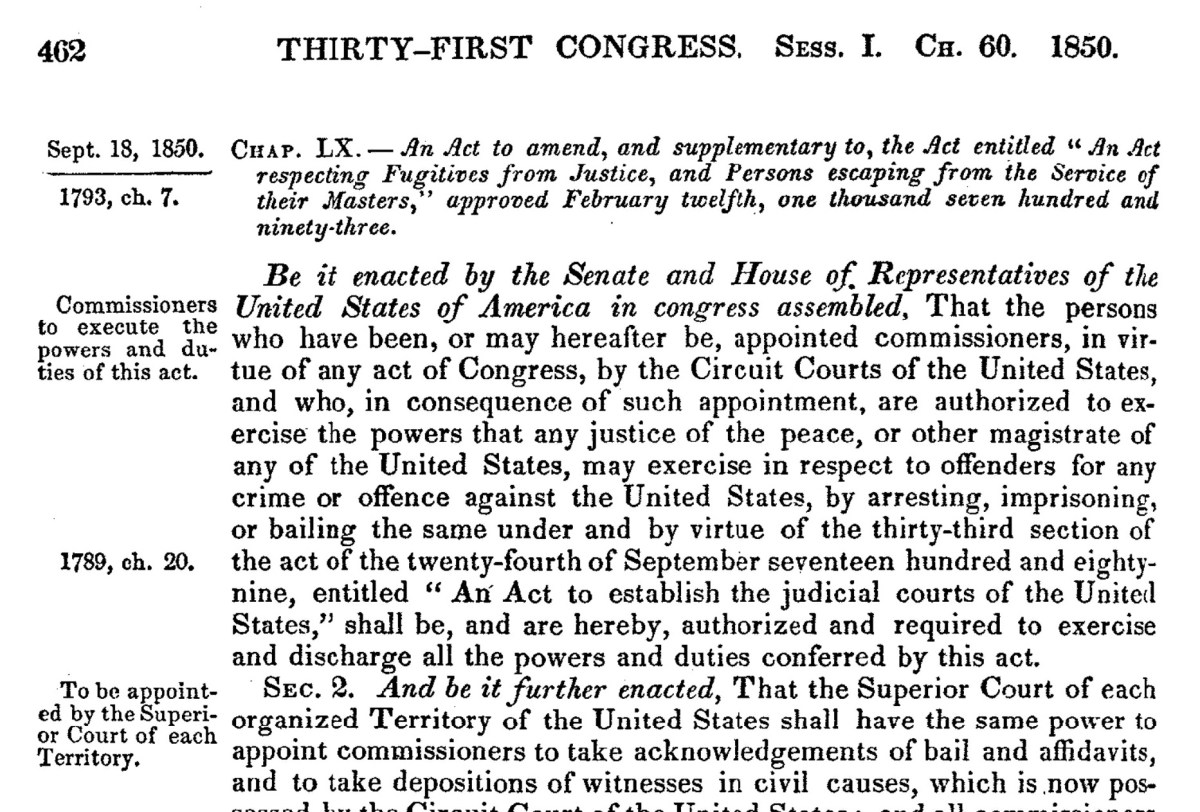
The Compromise of 1850 included the Fugitive Slave Act, a federal law signed just two years before Mr. Douglass’s 1852 speech. As historian Eric Foner has noted, this act demonstrates that pro-slavery states were willing to abandon their usual defense of states’ rights when it came to protecting the institution of chattel slavery. Eric Foner on the Fugitive Slave Act.
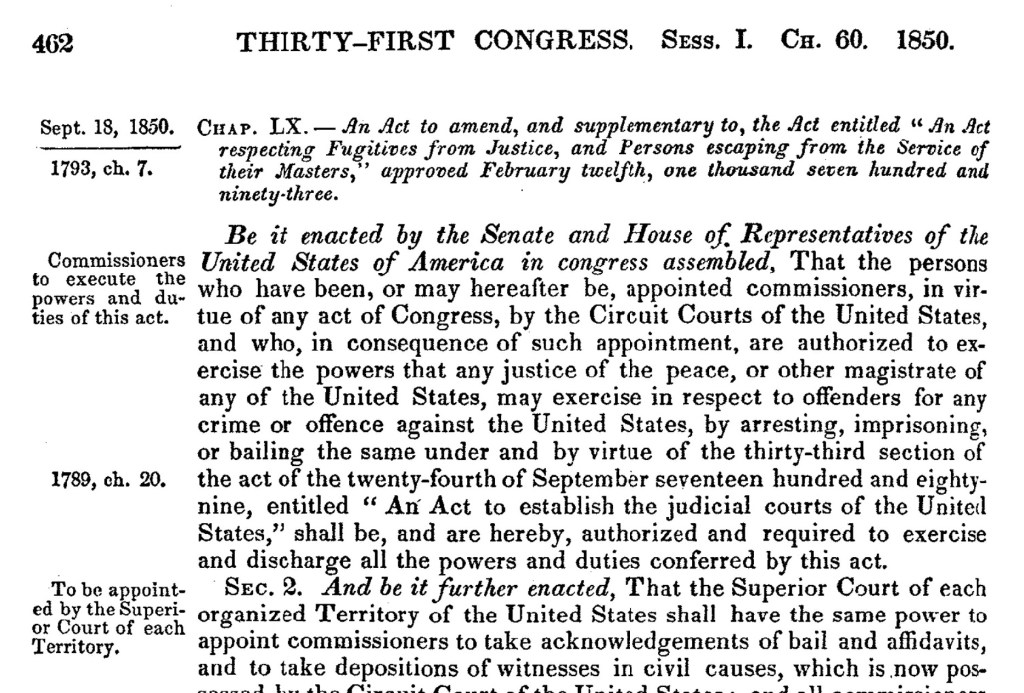
The U.S. Statutes at Large, Volume 9 (1845-1847), 29th through 31st Congress.

EdSiteMent , National Endowment for the Humanities, provides information, context and lesson plans.

Library of Congress, papers and documents of Frederick Douglass

Original Biographies that are available online

Timeline of Mr Douglass’ life, presented by the Library of Congress. Brief Summary Based on the Library of Congress

Frederick Douglass married Anna Murray in 1838. Together, they had five children: Rosetta (1839), Lewis Henry (1840), Frederick Jr. (dates vary, likely born around 1842–1843), Charles Remond (1844), and Annie (1849). The family moved to Rochester, New York in 1847, where Douglass continued his abolitionist work.

In 1859, following the failed John Brown raid, Douglass fled briefly to Canada to avoid arrest, returning in 1860—the same year his daughter Annie died. That year, Abraham Lincoln was elected president, and South Carolina became the first state to secede from the Union.

During the Civil War, slavery was abolished in Washington, D.C. in 1862, and the Emancipation Proclamation took effect in 1863, freeing enslaved people in Confederate states. That year, Douglass met with President Lincoln to advocate for Black soldiers and equal treatment.

On April 9, 1865, General Lee surrendered to Grant, effectively ending the Civil War. Lincoln was assassinated five days later. The 13th Amendment, abolishing slavery, was ratified later that year.

Douglass remained active during Reconstruction, fighting for civil rights and women’s suffrage. In 1870, the 15th Amendment guaranteed the right to vote regardless of race. That same year, after a suspicious fire at their Rochester home, the Douglass family moved to Washington, D.C., where Douglass was nominated for vice president by the Equal Rights Party, alongside presidential candidate Victoria Woodhull.

In 1874, Douglass became president of the Freedmen’s Savings Bank in a final effort to save the institution, which was failing and held the savings of many newly freed people. In 1875, Congress passed a Civil Rights Act to combat public discrimination, but in 1883 the U.S. Supreme Court rules the act was unconstitutional.

By 1877, Douglass had been appointed U.S. Marshal for the District of Columbia and later purchased a home in Anacostia (now Cedar Hill). Anna Murray Douglass, his wife of 43 years, died in 1881. He married Helen Pitts in 1884.

From 1889 to 1891, Douglass served as U.S. minister to Haiti and chargé d’affaires to Santo Domingo. He died unexpectedly in 1895.

Quotes From “What To A Slave Is the Fourth of July?”

Now, take the Constitution according to its plain reading, and I defy the presentation of a single proslavery clause in it.  On the other hand it will be found to contain principles and purposes, entirely hostile to the existence of slavery. . . . 

Great streams are not easily turned from channels, worn deep in the course of ages. They may sometimes rise in quiet and stately majesty, and inundate the land, refreshing and fertilizing the earth with their mysterious properties. They may also rise in wrath and fury, and bear away, on their angry waves, the accumulated wealth of years of toil and hardship. They, however, gradually flow back to the same old channel, and flow on as serenely as ever. But, while the river may not be turned aside, it may dry up, and leave nothing behind but the withered branch, and the unsightly rock, to howl in the abyss—sweeping wind, the sad tale of departed glory. As with rivers so with nations.
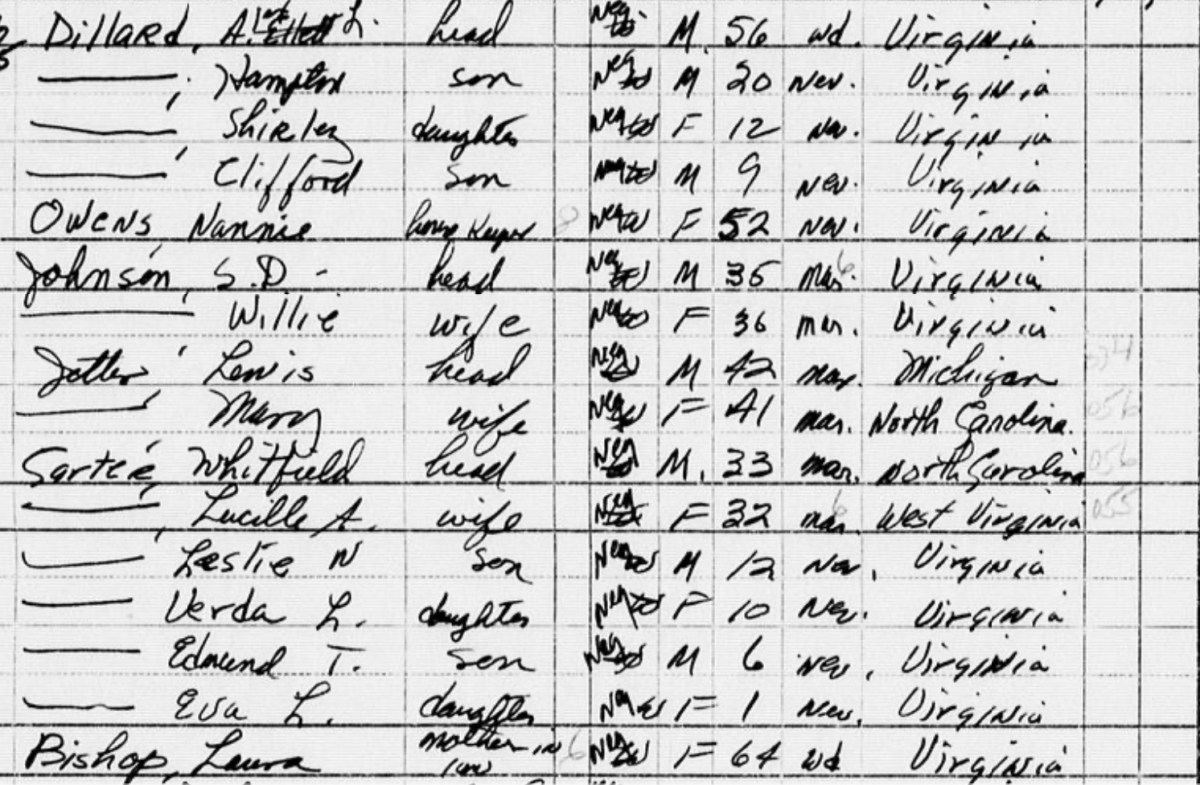
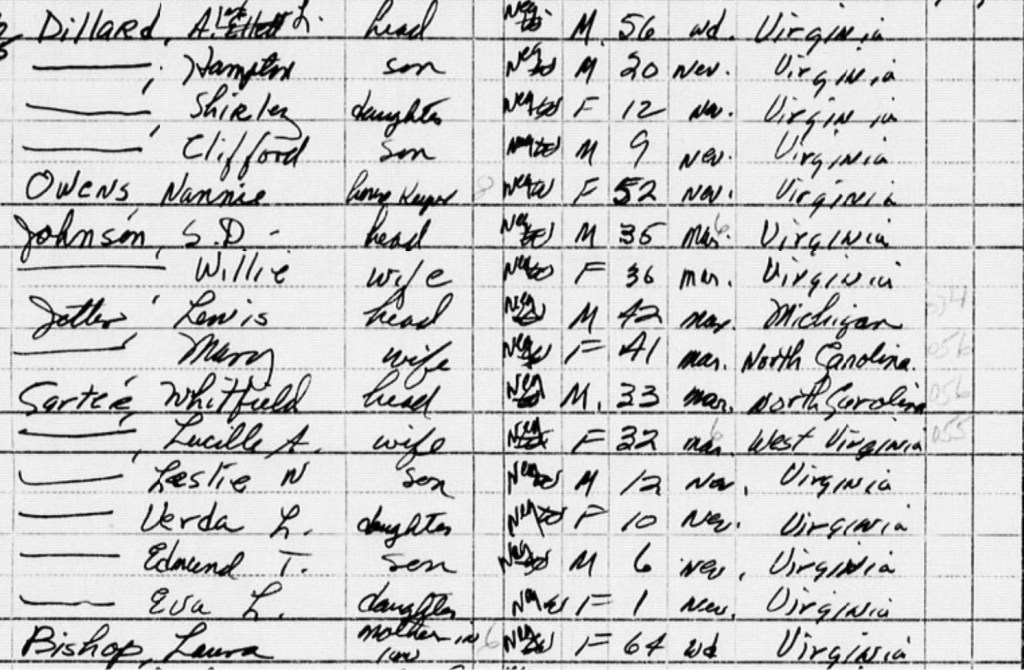
Primary Source: US Population Census of Montgomery County, Virginia

The U.S. Population Census is a crucial tool for exploring family history, especially for African Americans in Appalachia, where tracing lineage is often challenging due to the lasting impacts of slavery, limited documentation, and systemic discrimination.

The U.S. Population Census is a crucial tool for exploring family history, especially for African Americans in Appalachia, where tracing lineage is often challenging due to the lasting impacts of slavery, limited documentation, and systemic discrimination. Census records provide valuable insights by identifying ancestors across generations, shedding light on social and economic conditions, mapping migration patterns, and uncovering extended family and community networks. By using these records, researchers can reconstruct family histories and help tell the stories of those who have been underrepresented in the history of our Appalachian region.

Sick Benefits & Death Tax – Mutual Aid of the Independent Order of St Luke

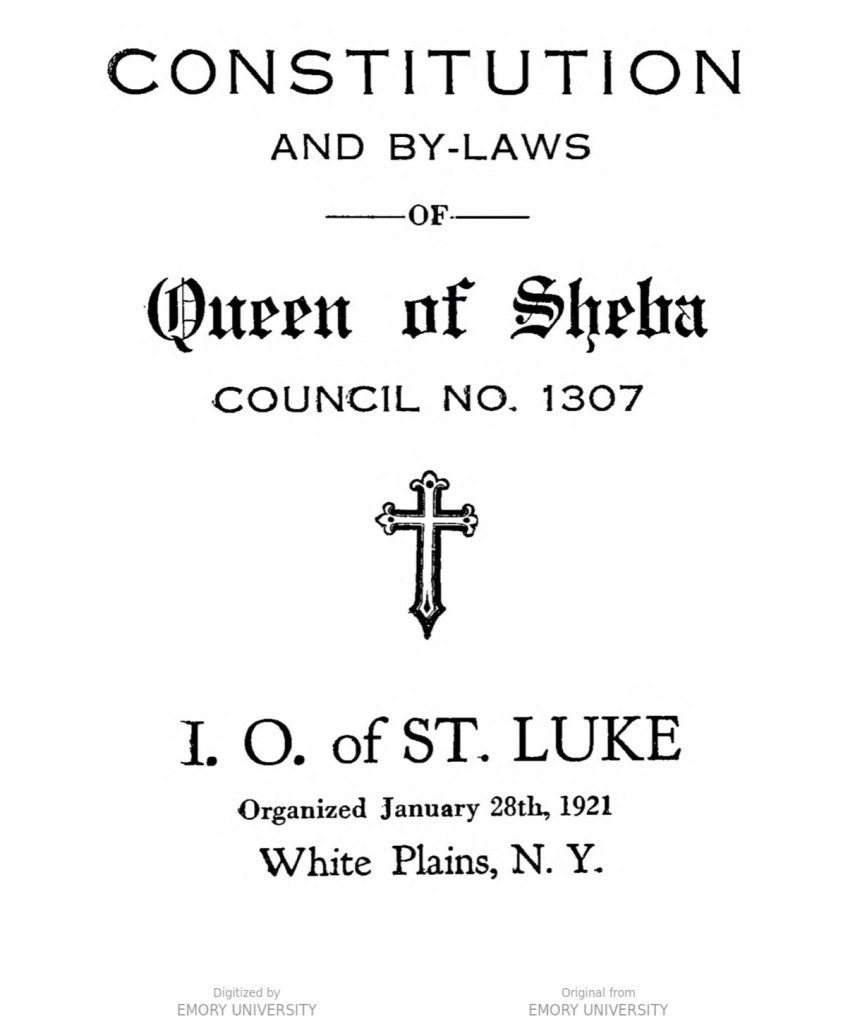
In Blacksburg, Virginia, the Independent Order of St Luke shared the same building with the Grant United Order of Odd Fellows, Tadmore Light 6184, located in New Town. That order’s copy of the Constitution and By-laws may be lost to history, but the Queen of Sheba Council’s 1921 version is fortunately accessible. This document highlights the significance of mutual aid within the framework of the function of the Order of St Luke.

Independent Order of St. Luke. Queen of Sheba Council No. , Randall K. Burkett, Lucy Emanuel, and Amos M. Gailliard. Constitution And By-laws of Queen of Sheba Council No. 1307, I.O. of St. Luke, Organized January 28th, 1921, White Plains, N.Y. [White Plains, N.Y.]: [The Council], 1921.


Madame Maggie J. Walker’s Vision for the Independent Order of St Luke Reflected in the Constitution and By-laws

During the Jim Crow era, white-owned firms refused to grant disability and life insurance to the black community. In response, IOSL provided weekly sickness and disability benefits as well as funeral assistance for its members starting in 1895. Similar to contemporary insurance companies, it offered various premium options. Mrs. Walker’s effective leadership in membership drives bolstered the organization’s finances, enabling prompt payment of death claims and reduced premium costs.

Sick Benefit

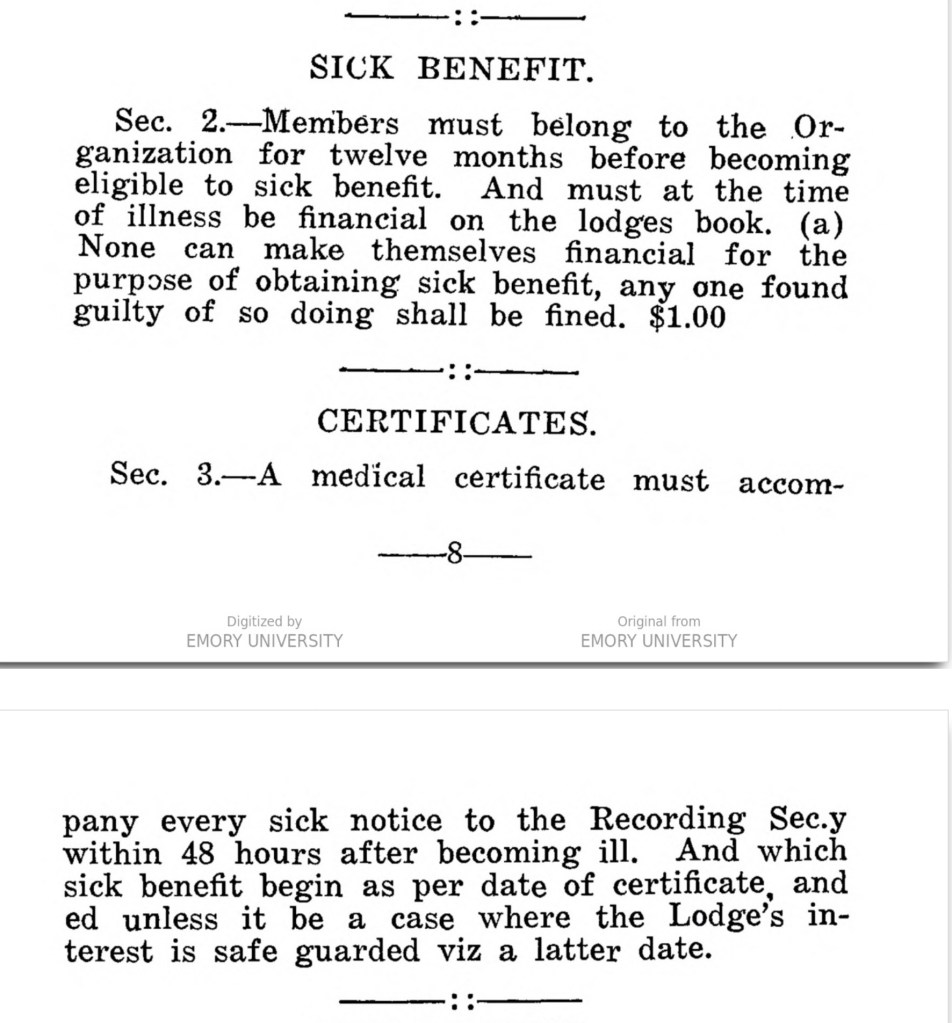
Members who wished to receive financial support in the event of being sick or disabled, paid monthly dues into the Sick Benefit fund. The Sick Committee manages the implementation of this benefit. The member could receive no more than $35/year. That equates to about $t00 in current value.

Death Taxes and Benefit

Resources:

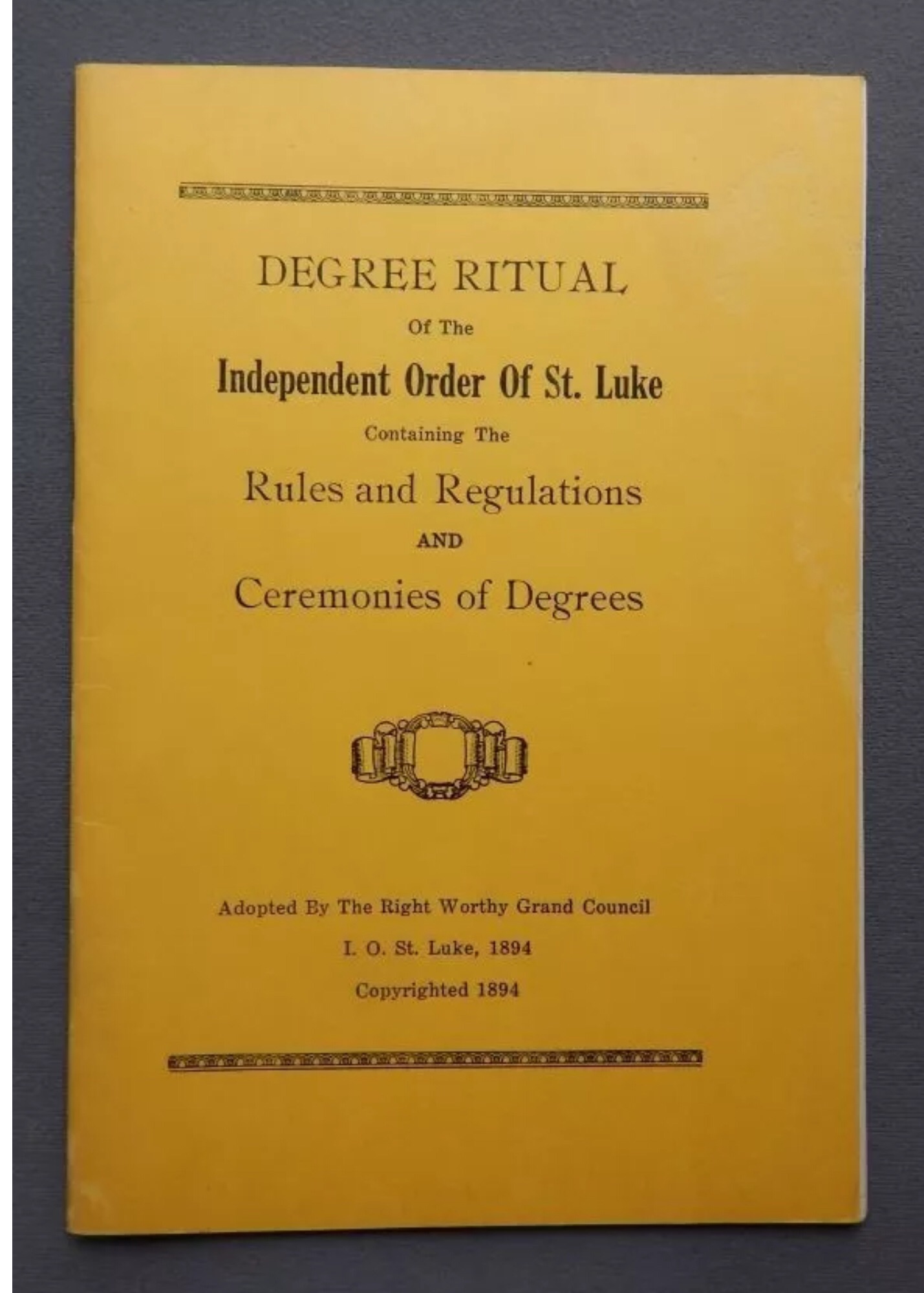
Degree Ritual of the Independent Order of St Luke

Finding Aid – Right Worthy Grand Council, Independent Order
of St. Luke Records, CATALOG NO. MAWA 9388 (COLLECTION), MAGGIE L. WALKER NATIONAL HISTORIC SITE

National Museum of African American Art and Culture

BLACKSBURG [VIRGINIA] ODD FELLOWS RECORDS, 1902-1969 (MS1988-009)

The Green Book 1949

Christiansburg Institute, Inc provides an excellent tour of Montgomery County historic sites, including much information about the Morgan family who owned and ran the Eureka Hotel.

The famous Green Book guide points travelers to seek the Eureka Hotel in Christiansburg. This hotel was located on Depot Street, east of Franklin street.

Courtesy of the Henry Ford Collection
Eureka Hotel

The Eureka Hotel was on the left side of Depot Street, at the top right section of this map. The Morgan family owned and operated the hotel from the 1930 to 1970. After that time the building was used as Rosalie’s Soul Kitchen (Rosalie Paige, 1983 to 1985), grocery store, beauty shop, barber, and taxi stand. Burrell and Rae Morgan along with S.B. Morgan, Burrell’s brother owned the establishments along with other businesses in Christiansburg.

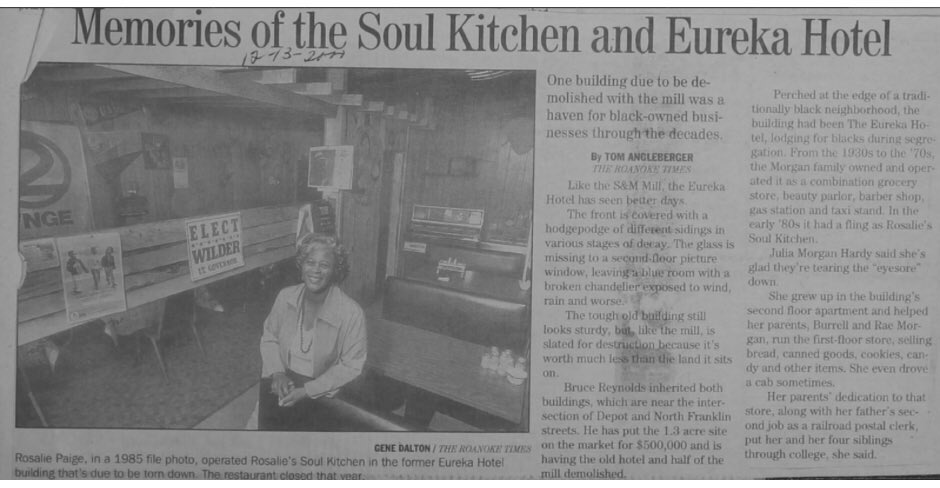
The Roanoke Times, 13 December 2000 (photo Gene Dalton, Roanoke Times)

Memories of the Soul Kitchen and Eureka Hotel.

One building due to be demolished with the mill was a haven for black-owned businesses through the decades.

Like the S&M Mill, the Eureka Hotel has seen better days.

The front is covered with a hodgepodge of different sidings in various stages of decay. The glass is missing to a second-floor picture window, leaving a blue room with a broken chandelier exposed to winde, rain and worse.

The tough old building still looks sturdy, but like the mill, is slated for destruction because it’s worth much less than the land it sits on.

Bruce Reynolds inherited both buildings, which are near the intersection of Depot and North Franklin streets. He has put the 1.3 acre site on the market for $500,000 and is having the old hotel and half of the mill demolished.

Perched at the edge of a traditionally black neighborhood, the building had been The Eureka Hotel, lodging for blacks during segregation. From the 1930s to the ’70s, the Morgan family owned and operated it as a combination grocery store, beauty parlor, barber shop, gas station and taxi stand. In the early ’80s it had a fling as Rosalie’s Soul Kitchen.

Julie Morgan Hardy said she’s glad they’re tearing the “eyesore” down.

She grew up in the building’s second floor apartment and helped her parents, Burrell and Rae Morgan, run the first-floor store, selling bread, canned goods, cookies, candy and other items. She even drove a cab sometimes.

Her parents’ dedication to that store, along with her father’s second job as a railroad postal clerk, put her and her four siblings through college, she said.

By Tom Angleberger, The Roanoke Times, 13 December 2000

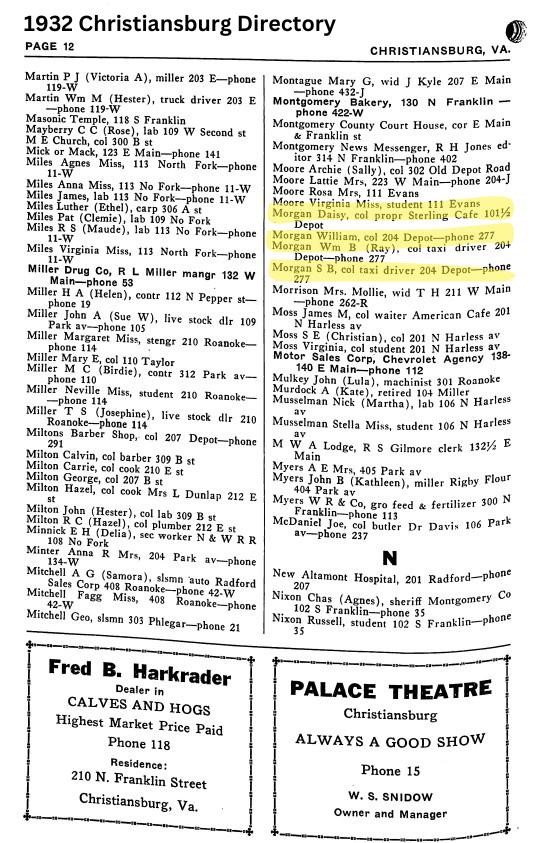
In the 1932 Christiansburg, Va Directory Wm B (Burrell) & Ray Morgan were listed at 204 Depot Street (taxi driver) along with his brother S.B. Morgan (taxi driver) and William Morgan. Daisy Morgan was listed as the proprietor of the Sterling Cafe (101 1/2 Depot). William Morgan at 204 Depot was the brother of Burrell and S.B. Morgan.

1932 Christiansburg Directory

In the 1962 Christiansburg Directory S.B. Morgan, Taxi Co was located at 100 Depot, Burrell Morgan residence was 10 Depot (Eureka Hotel), & Mrs Daisy Morgan was living at 119 Depot.

Courtesy of Montgomery Museum of Art & History, Christiansburg, Va

Obituary for Senior Barrett Morgan (S.B.) Roanoke Times, 23 June 1990

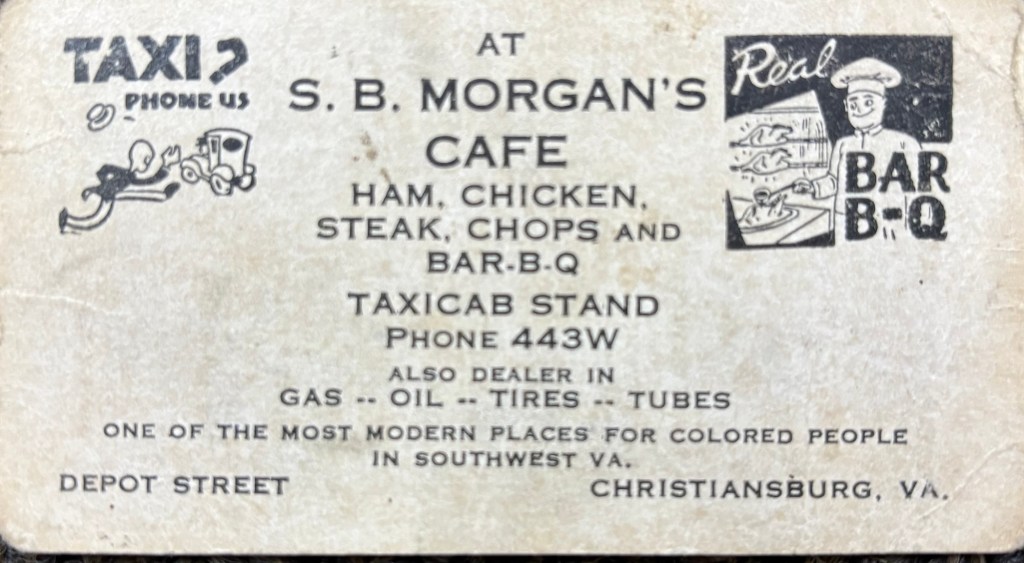
Senior Barrett Morgan, age 75, departed this life June 20, 1990, at the Montgomery County Regional Hospital after a short illness. He was born October 12, 1914, in Buxton, Iowa, the son of the late William Morgan and Ella P. Morgan. He was a faithful member of the Shaeffer Memorial Baptist Church in Christiansburg, Va., where he served as Chairman of the Trustee Board and past Chairman of the Deacon Board. He was the owner and founder of the S.B. Morgan Cafe and Taxi Company in Christiansburg, Va., having served the community for over fifty years. He was also a member of the Montgomery County Branch of the N.A.A.C.P. He was preceded in death by his wife, Mrs. Lucy Holmes Morgan; one son and a sister, Annette Simmons. His survivors are one daughter, Ruth M. Crisp of Washington, D. C.; a son-in-law, James R. Crisp, also of Washington, D. C.; one granddaughter, and two great-grandchildren; one brother, Mr. Burrell Morgan of Christiansburg, Va. Funeral services will be Sunday at 2:00 p.m. at the Shaeffer Memorial Baptist Church, Christiansburg, Va., with Dr. C. L. Brown officiating. Burial will be at the Shaeffer Memorial Cemetery, Christiansburg, Va. Viewing will be Saturday from 7:00 until 9:00 p.m. at the Claytor-Alexander and Penn Funeral Home, Radford, Va. The body will be placed in the church one hour prior to service. Claytor-Alexander and Penn Funeral Home in charge of the arrangements.


University of Virginia post for S.B. Morgan and their Green Book online exhibit